
In industrial applications, the gear shaft is a critical component responsible for transmitting torque and motion in mechanical systems. The failure of a gear shaft can lead to significant downtime, reduced efficiency, and safety hazards. This study focuses on the axial cracking failure of a 20CrMnTi steel gear shaft observed after fine machining. The gear shaft underwent carbonitriding treatment to enhance surface hardness and wear resistance. However, post-processing inspection revealed multiple axial cracks, prompting a detailed investigation into the root cause. We conducted a comprehensive analysis involving microstructure examination, chemical composition assessment, carbonitriding layer depth measurement, and hardness profiling to identify the failure mechanism. The primary objective is to determine whether the cracking originated from material defects, heat treatment processes, or manufacturing steps such as forging. By systematically evaluating these factors, we aim to provide insights into preventing similar failures in future productions of gear shaft components.
The gear shaft material, 20CrMnTi steel, is a low-carbon alloy steel commonly used for carburizing or carbonitriding applications due to its high hardenability, good toughness, and excellent fatigue resistance. Typical applications include gears, shafts, and bearings subjected to high loads and friction. In this case, the gear shaft was manufactured through forging, followed by machining, carbonitriding, quenching, and low-temperature tempering. The cracking was detected after the final grinding process, with cracks propagating axially along the shaft’s smaller diameter and gear teeth regions. Initial visual inspection showed a smooth, bright machined surface with visible crack lines, suggesting potential internal or process-related issues. We employed standardized methods to analyze the gear shaft, ensuring reproducibility and accuracy in our findings.
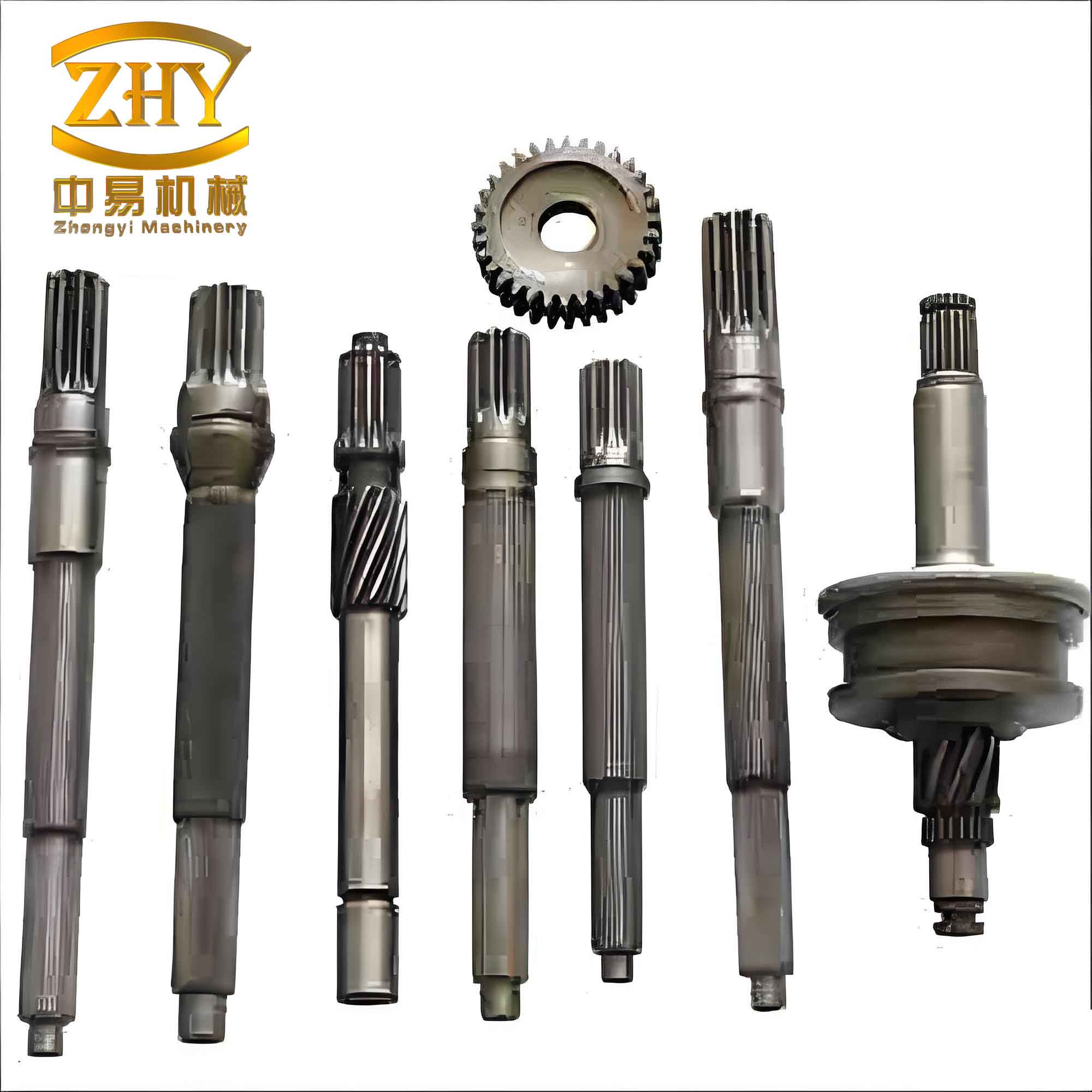
To begin the analysis, we first assessed the chemical composition of the gear shaft material. Samples were taken from areas adjacent to the crack regions, and spark discharge atomic emission spectrometry was used according to standard procedures. The results are summarized in Table 1, which compares the measured values with the standard requirements for 20CrMnTi steel. The composition falls within the specified range, indicating that the raw material quality is not a contributing factor to the cracking. Notably, the low phosphorus and sulfur contents classify the steel as high-grade, reducing the likelihood of impurity-induced brittleness. This initial step rules out material incompatibility as a cause for the gear shaft failure.
| Element | C | Si | Mn | P | S | Cr | Ti | Ni | Cu | Fe |
|---|---|---|---|---|---|---|---|---|---|---|
| Measured Value | 0.20 | 0.28 | 0.89 | 0.018 | 0.004 | 1.17 | 0.07 | 0.020 | 0.014 | Bal. |
| Standard Range | 0.17–0.23 | 0.17–0.37 | 0.80–1.10 | ≤0.030 | ≤0.030 | 1.00–1.30 | 0.04–0.10 | ≤0.30 | ≤0.25 | Bal. |
Following chemical analysis, we examined the microstructure of the gear shaft to identify any anomalies. Specimens were prepared from both axial and radial directions relative to the crack, as illustrated in the sampling diagram. The unetched surfaces were observed for non-metallic inclusions, and the etched surfaces (using 4% nital solution) were analyzed for phase constituents. The non-metallic inclusion rating indicated the presence of minor sulfide and oxide inclusions, but all levels were within acceptable limits (A0, B0, C0, D0), confirming no significant冶金 defects. However, multiple micro-cracks and疏松 structures were observed in the crack-affected areas, which are characteristic of forging-related defects rather than heat treatment issues. This suggests that the gear shaft cracking initiated during the forging process.
The microstructure of the carbonitrided layer in non-cracked regions consisted of tempered martensite, a small amount of retained austenite, and secondary carbides, as expected for a properly treated gear shaft. The core region exhibited tempered martensite and ferrite, indicating adequate hardening penetration. In contrast, the crack-affected areas showed coarser microstructures with oxidation layers along the crack faces, evidence of pre-existing cracks that were exposed to high temperatures during subsequent processing. The crack tips appeared blunt, unlike the sharp tips typical of quenching cracks, further supporting the forging origin. The hardness profile was measured to assess the effectiveness of the carbonitriding process. Surface Rockwell hardness averaged 62.5 HRC, and the effective case depth, defined as the depth where hardness drops to 550 HV, was approximately 0.73 mm. This meets the specifications for a gear shaft in service, confirming that heat treatment was performed correctly.
To quantify the hardness gradient, we used Vickers microhardness testing with a 100 g load and 15 s dwell time. The hardness values decreased gradually from the surface to the core, following a typical decay curve. The relationship between hardness (H) and depth (d) can be modeled using an exponential decay function: $$ H = H_0 + A \cdot e^{-k \cdot d} $$ where \( H_0 \) is the core hardness, \( A \) is a constant, and \( k \) is the decay coefficient. For this gear shaft, the data fitted well with parameters derived from measurements, indicating a consistent carbonitriding layer. Table 2 presents the hardness values at various depths, demonstrating the uniformity of the treatment away from cracked zones.
| Depth from Surface (mm) | Hardness (HV) | Deviation (HV) |
|---|---|---|
| 0.00 | 850 | ±10 |
| 0.10 | 820 | ±8 |
| 0.20 | 780 | ±7 |
| 0.30 | 740 | ±6 |
| 0.40 | 700 | ±5 |
| 0.50 | 660 | ±4 |
| 0.60 | 620 | ±3 |
| 0.70 | 580 | ±2 |
| 0.73 | 550 | ±1 |
| 0.80 | 520 | ±2 |
| 1.00 | 480 | ±3 |
The discussion now turns to the root cause analysis of the gear shaft cracking. Based on the evidence, we conclude that the cracking occurred during the forging process, not heat treatment. Several factors support this: the presence of oxidation layers on crack faces indicates exposure to high temperatures before carbonitriding, and the microstructural features align with forging defects such as incomplete densification or excessive strain. Forging involves plastic deformation at elevated temperatures, and if parameters like temperature, deformation speed, or reduction ratio are inappropriate, internal stresses can exceed the material’s strength, leading to cracking. In this gear shaft, the smaller diameter section experienced a high deformation ratio (approximately 70%), which likely induced stress concentrations. The equation for stress during forging can be expressed as: $$ \sigma = K \cdot \varepsilon^n $$ where \( \sigma \) is the flow stress, \( K \) is the strength coefficient, \( \varepsilon \) is the strain, and \( n \) is the strain-hardening exponent. For 20CrMnTi steel, high strain rates without adequate intermediate annealing can cause crack initiation.
Furthermore, we evaluated the possibility of hydrogen embrittlement or inclusion-related failures, but the non-metallic inclusion levels were low, and no signs of hydrogen-induced cracking were observed. The gear shaft’s chemical composition, with low phosphorus and sulfur, minimizes the risk of temper brittleness. Heat treatment parameters, including carbonitriding temperature, time, and quenching media, were within standard ranges, as verified by the uniform microstructure and hardness. Thus, the primary cause is attributed to improper forging techniques, such as excessive single-pass deformation or insufficient preheating. To prevent recurrence, we recommend optimizing the forging process for the gear shaft by implementing multi-pass forging with smaller reduction ratios, controlling deformation speed, and conducting non-destructive testing (e.g., ultrasonic inspection) after forging to detect internal flaws early.
In conclusion, the failure analysis of the 20CrMnTi steel gear shaft reveals that cracking originated during forging due to high deformation-induced stresses. The material composition, carbonitriding layer depth, and hardness profiles are normal, excluding heat treatment as a cause. This study underscores the importance of controlling forging parameters to ensure the integrity of critical components like gear shafts. Future work could involve finite element analysis to simulate stress distributions during forging and correlate them with crack initiation sites. By addressing these manufacturing aspects, the reliability and service life of gear shafts can be significantly improved, reducing the risk of unexpected failures in industrial applications.
To further elaborate on the implications, the gear shaft is a quintessential element in power transmission systems, and its failure can have cascading effects on machinery performance. The observed cracking not only compromises the structural integrity but also leads to increased vibration, noise, and potential catastrophic breakdowns. In high-speed applications, such as automotive or aerospace systems, a faulty gear shaft can result in severe accidents. Therefore, understanding the failure mechanisms through rigorous analysis is paramount. Our approach combined multiple techniques to provide a holistic view, ensuring that all potential factors were considered. The use of advanced microscopy and hardness testing allowed us to pinpoint the exact stage where the defect introduced, which is crucial for implementing corrective actions in the production line.
Additionally, the economic impact of gear shaft failures cannot be overlooked. Replacing a failed component involves not only the cost of the part but also downtime, labor, and potential losses in productivity. By identifying forging as the root cause, manufacturers can focus on process improvements rather than altering material specifications or heat treatment cycles, which might be more costly and time-consuming. For instance, adjusting the forging die design or introducing intermediate annealing steps can alleviate stress concentrations. The formula for critical stress intensity factor \( K_{IC} \) in fracture mechanics can be applied to assess crack propagation: $$ K_{IC} = Y \cdot \sigma \cdot \sqrt{\pi \cdot a} $$ where \( Y \) is a geometric factor, \( \sigma \) is the applied stress, and \( a \) is the crack length. For this gear shaft, the blunt crack tips indicate slow propagation, consistent with forging defects rather than rapid fracture.
In summary, this analysis serves as a case study for similar failures in alloy steel components. The methodology outlined here—combining chemical, microstructural, and mechanical testing—can be adapted for other critical parts. Emphasizing the role of forging in gear shaft manufacturing highlights the need for continuous monitoring and quality control throughout the production chain. As industries move towards higher efficiency and reliability, such detailed failure analyses become indispensable for advancing manufacturing technologies and ensuring product safety.