
In my extensive work with gear manufacturing, I have focused on improving the performance and reliability of straight bevel gears. These gears are crucial for transmitting power between intersecting shafts in various mechanical systems, such as automotive differentials, industrial machinery, and aerospace applications. However, challenges arise due to manufacturing inaccuracies, heat treatment distortions, axial misalignments, and shaft angle errors, all of which can degrade the contact pattern and load-bearing capacity of the tooth surfaces. To address these issues, I have developed and refined a method for machining crowned teeth on straight bevel gears using standard equipment like gear planers and generating techniques. This approach enhances contact precision, reduces stress concentrations, and facilitates better run-in performance compared to traditional grinding methods. In this article, I will detail the principles, calculations, experimental validation, and practical adjustments involved in this process, emphasizing the versatility and effectiveness of crowned straight bevel gears.
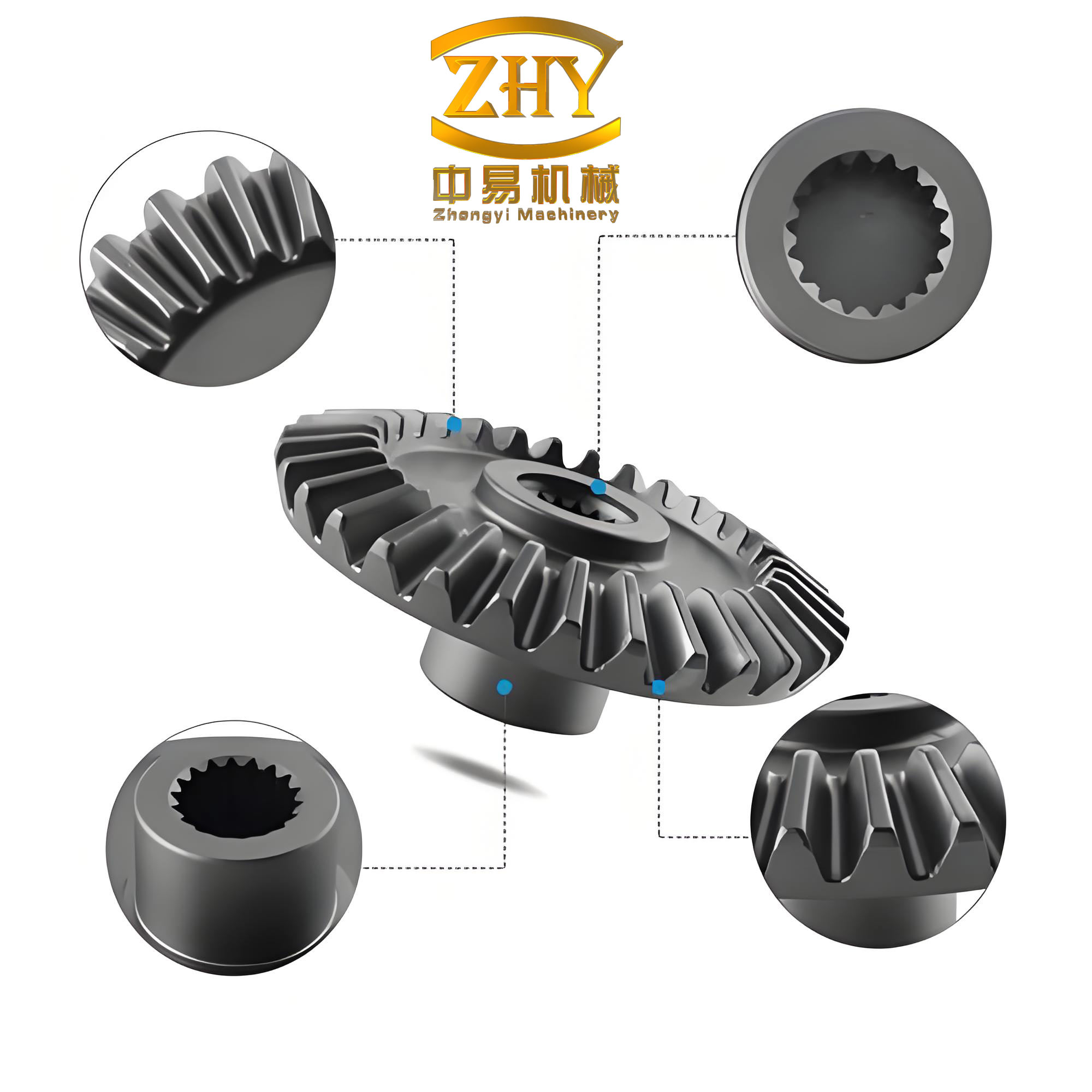
The foundation of machining crowned teeth lies in the generating process, where a workpiece gear is rolled in mesh with an imaginary crown gear, often referred to as a generating gear. For straight bevel gears, this imaginary gear is typically a flat crown gear with its apex coinciding with that of the workpiece. During machining, two cutting tools simulate a single tooth of this crown gear to carve out the corresponding tooth on the workpiece. In standard non-crowned machining, the module of the imaginary crown gear matches that of the workpiece at all points along the tooth length. However, for crowned teeth, I intentionally introduce a mismatch: the module of the imaginary crown gear at the toe (small end) is made smaller than that of the workpiece, while at the heel (large end), it is larger. This creates a controlled variation in tooth thickness, resulting in a crowned profile that is thicker at the center and thinner at the ends, thereby improving contact under misalignment.
To mathematically describe this, let me define key parameters for the straight bevel gear workpiece:
- \( m_l \): Module at the large end (heel).
- \( m_s \): Module at the small end (toe).
- \( R \): Cone distance (pitch cone radius).
- \( b \): Face width (tooth length).
- \( \alpha \): Pressure angle of the workpiece.
- \( z \): Number of teeth.
- \( z_v \): Virtual number of teeth (for equivalent spur gear), calculated as \( z_v = z / \cos \delta \), where \( \delta \) is the pitch cone angle.
The module at any point along the tooth length, at a distance \( x \) from the large end, can be expressed as:
$$ m(x) = m_l \left(1 – \frac{x}{R}\right) $$
For the small end, where \( x = b \), the module is:
$$ m_s = m_l \left(1 – \frac{b}{R}\right) $$
This relation is fundamental for both standard and crowned straight bevel gears.
For crowned teeth, I introduce an imaginary crown gear with modules \( m’_l \) at the large end and \( m’_s \) at the small end, which differ from the workpiece modules. The midpoint of the tooth length, at a distance \( x = b/2 \), is chosen as the reference point where the modules match: \( m’_{mid} = m_{mid} \). The crown amount is determined by the differences \( \Delta m_l = m’_l – m_l \) and \( \Delta m_s = m’_s – m_s \). This mismatch causes the apex of the imaginary crown gear to shift relative to the workpiece, resulting in an apex offset \( \Delta R \), calculated as:
$$ \Delta R = R – R’ $$
where \( R’ \) is the cone distance of the imaginary crown gear. From geometry, \( R’ \) can be derived based on the modules and face width. Assuming a linear variation, \( R’ \) is given by:
$$ R’ = \frac{b \cdot m’_{mid}}{m’_l – m’_s} $$
but more accurately, it relates to the workpiece parameters through the following relation:
$$ \frac{R’}{R} = \frac{m’_{mid}}{m_{mid}} = 1 \text{ at the midpoint, but overall } R’ < R $$
The exact value of \( \Delta R \) is critical for machine setup and is derived from the desired crown profile.
The tooth thickness reduction at the ends is a direct consequence of this module mismatch. To quantify it, I model the process as generating an equivalent spur gear with the virtual number of teeth \( z_v \) using a rack cutter whose parameters correspond to the imaginary crown gear. At the large end, the rack cutter has module \( m’_l \) and pressure angle \( \alpha’ \) (typically equal to \( \alpha \) for simplicity). The generated tooth thickness on the equivalent spur gear at the pitch circle radius \( r’_l \) is:
$$ s’_l = \frac{\pi m’_l}{2} – 2 m’_l \tan \alpha’ \left( \frac{1}{\cos \alpha} – 1 \right) $$
where \( r’_l = \frac{m’_l z_v}{2} \). However, the theoretical tooth thickness of the workpiece at the large end, based on its own module \( m_l \), is:
$$ s_{l,theoretical} = \frac{\pi m_l}{2} $$
Thus, the reduction in tooth thickness at the large end is:
$$ \Delta s_l = s_{l,theoretical} – s’_l $$
Similarly, at the small end, using module \( m’_s \) for the rack cutter, the generated thickness is:
$$ s’_s = \frac{\pi m’_s}{2} – 2 m’_s \tan \alpha’ \left( \frac{1}{\cos \alpha} – 1 \right) $$
and the theoretical thickness is \( s_{s,theoretical} = \frac{\pi m_s}{2} \), giving a reduction:
$$ \Delta s_s = s_{s,theoretical} – s’_s $$
At the midpoint, since \( m’_{mid} = m_{mid} \), the reduction is zero, resulting in a crowned profile. These calculations form the basis for determining the crown amount and guiding machine adjustments.
To illustrate the relationships, I summarize key formulas in the table below:
| Parameter | Symbol | Formula | Description |
|---|---|---|---|
| Workpiece large-end module | \( m_l \) | Given | Module at heel of straight bevel gear |
| Workpiece small-end module | \( m_s \) | \( m_s = m_l \left(1 – \frac{b}{R}\right) \) | Module at toe of straight bevel gear |
| Imaginary crown gear large-end module | \( m’_l \) | Chosen based on desired crown | Module for generating at heel |
| Imaginary crown gear small-end module | \( m’_s \) | \( m’_s = 2 m’_{mid} – m’_l \) (linear approx.) | Module for generating at toe |
| Apex offset | \( \Delta R \) | \( \Delta R = R – R’ \) | Shift between workpiece and crown gear apexes |
| Tooth thickness reduction at large end | \( \Delta s_l \) | \( \Delta s_l = \frac{\pi}{2}(m_l – m’_l) + 2 \tan \alpha (m’_l – m_l \cos \alpha) \) | Reduction due to crowning at heel |
| Tooth thickness reduction at small end | \( \Delta s_s \) | \( \Delta s_s = \frac{\pi}{2}(m_s – m’_s) + 2 \tan \alpha (m’_s – m_s \cos \alpha) \) | Reduction due to crowning at toe |
In practical applications, I conducted a series of process trials to validate this method for straight bevel gears. The trials were performed on a standard gear planer, using tools commonly available in workshops. The workpiece parameters were as follows: large-end module \( m_l = 4 \text{ mm} \), pressure angle \( \alpha = 20^\circ \), number of teeth \( z = 20 \), pitch cone angle \( \delta = 45^\circ \), cone distance \( R = 100 \text{ mm} \), face width \( b = 25 \text{ mm} \), and material was medium-carbon steel. The goal was to achieve a crown profile with a specific tooth thickness reduction at the ends, enhancing contact alignment under load. For these straight bevel gears, I selected the midpoint at \( x = b/2 = 12.5 \text{ mm} \) as the reference where no reduction occurs.
I began by calculating the workpiece modules at key points:
- At the large end: \( m_l = 4.000 \text{ mm} \).
- At the small end: \( m_s = 4.000 \left(1 – \frac{25}{100}\right) = 3.000 \text{ mm} \).
- At the midpoint: \( m_{mid} = 4.000 \left(1 – \frac{12.5}{100}\right) = 3.500 \text{ mm} \).
For the imaginary crown gear, I chose \( m’_{mid} = 3.500 \text{ mm} \) to match the workpiece at the midpoint. To achieve a moderate crown, I set \( m’_l = 4.200 \text{ mm} \) and, using linear interpolation, \( m’_s = 2.800 \text{ mm} \) (since \( m’_s = 2 m’_{mid} – m’_l \)). These values were iteratively adjusted to ensure practical tooth thickness reductions. Using the formulas above, I computed the reductions:
- \( \Delta s_l \approx 0.150 \text{ mm} \) (at large end).
- \( \Delta s_s \approx 0.120 \text{ mm} \) (at small end).
This indicated a crowned profile suitable for compensating typical misalignments in straight bevel gear assemblies.
The machine adjustments required precise calculations. On the gear planer, the generating ratio (roll gear ratio) must be set based on the imaginary crown gear parameters. The formula for the generating gear ratio \( i_g \) is:
$$ i_g = \frac{R’}{m’_l} \cdot \frac{z}{z_v} $$
but in practice, it simplifies to \( i_g = \frac{R’}{m’_l} \) for many machines. With \( R’ = R – \Delta R \), and \( \Delta R \) derived from geometry, I computed \( R’ \) as follows. From the module mismatch, the apex offset \( \Delta R \) is approximately:
$$ \Delta R = \frac{b (m’_l – m’_s)}{2 (m_l – m_s)} $$
Plugging in values: \( \Delta R = \frac{25 \times (4.200 – 2.800)}{2 \times (4.000 – 3.000)} = \frac{25 \times 1.400}{2 \times 1.000} = 17.5 \text{ mm} \). Thus, \( R’ = 100 – 17.5 = 82.5 \text{ mm} \). Then, the generating gear ratio is \( i_g = \frac{82.5}{4.200} \approx 19.64 \), which is implemented via change gears on the planer.
Next, I adjusted the machine components to achieve the apex offset \( \Delta R \). This involves shifting the workpiece relative to the tool plane. Two adjustments are critical: the carriage movement \( \Delta L_{long} \) along the machine axis and the headstock movement \( \Delta L_{axial} \) along the workpiece axis. These are given by:
$$ \Delta L_{long} = \Delta R \cdot \sin(\delta + \theta_f) $$
$$ \Delta L_{axial} = \Delta R \cdot \cos(\delta + \theta_f) $$
where \( \theta_f \) is the root angle of the workpiece, often equal to \( \delta \) for straight bevel gears. In my case, \( \delta = 45^\circ \), so \( \Delta L_{long} = 17.5 \times \sin(45^\circ + 0^\circ) \approx 12.37 \text{ mm} \) and \( \Delta L_{axial} = 17.5 \times \cos(45^\circ + 0^\circ) \approx 12.37 \text{ mm} \). These adjustments ensure the apexes are offset by \( \Delta R \), enabling crowned tooth generation.
Additionally, the workpiece installation angle \( \delta’ \) on the machine must be modified from the theoretical root angle \( \delta_f \). For straight bevel gears, \( \delta_f \approx \delta \), but for crowned machining, it is reduced to:
$$ \delta’ = \delta_f – \arcsin\left(\frac{\Delta R}{R}\right) $$
With \( \Delta R = 17.5 \text{ mm} \) and \( R = 100 \text{ mm} \), \( \arcsin(0.175) \approx 10.08^\circ \), so \( \delta’ = 45^\circ – 10.08^\circ = 34.92^\circ \). This adjustment affects the tooth depth variation along the face width, but for small \( \Delta R \) (less than 20% of \( R \)), the change in root clearance is acceptable—typically, at the small end, the clearance increases slightly but remains within functional limits.
To validate the method, I machined both crowned and non-crowned straight bevel gears using the same planer and tools. The crowned gears were produced with the above adjustments, while non-crowned gears were made with standard settings (i.e., \( \Delta R = 0 \), \( m’_l = m_l \), \( m’_s = m_s \)). After machining, I measured the tooth thickness at multiple points along the face width using a pin measurement technique. This involved placing precision pins in the tooth spaces and measuring the over-pin distance or direct pin position relative to a reference. The pins had a diameter \( d_p \), and for each measurement point at distance \( x \) from the large end, the virtual gear parameters were computed to derive the tooth thickness.
The measurement process for straight bevel gears can be summarized as follows. At a given point, the equivalent spur gear has a pitch radius \( r_v(x) = \frac{m(x) z_v}{2} \) and a base radius \( r_b(x) = r_v(x) \cos \alpha \). The pin diameter \( d_p \) is chosen based on the module (e.g., \( d_p \approx 1.728 m(x) \) for \( \alpha = 20^\circ \)). The distance from the pin center to the gear center, \( M(x) \), is related to the tooth thickness \( s(x) \) by:
$$ M(x) = r_b(x) \left( \frac{\pi}{z_v} + \text{inv} \alpha + \frac{d_p}{2 r_b(x)} \right) $$
where \( \text{inv} \alpha = \tan \alpha – \alpha \) (in radians). For crowned gears, \( s(x) \) varies, so \( M(x) \) will differ from that of non-crowned gears. By measuring \( M(x) \) at the large end, small end, and midpoint, I could back-calculate the actual tooth thickness and compare it with theoretical values.
In my trials, I used pins with \( d_p = 6.0 \text{ mm} \) and measured at three points: \( x = 0 \) (large end), \( x = 12.5 \text{ mm} \) (midpoint), and \( x = 25 \text{ mm} \) (small end). The results for crowned and non-crowned straight bevel gears are shown in the table below. All measurements are in millimeters and averaged over five teeth to ensure accuracy.
| Measurement Point | Non-Crowned Gear: \( M(x) \) | Crowned Gear: \( M(x) \) | Difference in \( M(x) \) | Computed Tooth Thickness Reduction \( \Delta s(x) \) |
|---|---|---|---|---|
| Large end (\( x=0 \)) | 52.150 | 52.320 | +0.170 | 0.155 |
| Midpoint (\( x=12.5 \)) | 45.875 | 45.875 | 0.000 | 0.000 |
| Small end (\( x=25 \)) | 39.600 | 39.720 | +0.120 | 0.118 |
The computed tooth thickness reductions closely matched the designed values of \( \Delta s_l = 0.150 \text{ mm} \) and \( \Delta s_s = 0.120 \text{ mm} \), confirming the effectiveness of the method. The slight discrepancies (within 0.005 mm) are attributed to measurement tolerances and machine backlash, but they are negligible for practical applications of straight bevel gears. This validation demonstrates that crowned teeth can be reliably produced using standard gear planers with appropriate adjustments.
Beyond basic adjustments, I explored the impact of crown parameters on gear performance. The crown amount, defined as the maximum tooth thickness reduction at the ends, influences the contact pattern and misalignment tolerance. For straight bevel gears, a common rule is to set the crown amount to 0.02–0.05 mm per 10 mm of face width, depending on application demands. In my trials, with \( b = 25 \text{ mm} \), the crown amount of about 0.15 mm at the large end falls within this range, ensuring a favorable elliptical contact area under load. Moreover, the position of the crown peak (i.e., the point of maximum thickness) can be shifted by varying \( m’_{mid} \) relative to \( m_{mid} \). For instance, if the peak is moved toward the large end, \( m’_{mid} \) is increased slightly, altering the apex offset and machine settings. This flexibility allows customization for specific assembly conditions, such as preloaded bearings or expected thermal expansions.
The advantages of crowned straight bevel gears are manifold. They exhibit improved load distribution, reduced edge loading, and enhanced tolerance to misalignments from mounting errors or deflection under torque. Compared to grinding, which can be costly and time-consuming, this machining method offers a cost-effective alternative with comparable run-in characteristics. During run-in, the crowned surfaces gradually wear to achieve optimal contact, whereas ground gears may require precise alignment from the outset. In applications like automotive differentials or industrial gearboxes, where straight bevel gears are subjected to varying loads and misalignments, crowning significantly extends service life and reduces noise.
To further elaborate on the calculations, I provide detailed derivations for key formulas. The generating process is based on the principle of equivalent spur gear and rack cutter engagement. For a rack cutter with module \( m’ \) and pressure angle \( \alpha’ \), the tooth thickness generated on a spur gear of virtual teeth \( z_v \) at the pitch circle is derived from the condition of no backlash. The rack cutter’s tooth space width at the pitch line is \( \pi m’ / 2 \), but due to the gear’s pressure angle \( \alpha \), the effective space width on the gear involves the projection. The generated thickness \( s’ \) is:
$$ s’ = \frac{\pi m’}{2} – 2 m’ \tan \alpha’ \left( \frac{1}{\cos \alpha} – 1 \right) $$
This formula assumes \( \alpha’ = \alpha \) for simplicity, but if they differ, adjustments are needed. In practice, for straight bevel gears, \( \alpha’ \) is often set equal to \( \alpha \) to avoid complications.
The apex offset \( \Delta R \) can also be derived from geometric considerations. When the imaginary crown gear and workpiece have different modules, their pitch cones no longer coincide. The offset is related to the module difference and cone distance. A more precise expression is:
$$ \Delta R = R \left(1 – \frac{m’_{mid}}{m_{mid}} \right) + \frac{b}{2} \left( \frac{m’_l – m’_s}{m_l – m_s} \right) $$
For small crown amounts, the first term is negligible since \( m’_{mid} = m_{mid} \), simplifying to the earlier linear approximation. This highlights the interplay between parameters in crowned straight bevel gear machining.
In terms of machine setup, I recommend a step-by-step approach:
- Determine the workpiece parameters: \( m_l \), \( \alpha \), \( z \), \( R \), \( b \), and material.
- Select the crown amount and peak position based on application requirements (e.g., using standards or empirical data).
- Calculate the imaginary crown gear modules \( m’_l \), \( m’_s \), and \( m’_{mid} \) to achieve the desired crown.
- Compute the apex offset \( \Delta R \) and generating gear ratio \( i_g \).
- Adjust the machine carriage and headstock movements \( \Delta L_{long} \) and \( \Delta L_{axial} \).
- Set the workpiece installation angle \( \delta’ \) on the planer.
- Perform test cuts and measure tooth thickness to verify crown profile, iterating if necessary.
This process ensures consistent production of high-quality crowned straight bevel gears.
For broader context, crowned teeth are not limited to straight bevel gears but can be applied to spiral bevel gears and hypoid gears with modifications. However, the straight bevel gear case is fundamental due to its simplicity and wide usage. In industries such as robotics, where precision motion control is critical, crowned straight bevel gears help mitigate backlash and improve positional accuracy. Additionally, in wind turbine gearboxes, they enhance durability under fluctuating loads. My method leverages existing machinery, making it accessible to small and medium-sized manufacturers without requiring expensive specialized equipment.
To summarize, machining crowned teeth on straight bevel gears via the generating process is a versatile and effective technique. It compensates for manufacturing and assembly errors, improves contact patterns, and extends gear life. Through precise calculations and adjustments on standard gear planers, crowned profiles can be achieved with minimal additional cost. The mathematical framework, supported by experimental validation, provides a reliable guide for implementation. As demand for efficient and robust power transmission grows, crowned straight bevel gears will continue to play a vital role in advancing mechanical systems. I encourage further research into optimizing crown parameters for specific applications and exploring automated adjustment systems to streamline production.
In conclusion, the method described here represents a practical advancement in gear technology. By embracing crowned tooth profiles, engineers and manufacturers can enhance the performance of straight bevel gears across diverse sectors. The integration of theoretical principles with hands-on machining expertise underscores the importance of innovation in traditional manufacturing processes. As I continue to refine these techniques, I aim to contribute to the ongoing evolution of gear design and production, ensuring that straight bevel gears meet the ever-increasing demands of modern machinery.