
In my extensive career working with industrial machinery, particularly in sectors like cotton processing, I have encountered a wide array of speed reducers. Among them, the cycloidal drive has consistently stood out due to its unique advantages. My hands-on experience with the installation, operation, and maintenance of cycloidal drives has provided me with deep insights that I believe are valuable for engineers and technicians across various fields. This guide aims to share that knowledge comprehensively, focusing on the practical aspects of using cycloidal drives.
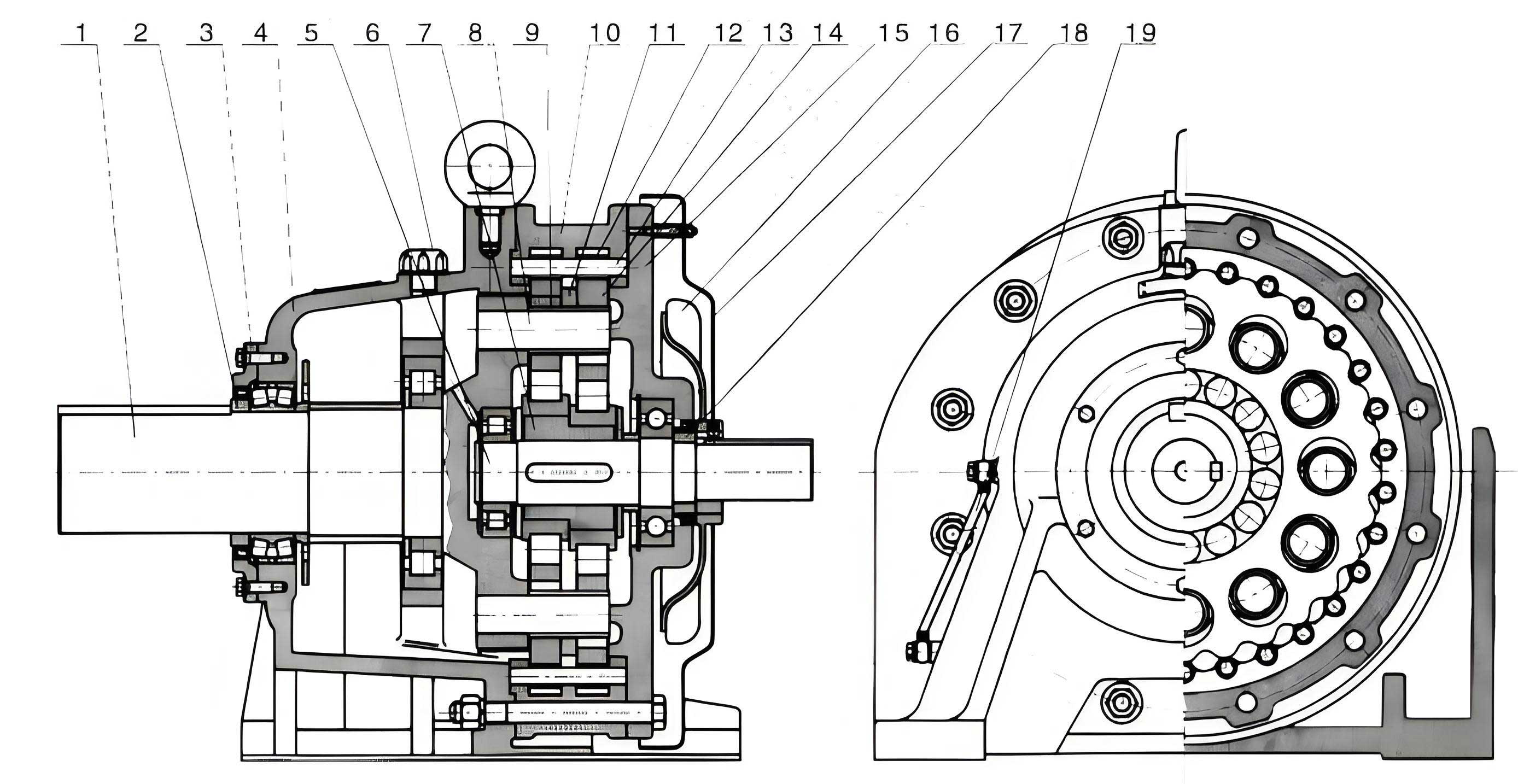
The cycloidal drive, often referred to as a cycloidal speed reducer, operates on a fascinating principle of cycloidal motion and planetary gearing. This mechanism involves a set of cycloidal discs (or lobes) meshing with stationary pin gears. The result is a compact, high-torque, and highly efficient transmission system. I have seen cycloidal drives replace traditional gear, worm, and belt drives in many applications due to their superior durability and lower failure rates. The core of its operation can be described mathematically. The fundamental kinematics involve the generation of a cycloidal curve. The path of a point on the rolling circle (the cycloidal disc) relative to a fixed circle (the pin gear ring) is given by the parametric equations:
$$ x = (R – r) \cos(\theta) + e \cos\left(\frac{R – r}{r} \theta\right) $$
$$ y = (R – r) \sin(\theta) – e \sin\left(\frac{R – r}{r} \theta\right) $$
Here, \( R \) is the radius of the pin gear pitch circle, \( r \) is the radius of the cycloidal disc’s generating circle, \( e \) is the eccentricity, and \( \theta \) is the input shaft rotation angle. This motion ensures multiple tooth contacts, leading to high load capacity and smooth operation. The transmission ratio of a cycloidal drive is a key characteristic. It is determined by the number of pins (or pin gear teeth) \( Z_p \) and the number of lobes on the cycloidal disc \( Z_c \). The standard formula for the reduction ratio \( i \) is:
$$ i = \frac{Z_p}{Z_p – Z_c} $$
Typically, for a single-stage cycloidal drive, \( Z_c = Z_p – 1 \), which simplifies the ratio to \( i = Z_p \). This design yields very high reduction ratios in a single stage, a hallmark of the cycloidal drive. For instance, a common cycloidal drive with 40 pins will have a reduction ratio of 40:1. The efficiency \( \eta \) of a well-lubricated cycloidal drive can be modeled as a function of load and speed, often exceeding 90% for optimal conditions. An approximate formula for output torque \( T_{out} \) considering efficiency is:
$$ T_{out} = T_{in} \times i \times \eta $$
where \( T_{in} \) is the input torque. Understanding these principles is crucial for proper selection and application of a cycloidal drive.
Applications and Uses of Cycloidal Drives
From my observations, the cycloidal drive is remarkably versatile. Its design makes it suitable for demanding environments where reliability is paramount. I have deployed and maintained cycloidal drives in numerous settings beyond just cotton processing. The following table categorizes some primary industrial applications where the cycloidal drive excels due to its high shock load tolerance and compact size.
| Industry Sector | Typical Machinery/Application | Key Benefit of Cycloidal Drive |
|---|---|---|
| Material Handling & Lifting | Hoists, conveyors, crane drives, palletizers | High torque at low speed, precise positioning |
| Mining & Mineral Processing | Crushers, feeders, slurry pumps, winches | Robustness against heavy shock loads and contaminants |
| Petrochemical & Chemical | Mixers, agitators, extruder drives, pump drives | Reliable operation in hazardous areas, low maintenance |
| Food & Pharmaceutical Processing | Packaging machines, filling lines, conveyor systems | Hygienic design possibilities, smooth motion control |
| Textile & Cotton Processing | Ginning machinery, bale presses, lint cleaners, openers | Space-saving design, handles fibrous dust well |
| Renewable Energy | Solar tracker drives, small wind turbine pitch control | High ratio in compact package, good holding torque |
| General Manufacturing | Indexing tables, robotics, assembly line actuators | High precision, backlash reduction capabilities |
In each of these applications, the intrinsic advantages of the cycloidal drive—such as its ability to handle high overhung loads and its exceptional durability—make it a preferred choice. I have specifically noted that in cotton processing plants, where equipment runs continuously during the season, the low failure rate of a well-maintained cycloidal drive significantly reduces downtime compared to other reducer types.
Operating Conditions and Requirements
Based on my experience, adhering to the specified operating conditions is critical for maximizing the lifespan of a cycloidal drive. These units are designed for rigorous service, but they have limits that must be respected.
First, a cycloidal drive is typically rated for continuous duty operation (S1 duty cycle) and is capable of bidirectional rotation. This flexibility is useful in reversing conveyors or mixers. The standard input speed for many series is around 1500 RPM. However, for drives with power ratings above a certain threshold, often around 18.5 kW, I recommend using a 4-pole motor with an input speed of approximately 1500 RPM to balance thermal performance and mechanical stress. The relationship between input power \( P \) (in kW), input speed \( N_{in} \) (in RPM), and torque can be expressed as:
$$ T_{in} = \frac{9549 \times P}{N_{in}} \text{ Nm} $$
This helps in verifying that the selected cycloidal drive is within its rated torque capacity.
Regarding installation orientation, most standard series of cycloidal drives are designed for horizontal mounting. While they can tolerate some inclination, the maximum allowable tilt angle \( \alpha_{max} \) is generally specified as less than 15 degrees. If installation at a steeper angle is unavoidable, additional measures such as special lubricant reservoirs or auxiliary lubrication pumps are necessary to ensure the cycloidal drive’s internal components remain properly lubricated and to prevent oil leakage. The force on the oil seal increases with tilt, which can be approximated by the component of the oil head pressure:
$$ P_{seal} = \rho g h \sin(\alpha) $$
where \( \rho \) is oil density, \( g \) is gravity, and \( h \) is the oil height.
A crucial point I must emphasize is that the output shaft of a cycloidal drive is not designed to withstand substantial external axial or radial forces. When such forces are present from connected equipment like pulleys or sprockets, external support bearings or torque arms must be used. The permissible overhung load \( F_{oh} \) can often be found in manufacturer catalogs and is a function of the distance from the shaft end. A simplified check involves ensuring the actual bending moment is less than the allowable:
$$ M_{bending} = F_{applied} \times L < M_{allowable} $$
where \( L \) is the load distance from the bearing.
Lubrication Practices for Optimal Performance
Proper lubrication is the lifeblood of any cycloidal drive. Through trial and error, I have developed a meticulous lubrication regime that prevents premature wear. Standard cycloidal drives use a splash lubrication system where the oil level should be maintained at the center of the sight glass. In harsh environments with high ambient temperatures or severe dust, I advocate for forced circulation (oil pump) systems to ensure adequate cooling and lubrication.
The choice of lubricant is paramount. I exclusively use high-quality extreme pressure (EP) gear oils with the correct viscosity grade for the operating temperature range. The recommended viscosity \( \nu \) at 40°C typically falls within the ISO VG 150 to 320 range for most industrial cycloidal drives. The following table summarizes a robust lubrication schedule I have followed for years.
| Maintenance Activity | Timing/Frequency | Procedure Details | Oil Type & Specifications |
|---|---|---|---|
| Initial Fill | Before first operation (unit ships dry) | Fill to center of sight glass via the breather/vent plug. | EP Gear Oil, ISO VG 220 (or as per manufacturer). Viscosity index > 95, with anti-wear additives. |
| First Oil Change | After the first 100-200 hours of run-in | Drain completely via drain plug, flush if necessary, refill with fresh oil. Removes initial wear particles. | |
| Routine Oil Change | Every 6 months for continuous operation (~4000 hrs). Every 3-4 months in severe conditions. | Drain old oil, inspect for metal debris or discoloration, clean magnetic plugs, refill. | |
| Regular Top-up & Inspection | Weekly or monthly based on operating hours | Check oil level via sight glass, top up if low. Inspect for leaks. | Same as fill oil. Do not mix different brands/grades. |
| Oil Analysis | Annually for critical drives | Send oil sample to lab to check for viscosity breakdown, water content, and wear metals. | N/A |
For vertical mounting configurations of a cycloidal drive, extra vigilance is required to prevent the oil pump (if internal) from running dry. I always specify models with enhanced lubrication systems for vertical applications. The drain and fill plugs are strategically located; the fill is usually at the top via the breather, and the drain is at the lowest point. A simple formula to estimate oil volume \( V \) for top-up, assuming a cylindrical housing section, is:
$$ V = \pi r^2 (h_{target} – h_{current}) $$
where \( r \) is the internal radius of the sump and \( h \) are oil heights. Consistent cleaning and timely oil changes are, in my experience, the most cost-effective measures to extend the service life of a cycloidal drive significantly.
Installation Procedures and Alignment
Correct installation sets the foundation for reliable operation. I have developed a step-by-step procedure that minimizes common pitfalls. The process begins with handling the cycloidal drive itself. The output shaft is precision-fitted and must never be subjected to direct hammer blows when attaching couplings, pulleys, or sprockets. The axial impact can damage the internal bearings and the cycloidal disc assembly. Instead, I always use the threaded holes provided on the shaft end. Screws are inserted and tightened evenly to draw the coupling onto the shaft. The fit between the shaft and the connected part should be a transition fit, typically H7/k6 for optimal force transmission.
The lifting eyes on the housing are only for lifting the reducer itself, not the entire assembled machine. During foundation mounting, precise alignment is non-negotiable. The cycloidal drive must be leveled and aligned with the driven machine within the tolerance specified for the coupling used. The following table outlines the key installation steps and tolerances I adhere to.
| Step | Action | Tool/Standard | Tolerance/Note |
|---|---|---|---|
| 1. Foundation Preparation | Clean and level foundation surface. Position anchor bolts. | Spirit level, straight edge. | Foundation flatness within 0.5 mm/m. |
| 2. Preliminary Positioning | Place cycloidal drive on base. Use temporary shims. | Shim stock (steel or cast iron). | Avoid more than 3 shims stacked at one point to prevent springing. |
| 3. Rough Alignment | Align centerline and height relative to driven machine shaft. | Calipers, measuring tape. | Get within 1-2 mm of final position. |
| 4. Final Leveling & Alignment | Use precision shims or wedges to achieve final height and level. Then perform shaft alignment. | Dial indicators, laser alignment tool. | Angular misalignment < 0.05°, parallel offset < 0.1 mm (per coupling specs). |
| 5. Grouting | Pour non-shrink cement grout uniformly around base. | Flowable grout mix. | Ensure full contact, no voids or bubbles. Let cure fully. |
| 6. Final Tightening | After grout cures, perform final tightening of anchor bolts in a cross pattern. | Torque wrench. | Torque to manufacturer’s specification (e.g., 80% of bolt yield). |
| 7. Re-check Alignment | Check alignment again after final tightening and after 24 hours. | Dial indicators. | Realign if any shift has occurred. |
The shimming pattern is critical to avoid distorting the cycloidal drive’s housing. Shims should be placed symmetrically near the anchor bolts, allowing space for grout flow. The grouting process must be done carefully to create a solid, uniform support that dampens vibrations. Misalignment is a primary cause of premature bearing failure in a cycloidal drive, so I never rush this stage.
Maintenance, Troubleshooting, and Repair Insights
Despite their robustness, cycloidal drives do require maintenance and occasionally repair. Over the years, I have diagnosed and fixed numerous issues. The most common failures follow a predictable pattern, and having a systematic approach drastically reduces downtime. The following table lists typical faults, their symptoms, and corrective actions based on my experience.
| Fault Category | Symptoms/Observations | Probable Cause | Recommended Repair Action |
|---|---|---|---|
| Bearing Failure | Excessive noise (grinding, rumbling), overheating, increased vibration. | Fatigue, contamination, misalignment, lubrication failure. | Disassemble unit, replace both input and output bearings with high-quality equivalents. Clean housing thoroughly. |
| Oil Leakage | Oil seepage from seals, joint faces, or breather. | Worn shaft seals, damaged gaskets/O-rings, overfilling, clogged breather. | Replace shaft seals and static gaskets (paper or rubber). Ensure breather is clear. Maintain correct oil level. |
| Output Shaft Failure | Sheared shaft, inability to transmit torque, severe twisting. | Excessive overhung load, shock loads, material defect, improper coupling installation. | Machine a new shaft from high-tensile steel (e.g., 4140). Reassemble with proper fits. Review load calculations and add external support. |
| Internal Component Wear/Damage | Loss of reduction ratio, erratic motion, metallic debris in oil. | Abrasive wear from contamination, pitting on cycloidal discs or pins, lack of lubrication. | Complete overhaul. Replace cycloidal disc set, needle rollers, and pin gears. Flush housing meticulously. |
| Motor Related Issues | Cycloidal drive does not turn, hums, or trips overload. | Motor burnout, electrical fault, incorrect power supply. | Repair or replace the driving electric motor. Check voltage, current, and starter settings. |
The most time-consuming part of repair is often the reassembly of the cycloidal disc assembly. Through repeated disassembly and reassembly, I have perfected a method that cuts the time to about thirty minutes per unit. The key lies in the orientation of the cycloidal discs. Here is my proven procedure:
-
Position the motor or input housing vertically, with the shaft opening facing up.
-
Insert the eccentric bearing and the first cycloidal disc. Crucially, ensure the side of the disc marked with a “1” or “A” is facing upward.
-
When installing the second cycloidal disc (in double-disc designs for load balancing), it must be positioned so that its marked side (e.g., “2” or “B”) also faces upward, and its lobes are offset from the first disc. This is typically a 180-degree offset—the lobes of the second disc should fill the gaps of the first.
-
This precise orientation ensures proper phasing, balances forces, and allows smooth engagement with the pin gear housing. Following this sequence eliminates binding and ensures the cycloidal drive operates smoothly immediately after reassembly.
For bearing preload adjustment, which is sometimes necessary, I use a feeler gauge to set the clearance between the bearing races as per the manual, often aiming for a near-zero clearance. The relationship for thermal expansion should also be considered. A simple check for bearing health before installation is to measure radial play \( \delta_r \):
$$ \delta_r = D_{outer} – D_{inner} – 2 \times (Ball Diameter) $$
It should be within the manufacturer’s specified range.
Advanced Considerations and Long-Term Strategy
To truly master the use of a cycloidal drive, one must think beyond basic operation. I consider factors like thermal management and system integration. The heat dissipation of a cycloidal drive under load can be estimated. The power loss \( P_{loss} \) primarily from friction can be related to the input power and efficiency:
$$ P_{loss} = P_{in} \times (1 – \eta) $$
This heat must be dissipated via the housing surface area \( A \) and cooling. For high-duty cycles, I sometimes specify units with cooling fins or auxiliary fans. Furthermore, when integrating a cycloidal drive into a control system, its slight torsional compliance and near-zero backlash characteristics are advantageous for precision motion control. The torsional stiffness \( k_t \) can be a factor in system resonance calculations:
$$ \omega_n = \sqrt{\frac{k_t}{J_{load}}} $$
where \( \omega_n \) is the natural frequency and \( J_{load} \) is the reflected load inertia.
In summary, the cycloidal drive is an engineering marvel that offers unparalleled benefits in the right applications. My extensive hands-on experience confirms that success with a cycloidal drive hinges on understanding its principles, respecting its operating limits, executing flawless installation, adhering to a strict lubrication regimen, and employing efficient repair techniques. By sharing these insights, I hope to empower others to harness the full potential of this remarkable speed reducer, ensuring reliable and efficient operation for years to come. The cycloidal drive, when treated with the care and knowledge it deserves, becomes not just a component but a cornerstone of robust mechanical system design.