
Mechanical drawings are indispensable in the field of mechanical design, serving as the blueprint for transforming design concepts into tangible products. They provide manufacturers, engineers, and technicians with information about the shape, dimensions, and geometric features of a mechanical product, as well as the dimensional and tolerance requirements for its parts. These details describe length, width, height, diameter, and permissible tolerance ranges. In the manufacturing process, mechanical drawings play a crucial guiding and communicative role. However, a significant challenge persists in the transition from 2D documentation to 3D digital models: the effective and clear expression of geometric tolerances and surface finish specifications on the three-dimensional model itself. This paper addresses this gap by proposing a novel methodology for the automated reconstruction of a cylindrical gear from its DXF file format, explicitly incorporating key tolerance information into the resulting 3D model.
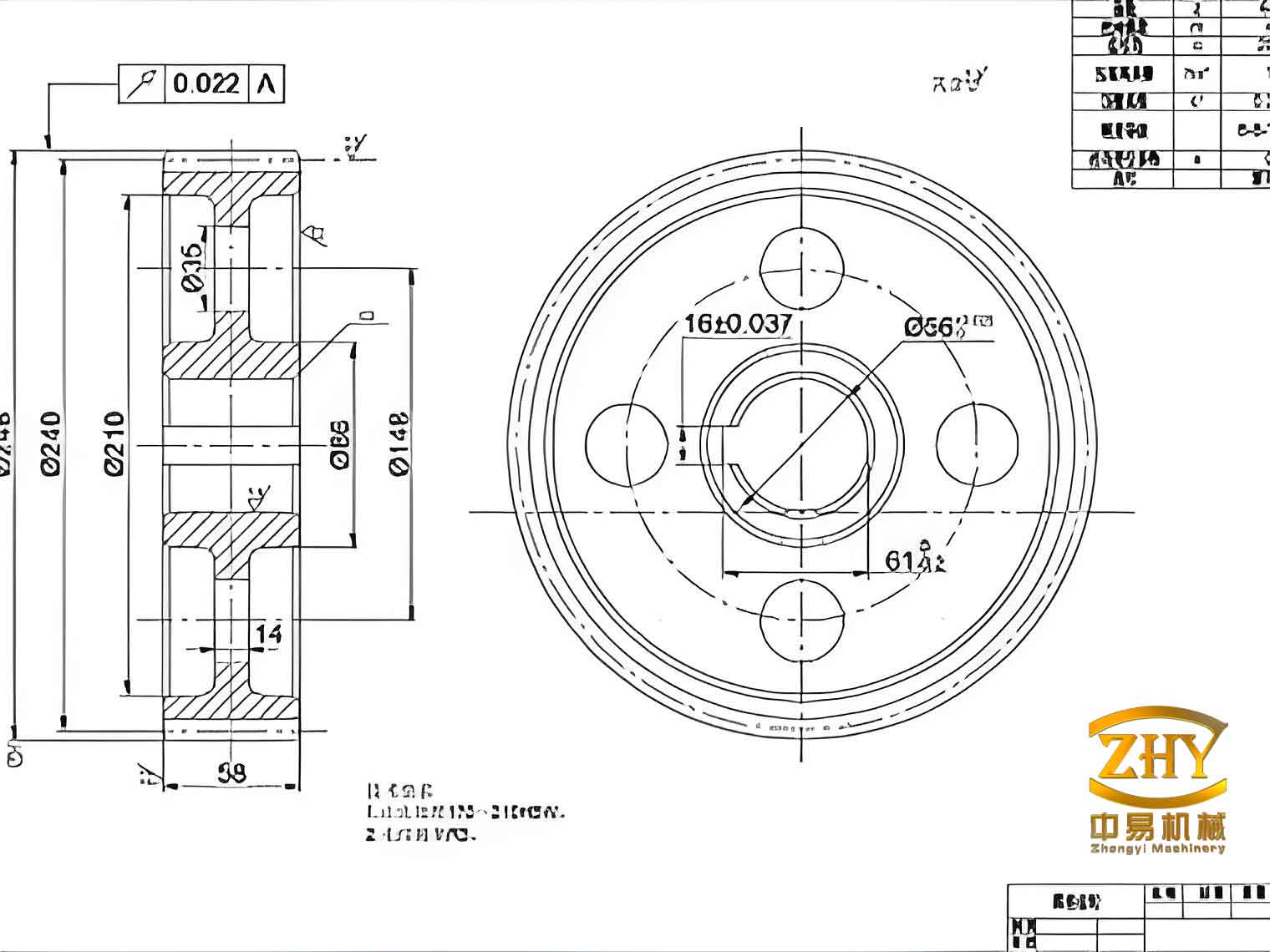
The proposed method for cylindrical gear reconstruction employs a multi-stage strategy. It begins with the preprocessing of the DXF file to extract all geometric entities and annotation data. Subsequently, a clustering algorithm organizes these entities into their respective orthographic views. The core of the information extraction leverages a neural network to correlate dimensions with their corresponding geometric features. Finally, this extracted data drives a parametric modeling routine to generate a 3D model of the cylindrical gear adorned with its critical tolerances. This approach provides an effective solution for integrating manufacturing intent directly into the digital model of a cylindrical gear.
Methodology for Cylindrical Gear Reconstruction
The complete workflow for reconstructing a cylindrical gear from a DXF file involves several interconnected steps. First, the DXF file is parsed to retrieve all relevant data, including lines, circles, arcs, and various annotations (dimensions, geometric tolerances, surface finish symbols). Second, the extracted geometric entities are intelligently grouped into their respective front, top, and side views using a clustering technique. Third, critical dimensions and their associated tolerance data are identified and linked to specific geometric features of the cylindrical gear. Finally, this structured data is used to parameterically generate the 3D solid model, applying the identified tolerances to the appropriate faces and features. The following sections detail the key algorithms and processes involved.
View Segmentation using K-means Clustering
Engineering drawings typically present multiple orthographic views. The first computational challenge is to automatically segment the extracted DXF entities (lines, circles, arcs) into their respective views. We employ the K-means algorithm, a partition-based clustering method, for this task. The core idea is to partition \( n \) observations (entity coordinates) into \( k \) clusters, where each observation belongs to the cluster with the nearest mean (cluster center). The algorithm minimizes the within-cluster sum of squares (variance).
The process begins by identifying centerlines (entities on a “Center” layer). Intersections of these centerlines are calculated to find candidate points for view centers. These points are used as initial centroids for the K-means algorithm. The coordinates of all other entities (end points of lines, centers of circles and arcs) are then assigned to the closest cluster center. The algorithm iteratively refines the centroids and reassigns points until convergence. The formula for assigning an entity point \( P(x, y) \) to a cluster is based on minimizing the Euclidean distance:
$$ \text{Cluster}(P) = \underset{i \in \{1, \dots, k\}}{\arg\min} \lVert P – C_i \rVert $$
where \( C_i \) is the centroid of the \( i \)-th cluster.
The result is a clear separation of entities belonging to different views of the cylindrical gear, such as the front view showing the gear profile and the side view showing the web and hub details. An example clustering outcome is conceptually shown below, where entities are color-coded by their assigned view cluster.
| Entity Type | Count in Cluster 1 (Front View) | Count in Cluster 2 (Side View) | Count in Cluster 3 (Other) |
|---|---|---|---|
| LINE | 45 | 38 | 12 |
| CIRCLE | 8 | 3 | 1 |
| ARC | 15 | 10 | 5 |
| DIMENSION (Leader Points) | 22 | 18 | 7 |
Comprehensive DXF Information Extraction
Accurate reconstruction of a cylindrical gear requires extracting not just basic geometry but also manufacturing specifications. The DXF file is parsed for several key information types:
- Dimensioning Data: Linear, diameter, radius, and angular dimensions. Each dimension entity contains data about its type, the coordinates of its definition points (which touch the measured geometry), and its textual value (including tolerances like \( 45^{+0.33}_{-0.02} \)).
- Surface Finish (Roughness) Symbols: According to standards like GB/T 131, these symbols have a defined shape. Their insertion point and rotation are extracted. To find the exact point on the geometry to which the roughness applies, a distance calculation is performed between the symbol’s attachment point and nearby line segments identified as candidate edges.
- Datum Feature Symbols: These symbols define reference geometries for tolerances. Similar to roughness symbols, the extraction involves locating the triangle and its baseline to determine the referenced edge or surface of the cylindrical gear.
- Geometric Tolerance Symbols: These are complex blocks containing feature control frames. A template matching approach is used for recognition. The block’s graphical content is rasterized and compared against a pre-defined library of tolerance symbols (e.g., for concentricity \(\bigcirc\), parallelism \(\parallel\), runout \(\nearrow\)).
For geometric tolerance recognition, Normalized Cross-Correlation (NCC) template matching is highly effective due to the simple white background of drawings. Given a template image \( T \) and a search image \( I \), the NCC coefficient \( R(x,y) \) at location \( (x, y) \) in \( I \) is calculated as:
$$ R(x, y) = \frac{\sum_{x’,y’} (T'(x’,y’) \cdot I'(x+x’, y+y’))}{\sqrt{\sum_{x’,y’} T'(x’,y’)^2 \cdot \sum_{x’,y’} I'(x+x’, y+y’)^2}} $$
where \( T’ \) and \( I’ \) are the mean-subtracted versions of \( T \) and the sub-image of \( I \):
$$ T'(x’,y’) = T(x’,y’) – \frac{1}{w \cdot h}\sum_{x”,y”}T(x”,y”) $$
$$ I'(x+x’,y+y’) = I(x+x’,y+y’) – \frac{1}{w \cdot h}\sum_{x”,y”}I(x+x”,y+y”) $$
Here, \( w \) and \( h \) are the width and height of the template \( T \). The location with the maximum \( R \) value indicates the best match, successfully identifying symbols like circular runout applied to a cylindrical gear face.
Feature and Parameter Identification using BP Neural Network
Linking a dimension value (e.g., “190”) to the specific geometric feature it describes (e.g., addendum circle diameter) is a critical step. This is framed as a pattern recognition problem. A Backpropagation (BP) Neural Network is trained to predict the key parameters of a cylindrical gear based on a set of input features extracted from the drawing data. For a web-type cylindrical gear, these parameters include addendum circle diameter, root circle diameter, module, face width, web thickness, bore diameter, keyway width, and keyway depth.
The network architecture consists of an input layer (receiving features like dimension text value, view location, presence of associated tolerances), one or more hidden layers, and an output layer (predicting the parameter value). The Xavier method is used for weight initialization in the hidden layers to promote stable gradient flow:
$$ W \sim U\left[ -\frac{\sqrt{6}}{\sqrt{n_{in} + n_{out}}}, \frac{\sqrt{6}}{\sqrt{n_{in} + n_{out}}} \right] $$
where \( n_{in} \) and \( n_{out} \) are the number of input and output units to the layer.
The input to a hidden layer neuron \( i \) is:
$$ \text{net}_i = \sum_{j=1}^{M} w_{ij} x_j + \theta_i $$
where \( w_{ij} \) are weights, \( x_j \) are inputs, and \( \theta_i \) is the bias.
The output of the hidden layer uses the tanh activation function for its faster convergence and zero-centered output compared to sigmoid:
$$ o_i = \phi(\text{net}_i) = \tanh(\text{net}_i) = \frac{e^{\text{net}_i} – e^{-\text{net}_i}}{e^{\text{net}_i} + e^{-\text{net}_i}} $$
The output layer’s computation follows similarly. The network is trained using a mean squared error (MSE) loss function:
$$ L = \frac{1}{2} \sum_{k=1}^{K} (y_k – o_k)^2 $$
where \( y_k \) is the true value and \( o_k \) is the predicted value for the \( k \)-th output parameter.
The trained network demonstrates high accuracy in predicting cylindrical gear parameters. For instance, predictions for the addendum circle diameter show close alignment with actual values, as evidenced by low Root Mean Square Error (RMSE).
| Parameter | True Value (mm) | Predicted Value (mm) | RMSE (Sample) |
|---|---|---|---|
| Addendum Circle Diameter | 190.00 | 190.00001 | 3.1e-5 |
| Root Circle Diameter | 180.00 | 179.99989 | 4.0e-5 |
| Bore Diameter | 45.00 | 45.00021 | 2.8e-5 |
| Keyway Width | 14.00 | 13.99994 | 3.6e-5 |
| Web Thickness | 24.00 | 24.00016 | 3.3e-5 |
Parameter Correspondence and 3D Modeling with Tolerances
The final stage integrates all extracted and interpreted information to create a dimensionally accurate and toleranced 3D model of the cylindrical gear. The parameters identified by the BP network are rounded to standard values and explicitly linked to their source annotations—dimensions, geometric tolerances, datum references, and surface finish symbols.
This structured data table becomes the input for a parametric modeling script, typically implemented using an API like VBA for SolidWorks. The script sequentially creates features: extruding the gear blank, cutting the bore, adding the keyway, forming the web, and generating the gear teeth based on calculated parameters like module and number of teeth (derived from addendum and pitch diameters). Crucially, during the feature creation, the associated tolerance information is applied to the relevant faces and features in the 3D CAD model. For example, the bore diameter is created with its specified fit tolerance (\(45^{+0.33}_{-0.02}\)), the keyway is positioned with its symmetry tolerance relative to datum A (the bore axis), and the gear face is assigned a circular runout tolerance relative to the same datum. Surface roughness values (e.g., Ra 3.2) are also attached to the appropriate faces.
| Feature | Dimension & Tolerance | Associated Datum | Surface Finish | Geometric Tolerance |
|---|---|---|---|---|
| Addendum Circle | Ø190 | A | Ra 3.2 | Circular Runout |
| Bore | Ø45^{+0.33}_{-0.02} | A (Primary) | N/A | N/A |
| Keyway Width | 14^{+0.24}_{-0.02} | A | N/A | Symmetry |
| Gear Face (Side) | Thickness = 60 | A | Ra 3.2 | N/A |
Conclusion
This paper presents a comprehensive methodology for the automated three-dimensional reconstruction of a cylindrical gear from its DXF file representation, with the distinct capability of embedding critical manufacturing tolerance information directly into the resulting digital model. The process leverages K-means clustering for intelligent view segmentation, a BP neural network for accurate parameter identification and correlation, and robust algorithms for extracting and interpreting roughness, datum, and geometric tolerance symbols. By integrating these components into a parametric modeling workflow, the method successfully bridges the informational gap between 2D engineering drawings and 3D CAD models. The reconstructed model of the cylindrical gear is not only geometrically accurate but also carries the essential GD&T data necessary for downstream manufacturing and inspection processes. This approach offers a significant step towards fully automated, intent-preserving digital twin creation for mechanical components like the cylindrical gear, with promising implications for design reuse, process planning, and quality assurance in intelligent manufacturing systems.