
In my experience working with coal mine equipment, the bevel gears in transfer reducers are critical yet vulnerable components. These bevel gears, especially spiral bevel gears at the high-speed end, often exhibit higher failure rates compared to other gear pairs within the gearbox. This issue not only leads to significant downtime but also incurs substantial costs due to replacement and maintenance. The harsh operating conditions in coal mines, including high impact loads, excessive humidity, and dust-laden environments, exacerbate the wear and tear on bevel gears. Over the years, I have observed that improper maintenance and adjustment are primary contributors to premature failures. Therefore, understanding the failure mechanisms and implementing effective preventive measures are essential to enhance the service life of bevel gears, reduce operational costs, and ensure reliable performance in coal mining applications.
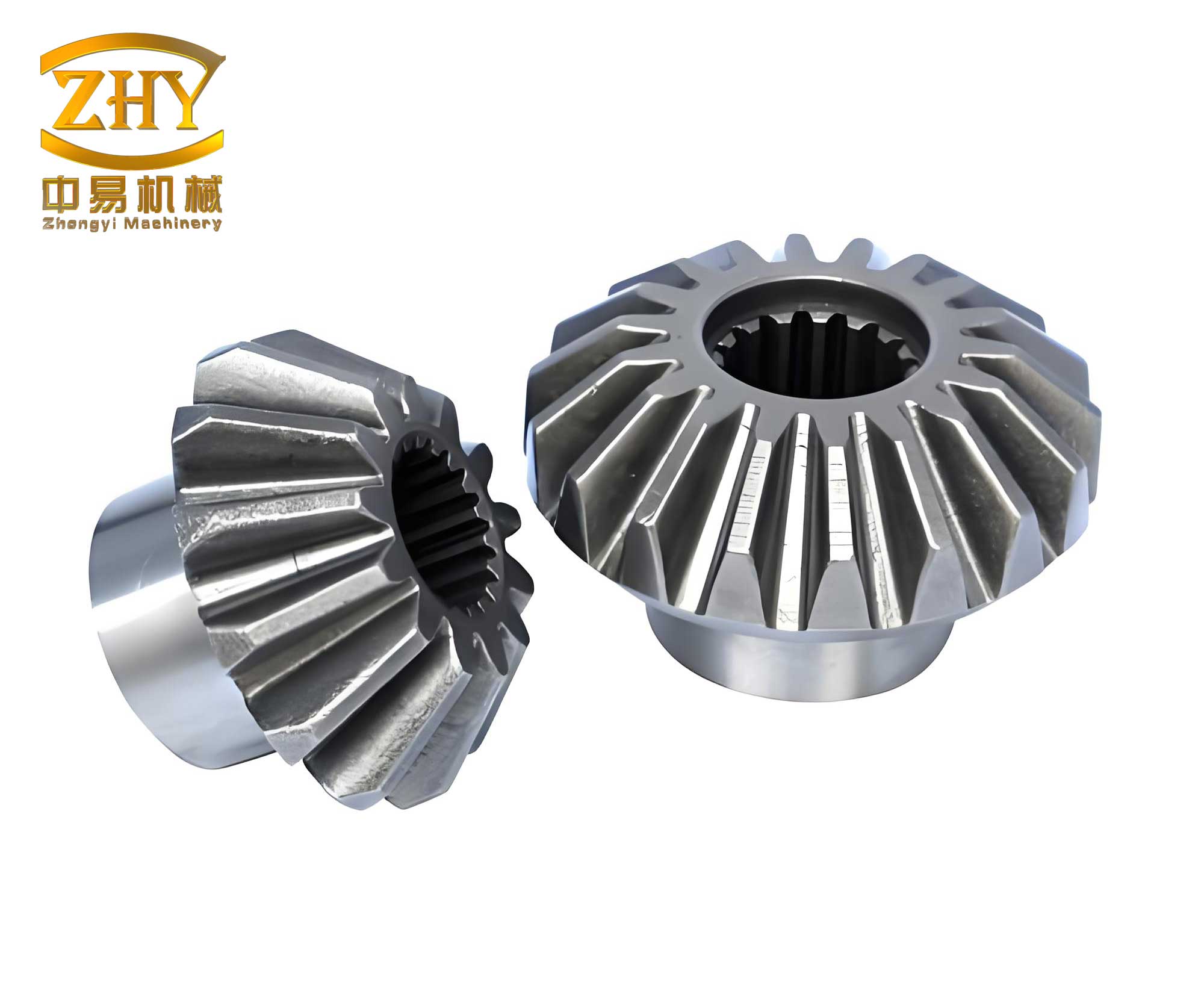
The structure of a typical coal mine transfer reducer is designed to accommodate spatial constraints in mine roadways. The motor axis must be perpendicular to the chain wheel axis of the transfer machine, necessitating a 90-degree arrangement between the driving and driven shafts. This configuration relies heavily on bevel gears to transmit power efficiently. In many reducers, the bevel gears are positioned at the high-speed input end, where they are subjected to rapid rotational speeds and dynamic loads. For instance, a common reducer model might have a speed ratio of 3.15, powered by a 400 kW motor running at 1,450 rpm. The bevel gears in such systems are precision components that require careful alignment and lubrication. Their performance is influenced by factors like gear geometry, material properties, and operating conditions. The spiral bevel gear design is often preferred due to its smooth engagement and higher load capacity, but it is also more susceptible to misalignment issues.
Bevel gears can fail in various modes, including pitting, spalling, scuffing, and tooth breakage. Based on my observations, the root causes of these failures can be categorized into several key areas: inadequate maintenance, improper gear adjustment, lubrication failures, and environmental factors. To systematically address these, I will delve into each cause and propose preventive strategies, supported by tables and engineering formulas.
Failure Mechanisms of Bevel Gears
The failure of bevel gears often stems from a combination of mechanical stress, thermal effects, and material fatigue. One common issue is misalignment of the gear axes, which leads to uneven load distribution across the tooth faces. This can be quantified using the contact stress formula for bevel gears. The maximum contact stress \(\sigma_H\) can be calculated as:
$$ \sigma_H = Z_E \sqrt{ \frac{F_t}{b d_{e1}} \cdot \frac{u + 1}{u} \cdot K_A K_V K_{H\beta} K_{H\alpha} } $$
where \(Z_E\) is the elasticity coefficient, \(F_t\) is the tangential force, \(b\) is the face width, \(d_{e1}\) is the pitch diameter of the pinion, \(u\) is the gear ratio, and \(K_A\), \(K_V\), \(K_{H\beta}\), \(K_{H\alpha}\) are application, dynamic, face load, and transverse load factors, respectively. Misalignment increases \(K_{H\beta}\), leading to elevated stress and premature failure. Another critical aspect is the bending stress at the tooth root, given by:
$$ \sigma_F = \frac{F_t}{b m_n} Y_F Y_S Y_\beta K_A K_V K_{F\beta} K_{F\alpha} $$
where \(m_n\) is the normal module, \(Y_F\) is the form factor, \(Y_S\) is the stress correction factor, \(Y_\beta\) is the helix angle factor, and \(K_{F\beta}\), \(K_{F\alpha}\) are bending load factors. Improper meshing间隙 can exacerbate these stresses, causing cracks and eventual tooth fracture.
Lubrication plays a vital role in bevel gear performance. Inadequate lubrication leads to metal-to-metal contact, resulting in scuffing and wear. The film thickness parameter \(\lambda\) is crucial here:
$$ \lambda = \frac{h_{\min}}{\sqrt{R_{q1}^2 + R_{q2}^2}} $$
where \(h_{\min}\) is the minimum film thickness and \(R_{q1}\), \(R_{q2}\) are the surface roughness values. If \(\lambda < 1\), boundary lubrication occurs, increasing the risk of damage. Environmental factors like dust contamination accelerate abrasive wear, while humidity promotes corrosion. Additionally, thermal expansion from overheating can alter gear clearances, affecting meshing.
Preventive Measures for Bevel Gear Longevity
To mitigate these issues, a proactive maintenance regime is essential. Regular inspection and adjustment of bevel gears can prevent many failures. The meshing间隙 of bevel gears should be carefully controlled. For most coal mine reducers, the recommended backlash is between 0.20 mm and 0.30 mm, but this varies with power rating. The backlash \(\delta\) can be adjusted using shims and measured via the “wire compression” method or dial indicators. The relationship between backlash and gear parameters is:
$$ \delta = \Delta C \cdot \tan \alpha $$
where \(\Delta C\) is the center distance change and \(\alpha\) is the pressure angle. Proper backlash ensures smooth operation and reduces impact loads.
The contact pattern on bevel gear teeth is another critical indicator. It should be elliptical or rectangular, covering 32% to 50% of the tooth length and 40% to 60% of the tooth height, positioned slightly toward the toe end. Adjustments involve moving the pinion axially or radially. The table below summarizes common adjustment scenarios based on contact pattern observations:
| Contact Pattern Issue | Probable Cause | Adjustment Action |
|---|---|---|
| Pattern too large or spread | Excessive backlash | Reduce backlash by adjusting shims |
| Pattern too small or concentrated | Insufficient backlash | Increase backlash carefully |
| Pattern偏向大端 | Pinion too far from gear center | Move pinion closer axially |
| Pattern偏向小端 | Pinion too close to gear center | Move pinion away axially |
| Pattern偏向齿顶 | Gear depth too shallow | Adjust gear mounting distance |
| Pattern偏向齿根 | Gear depth too deep | Adjust gear mounting distance |
Lubrication management is equally important. Using the correct grade of oil and maintaining proper oil levels can prevent thermal and wear-related failures. The oil change interval should be based on operating temperature. For instance, at 65–70°C, oil should be changed every 2,500 hours or 6 months. If temperatures exceed this, the interval shortens. The viscosity-temperature relationship can be approximated by:
$$ \log \log(\nu + 0.7) = A – B \log T $$
where \(\nu\) is the kinematic viscosity, \(T\) is the temperature in Kelvin, and \(A\), \(B\) are constants. Regular oil analysis for metal contaminants helps detect early wear of bevel gears.
Bearing health directly affects bevel gear alignment. Worn or damaged bearings cause shaft deflection, altering meshing conditions. The bearing life \(L_{10}\) can be estimated using:
$$ L_{10} = \left( \frac{C}{P} \right)^3 $$
for ball bearings, where \(C\) is the dynamic load rating and \(P\) is the equivalent dynamic load. Monitoring vibration signatures can predict bearing failures. Implementing condition-based maintenance, such as vibration analysis and thermography, allows for timely interventions before bevel gear damage occurs.
Engineering Practices and Case Insights
In my practice, I have developed a systematic approach to bevel gear maintenance. Before commissioning a reducer, I verify all alignments using laser alignment tools to ensure parallelism and perpendicularity within tolerances. During operation, I schedule quarterly inspections that include checking locknuts, bearing clearances, and shim conditions. For bevel gears, I use marking compounds to validate contact patterns and adjust as needed. A common mistake is over-tightening locknuts, which induces preload and heat generation. The proper tightening torque \(T\) for locknuts can be derived from:
$$ T = K \cdot F \cdot d $$
where \(K\) is the torque coefficient, \(F\) is the axial force, and \(d\) is the nominal diameter. Using a torque wrench ensures consistency.
Environmental controls also play a role. Installing effective seals and filters minimizes dust ingress into the reducer. For humidity, desiccant breathers can be used to keep the internal atmosphere dry. Additionally, I recommend using bevel gears made from materials with high hardness and toughness, such as case-hardened steels, to withstand impact loads. The surface hardness \(H\) can be correlated with wear resistance through the Archard wear equation:
$$ V = K \frac{N \cdot s}{H} $$
where \(V\) is wear volume, \(K\) is a wear coefficient, \(N\) is normal load, and \(s\) is sliding distance. Harder surfaces reduce \(V\), extending bevel gear life.
To illustrate the impact of these measures, consider a scenario where bevel gear life increased from 2.6 million tons of coal throughput to over 4 million tons after implementing rigorous adjustment protocols and oil analysis. This translates to cost savings of approximately 30% on replacement parts. The table below compares key performance metrics before and after preventive measures:
| Metric | Before Prevention | After Prevention |
|---|---|---|
| Average bevel gear life (million tons) | 2.6 | 4.2 |
| Failure rate per year | 21 pairs | 10 pairs |
| Maintenance downtime (hours/year) | 150 | 80 |
| Cost savings (percentage) | Baseline | 30% |
Furthermore, computational tools like finite element analysis (FEA) can simulate bevel gear stresses under load. For example, modeling the gear pair with boundary conditions reflecting mine operations helps optimize tooth geometry and material selection. The stress distribution \(\sigma(x,y)\) from FEA can inform design improvements, reducing stress concentrations at the tooth fillets.
Advanced Considerations for Bevel Gear Systems
Beyond basic maintenance, understanding the dynamics of bevel gear systems can lead to further enhancements. The natural frequencies of the gear-shaft assembly should be analyzed to avoid resonance, which amplifies vibrations and accelerates wear. The fundamental frequency \(f_n\) can be estimated as:
$$ f_n = \frac{1}{2\pi} \sqrt{\frac{k}{m}} $$
where \(k\) is the stiffness and \(m\) is the mass. Operating speeds should stay away from critical frequencies to prevent resonant failures.
Thermal management is another advanced aspect. The heat generation \(Q\) in bevel gears due to friction can be calculated using:
$$ Q = \mu \cdot F_t \cdot v $$
where \(\mu\) is the coefficient of friction and \(v\) is the sliding velocity. Efficient cooling systems, such as oil coolers or fan-assisted vents, help dissipate this heat, maintaining stable clearances and lubrication properties. I often integrate temperature sensors into reducers for real-time monitoring, enabling predictive maintenance.
Noise and vibration analysis also provides insights into bevel gear health. Abnormal sounds often indicate misalignment or wear. Using frequency domain analysis, specific fault frequencies can be identified. For instance, the gear mesh frequency \(f_m\) is:
$$ f_m = N \cdot f_r $$
where \(N\) is the number of teeth and \(f_r\) is the rotational frequency. Peaks at \(f_m\) or its harmonics suggest issues with the bevel gears.
In terms of material science, advancements in coatings, such as diamond-like carbon (DLC) or nitriding, can significantly improve the surface properties of bevel gears. These coatings reduce friction and enhance wear resistance. The coefficient of friction \(\mu\) for coated surfaces can be as low as 0.05, compared to 0.1–0.15 for uncoated steels, directly reducing heat generation and wear rates.
Conclusion
In summary, the longevity of bevel gears in coal mine transfer reducers hinges on a multifaceted approach that combines diligent maintenance, precise adjustment, proper lubrication, and environmental control. By understanding the failure mechanisms—such as misalignment, excessive stress, and lubrication breakdown—and implementing preventive measures like regular inspections, contact pattern optimization, and oil management, the service life of bevel gears can be substantially extended. My experience underscores that proactive practices not only reduce costs but also enhance operational reliability in the demanding conditions of coal mining. Emphasizing the importance of bevel gear care through training and standardized procedures will continue to drive improvements in this critical area. As technology evolves, integrating advanced monitoring and material innovations will further bolster the performance of these essential components, ensuring that bevel gears remain durable and efficient in their pivotal role within mining machinery.