
In modern manufacturing, the integration of industrial information systems is crucial for enhancing productivity and efficiency. As a key component in gear production, gear hobbing machines play a vital role in the automotive and machinery industries. Gear hobbing is a precision process that involves cutting gears using a hob, and gear hobbing machines are widely employed due to their ability to produce high-quality gears with complex profiles. In this article, I explore the application of FANUC CNC systems in gear hobbing machines for data acquisition within Supervisory Control and Data Acquisition (SCADA) systems. I will discuss the characteristics of FANUC CNC systems and gear hobbing machines, methods for data extraction and networking, the integration of data platforms, and security considerations. Throughout, I will emphasize the importance of gear hobbing and gear hobbing machines in industrial automation, using tables and formulas to summarize key points.
The FANUC CNC system is renowned for its reliability and flexibility in industrial applications. In gear hobbing machines, these systems facilitate real-time data collection, which is essential for monitoring and optimizing the gear hobbing process. FANUC systems are typically hybrid, combining software and hardware elements to handle tasks such as trajectory calculations, servo control, and input/output management. This architecture allows for efficient data storage in memory areas, which external computers can access via communication protocols. For instance, data like axis coordinates, machine status, and load information can be retrieved using application programming interfaces (APIs). The evolution from hardware-based to software-oriented CNC systems highlights a trend toward open platforms, which reduce costs and enhance adaptability in gear hobbing applications. In gear hobbing machines, the FANUC system’s ability to monitor up to 28 different status parameters, including servo load rates and motor temperatures, is particularly beneficial for predictive maintenance. This capability ensures that gear hobbing operations remain efficient and minimizes downtime.
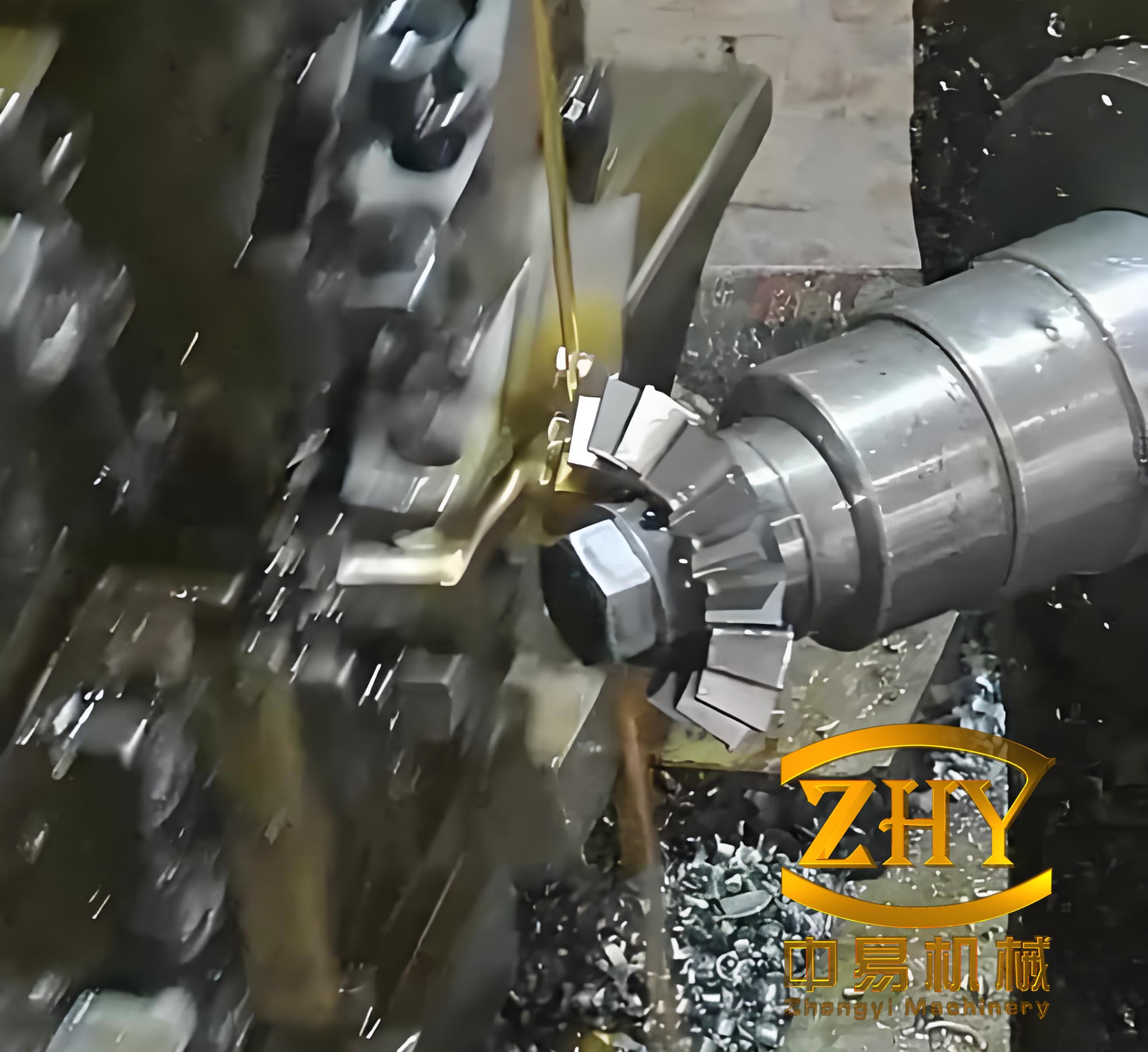
Gear hobbing machines are specialized equipment designed for generating gears through coordinated movements of the hob and workpiece. The gear hobbing process involves several kinematic chains: the main drive chain, the generating motion chain, and feed chains for vertical, axial, and radial movements. During gear hobbing, the rotation of the hob axis, the workpiece axis, and the vertical movement of the hob constitute the primary cutting motions. One key characteristic of gear hobbing machines is their consistent machining path; in high-efficiency gear hobbing, the machine operates continuously in a loop, with the program cycling repeatedly except during tool changes or maintenance. This continuous operation poses challenges for data acquisition, as it requires persistent monitoring without interruptions. Additionally, tool monitoring is critical in gear hobbing because the hob is a complex and expensive tool. Tracking hob information, such as wear and usage, necessitates integrating identification methods like RFID or barcode scanning into the data acquisition system. Moreover, gear hobbing machines often operate under heavy loads and multi-axis coordination, making them prone to servo-related issues. Thus, real-time data on parameters like load rates and currents are invaluable for preventing failures in gear hobbing processes.
Data acquisition in gear hobbing machines relies on robust networking and protocol-based data extraction. The factory information architecture typically consists of three layers: Enterprise Resource Planning (ERP), Manufacturing Execution System (MES), and SCADA. SCADA systems serve as the foundation for device-level data collection, using databases for storage and industrial networks for transmission. In FANUC-based gear hobbing machines, the SCADA system involves data transfer units (DTUs) connected via Ethernet, which support functions like FTP servers and VPNs. The Smart NC Link data collector, equipped with the FOCAS library, enables data acquisition from FANUC systems, while FANUC MT-Link i software integrates various devices, including CNCs and robots, and interfaces with databases like MongoDB. The data flow follows an ETL (Extract, Transform, Load) process, where dynamic data is collected and periodically staticized for analysis. To illustrate the data acquisition methods, consider the following table comparing different protocols used in gear hobbing machines:
| Protocol | Function | Application in Gear Hobbing |
|---|---|---|
| FOCAS | Standard function library for data query | Extracts machine status, coordinates, and load data |
| OPC | Industrial standard for process control | Standardizes data for platform integration |
| API | Application programming interface | Enables custom data access and analysis |
| PMC | Programmable Machine Controller | Handles input/output for tool identification |
Network configuration is a fundamental aspect of data acquisition in gear hobbing machines. Industrial Ethernet forms the backbone of SCADA systems, and devices must be assigned unique IP addresses within a defined range. Using TCP/IP protocols, IP addresses are categorized into classes (e.g., A, B, C), with subnet masks employed to optimize address allocation and improve network efficiency. For example, in a facility with numerous gear hobbing machines, a Class C network (e.g., 192.168.x.x) might be used, with subnets划分 to limit broadcast domains and enhance security. The formula for calculating the number of available IP addresses in a subnet is given by: $$ N = 2^{(32 – n)} – 2 $$ where \( N \) is the number of usable addresses, and \( n \) is the number of bits in the subnet mask. This ensures that gear hobbing machines are efficiently networked without overwhelming the system. Data extraction from FANUC systems involves accessing specific memory addresses via FOCAS functions. For instance, to monitor the part count in a gear hobbing machine, the system typically increments a counter upon encountering M02 or M30 commands in the NC program. However, in continuous gear hobbing cycles where these commands are bypassed via jumps, a macro program can be used to manually increment a variable, such as #500 in the example below:
In gear hobbing operations, tool management is critical, and data acquisition must include hob identification. This is achieved by embedding unique codes into each hob, which are read via scanners or RFID and transmitted to the machine’s PMC. The PMC then stores this data in designated registers, such as R1000, and moves it to D-data areas for external access. The following formula represents the data transfer process in PMC: $$ \text{Data}_{\text{output}} = \text{MOVE}(\text{Input}_{\text{register}}, \text{D}_{\text{address}}) $$ This ensures that tool information is seamlessly integrated into the SCADA system. Furthermore, advanced FANUC systems support OPC and API protocols, which standardize data exchange and enable real-time monitoring of gear hobbing parameters like servo load and motor temperature. The integration of these protocols into DTUs allows for plug-and-play data collection, reducing implementation time for gear hobbing applications.
The data platform in SCADA systems for gear hobbing machines can be deployed on local or cloud servers. Local servers offer low latency and high security but require significant initial investment, whereas cloud servers provide scalability and ease of maintenance. The SCADA architecture typically supports both B/S (Browser/Server) and C/S (Client/Server) models. B/S architectures use HTTP protocols for wide-area access but may have security vulnerabilities, while C/S architectures offer enhanced security through multi-layer authentication, making them suitable for sensitive gear hobbing data. Data is stored in real-time and historical databases, with compression techniques applied to optimize storage. For example, dynamic data from gear hobbing machines is collected continuously, and static data is generated during idle periods. The relationship between data volume and storage efficiency can be expressed as: $$ \text{Storage}_{\text{efficiency}} = \frac{\text{Compressed Size}}{\text{Original Size}} \times 100\% $$ This ensures that large datasets from gear hobbing operations are managed effectively.
Security is paramount in SCADA systems for gear hobbing machines. To protect against cyber threats, several measures are implemented: gear hobbing machines are isolated in dedicated network segments, servers use dual network cards for separation, and firewalls are installed between operational and office networks. Additionally, antivirus software with regular updates, IP whitelisting, and role-based access controls are employed. The security model can be summarized by the following table:
| Security Measure | Description | Benefit for Gear Hobbing |
|---|---|---|
| Network Segmentation | Isolates machine networks from corporate LAN | Prevents unauthorized access to gear hobbing data |
| Firewalls | Filters traffic between networks | Blocks malicious attacks on gear hobbing systems |
| IP Whitelisting | Restricts access to approved IP addresses | Ensures only authorized devices connect |
| Data Encryption | Encrypts data in transit and at rest | Protects sensitive gear hobbing parameters |
In conclusion, the integration of FANUC CNC systems into gear hobbing machines for SCADA-based data acquisition significantly enhances manufacturing intelligence. Gear hobbing processes benefit from real-time monitoring of parameters like load rates and tool usage, which improve efficiency and reduce downtime. The use of protocols such as FOCAS, OPC, and API, combined with robust networking and security measures, ensures reliable data flow. As gear hobbing technology evolves, further research into adaptive data acquisition methods will be essential for optimizing gear production in the era of Industry 4.0. By leveraging these insights, manufacturers can achieve higher productivity and quality in gear hobbing operations, solidifying the role of gear hobbing machines in advanced industrial systems.