
In the realm of precision motion control and high-reduction-ratio transmission systems, the harmonic drive gear stands out as a pivotal technology. As a researcher deeply engaged in the mechanics of flexible components, I find the deformation behavior of the flexspline—the core deformable element in a harmonic drive gear—to be of paramount importance. The flexspline’s deformation directly dictates its stress distribution, fatigue life, and ultimately, the reliability and performance of the entire harmonic drive gear system. This article delves into a comprehensive theoretical analysis of the deformation of a ring-type flexspline in a two-wave harmonic drive gear. By establishing mathematical models for deformation and internal bending moments, introducing the concept of deformation sensitivity, and performing simulated analyses, this work aims to provide foundational insights for optimizing the design and performance assessment of harmonic drive gear components.
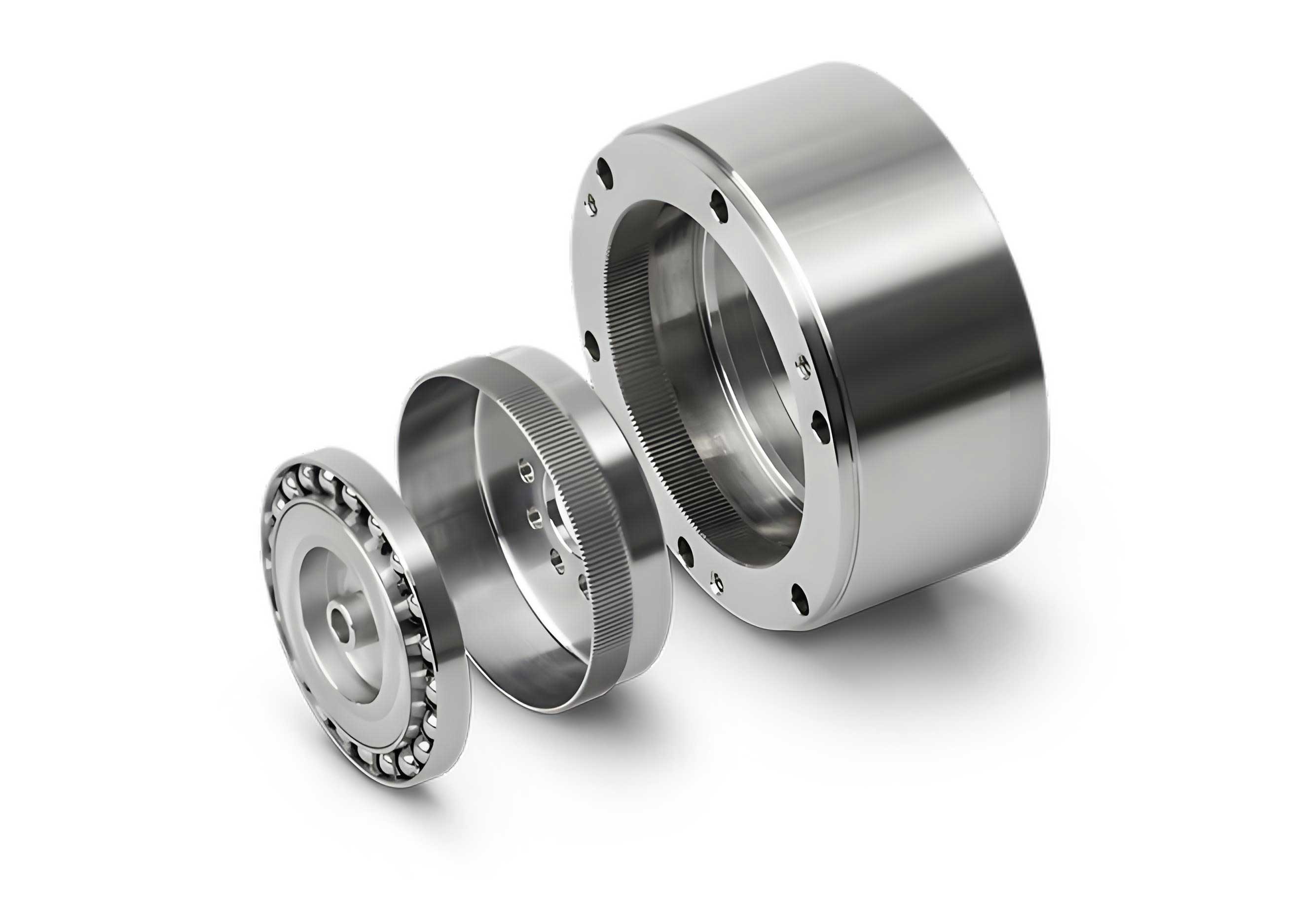
The harmonic drive gear, a breakthrough from the mid-20th century, has found extensive applications in aerospace, robotics, medical devices, and precision instrumentation due to its unique advantages. These include a compact structure, high gear reduction ratio, significant load-bearing capacity, low relative sliding velocity between teeth, smooth operation, and minimal noise. The operational principle of a harmonic drive gear relies on the controlled elastic deformation of a flexible component, the flexspline, to transmit motion and torque. Consequently, the flexspline operates under cyclic, asymmetric stress states, making its fatigue life a critical limiting factor for the harmonic drive gear’s durability. A profound understanding of the flexspline’s deformation under load is therefore essential for predicting its stress field, identifying potential failure points, and achieving optimal meshing conditions with the rigid circular spline.
A standard harmonic drive gear assembly comprises three primary components: the wave generator, the flexspline (which has external teeth), and the circular spline (which has internal teeth). The wave generator, typically the input element, is often an elliptical cam or a assembly of rotating bearings. The flexspline is a thin-walled, flexible cylinder with external teeth, and the circular spline is a rigid ring with internal teeth. In a two-wave harmonic drive gear system, the wave generator possesses two lobes. Before assembly, the flexspline is circular. Upon insertion of the wave generator, the flexspline is forced into an elliptical shape. This deformation causes the teeth of the flexspline to engage fully with the teeth of the circular spline at the two major axis regions of the ellipse and to disengage at the minor axis regions. As the wave generator rotates, the elliptical deformation pattern propagates around the flexspline, causing successive tooth engagement and disengagement, thereby producing a high reduction ratio. The fundamental kinematic relationship dictates that the difference in the number of teeth between the circular spline and the flexspline equals the wave number (or its integer multiple). For manufacturing convenience, involute tooth profiles are commonly employed in harmonic drive gear systems.
The analysis of deformation in the flexspline of a harmonic drive gear hinges on the concept of the neutral layer. In mechanics of materials, the neutral layer is a hypothetical surface within a bending beam or shell where the longitudinal strain is zero during deformation. For the flexspline undergoing bending, it is assumed that the length of this neutral layer remains constant before and after deformation. This layer serves as the reference for calculating the deformed geometry. The intersection of the neutral layer with a cross-section defines the neutral axis, about which the cross-section rotates during bending, and where the normal bending stress is zero. For the relatively small elastic deformations encountered in harmonic drive gear operation, it is generally accurate enough to assume that the geometric mid-surface of the flexspline’s cylindrical wall coincides with this strain-neutral layer. The relationship between the curvature of the neutral layer after bending and the internal bending moment is given by the fundamental beam theory formula:
$$ \rho = \frac{EI}{M} $$
Here, \( \rho \) is the radius of curvature of the neutral layer after deformation, \( E \) is the modulus of elasticity of the flexspline material, \( I \) is the area moment of inertia of the flexspline cross-section about the neutral axis, and \( M \) is the internal bending moment acting on that cross-section. The product \( EI \) is known as the flexural rigidity. This equation is foundational for linking the kinematic deformation to the internal stress state within the flexspline of a harmonic drive gear.
To quantitatively analyze the deformation, we develop a mathematical model by simplifying the toothed ring of the flexspline to an equivalent smooth, thin-walled circular ring. Consider a ring with a mean radius \( r_m \) representing the neutral circle of the flexspline before deformation. In a two-wave harmonic drive gear system, the wave generator applies two diametrically opposite radial forces \( F \) inward at points corresponding to the ends of the major axis of the eventual ellipse. This ring is a statically indeterminate structure. Utilizing symmetry and employing methods from structural mechanics (such as Castigliano’s theorem or the method of consistent deformations), we can solve for the internal bending moment. By considering symmetry about both the vertical and horizontal diameters, we analyze one quarter of the ring. The internal bending moment \( M \) at any cross-section defined by an angular coordinate \( \varphi \) (measured from the horizontal diameter where the force is not directly applied) is derived as:
$$ M(\varphi) = F r_m \left( \frac{1}{\pi} – \frac{\cos\varphi}{2} \right) $$
In this equation, \( F \) is the radial force exerted by the wave generator per lobe, \( r_m \) is the mean radius of the flexspline’s neutral circle in its undeformed state, and \( \varphi \) is the angular position from the horizontal axis (ranging from \( 0^\circ \) to \( 90^\circ \) for the first quadrant). This formula is crucial for the harmonic drive gear analysis as it describes the variation of bending stress along the flexspline’s circumference.
The deformation magnitudes along the principal axes are of primary interest for meshing analysis in a harmonic drive gear. The relative displacement \( \delta_{AB} \) of the two force application points (along the major axis) and the relative displacement \( \delta_{CD} \) of the points on the perpendicular diameter (minor axis) can be calculated using energy methods like Mohr’s integral. The results are:
$$ \delta_{AB} = \frac{F r_m^3}{EI} \left( \frac{\pi}{4} – \frac{2}{\pi} \right) \approx \frac{0.1488 F r_m^3}{EI} $$
$$ \delta_{CD} = \frac{F r_m^3}{EI} \left( \frac{2}{\pi} – \frac{1}{2} \right) \approx \frac{0.1366 F r_m^3}{EI} $$
Since \( \delta_{AB} > \delta_{CD} \), the maximum radial deformation of the flexspline neutral layer occurs at the force application points. The maximum radial deformation \( W_0 \) is half of \( \delta_{AB} \):
$$ W_0 = \frac{\delta_{AB}}{2} \approx \frac{0.0744 F r_m^3}{EI} $$
To express this in terms of more fundamental harmonic drive gear design parameters, we introduce the geometric parameters of the flexspline. Let \( m \) be the module, \( Z_r \) be the number of teeth on the flexspline, and \( d_R = m Z_r \) be its pitch diameter. For a standard involute tooth profile with pressure angle \( \alpha = 20^\circ \) and full-depth teeth, the dedendum coefficient for the flexspline is often taken as \( h_{fR}^* = 1.35 \). The dedendum height is \( h_{fR} = m h_{fR}^* = 1.35m \). The wall thickness \( \delta \) of the ring-type flexspline body is typically chosen as \( \delta = (0.01 \text{ to } 0.015) d_R \). For this analysis, we take \( \delta = 0.01 d_R = 0.01 m Z_r \).
Assuming the flexspline is a non-profile-shifted gear, the mean radius \( r_m \) of the neutral circle can be approximated as the pitch radius minus the dedendum height and half the wall thickness:
$$ r_m = \frac{d_R}{2} – h_{fR} – \frac{\delta}{2} = \frac{m Z_r}{2} – 1.35m – \frac{0.01 m Z_r}{2} = m \left( 0.495 Z_r – 1.35 \right) $$
The area moment of inertia \( I \) for a rectangular cross-section of the ring (width \( b \) axial length, thickness \( \delta \)) about its neutral axis is:
$$ I = \frac{b \delta^3}{12} $$
Substituting \( I \) and \( r_m \) into the expression for \( W_0 \), and noting that \( \delta = 0.01 m Z_r \), we obtain:
$$ W_0 \approx \frac{0.0744 F \left[ m (0.495 Z_r – 1.35) \right]^3}{E \cdot b \cdot \frac{(0.01 m Z_r)^3}{12}} = \frac{0.0744 F \cdot m^3 (0.495 Z_r – 1.35)^3 \cdot 12}{E b m^3 (0.01)^3 Z_r^3} $$
Simplifying the constants:
$$ W_0 \approx \frac{0.8928 F}{E b} \cdot \frac{(0.495 Z_r – 1.35)^3}{(0.01)^3 Z_r^3} = \frac{0.8928 F}{E b (10^{-6})} \cdot \left( \frac{0.495 Z_r – 1.35}{Z_r} \right)^3 = \frac{892,800 F}{E b} \cdot \left( 0.495 – \frac{1.35}{Z_r} \right)^3 $$
For a given harmonic drive gear with fixed material (E), axial width (b), and wave generator force (F), the maximum radial deformation is proportional to the cube of a specific term:
$$ W_0 \propto \left( 0.495 – \frac{1.35}{Z_r} \right)^3 $$
This relationship reveals the profound influence of the flexspline tooth count \( Z_r \) on the deformation magnitude in a harmonic drive gear. To systematically study this influence, I introduce the concept of “deformation sensitivity” for the flexspline. Deformation sensitivity here refers to the rate of change of the maximum radial deformation \( W_0 \) with respect to the number of teeth \( Z_r \). It indicates how sensitively the deformation responds to variations in tooth count, which is a key design parameter for any harmonic drive gear.
Let us define a normalized deformation function \( f(Z_r) \) that captures the proportionality:
$$ f(Z_r) = \left( 0.495 – \frac{1.35}{Z_r} \right)^3 $$
The sensitivity can be examined by plotting \( f(Z_r) \) against \( Z_r \) and by calculating its derivative. The derivative \( f'(Z_r) \) represents the rate of change of deformation potential with tooth count:
$$ f'(Z_r) = \frac{d}{dZ_r} \left[ \left( 0.495 – \frac{1.35}{Z_r} \right)^3 \right] = 3 \left( 0.495 – \frac{1.35}{Z_r} \right)^2 \cdot \left( \frac{1.35}{Z_r^2} \right) = \frac{4.05}{Z_r^2} \left( 0.495 – \frac{1.35}{Z_r} \right)^2 $$
To visualize these relationships, the following table summarizes the values of \( f(Z_r) \) and \( f'(Z_r) \) for a range of tooth counts typical in harmonic drive gear design:
| Flexspline Tooth Count, \( Z_r \) | Deformation Factor, \( f(Z_r) \) | Sensitivity (Derivative), \( f'(Z_r) \) |
|---|---|---|
| 50 | \( (0.495 – 0.027)^3 = (0.468)^3 \approx 0.1025 \) | \( \frac{4.05}{2500} (0.468)^2 \approx 0.000355 \) |
| 80 | \( (0.495 – 0.016875)^3 = (0.478125)^3 \approx 0.1093 \) | \( \frac{4.05}{6400} (0.478125)^2 \approx 0.000144 \) |
| 100 | \( (0.495 – 0.0135)^3 = (0.4815)^3 \approx 0.1116 \) | \( \frac{4.05}{10000} (0.4815)^2 \approx 0.000094 \) |
| 150 | \( (0.495 – 0.009)^3 = (0.486)^3 \approx 0.1148 \) | \( \frac{4.05}{22500} (0.486)^2 \approx 0.000042 \) |
| 200 | \( (0.495 – 0.00675)^3 = (0.48825)^3 \approx 0.1164 \) | \( \frac{4.05}{40000} (0.48825)^2 \approx 0.000024 \) |
| 300 | \( (0.495 – 0.0045)^3 = (0.4905)^3 \approx 0.1180 \) | \( \frac{4.05}{90000} (0.4905)^2 \approx 0.000011 \) |
| 500 | \( (0.495 – 0.0027)^3 = (0.4923)^3 \approx 0.1193 \) | \( \frac{4.05}{250000} (0.4923)^2 \approx 0.0000039 \) |
The data clearly shows that as \( Z_r \) increases, the deformation factor \( f(Z_r) \) increases asymptotically towards \( (0.495)^3 \approx 0.1213 \). More importantly, the sensitivity \( f'(Z_r) \) decreases rapidly with increasing \( Z_r \). For tooth counts below 100, the deformation is highly sensitive to changes in \( Z_r \); a small change in tooth count leads to a relatively significant change in deformation. For instance, moving from 50 to 80 teeth increases \( f(Z_r) \) by about 6.6%. However, for tooth counts above 200, the sensitivity becomes very low. Increasing \( Z_r \) from 200 to 500 increases \( f(Z_r) \) by only about 2.5%, and the rate of change is minuscule. This implies that for harmonic drive gear designs aiming to minimize flexspline deformation (and thus stress) to enhance fatigue life, selecting a flexspline tooth count greater than 200 is advantageous, as further increases yield diminishing returns in deformation reduction. This analytical finding correlates well with the practice of using high tooth counts in commercial harmonic drive gear reducers.
Another critical aspect for the harmonic drive gear designer is identifying locations of maximum stress, which often coincide with regions of high bending moment or rapid change in curvature. From the bending moment equation \( M(\varphi) = F r_m (1/\pi – (\cos\varphi)/2) \), the moment is maximum where \( \cos\varphi \) is minimum (i.e., \( \varphi = 90^\circ \) or \( 270^\circ \), which correspond to the force application points along the major axis). Therefore, the tooth roots at these locations are primary critical sections. However, the curvature of the neutral layer, given by \( \kappa = 1 / \rho = M / (EI) \), also provides insight. Substituting the moment expression into the curvature formula:
$$ \rho(\varphi) = \frac{EI}{M(\varphi)} = \frac{EI}{F r_m \left( \frac{1}{\pi} – \frac{\cos\varphi}{2} \right)} $$
For a fixed set of parameters (E, I, F, r_m), the curvature radius varies with \( \varphi \). It is insightful to examine the function:
$$ g(\varphi) = \frac{1}{\frac{1}{\pi} – \frac{\cos\varphi}{2}} $$
where \( \rho(\varphi) \propto g(\varphi) \). A plot or analysis of \( g(\varphi) \) reveals interesting behavior. The denominator \( \frac{1}{\pi} – \frac{\cos\varphi}{2} \) becomes zero when \( \cos\varphi = \frac{2}{\pi} \approx 0.6366 \), which corresponds to \( \varphi \approx 50.4^\circ \) (and symmetrically, \( 129.6^\circ \), \( 230.4^\circ \), \( 309.6^\circ \)). At these angles, the theoretical curvature radius goes to infinity, indicating a point of inflection where the bending moment changes sign. This signifies a reversal in the direction of bending curvature of the neutral layer. In the vicinity of these angles, a small change in \( \varphi \) leads to a dramatic change in curvature radius (i.e., high curvature sensitivity). Consequently, the cross-sections near these inflection points (approximately \( 50^\circ \), \( 130^\circ \), \( 230^\circ \), and \( 310^\circ \) from the horizontal axis) also experience significant stress variations and should be considered secondary critical sections in the harmonic drive gear flexspline. The bending stress distribution can be summarized by the following formula derived from the flexure formula \( \sigma = M y / I \), where \( y \) is the distance from the neutral axis:
$$ \sigma(\varphi, y) = \frac{M(\varphi) \cdot y}{I} = \frac{F r_m \left( \frac{1}{\pi} – \frac{\cos\varphi}{2} \right) \cdot y}{I} $$
Here, \( y \) is positive outward from the neutral axis. The maximum bending stress on the outer surface (where \( y = \delta/2 \)) at the major axis (\( \varphi = 90^\circ \)) is:
$$ \sigma_{max} = \frac{F r_m \left( \frac{1}{\pi} \right) \cdot (\delta/2)}{I} = \frac{F r_m \delta}{2\pi I} $$
Substituting \( I = b\delta^3/12 \):
$$ \sigma_{max} = \frac{F r_m \delta}{2\pi} \cdot \frac{12}{b\delta^3} = \frac{6 F r_m}{\pi b \delta^2} $$
This stress is cyclic as the wave generator rotates, driving the fatigue analysis for the harmonic drive gear flexspline.
To further elaborate on the design implications for harmonic drive gear systems, let’s consider the interplay between deformation, tooth count, and wave generator force. The force \( F \) exerted by the wave generator is not independent; it is related to the torque transmission capacity of the harmonic drive gear. A simplified relation can be derived from equilibrium. The torque \( T \) transmitted by the harmonic drive gear is related to the tangential force at the pitch circle of the meshing teeth. This tangential force, in turn, is balanced by the radial force components from the wave generator. For a two-wave system, a rough approximation is \( T \approx F \cdot d_R / 2 \), ignoring friction and detailed tooth geometry. Therefore, for a required output torque, a certain \( F \) is necessary. Substituting this into the deformation equation shows that for a given torque and material, the deformation scales with \( r_m^3 / I \), which strongly depends on \( Z_r \) and \( \delta \). This underscores the importance of the flexspline’s geometric ratios in harmonic drive gear design.
In conclusion, the deformation analysis of the flexspline is a cornerstone for ensuring the reliability and performance of harmonic drive gear systems. Through theoretical modeling, we established that the maximum radial deformation of a ring-type flexspline in a two-wave harmonic drive gear is proportional to the cube of the term \( (0.495 – 1.35/Z_r) \). The concept of deformation sensitivity elucidates that the influence of tooth count on deformation is most pronounced for \( Z_r < 100 \) and becomes negligible for \( Z_r > 200 \). Therefore, to minimize deformation-induced stresses and enhance fatigue life, harmonic drive gear designers should opt for flexspline tooth counts substantially above 200, where the sensitivity is low. Furthermore, the internal bending moment distribution pinpoints the major axis locations (\( \varphi = 90^\circ, 270^\circ \)) as primary critical sections. The analysis of neutral layer curvature also highlights the regions near \( \varphi \approx 50^\circ, 130^\circ, 230^\circ, 310^\circ \) as secondary critical sections due to inflection points where curvature changes sign rapidly. These findings provide a theoretical foundation for optimizing flexspline geometry, selecting appropriate tooth counts, and identifying potential failure locations in harmonic drive gear assemblies. Future work could integrate these analytical results with finite element analysis to account for the complex effects of tooth geometry and material nonlinearities, further advancing the design and durability of harmonic drive gear technology.
To encapsulate key formulas and parameters for quick reference in harmonic drive gear design, the following summary table is provided:
| Parameter | Symbol | Formula/Relation | Remarks |
|---|---|---|---|
| Neutral Layer Curvature Radius | \( \rho \) | \( \rho = \dfrac{EI}{M} \) | Fundamental bending relation |
| Bending Moment | \( M(\varphi) \) | \( M = F r_m \left( \dfrac{1}{\pi} – \dfrac{\cos\varphi}{2} \right) \) | For a two-wave harmonic drive gear |
| Max. Radial Deformation | \( W_0 \) | \( W_0 \approx \dfrac{0.0744 F r_m^3}{EI} \) | At the major axis force points |
| Deformation Factor | \( f(Z_r) \) | \( f(Z_r) = \left( 0.495 – \dfrac{1.35}{Z_r} \right)^3 \) | Proportionality term for \( W_0 \) |
| Deformation Sensitivity | \( f'(Z_r) \) | \( f'(Z_r) = \dfrac{4.05}{Z_r^2} \left( 0.495 – \dfrac{1.35}{Z_r} \right)^2 \) | Rate of change w.r.t. tooth count |
| Max. Bending Stress (outer surface at major axis) | \( \sigma_{max} \) | \( \sigma_{max} = \dfrac{6 F r_m}{\pi b \delta^2} \) | For rectangular ring cross-section |
| Flexspline Neutral Radius | \( r_m \) | \( r_m \approx m (0.495 Z_r – 1.35) \) | For standard tooth profile, \( \delta = 0.01 m Z_r \) |
| Critical Section Angles | \( \varphi_{crit} \) | \( 90^\circ, 270^\circ \) (primary); \( \approx 50^\circ, 130^\circ, 230^\circ, 310^\circ \) (secondary) | Locations of max moment and inflection |
This comprehensive analysis underscores the intricate relationship between geometry, load, and deformation in the heart of a harmonic drive gear—the flexspline. By leveraging these models and insights, engineers can make informed decisions to push the boundaries of efficiency, compactness, and longevity in harmonic drive gear applications across various high-tech industries.