
In my investigation into the performance of high-precision transmission mechanisms under extreme conditions, I focus on the planetary roller screw assembly, a critical component in aerospace, military, and industrial applications. This assembly converts rotational motion to linear motion with exceptional accuracy, load capacity, and speed. My research aims to analyze its deformation behavior across three distinct loading stages: the light-load elastic stage, the heavy-load plastic stage, and the high-overload stage. Understanding these phases is vital for ensuring reliability in scenarios like solar panel deployment in space, where the planetary roller screw assembly must withstand sudden, multi-fold overloads. I develop theoretical models, conduct finite element simulations, and perform experimental tests to comprehensively evaluate axial stiffness, static load ratings, and ultimate bearing limits. Throughout this study, I emphasize the role of design parameters and machining precision on the performance of the planetary roller screw assembly.
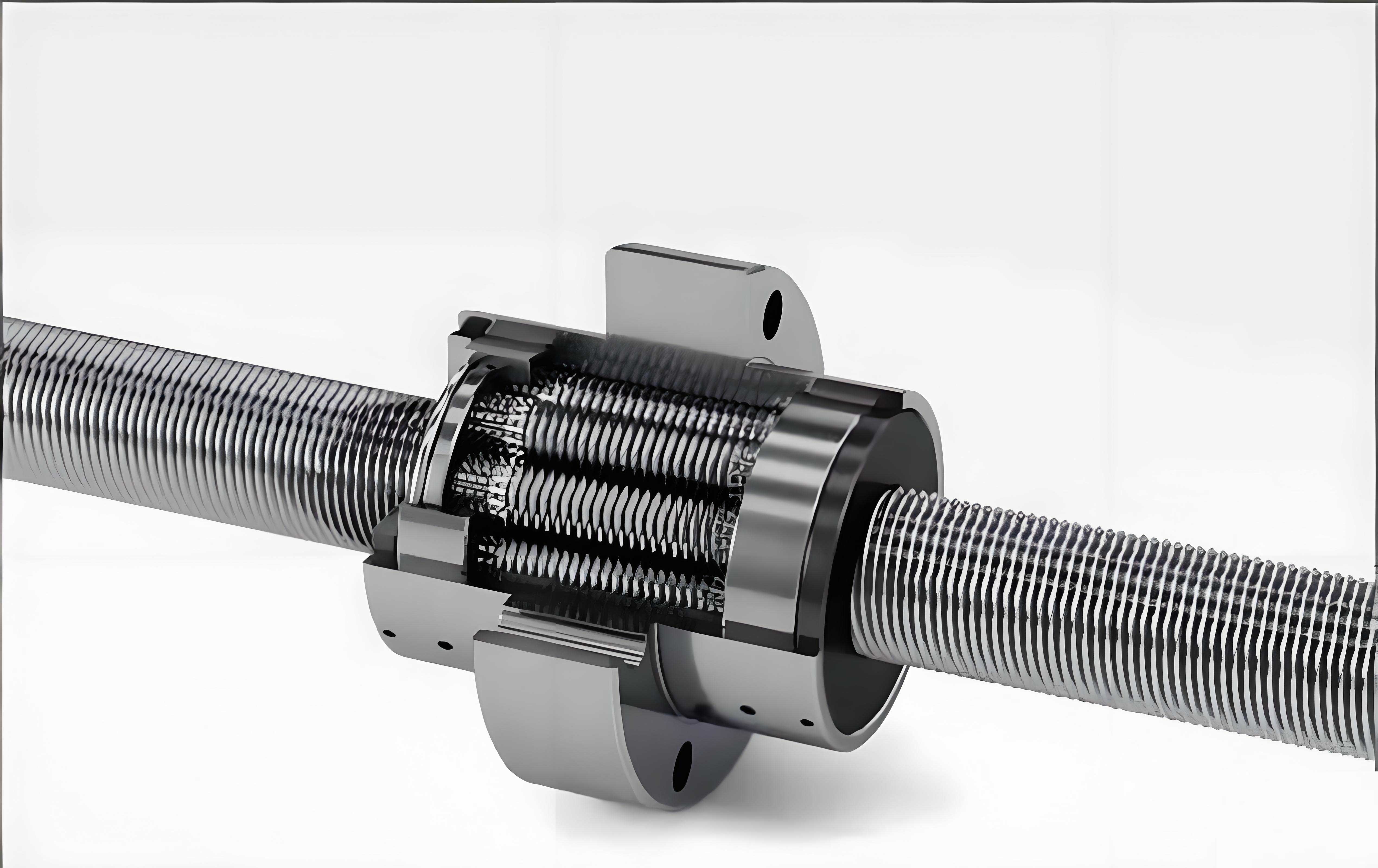
The planetary roller screw assembly consists of a screw, multiple rollers, a nut, an internal gear ring, and a retainer. Its thread profiles typically involve triangular shapes for the screw and nut, and circular arcs for the rollers. When subjected to axial loads, the assembly experiences Hertzian contact deformation, axial compression between shaft segments, and thread tooth deformation. My analysis begins with the elastic regime, where deformations are reversible, and progresses to plastic deformation under heavier loads, ultimately identifying the failure point. I leverage mathematical modeling, sensitivity analysis, and empirical validation to provide a holistic view of the planetary roller screw assembly’s behavior. The findings underscore the importance of optimizing thread load distribution and precision grades to enhance the durability of the planetary roller screw assembly in demanding environments.
Axial Stiffness Modeling in the Light-Load Elastic Stage
In the light-load elastic stage, the planetary roller screw assembly exhibits linear deformation, with all components returning to their original state upon unloading. My primary objective is to establish an axial stiffness model that accounts for uneven load distribution among thread teeth. I base this model on several assumptions: the load distribution on the screw-roller side matches that on the roller-nut side, each roller carries an equal load, and no manufacturing or assembly errors are present. These simplifications allow me to derive a comprehensive stiffness expression for the planetary roller screw assembly.
The total axial deformation \(\delta_{\text{total}}\) under an axial force \(F\) arises from three sources: Hertzian contact deformation \(\delta_{\text{Hertz}}\), axial compression of shaft segments \(\delta_{\text{comp}}\), and thread tooth flexure \(\delta_{\text{thread}}\). Using Hertzian contact theory, the deformation at each contact point is given by:
$$ \delta_{\text{Hertz}} = \frac{2K(e)}{\pi m_a} \sqrt[3]{\frac{9}{32} \left( \frac{1 – \mu_1^2}{E_1} + \frac{1 – \mu_2^2}{E_2} \right)^2 \sum \rho \cdot Q^{2/3} } $$
where \(Q\) is the normal contact force, \(K(e)\) is the elliptic integral, \(\mu_1\) and \(\mu_2\) are Poisson’s ratios, \(E_1\) and \(E_2\) are elastic moduli, and \(\sum \rho\) is the sum of curvatures. For the planetary roller screw assembly, I consider contacts between the screw and rollers, and between the rollers and nut.
Load distribution across thread teeth is non-uniform due to the sequential engagement of threads. I adopt a model where the load on each tooth decreases from the load-bearing end. For a planetary roller screw assembly with \(N\) rollers and \(Z\) engaged threads per roller, the load distribution satisfies:
$$ Q_{j-1}^{2/3} = Q_j^{2/3} + \left( \frac{1}{E_s A_s} + \frac{1}{E_n A_n} \right) \frac{P N}{K_s + K_n} \sum_{v=j}^{Z} Q_v \sin^2 \beta \cos^2 \alpha $$
$$ F = N \sum_{j=1}^{Z} Q_j \sin \beta \cos \alpha $$
Here, \(P\) is the pitch, \(E_s\) and \(E_n\) are elastic moduli of the screw and nut, \(A_s\) and \(A_n\) are effective cross-sectional areas, \(\beta\) is the contact angle, and \(\alpha\) is the helix angle. The axial deformation due to Hertzian contact for the \(i\)-th roller and \(j\)-th thread pair on the screw-roller side (\(x = s\)) or roller-nut side (\(x = n\)) is:
$$ l_{xij} = \frac{\delta_{xij}}{\sin \beta \cos \alpha} $$
The corresponding axial contact stiffness \(K_{xij}\) is derived as:
$$ K_{xij} = \frac{dF_{xij}}{dl_{xij}} = \frac{3 F_{xij}^{1/3}}{2} \cdot (\cos \alpha \sin \beta)^{5/3} \cdot K_x $$
where \(F_{xij} = Q_{xij} \sin \beta \cos \alpha\) and \(K_x\) is a contact coefficient specific to the screw-roller or roller-nut interface.
Thread tooth deformation includes five components: bending \(\delta_1\), shear \(\delta_2\), root tilt \(\delta_3\), root shear \(\delta_4\), and radial compression \(\delta_5\). For external threads (screw and rollers) and internal threads (nut), these deformations are expressed as:
$$ \delta_{1ij} = (1 – \mu^2) \frac{3F_{ij}}{4E} \left( \left(1 – \left(2 – \frac{b}{a}\right)^3 + 2 \ln\left(\frac{a}{b}\right)\right) \cot^3 \beta – 4 \left(\frac{c}{a}\right)^3 \tan \beta \right) $$
$$ \delta_{2ij} = (1 + \mu) \frac{6F_{ij}}{5E} \cdot \cot^3 \beta \cdot \ln\left(\frac{a}{b}\right) $$
$$ \delta_{3ij} = (1 – \mu^2) \frac{12c}{\pi E a^2} \cdot F_i \cdot \left( \frac{c – b}{a} \tan \beta \right) $$
$$ \delta_{4ij} = (1 – \mu^2) \frac{2F_{ij}}{\pi E} \left( \frac{P}{a} \ln\left(\frac{P + a/2}{P – a/2}\right) + \frac{1}{2} \ln\left(\frac{4P^2}{a^2} – 1\right) \right) $$
$$ \delta_{5yij} = (1 – \mu^2) \frac{\tan \beta}{2} \cdot \frac{d_0}{P} \cdot \frac{F_r}{E} \quad \text{(for external threads)} $$
$$ \delta_{5nij} = \left( \frac{D_0^2 + d_p^2}{D_0^2 – d_p^2} + \mu \right) \frac{\tan^2 \beta}{2} \cdot \frac{D_1}{P} \cdot \frac{F_{ijr}}{E} \quad \text{(for internal threads)} $$
where \(a\), \(b\), and \(c\) are thread root, pitch, and crest thicknesses, respectively; \(d_0\) and \(D_0\) are equivalent diameters; and \(F_r\) is the radial force component. The total thread tooth axial stiffness \(K_{T yij}\) for thread type \(y\) (screw, roller, or nut) is:
$$ K_{T yij} = \frac{F_{xij}}{\delta_{T yij}} \quad \text{with} \quad \delta_{T yij} = \sum_{t=1}^{4} \delta_{tij} + \delta_{5yij} $$
Axial compression of shaft segments is modeled using elementary spring theory. The stiffness of each compression unit (length equal to pitch \(P\)) for the screw, nut, and rollers is:
$$ K_{bs} = \frac{E_s A_s}{P}, \quad A_s = \frac{\pi d_{0s}^2}{4} $$
$$ K_{bn} = \frac{E_n A_n}{P}, \quad A_n = \frac{\pi (D_{0n}^2 – d_{pn}^2)}{4} $$
$$ K_{br} = \frac{2E_r A_r}{P}, \quad A_r = \frac{\pi d_{0r}^2}{4} $$
For non-contact sections of the screw, the stiffness \(K_{bsw}\) is:
$$ K_{bsw} = \frac{E_s A_s}{L} $$
where \(L\) is the theoretical length of the non-contact segment. Combining all contributions, the overall axial stiffness \(K_Z\) of the planetary roller screw assembly is:
$$ \frac{1}{K_Z} = \frac{1}{\sum_{i=1}^{N} \sum_{j=1}^{Z} \frac{K_{sij} K_{nij}}{K_{sij} + K_{nij}}} + \frac{1}{Z K_{bs}} + \frac{1}{Z K_{bn}} + \frac{1}{2 Z N K_{br}} + \frac{1}{K_{bsw}} + \frac{1}{\sum_{i=1}^{N} \sum_{j=1}^{Z} \frac{K_{T sij} K_{T nij} K_{T rij}}{(K_{T sij} + K_{T nij}) K_{T rij} + 2 K_{T sij} K_{T nij}}} $$
This model provides a foundational understanding of the elastic response of the planetary roller screw assembly, highlighting the significance of thread load distribution in stiffness calculations.
Static Load Rating and Plastic Deformation in the Heavy-Load Plastic Stage
When the planetary roller screw assembly is subjected to loads exceeding the elastic limit, plastic deformation occurs. My analysis in this stage focuses on determining the rated static load \(C_{0a}\), which represents the maximum load the assembly can withstand without permanent damage, and evaluating the associated plastic deformations. I introduce a precision coefficient \(f_a\) to account for incomplete thread contact due to machining errors, akin to methodologies used for ball screw assemblies.
In practical scenarios, Hertzian contact deformation dominates the total deformation (approximately 98%). Thus, I simplify the axial stiffness model by neglecting thread tooth and shaft compression deformations. The simplified axial stiffness \(K_{zj}\) is:
$$ K_{zj} = \frac{3}{2} F^{1/3} \left( \frac{1}{K_s + K_n} \right) (N Z M)^{2/3} (\cos \alpha \sin \beta)^{5/3} $$
where \(M\) is a load unevenness coefficient. Incorporating the precision coefficient \(f_a\) from ISO 3408-4 standards, the modified axial stiffness \(K_{zd}\) becomes:
$$ K_{zd} = f_a K_{zj} $$
The precision coefficient values depend on the accuracy grade of the planetary roller screw assembly, as shown in Table 1.
| Accuracy Grade | 1 | 2 | 3 | 4 | 5 |
|---|---|---|---|---|---|
| Precision Coefficient \(f_a\) | 0.60 | 0.58 | 0.55 | 0.53 | 0.50 |
By equating \(K_{zd}\) with the simplified stiffness, I derive the equivalent number of load-bearing threads per roller \(Z_d\):
$$ Z_d = f_a^{3/2} Z $$
Using this, the rated static load \(C_{0ad}\) for the planetary roller screw assembly is calculated as:
$$ C_{0ad} = \frac{27.74 (f_a^{3/2} Z) N \cos \alpha d_{0r}^2}{8 \cos \beta \sin \beta} \cdot (4 \sin \beta – \cos \beta) $$
This formula emphasizes the influence of design parameters and precision on the load capacity of the planetary roller screw assembly.
To optimize the planetary roller screw assembly for higher static loads, I conduct a sensitivity analysis. The rated static load is a function of five key parameters: \(C_{0ad} = F(f_a, Z, N, \beta, \alpha)\). Using initial values \(f_a = 0.5\), \(Z = 28\), \(N = 11\), \(\beta = 45^\circ\), \(\alpha = 4.67^\circ\), I vary each parameter within a specified range while holding others constant. The relative sensitivity \(r\) is defined as:
$$ r = \frac{C_{\text{max}} – C_{\text{min}}}{X_{\text{max}} – X_{\text{min}}} $$
where \(C_{\text{max}}\) and \(C_{\text{min}}\) are the maximum and minimum \(C_{0ad}\) values, and \(X_{\text{max}}\) and \(X_{\text{min}}\) are the parameter bounds. The results, summarized in Table 2, indicate that precision grade has the greatest impact, followed by the number of rollers, engaged threads, contact angle, and helix angle.
| Parameter | Parameter Range | Relative Sensitivity \(r\) |
|---|---|---|
| Precision Coefficient \(f_a\) | (0.5, 0.6) | 347,068 |
| Engaged Threads per Roller \(Z\) | (20, 30) | 3,940.8 |
| Number of Rollers \(N\) | (5, 15) | 10,031 |
| Contact Angle \(\beta\) (degrees) | (40, 50) | 655.5 |
| Helix Angle \(\alpha\) (degrees) | (4, 5) | 84 |
This analysis confirms that improving machining accuracy and increasing roller count are most effective for enhancing the static load capacity of the planetary roller screw assembly.
I further explore plastic deformation under rated static load using finite element analysis (FEA). I model a planetary roller screw assembly with specifications: 20 mm nominal diameter, 5 mm lead, 5 rollers, and accuracy grade 5. The material is GCr15 bearing steel. From the formula, the rated static load \(C_{0a}\) is computed as 100 kN. In ANSYS Workbench, I simulate the assembly under 100% \(C_{0a}\) (100 kN) and 285% \(C_{0a}\) (285 kN) axial loads. The FEA steps include geometry simplification, material assignment with elastic-plastic properties, frictionless contact settings, hexahedral meshing with refinement at contacts, boundary conditions (displacement constraints on screw/nut and fixed supports on rollers), and multi-step loading-unloading sequences.
Under 100% \(C_{0a}\), the FEA results show plastic deformations across thread pairs. On the screw-roller side, the maximum plastic deformation is 4.137 μm for the screw threads and 3.7458 μm for the roller threads. On the roller-nut side, the roller threads deform by 2.115 μm and the nut threads by 1.9545 μm. The total plastic deformation sums to 11.9523 μm. This non-uniform deformation across adjacent threads validates the assumption of uneven load distribution in the planetary roller screw assembly.
At 285% \(C_{0a}\), the FEA reveals severe plastic deformation, with thread crests exhibiting pronounced indentations. The deformation escalates from the least-loaded to the most-loaded threads, indicating progressive failure. These simulations predict that the planetary roller screw assembly approaches its bearing limit at this overload, with potential loss of transmission function.
Experimental Validation and Bearing Limit in the High-Overload Stage
To validate my theoretical and FEA findings, I conduct experimental tests on a planetary roller screw assembly using a vertical loading test bench. The setup includes a 600 kN pressure sensor, contact displacement sensors, a servo-driven loading beam, and data acquisition systems. I perform tests incrementally from light loads to overloads, recording axial force-deformation curves and permanent deformations after unloading. The procedure involves loading at 0.2 mm/min to a maximum load \(F_a\), unloading to 8 kN, measuring residual displacement \(l_i\), and repeating with increased \(F_a\) until failure signs like severe jamming or thread damage appear.
In the light-load elastic stage (up to 45 kN, 45% \(C_{0a}\)), the load-deformation curves return to origin upon unloading, confirming purely elastic behavior. I compare the experimental axial stiffness with my theoretical model for loads between 20 kN and 45 kN. The results, plotted in Figure 1, show excellent agreement, with relative errors under 6%. This validates the axial stiffness model for the planetary roller screw assembly in the elastic regime.
Beyond 50 kN (50% \(C_{0a}\)), the curves do not return to zero, indicating onset of plastic deformation. At 50% \(C_{0a}\), the single-cycle plastic deformation is 0.65 μm. As loads increase, cumulative plastic deformation grows. At 100% \(C_{0a}\) (100 kN), the single-cycle plastic deformation reaches 1.42 μm, and the total cumulative deformation is 12.77 μm. Compared to the FEA result of 11.9523 μm, the relative error is 6.84%, attributed to machining errors causing some threads to be unloaded in the actual planetary roller screw assembly.
At higher overloads, the load-deformation curves exhibit distinct transitions. At 245% \(C_{0a}\) (245 kN), a turning point appears where the slope increases sharply, indicating reduced stiffness. At 285% \(C_{0a}\) (285 kN), the slope approaches infinity, meaning deformation increases without additional load—a sign of impending failure. Post-test inspection of the screw raceway reveals no visible indentations at 100% \(C_{0a}\), but at 285% \(C_{0a}\), severe crest indentations are observed, with damage worsening from the least-loaded to most-loaded threads. The assembly becomes completely jammed, losing its transmission function. Thus, I identify the ultimate bearing limit of this planetary roller screw assembly as 285 kN (285% \(C_{0a}\)).
Table 3 summarizes key parameters of the tested planetary roller screw assembly for reference.
| Parameter | Value | Parameter | Value |
|---|---|---|---|
| Screw Pitch Diameter (mm) | 19.5 | Number of Threads per Roller \(Z\) | 28 |
| Lead \(L\) (mm) | 5 | Material | GCr15 |
| Roller Pitch Diameter (mm) | 6.5 | Accuracy Grade | 5 |
| Number of Rollers \(N\) | 5 | Rated Static Load \(C_{0a}\) (kN) | 100 |
Conclusions
My comprehensive study on the planetary roller screw assembly elucidates its deformation behavior across light-load elastic, heavy-load plastic, and high-overload stages. In the elastic stage, I develop an axial stiffness model incorporating thread load distribution, with experimental validation showing less than 6% error. This confirms the model’s accuracy for the planetary roller screw assembly under reversible deformations.
In the plastic stage, I derive a rated static load formula that includes a precision coefficient to account for machining errors. Sensitivity analysis reveals that precision grade and roller count most significantly influence the static load capacity of the planetary roller screw assembly. Finite element simulations under 100% rated static load show plastic deformations of 11.9523 μm, closely matching experimental measurements of 12.77 μm (6.84% error), underscoring the impact of uneven thread loading in the planetary roller screw assembly.
At high overloads, the planetary roller screw assembly exhibits a bearing limit at 285% of the rated static load, where load-deformation curves show infinite slope and thread crests suffer severe indentations, leading to transmission failure. My experimental tests corroborate this limit, with the assembly jamming beyond this point.
This work provides valuable insights for designing and optimizing planetary roller screw assemblies for extreme-duty applications. Future research could explore dynamic loading effects, thermal influences, and advanced materials to further enhance the performance and reliability of the planetary roller screw assembly.