
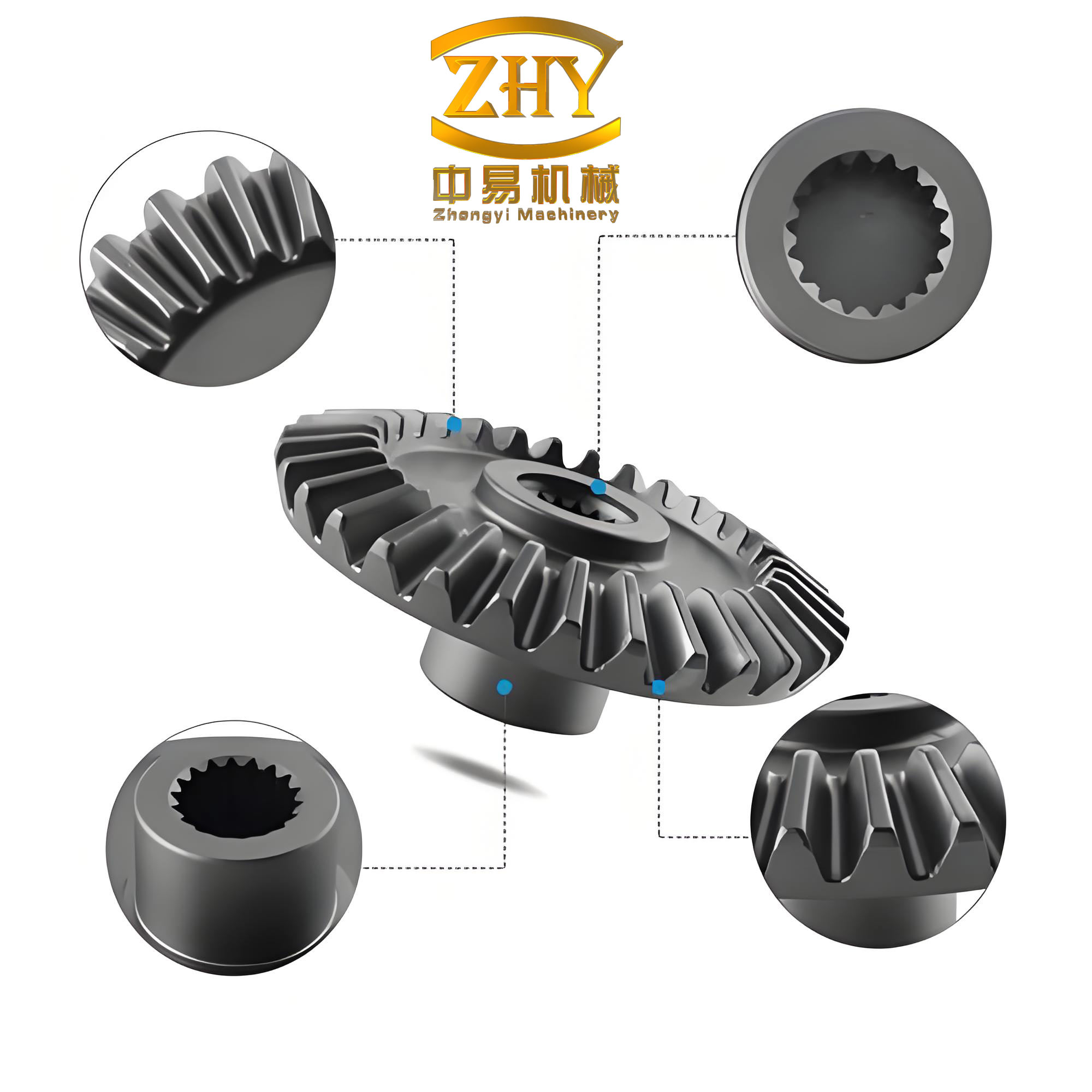
In mechanical transmission systems, the straight bevel gear plays a critical role due to its ability to transmit torque between intersecting shafts at angles ranging from 0° to 90°. Unlike cylindrical gears, the straight bevel gear offers advantages such as smoother operation, higher torque capacity, and a variable module along the tooth width. However, ensuring proper meshing between paired straight bevel gears is essential for optimal performance and longevity. Single-gear inspections, including measurements of tooth height, chordal thickness, and base tangent length, are insufficient for assessing parameters like cone distance, shaft angle, contact pattern, backlash, and tip clearance. These require paired gear inspection. Without a dedicated fixture,装配 errors may lead to uneven wear, noise, and premature failure, compounded by the difficulty of disassembling tightly fitted gears from shafts. This paper presents the design and analysis of a straight bevel gear meshing fixture, enabling pre-assembly verification of meshing conditions through adjustable parameters and systematic testing.
The fixture is designed to accommodate straight bevel gears with diameters ranging from 800 mm to 1200 mm and weights up to 5 tons per gear. Its structure includes a base, guide rails, sliders, mounting plates, pivot pins, brackets, fixed blocks, spacing sleeves, support bolts, locknuts, distance rings, cylindrical roller bearings, thrust roller bearings, mounting shafts, keys, and the straight bevel gears themselves. Adjustability is a key feature, allowing for cone angle variations from 0° to 20°, which facilitates the inspection of both straight bevel gears and straight cylindrical gears. The overall dimensions of the fixture are 2000 mm × 1020 mm × 1300 mm, providing a robust platform for precise measurements.
To operate the fixture, begin by leveling the fixed blocks. Install the straight bevel gear onto the mounting shaft, applying lubricant to the inner bore to ease assembly. The shaft diameter is modified to a clearance fit for easier installation and removal. Secure the gear with a key to prevent rotation. Pre-tighten the locknut at the shaft end to ensure bearing stability. Adjust the cone angle using support bolts, which pivot the fixed block around the pin. For a cone angle of 0°, the fixture can inspect straight cylindrical gears. Slide the bracket along the guide rails to engage the gears, lock the slider to prevent displacement, and manually rotate the gears via a hex wrench hole in the shaft end.
The meshing quality of straight bevel gears depends heavily on cone distance and cone angle. Cone distance, analogous to center distance in cylindrical gears, determines the axial position of the gears. Backlash can be adjusted by altering the cone distance: moving gears toward the small end reduces backlash, while moving toward the large end increases it. However, this adjustment is effective only when the cone angles match. The cone angle, defined as the angle between the gear axis and the pitch cone generatrix, directly influences contact pattern area and load distribution. The relationship between cone angle (δ), pitch diameter (d), and cone distance (R) can be expressed as:
$$ \tan \delta = \frac{d}{2R} $$
For a pair of straight bevel gears, the shaft angle (Σ) is the sum of the individual cone angles (δ₁ and δ₂):
$$ \Sigma = \delta_1 + \delta_2 $$
Backlash (j) is critical for preventing jamming and ensuring smooth operation. It can be calculated based on tooth thickness (s) and space width (e):
$$ j = e – s $$
In practice, backlash is measured using feeler gauges at both the large and small ends of the tooth. The following table summarizes key parameters and their effects on meshing:
| Parameter | Symbol | Typical Range | Impact on Meshing |
|---|---|---|---|
| Cone Angle | δ | 0° to 90° | Determines contact pattern and load distribution |
| Cone Distance | R | Design-dependent | Affects backlash and axial position |
| Backlash | j | 0.1 mm to 1.0 mm | Prevents binding; ensures smooth rotation |
| Contact Pattern Area | A_c | 60-80% of tooth face | Indicates meshing efficiency and wear resistance |
Meshing analysis reveals four primary states for straight bevel gears. First, the ideal meshing state features zero backlash on both driving and non-driving sides, with pitch cones coinciding. However, this is impractical due to manufacturing tolerances and risk of seizure. The contact pattern in this state covers the entire tooth face, maximizing load capacity. The theoretical contact ratio (ε) for straight bevel gears can be approximated as:
$$ \epsilon = \frac{L}{p} $$
where L is the length of action and p is the circular pitch. Second, the parallel meshing state exhibits equal backlash at both ends of the tooth, with zero backlash on the meshing side. This is achievable by adjusting cone distance via spacing sleeves. Backlash adjustment follows the formula:
$$ \Delta j = k \cdot \Delta R $$
where k is a proportionality constant dependent on gear geometry. Third, if the cone angle is too large, backlash at the small end is less than at the large end, leading to partial contact and accelerated wear. The wear rate (W) can be modeled as:
$$ W = C \cdot P \cdot v $$
where C is a material constant, P is contact pressure, and v is sliding velocity. Fourth, a small cone angle results in greater backlash at the small end, similarly causing uneven contact. In both skewed cases, gears may require scrapping or reworking. The contact pattern area A_c can be estimated using the formula:
$$ A_c = A_0 \cdot \cos(\delta – \delta_0) $$
where A_0 is the ideal area and δ_0 is the design cone angle.
The fixture enables quantitative analysis of these states. For instance, backlash measurements at multiple points along the tooth width can be tabulated to assess cone angle errors. The following table illustrates typical measurements for a straight bevel gear pair with a design backlash of 0.5 mm:
| Measurement Point | Backlash at Large End (mm) | Backlash at Small End (mm) | Inferred Cone Angle Error |
|---|---|---|---|
| Tooth 1 | 0.6 | 0.4 | Large cone angle |
| Tooth 2 | 0.5 | 0.5 | Parallel meshing |
| Tooth 3 | 0.4 | 0.6 | Small cone angle |
Additionally, the fixture facilitates contact pattern analysis using Prussian blue or similar methods. The contact ratio and efficiency are critical for high-torque applications, such as in dual-screw extruders. The torque capacity T of a straight bevel gear can be expressed as:
$$ T = \frac{F_t \cdot d}{2} $$
where F_t is the tangential force and d is the pitch diameter. Proper meshing ensures that F_t is evenly distributed, minimizing stress concentrations. The bending stress σ_b at the tooth root can be calculated using the Lewis formula:
$$ \sigma_b = \frac{F_t}{b \cdot m \cdot Y} $$
where b is face width, m is module, and Y is the Lewis form factor. For straight bevel gears, Y varies along the tooth, requiring integration over the face width.
In summary, the straight bevel gear meshing fixture provides a practical solution for pre-assembly inspection, addressing limitations of single-gear testing. By enabling adjustments in cone distance and cone angle, it ensures optimal meshing conditions, reduces assembly errors, and enhances the reliability of mechanical systems. The straight bevel gear’s performance hinges on precise geometric parameters, and this fixture serves as a vital tool in achieving that precision. Future work could involve automating measurements with sensors and integrating digital twin simulations for real-time analysis.