
In this paper, we address the critical challenge of wear in straight bevel gear transmissions, which are widely used in automotive, aerospace, and industrial applications due to their simplicity and cost-effectiveness. Wear accumulation over time leads to changes in tooth profile, increased dynamic loads, and potential failure, making anti-wear design essential for improving reliability and performance. We propose a comprehensive methodology that integrates ease-off flank modification with loaded tooth contact analysis (LTCA) and wear modeling to minimize surface wear in straight bevel gears. Our approach focuses on designing an optimal ease-off topology that reduces the amplitude of loaded transmission error (ALTE) and maximizes the number of wear cycles before a predefined wear depth threshold is reached. By combining geometric analysis with mechanical simulations, we account for the coupling effects of alignment errors, tooth modifications, and wear progression. This work provides a robust framework for the anti-wear design of straight bevel gears, enabling enhanced durability and operational stability.
The foundation of our methodology lies in the geometric generation of straight bevel gears using a cradle-type machine with plate cutters. The gear tooth surfaces are derived based on the theory of gearing, where the gear pair is generated through the simulation of a hypothetical crown gear. The coordinate systems involved in the machining process include the cutter frame, cradle frame, and workpiece frame, as illustrated in the following representation of the gear generation setup. The straight bevel gear tooth surface is represented mathematically by solving the equation of meshing, which ensures proper conjugation between the pinion and gear. For the modified pinion, we define an ease-off surface as the normal deviation from the fully conjugate tooth surface, expressed as a function of predefined transmission error and parabolic profile modifications. This allows us to control the initial contact pattern and load distribution, which are crucial for wear reduction.
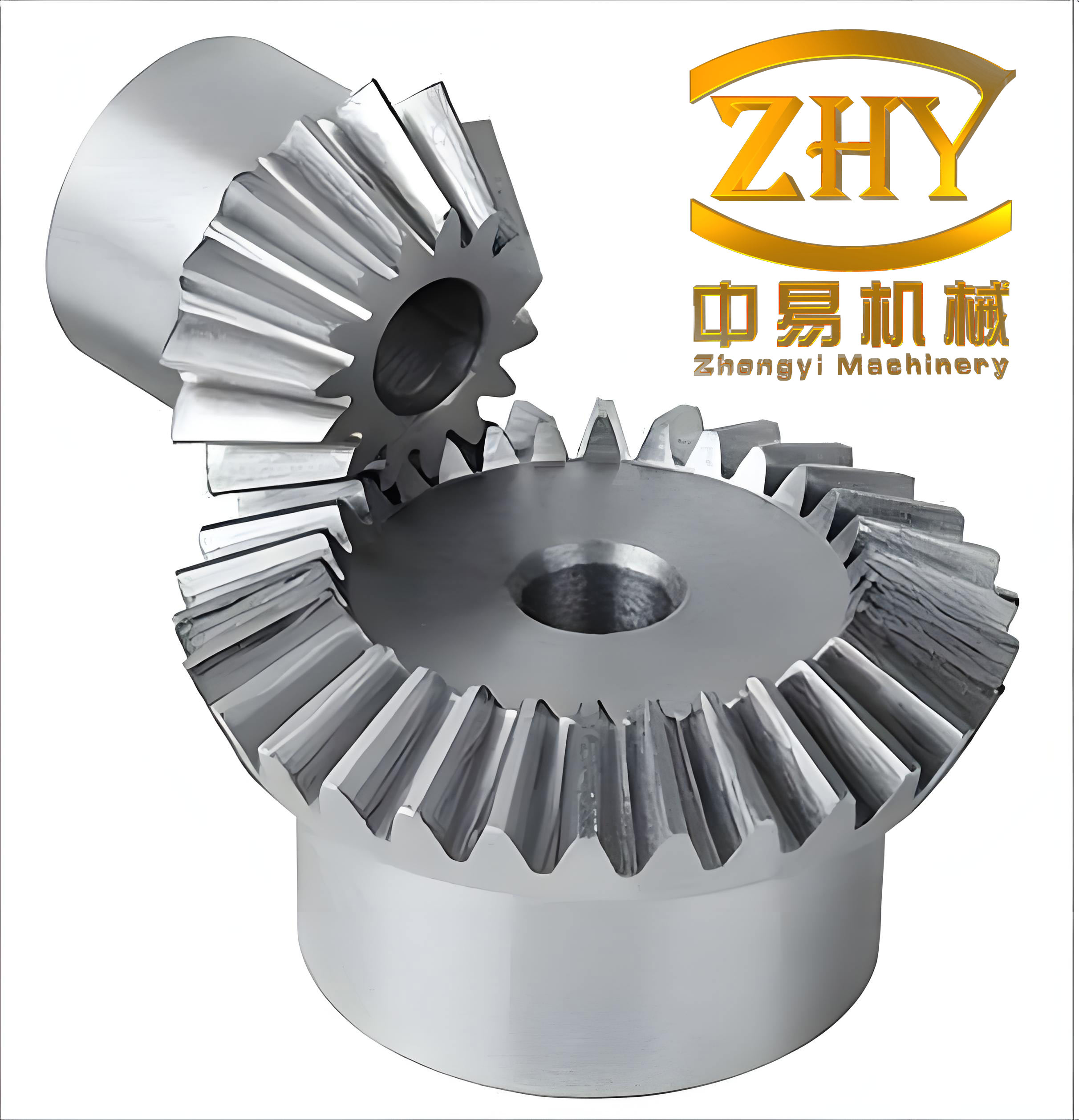
The ease-off modification for the straight bevel gear pinion is formulated as a vector sum of the conjugate gear tooth surface and normal ease-off deviations. The ease-off surface, denoted as δ_p(u, β), is given by:
$$ \delta_p(u, \beta) = (\mathbf{R}_{1\gamma}(u, \beta) – \mathbf{R}_{10}(u, \beta)) \cdot \mathbf{N}_{10}(u, \beta) $$
where \(\mathbf{R}_{1\gamma}\) represents the position vector of the ease-off pinion surface, \(\mathbf{R}_{10}\) is the position vector of the conjugate pinion surface, and \(\mathbf{N}_{10}\) is the unit normal vector. The ease-off surface is parameterized by u and β, which correspond to the tooth surface parameters. This modification introduces controlled deviations in both the profile and lead directions, enabling a optimized contact pattern that mitigates edge loading and reduces wear initiation. The transmission error function is designed as a fourth-order polynomial to ensure smooth meshing, while the ease-off curve along the contact line is parabolic, allowing for gradual load transition. This geometric design is pivotal for enhancing the wear resistance of straight bevel gears.
To model wear in straight bevel gears, we employ the Archard wear formula, which relates wear volume to sliding distance and contact pressure. The wear depth h at a contact point is computed as:
$$ h = a_0 p_H s $$
where \(a_0\) is the wear coefficient, \(p_H\) is the Hertzian contact pressure, and s is the sliding distance. The Hertzian pressure is derived from the contact load density w, composite elastic modulus E’, and composite curvature radius R:
$$ p_H = \sqrt{\frac{w E’}{2 \pi R}} $$
The sliding distance s is calculated based on the relative sliding velocity \(v_s\) between the pinion and gear teeth over a small time increment Δt:
$$ s = |v_s| \Delta t $$
The relative sliding velocity \(v_s\) is determined from the absolute velocities of the pinion and gear at the contact point, considering the gear kinematics and transmission error. For numerical implementation, we discretize the tooth surface into a grid of points and compute wear incrementally over multiple meshing cycles. The wear coefficient \(a_0\) is set to \(1 \times 10^{-18} \, \text{N/m}^2\) based on experimental data for carburized gears, ensuring realistic wear predictions. Our wear-loaded tooth contact analysis (WLTCA) integrates tooth contact analysis (TCA) and LTCA to update the tooth profile after each wear cycle, accounting for the dynamic changes in contact pressure and sliding conditions. This iterative process continues until the maximum wear depth reaches a threshold, typically set to 2 μm, at which point the tooth profile is reconstituted, and the analysis restarts. This method allows us to accurately simulate long-term wear behavior in straight bevel gears under various operating conditions.
The optimization of the ease-off modification aims to minimize the amplitude of loaded transmission error (ALTE) and maximize the number of wear cycles. The objective function G(y) is defined as:
$$ G(\mathbf{y}) = \min \left\{ c_1 \frac{t_e}{t_{e0}} + c_2 \frac{\eta_a}{\eta_{a0}} \right\} $$
where \(\mathbf{y}\) represents the design variables, including parameters for tooth spacing and contact line modifications, \(t_e\) and \(\eta_a\) are the ALTE and wear cycles for the modified tooth surface, and \(t_{e0}\) and \(\eta_{a0}\) are the reference values for the conjugate tooth surface. The weights \(c_1\) and \(c_2\) are set to 0.4 and 0.6, respectively, to balance the importance of ALTE reduction and wear resistance. We use a particle swarm optimization (PSO) algorithm to solve this nonlinear optimization problem, as it efficiently handles multiple local minima and implicit relationships between design variables and objectives. The optimization process involves numerous TCA and LTCA simulations to evaluate each candidate design, ensuring that the optimal ease-off surface provides the best compromise between dynamic performance and wear life for straight bevel gears.
To illustrate the geometric and operational parameters, we present a table summarizing the key dimensions of the straight bevel gear pair used in our case study. This table includes parameters such as module, pressure angle, number of teeth, and face width, which are essential for understanding the gear design and subsequent analysis.
| Parameter | Pinion | Gear |
|---|---|---|
| Module at Large End (mm) | 5.08 | 5.08 |
| Pressure Angle (°) | 20 | 20 |
| Face Width (mm) | 38.1 | 38.1 |
| Outer Cone Distance (mm) | 130.93 | 130.93 |
| Number of Teeth | 16 | 49 |
| Addendum (mm) | 7.16 | 3.00 |
| Dedendum (mm) | 3.95 | 8.12 |
| Pitch Cone Angle (°) | 18.083 | 71.916 |
The machining parameters for generating the straight bevel gear teeth are also critical for achieving the desired tooth geometry. The following table outlines the key settings used in the cradle-type machine with plate cutters, including tool positions and angles.
| Parameter | Pinion | Gear |
|---|---|---|
| Tool Radial Setting C_x (mm) | 108.056 | 108.056 |
| Tool Vertical Setting C_y (mm) | 175.433 | 175.433 |
| Tool Axial Setting C_z (mm) | 72.316 | 72.316 |
| Tool Tilt Angle φ_a (°) | 22 | 22 |
| Tool Swivel Angle φ_b (°) | -0.689 | -0.689 |
| Machine Center to Back (mm) | 0 | 0 |
| Workpiece Installation Angle (°) | 16.356 | 68.366 |
| Ratio of Roll | 3.2216 | 1.0520 |
Our results demonstrate that the optimal ease-off modification significantly improves the wear resistance of straight bevel gears. For instance, under a nominal torque of 1 kN·m and a pinion speed of 2000 rpm, the optimized ease-off surface increases the number of wear cycles by up to 40% compared to the conjugate tooth surface, while reducing the ALTE by approximately 25%. The wear distribution across the tooth surface is more uniform, with minimized localized wear at the tooth tips and roots. The following equation summarizes the wear depth calculation for a discrete contact point i over a time step Δt:
$$ h_i = a_0 p_{H,i} |v_{s,i}| \Delta t $$
where Δt is determined from the gear rotational speed and the number of discrete points per meshing cycle. The cumulative wear after k profile updates is obtained by summing the wear depths over all cycles, and the tooth profile is reconstituted when the maximum wear depth exceeds 2 μm. This process captures the progressive nature of wear in straight bevel gears and its impact on meshing performance.
The effect of load on wear cycles is pronounced; as the load increases, the number of cycles to reach the same wear depth decreases and eventually plateaus. For example, at a wear depth of 2 μm, the wear cycles drop from over 10^6 cycles at light loads to around 10^5 cycles at heavy loads, indicating that high loads accelerate wear but the relationship becomes less sensitive at extreme conditions. This trend is consistent across different modification designs, but the optimal ease-off surface maintains higher wear cycles across the load spectrum. Additionally, the ALTE varies with wear progression; initially, the ALTE decreases slightly due to mild wear acting as a run-in process, but it increases after multiple wear cycles as the tooth profile deviates further from the ideal geometry. The table below quantifies the wear cycles and ALTE for different ease-off designs under multiple load conditions, highlighting the superiority of the optimized modification.
| Load Condition (kN·m) | Conjugate Surface Wear Cycles | Optimal Ease-Off Wear Cycles | Conjugate ALTE (arc-sec) | Optimal Ease-Off ALTE (arc-sec) |
|---|---|---|---|---|
| 0.5 | 1,200,000 | 1,800,000 | 15.2 | 11.5 |
| 1.0 | 600,000 | 850,000 | 18.7 | 14.3 |
| 1.5 | 400,000 | 550,000 | 22.4 | 17.8 |
| 2.0 | 300,000 | 420,000 | 26.1 | 21.2 |
The loaded tooth contact analysis reveals that the ease-off modification alters the load distribution along the contact lines. In the double-tooth contact region, the initial clearance increases with wear cycles, leading to higher mesh deformations and altered load sharing between tooth pairs. The load distribution factor λ for the optimal ease-off design shows a reduction in load at the mesh-in region and an increase at the mesh-out region, which helps in distributing wear more evenly. The contact pressure p_H and sliding velocity v_s are computed for each discretized point on the tooth surface, and their product determines the wear rate. The following equation expresses the contact pressure in terms of the applied load and geometric parameters:
$$ p_H = \sqrt{ \frac{w E’}{2 \pi R} } $$
where w is the load per unit length, E’ is the equivalent Young’s modulus, and R is the effective radius of curvature at the contact point. For straight bevel gears, the contact primarily occurs along the tooth length direction, and the ease-off modification ensures that the pressure distribution is optimized to avoid stress concentrations. Under misalignment conditions, such as axial offsets of 0.01 mm and shaft angle errors of 0.3°, the optimal ease-off design maintains a stable contact pattern, whereas the conjugate tooth surface exhibits edge loading and higher wear rates.
Furthermore, we analyze the impact of wear on the dynamic performance of straight bevel gears. As wear accumulates, the mesh stiffness decreases due to increased clearances, leading to larger vibrations and noise. The transmission error function, which is a key excitations source, becomes more irregular with wear, exacerbating dynamic loads. However, the optimal ease-off modification mitigates this effect by maintaining a smoother transmission error curve even after multiple wear cycles. The ALTE as a function of wear cycles can be modeled as:
$$ \text{ALTE}(k) = \text{ALTE}_0 + \alpha k $$
where \(\text{ALTE}_0\) is the initial ALTE, k is the number of wear cycles, and α is a coefficient that depends on the load and modification design. For the optimal ease-off surface, α is smaller, indicating slower degradation in performance. This underscores the importance of anti-wear design in extending the service life of straight bevel gears.
In conclusion, our integrated approach to ease-off modification and wear analysis provides a effective solution for enhancing the durability and performance of straight bevel gears. The proposed methodology combines advanced geometric design with mechanical simulations to optimize tooth surfaces for minimal wear and reduced vibration. The results confirm that the optimal ease-off topology significantly increases wear cycles and lowers ALTE, making it a valuable tool for engineers designing high-reliability gear transmissions. Future work could explore the effects of lubricant films and surface treatments on wear behavior, further advancing the anti-wear capabilities of straight bevel gears.