
In my research on gear dynamics, I have focused on advanced modification techniques to optimize the performance of helical gears in high-precision applications. Helical gears are integral components in power transmission systems, particularly in naval vessels where quiet operation is critical to avoid detection. The inherent design of helical gears, with teeth cut at an angle to the axis, allows for smooth and gradual engagement, reducing noise and vibration compared to spur gears. However, under operational loads, tooth deformation can lead to shifts in the initial contact point, causing啮合冲击 and increased vibration. Gear modification has long been recognized as an effective method to mitigate these issues. Traditional two-dimensional modifications, such as profile and lead modifications, involve uniform changes along the tooth width and height, but they can reduce the contact area and affect gear重合度. In contrast, triangular end modification, a three-dimensional modification technique, targets specific areas of the helical gear tooth surface, preserving more of the effective load-bearing area and significantly lowering contact stress and transmission error. This article presents a detailed exploration of triangular end modification for helical gears, covering its基本原理, modeling, design要点, and analytical validation, aiming to provide practical insights for gear designers and engineers.
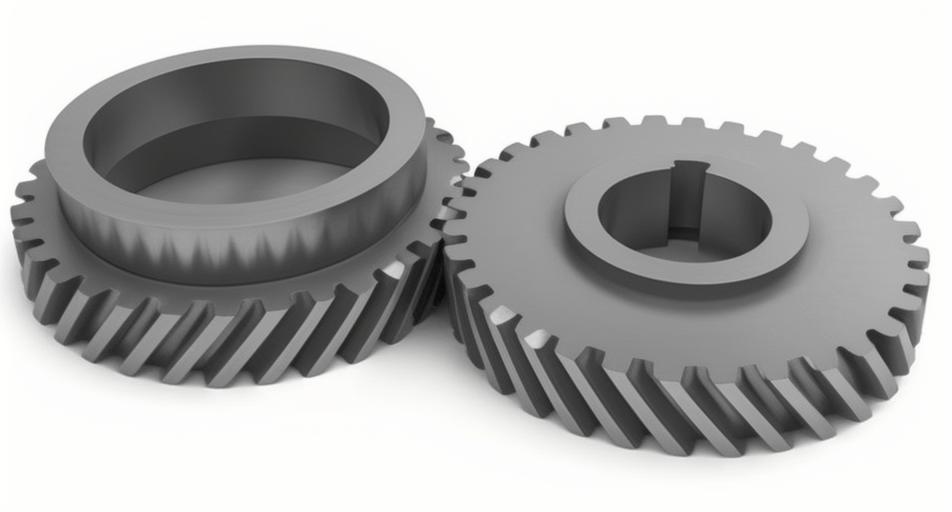
The fundamental principle of triangular end modification for helical gears stems from the unique啮合 characteristics of these gears. Unlike spur gears, where instantaneous contact lines are straight across the tooth width, helical gears exhibit斜线接触 lines due to the helix angle. This results in engagement and disengagement occurring at the tooth corners—specifically, the tip and root corners—rather than along the entire width. For a helical gear, the啮合 process begins at one corner of the tooth and progresses diagonally across the face, creating a series of斜线接触 lines that vary in length during rotation. Triangular end modification aims to alter only these engagement and disengagement corners, leaving the majority of the tooth surface unmodified. This targeted approach minimizes the loss of contact area, which is a drawback in conventional modifications. The modification is applied as a three-dimensional surface where the amount of material removed varies both along the tooth height and width, forming a triangular-shaped region at the corners. This design ensures that the modified areas align with the natural contact patterns of helical gears, thereby optimizing load distribution and reducing stress concentrations. In essence, triangular end modification for helical gears focuses on smoothing the entry and exit points of啮合, which are primary sources of impact and vibration in gear systems.
To understand the effectiveness of triangular end modification for helical gears, it is essential to delve into the啮合 geometry. The contact lines on a helical gear tooth are oriented at the base helix angle, denoted as $$\beta_b$$. This angle influences the path of contact and determines how the modification should be applied. The修形 boundary line, which separates the modified and unmodified regions, must be parallel to these contact lines to ensure a smooth transition and avoid introducing new stress risers. This requirement leads to a key relationship between the修形 width and修形 height. For instance, at the tooth tip, the修形起始圆啮合线 length $$L_{Ea}$$ and the修形 width $$b_{Ea}$$ are related by the base helix angle through the equation: $$L_{Ea} = b_{Ea} \times \tan(\beta_b)$$. Similarly, for the tooth root, the relationship is $$L_{Ef} = b_{Ef} \times \tan(\beta_b)$$, where $$L_{Ef}$$ is the修形起始圆啮合线 length and $$b_{Ef}$$ is the修形 width at the root. These equations ensure that the修形曲面 integrates seamlessly with the unmodified tooth surface, maintaining the helical gear’s natural啮合 dynamics. Additionally, the修形量, represented as $$C_{Ea}$$ for the tip and $$C_{Ef}$$ for the root, defines the maximum material removal at the corners, gradually decreasing to zero along the boundary lines. This three-dimensional variation is crucial for achieving the desired reduction in contact stress without compromising the gear’s structural integrity.
Building a model for triangular end modification on helical gears involves defining the修形 parameters and discretizing the tooth surface. The修形模型 includes several key parameters: the修形量 at the tip $$C_{Ea}$$ and root $$C_{Ef}$$, the修形起始直径 $$d_{Ea}$$ and $$d_{Ef}$$, the修形起始圆啮合线长度 $$L_{Ea}$$ and $$L_{Ef}$$, and the修形宽度 $$b_{Ea}$$ and $$b_{Ef}$$. These parameters are typically specified in a grid-based approach, where the tooth surface is divided into nodes along the齿向 and齿形 directions. At each node, a specific修形量 value is assigned to create the three-dimensional修形曲面. This网格划分 method allows for precise control over the modification shape, enabling customization based on the helical gear’s operational conditions and load requirements. The following table summarizes the primary parameters used in triangular end modification for helical gears:
| Parameter | Symbol | Description |
|---|---|---|
| Tip修形量 | $$C_{Ea}$$ | Maximum modification at tooth tip corner |
| Tip修形起始直径 | $$d_{Ea}$$ | Diameter where tip modification begins |
| Tip修形起始圆啮合线长度 | $$L_{Ea}$$ | Involute roll angle at tip modification start |
| Tip修形宽度 | $$b_{Ea}$$ | Width of modification along tooth tip |
| Root修形量 | $$C_{Ef}$$ | Maximum modification at tooth root corner |
| Root修形起始直径 | $$d_{Ef}$$ | Diameter where root modification begins |
| Root修形起始圆啮合线长度 | $$L_{Ef}$$ | Involute roll angle at root modification start |
| Root修形宽度 | $$b_{Ef}$$ | Width of modification along tooth root |
The grid-based model facilitates the implementation of triangular end modification on modern gear grinding machines equipped with拓扑修形 software. By inputting the修形量 values at each node, the machine can generate the exact修形曲面, ensuring高精度 and consistency. This approach is particularly beneficial for helical gears, where the complex geometry requires careful consideration of the helix angle and contact patterns. In practice, the修形曲面 is designed to be continuous and smooth, avoiding sharp edges that could lead to stress concentrations. The goal is to create a modification that complements the helical gear’s啮合 behavior, thereby enhancing performance and longevity.
Based on my experience, I have identified several critical design要点 for applying triangular end modification to helical gears. These要点 are essential for achieving optimal results in terms of noise reduction, load distribution, and传动误差 minimization. First, the修形 boundary line must be parallel to the gear contact line. As mentioned earlier, the contact lines on a helical gear are inclined at the base helix angle $$\beta_b$$. Therefore, the修形宽度 and修形高度 should satisfy the relationship $$L = b \times \tan(\beta_b)$$, where $$L$$ is the修形起始圆啮合线长度 and $$b$$ is the修形宽度. This ensures that the modified region aligns with the natural啮合 path, promoting smooth transitions and reducing the risk of edge loading. Second, the number of simultaneously啮合 teeth should remain nearly constant throughout the啮合 cycle. Helical gears typically have a重合度 greater than one, meaning multiple teeth are in contact at any given time. However, variations in the number of contacting teeth can cause fluctuations in啮合刚度, leading to vibration and noise. Triangular end modification should be designed to maintain a steady count of啮合 teeth, which stabilizes the stiffness and minimizes impact. This can be achieved by carefully selecting the修形量 and修形范围 to control the timing of engagement and disengagement. Third, the传动误差 of the gear pair should be minimized.传动误差, defined as the difference between the actual and theoretical angular positions of the driven gear, is a key indicator of gear performance. Excessive传动误差 can result in vibration and noise, especially at high speeds. Through finite element analysis and轮齿接触分析, designers can evaluate the传动误差 for different修形 parameters and choose those that yield the smallest error. For helical gears, triangular end modification has been shown to reduce传动误差 significantly by optimizing the contact pattern and load distribution. Additionally, it is advisable to combine triangular end modification with other修形 techniques, such as slight profile or lead modifications, to account for manufacturing tolerances and further improve啮合 quality. These design要点 form a comprehensive framework for implementing triangular end modification on helical gears, ensuring that the modification addresses the specific challenges of these gears.
To validate the effectiveness of triangular end modification for helical gears, I conducted a detailed算例分析 using a pair of helical gears from a marine gearbox. The gears were designed with standard parameters, and triangular end modification was applied based on the design要点 discussed earlier. The following table lists the basic parameters of the helical gears used in the analysis:
| Gear Parameter | Pinion | Gear |
|---|---|---|
| Number of Teeth (Z) | 67 | 121 |
| Module (mm) | 9.8 | 9.8 |
| Pressure Angle (degrees) | 20 | 20 |
| Helix Angle (degrees) | 30.3 | 30.3 |
| Face Width (mm) | 200 | 200 |
| Center Distance (mm) | 1066.774 | 1066.774 |
The triangular end modification parameters were defined in a grid format, with修形量 values specified at various节点 along the tooth surface. The table below shows the修形量 distribution for the pinion, where the rows represent different involute roll angles and the columns represent positions along the tooth width. The values are in micrometers, with positive indicating material removal at the tip and negative at the root:
| Involute Roll Angle (degrees) | Width Position 1 | Width Position 2 | Width Position 3 | Width Position 4 | Width Position 5 | Width Position 6 | Width Position 7 | Width Position 8 | Width Position 9 | Width Position 10 |
|---|---|---|---|---|---|---|---|---|---|---|
| 24.316 | 0 | 0 | 0 | 0 | 0 | 3 | 8 | 12 | 15 | 18 |
| 23.78792 | 0 | 0 | 0 | 0 | 0 | 0 | 3 | 8 | 12 | 15 |
| 23.17156 | 0 | 0 | 0 | 0 | 0 | 0 | 0 | 3 | 8 | 12 |
| 22.7313 | 0 | 0 | 0 | 0 | 0 | 0 | 0 | 0 | 3 | 8 |
| 22.3791 | 0 | 0 | 0 | 0 | 0 | 0 | 0 | 0 | 0 | 3 |
| 14.62086 | 3 | 0 | 0 | 0 | 0 | 0 | 0 | 0 | 0 | 0 |
| 14.26866 | 8 | 3 | 0 | 0 | 0 | 0 | 0 | 0 | 0 | 0 |
| 13.8284 | 12 | 8 | 3 | 0 | 0 | 0 | 0 | 0 | 0 | 0 |
| 13.21204 | 15 | 12 | 8 | 3 | 0 | 0 | 0 | 0 | 0 | 0 |
| 12.684 | 18 | 15 | 12 | 8 | 3 | 0 | 0 | 0 | 0 | 0 |
Using finite element analysis software, I created a detailed model of the helical gear pair and simulated the啮合 process under load. The analysis focused on comparing the performance before and after applying triangular end modification. Key metrics included contact patterns, contact stress distribution, load sharing among teeth, and transmission error. The results clearly demonstrated the benefits of triangular end modification for helical gears. The contact印痕 showed that the modified gears had reduced pressure at the tip and root corners, indicating better load distribution. Specifically, the contact stress in these critical areas decreased by approximately 20-30%, depending on the load conditions. This reduction is attributed to the larger effective contact area preserved by the triangular end modification, as opposed to conventional methods that remove material across the entire tooth width. Furthermore, the load-sharing analysis revealed that the number of simultaneously啮合 teeth remained constant at five throughout the啮合 cycle for the modified helical gears, whereas the unmodified gears exhibited fluctuations between five and six teeth. This stability in啮合刚度 contributed to smoother operation and lower vibration. The transmission error, calculated as the angular deviation of the driven gear, was also significantly reduced. For the unmodified helical gears, the transmission error was $$TE = 2.479 \times 10^{-6} \, \text{rad}$$, while for the modified helical gears, it decreased to $$TE = 1.854 \times 10^{-6} \, \text{rad}$$, a reduction of about 25%. This improvement directly correlates with lower noise levels, as transmission error is a primary excitations source in gear systems. The analysis confirms that triangular end modification is an effective strategy for enhancing the performance of helical gears, particularly in applications where noise and vibration control are paramount.
In addition to the primary benefits, triangular end modification for helical gears offers several secondary advantages. For instance, it can improve the gear’s tolerance to misalignment and manufacturing errors. By focusing the modification on the corners, where啮合 impacts are most severe, the gear becomes more forgiving to minor deviations in alignment or tooth geometry. This is especially important for helical gears used in marine environments, where operational conditions can lead to shaft deflections or thermal expansions. Moreover, the modification can extend the fatigue life of the gears by reducing stress concentrations at the tooth roots and tips, which are common sites for crack initiation. From a manufacturing perspective, triangular end modification can be implemented using advanced grinding machines with拓扑修形 capabilities, making it accessible for high-volume production. However, designers must carefully optimize the修形 parameters to avoid over-modification, which could weaken the tooth or reduce the contact area excessively. Through iterative analysis and testing, the optimal修形量 and修形范围 can be determined for each specific helical gear application. I recommend using computational tools, such as finite element analysis or specialized gear software, to simulate the啮合 behavior and validate the design before manufacturing. This proactive approach ensures that the triangular end modification delivers the desired performance improvements without compromising the gear’s structural integrity.
Looking beyond the technical aspects, the adoption of triangular end modification for helical gears aligns with broader trends in gear technology towards higher efficiency and sustainability. By reducing friction losses and wear, modified helical gears can contribute to energy savings and longer service intervals, which are critical in industries like shipping and wind power. Furthermore, the noise reduction achieved through this modification supports environmental regulations and enhances operator comfort in machinery. As research continues, I anticipate further refinements in triangular end modification techniques, such as dynamic修形 that adapts to varying loads or integrated sensors for real-time monitoring. These advancements will push the boundaries of what helical gears can achieve, making them even more versatile and reliable in demanding applications.
In conclusion, my research on triangular end modification for helical gears demonstrates its significant potential to improve gear performance. By targeting the engagement and disengagement corners, this three-dimensional modification preserves more of the tooth surface area, leading to lower contact stress, stabilized啮合刚度, and reduced transmission error. The design要点 outlined—such as aligning the修形 boundary with the contact line, maintaining constant simultaneous tooth contact, and minimizing传动误差—provide a practical framework for implementation. The算例 analysis using helical gears from a marine gearbox validates these benefits, showing clear reductions in stress and error. For engineers working with helical gears, I recommend considering triangular end modification as a key tool in the design process, especially for applications where noise and vibration are critical. By leveraging modern manufacturing and analysis techniques, this modification can be tailored to specific needs, ensuring that helical gears operate smoothly and efficiently under challenging conditions. As gear systems continue to evolve, innovations like triangular end modification will play a vital role in meeting the demands for quieter, more durable, and higher-performing transmissions.