
In the manufacturing of straight bevel gears, achieving high-quality finishes requires precise rough milling operations prior to finishing processes such as gear shaping. The design of the rough milling cutter’s tooth profile is critical to ensure uniform and minimal machining allowances, which directly impacts the efficiency and accuracy of gear production. Over years of experimentation and practice, I have developed a robust design method that combines calculation with graphical techniques. This approach is based on the principles of form milling cutters, where the tooth profile is approximated by circular arcs. Given that the tooth profile of a straight bevel gear varies from the large end to the small end, the designed profile must satisfy both extremes. For rough milling cutters, using circular arcs to substitute for the ideal involute profile is entirely feasible if the arc radius and center coordinates are appropriately selected. This method proves particularly effective when the apexes of the tip cone, pitch cone, and root cone of the straight bevel gear do not coincide, a common scenario in industrial applications.
The design process hinges on understanding the geometric relationships in straight bevel gears. Key parameters include the transverse module at the pitch circle, pressure angle, number of teeth, addendum, total tooth height, and finishing allowance. By deriving precise formulas, I can compute the coordinates of points on the tooth profile at both the large and small ends. These points are then used to construct circular arcs that approximate the involute shape. The use of circular arcs simplifies manufacturing while maintaining sufficient accuracy for rough milling. To illustrate, consider the fundamental geometry of a straight bevel gear: the pitch cone angle $\delta$, tip cone angle $\delta_e$, and root cone angle $\delta_i$ define the gear’s taper. When these cones do not intersect at a single point, additional calculations are necessary to account for the varying dimensions along the face width.
The design method involves several steps: parameter acquisition, formula derivation, coordinate calculation, and graphical construction. I start by gathering the gear’s original parameters, which are often provided in technical drawings. For a straight bevel gear, the transverse module $M_s$ at the pitch diameter is crucial, along with the pressure angle $\alpha_g$, number of teeth $Z$, addendum $h$, total tooth height $H$, and finishing allowance $\Delta_s$. Other dimensions, such as the pitch cone distance $L$, pitch diameter $d_g$, and theoretical outer diameter $d_e$, are also essential. The following table summarizes the primary parameters used in the design:
| Parameter | Symbol | Description |
|---|---|---|
| Transverse Module | $M_s$ | Module at the pitch circle on the transverse plane. |
| Pressure Angle | $\alpha_g$ | Angle between the line of action and the pitch line. |
| Number of Teeth | $Z$ | Total teeth on the straight bevel gear. |
| Addendum | $h$ | Height from the pitch circle to the tip of the tooth. |
| Total Tooth Height | $H$ | Full height of the tooth, including addendum and dedendum. |
| Finishing Allowance | $\Delta_s$ | Material left for subsequent finishing operations. |
| Pitch Cone Distance | $L$ | Distance from the apex to the pitch circle along the cone. |
| Pitch Diameter | $d_g$ | Diameter at the pitch circle: $d_g = M_s Z$. |
From these parameters, I derive formulas to compute the profile coordinates. The design is based on the involute gear theory, adapted for the conical geometry of straight bevel gears. For the large end, the back cone distance $L_1$ is calculated as $L_1 = L \tan \delta$. The base circle radius $R_{01}$ at the large end is then $R_{01} = L_1 \cos \alpha_g$. Similarly, for the small end, the back cone distance $L_2$ is $L_2 = L_0 \tan \delta$, where $L_0$ is the distance from the apex to the small end pitch circle. The base circle radius at the small end is $R_{02} = L_2 \cos \alpha_g$. The transverse module at the small end, $M_{s2}$, scales proportionally: $M_{s2} = L_0 M_s / L$. The tooth thickness at the pitch circle, $S_g$, also scales: $S_{g2} = L_0 S_g / L$ for the small end. Addendum and total tooth height at the small end, $h_2$ and $H_2$, are adjusted based on the cone geometry, using ratios derived from the gear’s specific dimensions.
A critical step is calculating the half-angle $\theta$ at the base circle for the tooth space. For the large end, $\theta_1$ is given by:
$$\theta_1 = \frac{\pi M_s – (S_g + \Delta_s)}{2L_1} – \text{inv} \alpha_g$$
where $\text{inv} \alpha_g = \tan \alpha_g – \alpha_g$ is the involute function. For the small end, $\theta_2$ is:
$$\theta_2 = \frac{\pi M_{s2} – (S_{g2} + \Delta_s)}{2L_2} – \text{inv} \alpha_g$$
These angles define the position of the tooth profile relative to the gear’s centerline. To compute coordinates, I establish a coordinate system with the base circle center as the origin and the tooth space centerline as the Y-axis. Using polar coordinates, any point on the profile has coordinates $(X, Y)$ where $X = R \sin \theta_n$ and $Y = R \cos \theta_n$. Here, $R$ is the radius from the base circle center to the point, and $\theta_n$ is the half-angle of the tooth space at that radius. For the large end, $\theta_n = \theta_1 + \text{inv} \alpha_n$, where $\alpha_n$ is the pressure angle at radius $R$, given by $\cos \alpha_n = R_{01} / R$. For the small end, $\theta_n = \theta_2 + \text{inv} \alpha_n$ with $\cos \alpha_n = R_{02} / R$.
I select three key radii on the profile to define the circular arc: the outer radius $R_e$ (at the tip), the inner radius $R_b$ (at the root or base, whichever is larger), and an intermediate radius $R_c$ at the midpoint. For the large end:
$$R_{e1} = L_1 + h, \quad R_{b1} = R_{e1} – H, \quad R_{c1} = \frac{R_{e1} + R_{b1}}{2}$$
If $R_{b1} < R_{01}$, I use $R_{01}$ as the inner reference point to ensure the profile extends to the base circle. Similarly, for the small end:
$$R_{e2} = L_2 + h_2, \quad R_{b2} = R_{e2} – H_2, \quad R_{c2} = \frac{R_{e2} + R_{b2}}{2}$$
With these radii, I compute the coordinates for three points on both ends. The following table outlines the formulas for coordinate calculation at a given radius $R$:
| Step | Formula | Description |
|---|---|---|
| 1. Compute $\alpha_n$ | $\cos \alpha_n = R_0 / R$ | Pressure angle at radius $R$, where $R_0$ is base radius. |
| 2. Compute $\text{inv} \alpha_n$ | $\text{inv} \alpha_n = \tan \alpha_n – \alpha_n$ | Involute function in radians. |
| 3. Compute $\theta_n$ | $\theta_n = \theta + \text{inv} \alpha_n$ | Half-angle for tooth space, with $\theta$ as $\theta_1$ or $\theta_2$. |
| 4. Compute coordinates | $X = R \sin \theta_n$, $Y = R \cos \theta_n$ | Cartesian coordinates in the defined system. |
For the large end of a straight bevel gear, with $\theta_1$ known, I calculate points at $R_{e1}$, $R_{c1}$, and $R_{b1}$ (or $R_{01}$ if larger). For example, at the outer radius:
$$\cos \alpha_{e1} = \frac{R_{01}}{R_{e1}}, \quad \alpha_{e1} = \cos^{-1} \left( \frac{R_{01}}{R_{e1}} \right), \quad \text{inv} \alpha_{e1} = \tan \alpha_{e1} – \alpha_{e1}$$
Then, $\theta_{e1} = \theta_1 + \text{inv} \alpha_{e1}$, and coordinates are $X_{e1} = R_{e1} \sin \theta_{e1}$, $Y_{e1} = R_{e1} \cos \theta_{e1}$. This process is repeated for the intermediate and inner radii. Similarly, for the small end, using $\theta_2$, I compute points at $R_{e2}$, $R_{c2}$, and $R_{b2}$ (or $R_{02}$). The result is two sets of three points each, defining the profile at both ends of the straight bevel gear.
With the coordinates calculated, I proceed to the graphical phase. Using software like AutoCAD, I plot the points and construct circles that pass through each set of three points. For the large end, the circle defined by points $(X_{e1}, Y_{e1})$, $(X_{c1}, Y_{c1})$, and $(X_{b1}, Y_{b1})$ yields an arc from the inner to outer radius, with the Y-axis as the symmetry line. The center coordinates $(X_1, Y_1)$ and radius $R_1$ of this arc are determined automatically by the software. For the small end, a similar circle is constructed from points $(X_{e2}, Y_{e2})$, $(X_{c2}, Y_{c2})$, and $(X_{b2}, Y_{b2})$, giving center $(X_2, Y_2)$ and radius $R_2$. If the inner point is at the base circle (i.e., $R_b < R_0$), I also draw the root circle line for reference. To find the cutter profile, I orthogonally translate the small-end arc, base circle line, and root circle line until the root circles of both ends coincide. Then, I construct an envelope arc that smoothly connects the two arcs, which represents the tooth profile of the rough milling cutter. The intersection of this envelope arc with the root circle defines the cutter’s top width, which is twice the distance from the Y-axis to that intersection point.
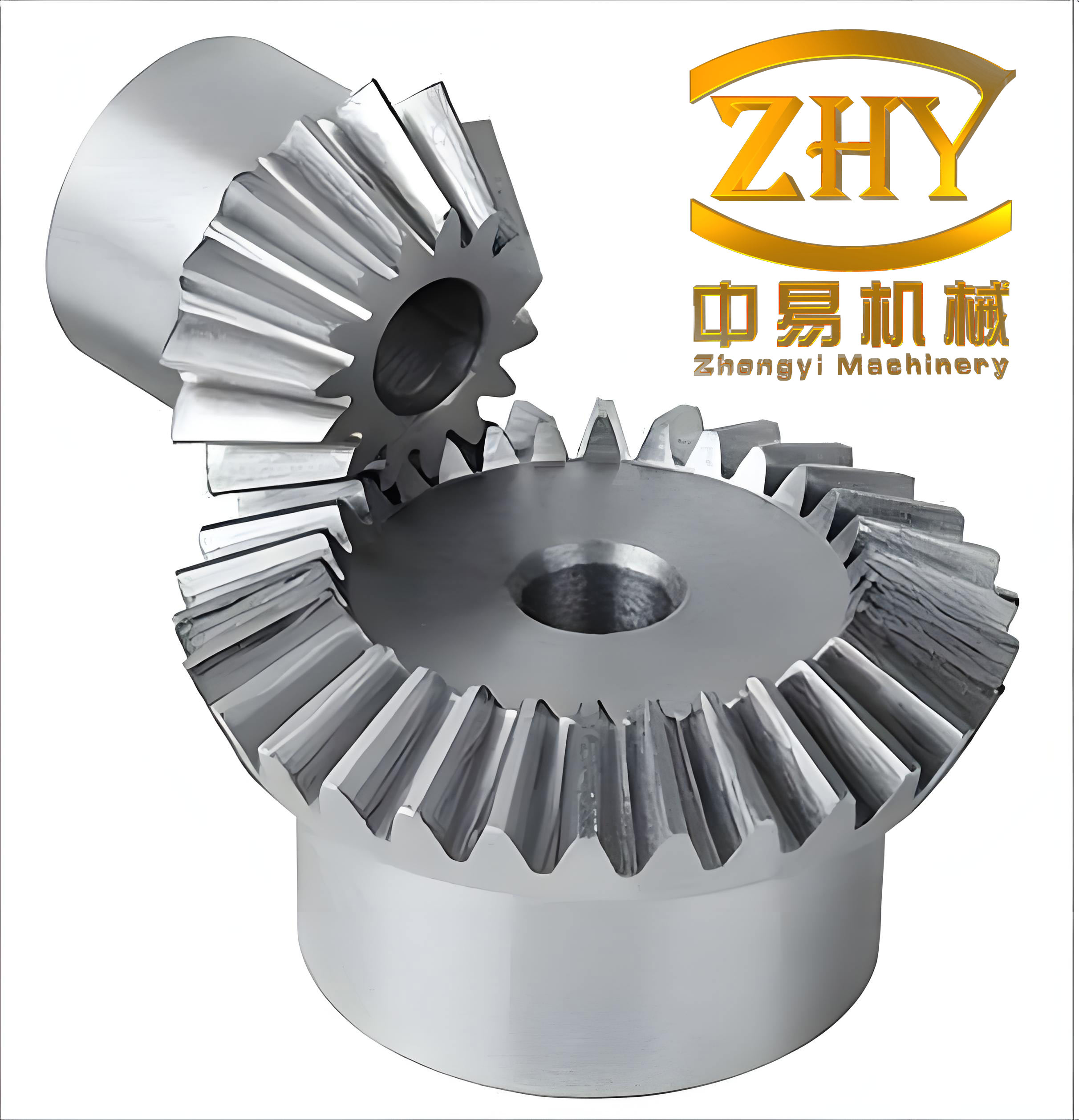
To demonstrate the method, I apply it to a specific straight bevel gear with the following parameters: $M_s = 6 \, \text{mm}$, $\alpha_g = 22^\circ 30’$, $Z = 10$, $h = 6.15 \, \text{mm}$, $H = 10.778 \, \text{mm}$ (process dimension), $S_g = 10.543 \, \text{mm}$ (average), $\Delta_s = 1.2 \, \text{mm}$ (process parameter). The cone dimensions are: pitch cone distance $L = 56.604 \, \text{mm}$, pitch cone angle $\delta = 32^\circ 0’19”$, tip cone angle $\delta_e = 39^\circ 22’55”$, root cone angle $\delta_i = 27^\circ 19’52”$, and theoretical outer diameter $d_e = 70.43 \, \text{mm}$. In this gear, the tip cone and root cone do not intersect at the same point as the pitch cone, so additional calculations are needed for the small-end parameters. From the geometry, I compute the distances from the apex to the small-end pitch circle and tip circle. For instance, the pitch cone distance at the small end $L_0$ is found using trigonometric relationships: $L_0 = 40.3566 \, \text{mm}$ from the given dimensions. The ratio $L_0 / L = 0.71296$ scales the parameters for the small end.
First, I calculate the large-end parameters. The back cone distance $L_1 = L \tan \delta = 56.604 \tan(32^\circ 0’19”) = 35.377 \, \text{mm}$. The base circle radius $R_{01} = L_1 \cos \alpha_g = 35.377 \cos(22^\circ 30′) = 32.684 \, \text{mm}$. The half-angle $\theta_1$ is:
$$\theta_1 = \frac{\pi \times 6 – (10.543 + 1.2)}{2 \times 35.377} – \text{inv}(22^\circ 30′) = 0.0789259 \, \text{rad} = 4.52212^\circ$$
where $\text{inv}(22^\circ 30′) = \tan(22.5^\circ) – 22.5^\circ \times \pi/180 = 0.0171676 \, \text{rad}$. Next, I select radii: $R_{e1} = L_1 + h = 35.377 + 6.15 = 41.527 \, \text{mm}$, $R_{b1} = R_{e1} – H = 41.527 – 10.778 = 30.749 \, \text{mm}$. Since $R_{b1} < R_{01}$, I use $R_{01} = 32.684 \, \text{mm}$ as the inner reference. The intermediate radius $R_{c1} = (41.527 + 32.684)/2 = 37.106 \, \text{mm}$. Now, compute coordinates for the large end:
- At $R_{e1} = 41.527 \, \text{mm}$: $\cos \alpha_{e1} = 32.684/41.527 = 0.787064$, $\alpha_{e1} = 38.08804^\circ$, $\text{inv} \alpha_{e1} = 0.119001 \, \text{rad}$, $\theta_{e1} = 0.0789259 + 0.119001 = 0.197927 \, \text{rad}$, $X_{e1} = 41.527 \sin(0.197927) = 8.166 \, \text{mm}$, $Y_{e1} = 41.527 \cos(0.197927) = 40.716 \, \text{mm}$.
- At $R_{c1} = 37.106 \, \text{mm}$: $\cos \alpha_{c1} = 32.684/37.106 = 0.880846$, $\alpha_{c1} = 28.25544^\circ$, $\text{inv} \alpha_{c1} = 0.04429 \, \text{rad}$, $\theta_{c1} = 0.0789259 + 0.04429 = 0.123215 \, \text{rad}$, $X_{c1} = 37.106 \sin(0.123215) = 4.560 \, \text{mm}$, $Y_{c1} = 37.106 \cos(0.123215) = 36.824 \, \text{mm}$.
- At $R_{01} = 32.684 \, \text{mm}$: $\alpha_{b1} = 0^\circ$, $\text{inv} \alpha_{b1} = 0$, $\theta_{b1} = \theta_1 = 0.0789259 \, \text{rad}$, $X_{b1} = 32.684 \sin(0.0789259) = 2.577 \, \text{mm}$, $Y_{b1} = 32.684 \cos(0.0789259) = 32.583 \, \text{mm}$.
Thus, the large-end points are: (2.577, 32.583), (4.560, 36.824), (8.166, 40.716).
For the small end of the straight bevel gear, I compute scaled parameters. The back cone distance $L_2 = L_0 \tan \delta = 40.3566 \tan(32^\circ 0’19”) = 25.2228 \, \text{mm}$. The base circle radius $R_{02} = L_2 \cos \alpha_g = 25.2228 \cos(22^\circ 30′) = 23.3028 \, \text{mm}$. The transverse module $M_{s2} = L_0 M_s / L = 0.71296 \times 6 = 4.27778 \, \text{mm}$. The tooth thickness $S_{g2} = L_0 S_g / L = 0.71296 \times 10.543 = 7.51678 \, \text{mm}$. The addendum $h_2 = h \times (L_0 / L_{\text{tip}})$ where $L_{\text{tip}}$ is the tip cone distance; from geometry, $h_2 = 4.046 \, \text{mm}$. The total tooth height $H_2 = (H – h) \times (L_0 / L) + h \times (L_0 / L_{\text{tip}}) = 7.346 \, \text{mm}$. The half-angle $\theta_2$ is:
$$\theta_2 = \frac{\pi \times 4.27778 – (7.51678 + 1.2)}{2 \times 25.2228} – \text{inv}(22^\circ 30′) = 0.0720966 \, \text{rad} = 4.13083^\circ$$
Now, select radii: $R_{e2} = L_2 + h_2 = 25.2228 + 4.046 = 29.269 \, \text{mm}$, $R_{b2} = R_{e2} – H_2 = 29.269 – 7.346 = 21.923 \, \text{mm}$. Since $R_{b2} < R_{02}$, I use $R_{02} = 23.3028 \, \text{mm}$ as the inner reference. The intermediate radius $R_{c2} = (29.269 + 23.3028)/2 = 26.286 \, \text{mm}$. Compute coordinates for the small end:
- At $R_{e2} = 29.269 \, \text{mm}$: $\cos \alpha_{e2} = 23.3028/29.269 = 0.796167$, $\alpha_{e2} = 37.23442^\circ$, $\text{inv} \alpha_{e2} = 0.110125 \, \text{rad}$, $\theta_{e2} = 0.0720966 + 0.110125 = 0.182222 \, \text{rad}$, $X_{e2} = 29.269 \sin(0.182222) = 5.304 \, \text{mm}$, $Y_{e2} = 29.269 \cos(0.182222) = 28.784 \, \text{mm}$.
- At $R_{c2} = 26.286 \, \text{mm}$: $\cos \alpha_{c2} = 23.3028/26.286 = 0.88652$, $\alpha_{c2} = 27.56115^\circ$, $\text{inv} \alpha_{c2} = 0.0408914 \, \text{rad}$, $\theta_{c2} = 0.0720966 + 0.0408914 = 0.112988 \, \text{rad}$, $X_{c2} = 26.286 \sin(0.112988) = 2.964 \, \text{mm}$, $Y_{c2} = 26.286 \cos(0.112988) = 26.118 \, \text{mm}$.
- At $R_{02} = 23.3028 \, \text{mm}$: $\alpha_{b2} = 0^\circ$, $\text{inv} \alpha_{b2} = 0$, $\theta_{b2} = \theta_2 = 0.0720966 \, \text{rad}$, $X_{b2} = 23.3028 \sin(0.0720966) = 1.679 \, \text{mm}$, $Y_{b2} = 23.3028 \cos(0.0720966) = 23.242 \, \text{mm}$.
Thus, the small-end points are: (1.679, 23.242), (2.964, 26.118), (5.304, 28.784).
Using AutoCAD, I plot these points. For the large end, the circle through the three points has center coordinates $(X_1, Y_1) = (18.071, 27.923)$ and radius $R_1 = 16.180 \, \text{mm}$. For the small end, the circle has center $(X_2, Y_2) = (12.412, 20.178)$ and radius $R_2 = 11.198 \, \text{mm}$. I then translate the small-end arc and its associated lines until the root circles align. The envelope arc that connects the two arcs has a radius $R = 13.791 \, \text{mm}$ and center coordinates relative to the root circle intersection of $(14.993, 1.793)$. The intersection of this envelope arc with the root circle gives a distance from the Y-axis of $1.315 \, \text{mm}$, so the cutter’s top width is $2 \times 1.315 = 2.630 \, \text{mm}$. This defines the complete tooth profile for the rough milling cutter, as shown in the design drawing.
The effectiveness of this method is evident in practical applications. For instance, a cutter designed for a straight bevel gear with the above parameters performed excellently in rough milling, leaving uniform and minimal stock for subsequent finishing. This ensures high-quality gear production with improved efficiency. The method’s accuracy stems from the precise mathematical modeling of the straight bevel gear geometry, and the use of circular arcs simplifies cutter manufacturing without compromising functionality. Moreover, by implementing this calculation process in programming languages like VB6, I can automate the design, significantly reducing time and minimizing errors. The program takes input parameters and outputs coordinates and drawings rapidly, enhancing productivity in tool design departments.
In conclusion, the combined calculation and graphical approach for designing rough milling cutter tooth profiles for straight bevel gears offers a reliable and efficient solution. It addresses the challenges posed by non-coincident cone apexes and ensures optimal machining allowances. The method leverages standard gear theory and modern software tools, making it accessible for industrial use. Future work could extend this approach to other gear types or incorporate advanced optimization algorithms. However, for straight bevel gears, this method has proven robust and is recommended for widespread adoption in manufacturing processes.