
In the field of mine governance and excavation, drilling rigs serve as the most efficient and direct equipment for exploration. Under complex and variable working conditions involving sedimentary rocks, volcanic rocks, and igneous rocks, the drill rig operates by rotating under the power system to drill through hard ores, fully leveraging the hard and wear-resistant characteristics of the drill bit. The drill rig employs a wear-resistant and impact-resistant bit for rotational drilling and mechanical rock breaking, causing minimal environmental and geological damage. It is particularly suitable for small-diameter deep-hole mechanical rock breaking and exploration in complex geological conditions. Drilling and exploration with drill rigs represent the most effective, direct, economical, least destructive, and most easily repairable process for ore extraction.
The top drive reducer directly provides power output for the top drive drilling rig. The driving methods of the top drive reducer primarily include electric motor drive and hydraulic drive. The drive system (power head device) is fixed on the support derrick, connected to the top drive system and the winch trailer system. The rope of the trailer is used to lift and lower the power head device of the top drive drilling rig, achieving drilling and retraction. The power head device of the top drive drilling rig is suspended and installed directly above the derrick space, sliding up and down on the derrick guide rails. The top drive reducer drives the power cutter head to rotate and cut through rocks for drilling.
The top drive reducer drives the power head device for drilling and rock fragmentation. The top drive reducer is designed with gear transmission, mainly composed of the power gear shaft group, the speed-increasing gear shaft group, the rotating main shaft, and the gearbox housing. The electric motor/hydraulic motor is connected to the power gear shaft group and the speed-increasing gear shaft group of the top drive reducer via splines. The rotation of the motor/motor drives the power gear shaft and the speed-increasing gear shaft to engage with the main shaft gear. The rotating main shaft is connected to the floating sleeve via splines. The power gear shaft drives the power cutter head to rotate and cut rocks.
The gearbox housing is typically a cast structure, but cast gearbox housings are prone to casting defects and poor appearance. During precision machining, casting sand holes often appear, with a repair rate usually exceeding 30% for cast gearbox housings. To reduce costs and shorten manufacturing time while meeting the strength requirements of the housing, a welded structure is adopted for the gearbox housing.
The power gear shaft and speed-increasing gear shaft are connected to external input sources and operate at high speeds. Under external alternating loads, they bear torsion, bending moments, and torque. The input shaft of the top drive reducer must resist fatigue fracture caused by long-term cyclic loads. To ensure smooth transmission, the material should have high toughness, and it should not develop cracks or twist under high-frequency vibration, repetitive loads, and alternating loads. It must maintain the integrity of the material structure at all times. Operating in a circulating liquid environment at around 80°C, it must possess resistance to thermal expansion and should not be prone to fracture or deformation. Based on these working characteristics, the material for the shaft requires high surface hardness and wear resistance, while the overall structure needs high strength and toughness. The core of the shaft must maintain high strength and toughness. Therefore, the high-speed heavy-duty gear material 18CrNiMo7-6 is selected, and carburizing heat treatment is applied.
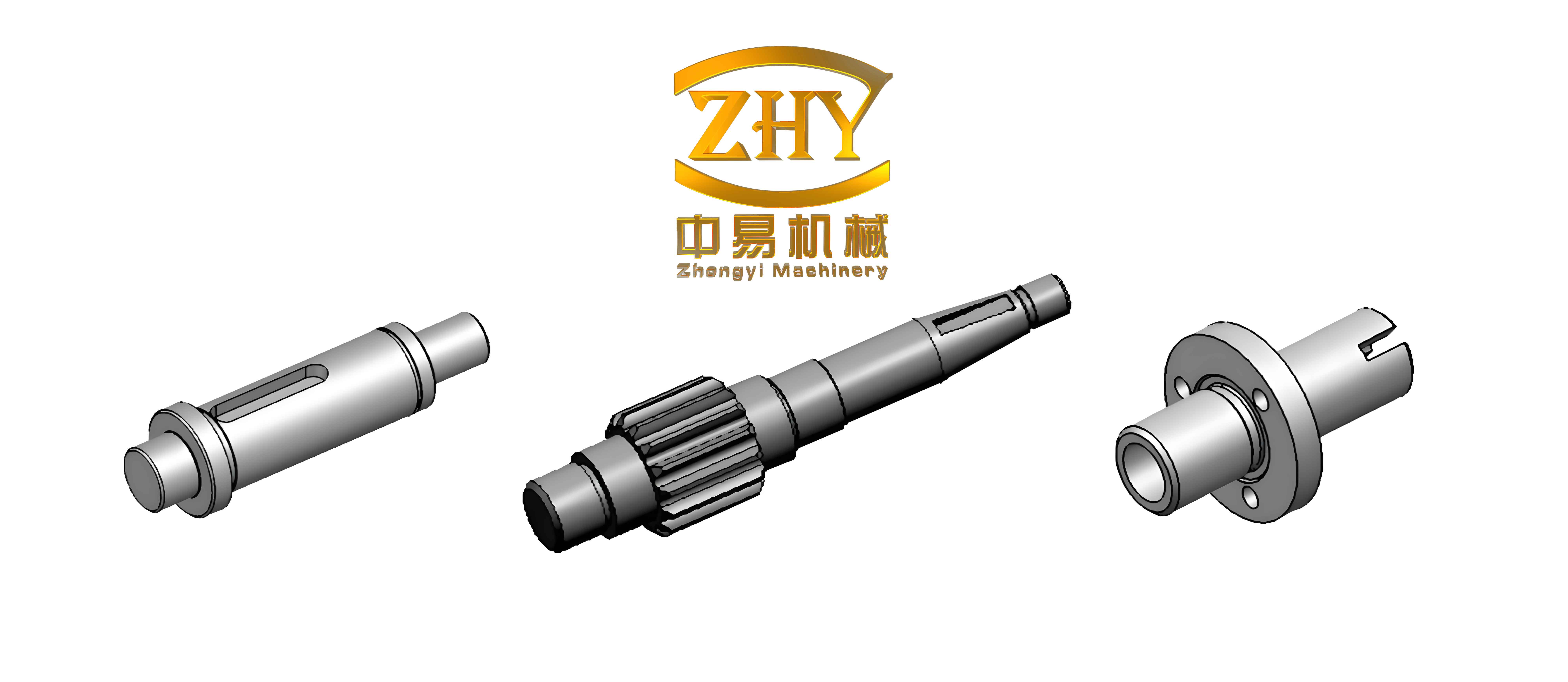
The electric motor/hydraulic motor provides the power source for the top drive reducer. The external power source has a power of 2×75 kW and a speed of 1,500 r/min. The top drive reducer adopts a vertical cylindrical structure, where the power gear shaft group and the speed-increasing gear shaft group engage with the rotating main shaft gear to provide power for the rotating cutting action of the power cutter head.
The power gear shaft group and speed-increasing gear shaft group mainly consist of the gear shaft and bearings. The gear portion of the speed-increasing gear shaft is identical to that of the power gear shaft, so the design of the speed-increasing gear shaft can reference the design of the power gear shaft.
The minimum diameter of the power gear shaft is calculated as follows:
$$ d_{\text{min}} \geq A_0 \sqrt[3]{\frac{P}{n}} $$
where \( P \) is the input shaft power, \( P = 75 \, \text{kW} \); \( n \) is the rated speed, \( n = 1500 \, \text{r/min} \); and \( A_0 \) is a coefficient selected based on the allowable torsional shear stress \( [\tau_p] \) of the material.
Based on the material properties of 18CrNiMo7-6 and the allowable torsional shear stresses for common shaft materials, the range of \( A_0 \) is 97 to 112. When \( A_0 = 97 \), \( d_{\text{min}} \geq 35.74 \, \text{mm} \); when \( A_0 = 112 \), \( d_{\text{min}} \geq 41.26 \, \text{mm} \). The minimum diameter of the power gear shaft is designed as 75 mm, and since 75 mm > 41.26 mm, the requirement is satisfied.
The structural design of the power gear shaft includes a gear module \( m_1 = 8 \, \text{mm} \), number of teeth \( Z_1 = 17 \), profile angle \( \alpha_1 = 20^\circ \), helix angle \( \beta = 10^\circ \), and right-hand helix. The external spline has a module \( m_2 = 2.1 \, \text{mm} \), number of teeth \( Z_2 = 32 \), and pressure angle \( \alpha_2 = 30^\circ \).
During operation, the power gear shaft is subjected to forces from bearings, centrifugal forces, torque, and the engaging force and torque from the meshing gear. The input torque acting on the gear spline is calculated as:
$$ T = 9550 \frac{P}{n} = 477.5 \, \text{N·m} $$
The transmitted force on the gear tooth surface is:
$$ F_t = \frac{2T}{d_1} = \frac{2T}{m_1 Z_1} = 7022.06 \, \text{N} $$
where \( d_1 \) is the pitch diameter of the gear.
The radial force acting on the gear is:
$$ F_r = F_t \frac{\tan \alpha_1}{\cos \beta} = 2595.25 \, \text{N} $$
The reactions on the horizontal plane are calculated as:
$$ F_{NV1} = F_r \frac{L_1}{L} = 1272.96 \, \text{N} $$
$$ F_{NV2} = F_r \frac{L_2}{L} = 1322.29 \, \text{N} $$
where \( L_1 = 129 \, \text{mm} \), \( L_2 = 134 \, \text{mm} \), and \( L = L_1 + L_2 = 263 \, \text{mm} \).
The reactions on the vertical plane are:
$$ F_{NH1} = F_{NH2} = \frac{F_t}{2} = 3511.03 \, \text{N} $$
The bending moments on the horizontal plane are:
$$ M_{V1} = F_{NV1} L_1 = 164.21 \, \text{N·m} $$
$$ M_{V2} = F_{NV2} L_2 = 177.19 \, \text{N·m} $$
The bending moments on the vertical plane are:
$$ M_{H1} = F_{NH1} L_1 = 452.92 \, \text{N·m} $$
$$ M_{H2} = F_{NH2} L_2 = 470.48 \, \text{N·m} $$
The resultant bending moments are:
$$ M_1 = \sqrt{M_{V1}^2 + M_{H1}^2} = 481.77 \, \text{N·m} $$
$$ M_2 = \sqrt{M_{V2}^2 + M_{H2}^2} = 502.74 \, \text{N·m} $$
The equivalent bending moment based on the third strength theory is:
$$ M_{\text{ca}} = \sqrt{M_2^2 + (a T)^2} = 576.3 \, \text{N·m} $$
where \( a \) is the stress correction factor, taken as 0.59 for pulsating cyclic stress.
The stress on the power gear shaft is:
$$ \sigma = \frac{\sqrt{M^2 + (a T)^2}}{W} = \frac{M_{\text{ca}}}{W} = 2.29 \, \text{MPa} $$
where \( W \) is the section modulus, and for a circular cross-section, \( W = 0.1 d_1^3 \).
The material 18CrNiMo7-6 steel undergoes quenching and tempering and carburizing heat treatment. The allowable bending stress \( [\sigma_{-1}] = 60 \, \text{MPa} \), and since \( \sigma < [\sigma_{-1}] \), the design is safe.
The spline strength of the power gear shaft is verified. The maximum output power of the motor/hydraulic motor is \( P = 75 \, \text{kW} \), and the input torque on the power gear shaft is \( T = 477.5 \, \text{N·m} \). The input spline of the power gear shaft uses a German standard spline with number of teeth \( Z_2 = 32 \), module \( m_2 = 2.1 \, \text{mm} \), and pressure angle \( \alpha_2 = 30^\circ \). The effective engagement length (spline effective length) is \( L_3 = 56 \, \text{mm} \), and the material is 18CrNiMo7-6.
The compressive stress is calculated as:
$$ \sigma_p = \frac{2T}{\phi Z_2 m_2 L_3 d_2} = 5.04 \, \text{N/mm}^2 $$
where \( d_2 \) is the pitch diameter of the spline, \( d_2 = m_2 Z_2 = 67.2 \, \text{mm} \), and \( \phi \) is the load factor, taken as 0.75.
The compressive stress \( \sigma_p = 5.04 \, \text{MPa} \), and the allowable compressive stress for 18CrNiMo7-6 is \( [\sigma] = 45 \, \text{MPa} \). Since \( \sigma_p < [\sigma] \), the spline strength meets the usage requirements.
The power gear shaft bears alternating loads during rotational engagement. Under high loads, the minimum diameter area is prone to fracture. The core technology of the 18CrNiMo7-6 material lies in the carburizing and quenching process. Gears and gear shafts are susceptible to distortion and shape deviations during carburizing and quenching due to uneven thermal expansion and contraction, resulting in residual stresses. Internal organizational transformations generate organizational stresses, leading to twisting and shape distortions, and local cracks may occur. By controlling the quenching time, temperature, and carbon potential reasonably, a superior carburized layer organization and hardened layer depth can be achieved. The power gear shaft requires a carburized and quenched layer depth of 1.4–1.8 mm, tooth surface hardness of 58–62 HRC, and core hardness of 36–43 HRC. To obtain these excellent properties, the process aims for a carburized layer depth of 1.7–2.1 mm. The carburizing and quenching temperatures for the 18CrNiMo7-6 power gear shaft are set at 820°C and 840°C for corresponding processes.
In the first experiment, quenching temperatures of 820°C and 840°C were used, with pre-cooling for 3 minutes before quenching to reduce cooling intensity. The process parameters and the metallographic structure of the carburized and quenched samples are summarized in the table below.
| Process Parameters | Martensite and Retained Austenite | Carbides | Core Structure |
|---|---|---|---|
| 820°C equalizing 30 min, pre-cool 3 min quench, slow cool 30 min, oil temperature 50°C | Grade 4 | Grade 1 | Grade 2 |
| 840°C equalizing 30 min, pre-cool 3 min quench, slow cool 40 min, oil temperature 60°C | Grade 1 | Grade 2 | Grade 2 |
| 840°C equalizing 60 min, pre-cool 3 min quench, slow cool 20 min, oil temperature 70°C | Grade 4 | Grade 1 | Grade 2 |
| 840°C equalizing 30 min, slow cool 25 min, oil temperature 60°C | Grade 4 | None | Grade 2 |
Result analysis: For the first batch, although the martensite and retained austenite grade was acceptable at grade 4, it did not achieve optimal performance, possibly due to too slow cooling. For the second batch, the quenching temperature was increased from 820°C to 840°C, and the slow cooling time was extended from 30 minutes to 40 minutes. By adjusting the cooling rate through slow cooling, a relatively better carburized microstructure was obtained. Based on the experience from the second batch, the oil temperature was increased from 60°C to 70°C for the third batch to effectively reduce the core temperature before quenching and minimize quenching stress. The equalizing time was extended from 30 minutes to 60 minutes, and the slow cooling time was shortened to 20 minutes. The microstructure showed martensite and retained austenite with a grain size of grade 4. Pre-cooling reduced the quenching temperature at the tooth portion but did not positively affect the shaft portion and carburized quenching structure. For the fourth batch, the pre-cooling step was eliminated, and the oil temperature was reduced, resulting in martensite and retained austenite at grade 4. The next steps involved reducing the quenching temperature to 820°C to lower the shaft hardness, eliminating pre-cooling, adding short-term intense cooling, shortening the slow cooling time, controlling the final cooling temperature of the tooth and shaft portions to 80–150°C, and utilizing self-tempering to reduce quenching stress.
In the second experiment, a quenching temperature of 820°C was used, pre-cooling was eliminated, short-term intense cooling for 3 minutes was added, slow cooling time was shortened to 20 minutes, and oil temperature was set to 60°C. The process parameters and results are summarized in the table below.
| Process Parameters | Martensite and Retained Austenite | Carbides | Core Structure |
|---|---|---|---|
| 820°C保温 4 h, intense cool 3 min, slow cool 20 min, oil temperature 60°C | Grade 1 | Grade 2 | Grade 1 |
| 820°C equalizing 60 min, intense cool 3 min, slow cool 20 min, oil temperature 60°C | Grade 2 | Grade 1 | Grade 1 |
Result analysis: From the metallographic analysis of the fifth and sixth batches, the microstructure showed significant improvement compared to the first experiment. Although the sixth batch had good microstructure, internal stresses were high, leading to cracking during subsequent keyway machining. By measuring the quenching return temperature and slice hardness, it was found that the cooling time for the fifth batch was reasonable but could be shortened. For a carburized and quenched slice with a diameter of 120 mm, there was incomplete hardening and uneven core hardness. After quenching at 820°C, the hardness decreased, showing a certain hardness gradient. The next steps involved maintaining a quenching temperature of 820°C, retaining the intense cooling step with time based on module size or shaft surface hardness requirements, extending the holding time to further reduce quenching thermal stress, and based on the tooth hardness after quenching, evaluating the feasibility of eliminating cryogenic treatment to reduce stress. It was preliminarily determined to control the intense cooling time within 3 minutes.
In the third experiment, a quenching temperature of 820°C was used, the equalizing time was extended, intense cooling time was controlled within 3 minutes, oil temperature was set to 60°C, and the slow cooling time was determined based on the oil-out temperature. The process parameters and the metallographic structure of the carburized and quenched accompanying samples are summarized in the table below.
| Process Parameters | Martensite and Retained Austenite | Carbides | Core Structure | Remarks |
|---|---|---|---|---|
| 820°C equalizing 3 h, intense cool 3 min, slow cool 15 min, oil temperature 60°C (carbon potential set 1.05%, measured 1.04%) | Grade 4 | Grade 4 | Grade 1 | No cryogenic treatment |
| 820°C equalizing 3 h, intense cool 3 min, slow cool 15 min, oil temperature 60°C (carbon potential set 1.05%, measured 1.04%) | Grade 3 | Grade 2 | Grade 1 | Cryogenic treatment |
| 820°C equalizing 4 h, intense cool 3 min, slow cool 22 min, oil temperature 60°C | Grade 4 | Grade 4 | Low carbon martensite + indistinct free ferrite, Grade 2 | No cryogenic treatment |
| 820°C equalizing 4 h, intense cool 3 min, slow cool 22 min, oil temperature 60°C | Grade 3 | Grade 2 | Low carbon martensite + small amount of free ferrite, Grade 3 | Cryogenic treatment |
Result analysis: Extending the carburizing equalizing time to 3–4 hours allows the core temperature to reach the equalizing temperature, but longer holding times increase production costs. After quenching, the final cooling temperature of the shaft was measured. For the seventh batch, the tooth temperature was 120–140°C, and the shaft temperature was 100–120°C. For the eighth batch, the tooth temperature was 100–120°C, and the shaft temperature was 110–150°C, indicating that the cooling time calculation method was reasonable. From the slice hardness, the surface hardness within 5 mm of the 120 mm diameter test slice decreased by 1–2 HRC compared to the second experiment, and the core hardness decreased by 1–3 HRC, with core hardness not exceeding 35 HRC. The cooling parameters for the second and third experiments were similar, but hardness differences existed. Samples without cryogenic treatment had martensite and retained austenite at grade 4, and minor process fluctuations could cause the structure grade to exceed limits. Therefore, based on the cooling parameters (intense cooling time controlled within 3 minutes), cryogenic treatment is necessary for controlling hardness and structure.
The carburizing and quenching parameters for the power gear shaft were solidified using a quenching temperature of 820°C, equalizing for 30 minutes, intense cooling for 30 minutes, slow cooling for 30 minutes, and oil temperature of 50°C. The test parameters and the solidified process carburizing and quenching metallographic structure are summarized in the table below.
| Process Parameters | Martensite and Retained Austenite | Carbides | Core Structure |
|---|---|---|---|
| 820°C equalizing 30 min, intense cool 30 min, slow cool 30 min, oil temperature 50°C | Grade 2 | Grade 1 | Grade 1 |
The metallographic structure of the test block showed martensite and retained austenite, carbides, and core structure all at grade 1, with good performance and no cracks.
Using the process procedure with quenching temperature of 820°C, equalizing for 30 minutes, intense cooling for 30 minutes, slow cooling for 30 minutes, and oil temperature of 50°C, the relevant equipment and process program numbers 36#+37# were used for batch testing. The process parameters and carburizing and quenching metallographic structure are summarized in the table below.
| Process Parameters | Hardness | Macrostructure | Microstructure |
|---|---|---|---|
| Carburizing + air cooling + high temperature tempering + quenching (intense cool 30 min, slow cool 30 min) + cryogenic treatment + secondary tempering | 38–41 HRC | No significant macrostructure defects | Surface carburized layer: fine martensite + carbides + retained austenite; Core: lath martensite + small amount of undissolved ferrite; Inner core: lath martensite + undissolved ferrite + small amount of bainite |
The carburizing curve fluctuations were normal, and the structure met the requirements. Surface turning inspection for cracks was performed, turning 1 mm each time until 5 mm depth, with no cracks observed in any layer. After several months of storage, no cracks were found, confirming that the 36#+37# process meets the carburizing and quenching requirements for the power gear shaft.
The design and development of the top drive reducer are primarily applied in mine safety aspects such as coal seam roof water hazard management and mine rescue. In the coal mining field, the top drive reducer provides power output for safer extraction of deeper coal seams. The top drive reducer designed in this study offers higher torque and, equipped with a power cutter head, can achieve vertical drilling depths exceeding 1,000 meters. It has broad application prospects in fields such as oil and natural gas extraction, geological exploration, and mine governance.