
The proliferation of paperless offices has made computers a staple in modern workspaces and meeting rooms. However, the traditional setup, with a fixed desktop monitor, often leads to inefficient use of valuable desk space and makes the screen prone to dust accumulation. The primary objective of a hidden desktop monitor lift mechanism is to conserve space, thereby improving workspace ergonomics and utilization. Additionally, it serves to protect the display from dust and provides a basic level of security by concealing the hardware when not in use.
The evolution of quick-lift mechanisms for hidden monitors has progressed through several generations. The first generation utilized chain drives, followed by a second generation employing rack and pinion gear systems. The third generation saw the use of round rod and bearing assemblies, the fourth adopted ball-bearing track structures, and the current, fifth generation predominantly utilizes linear guide rails paired with linear bearings.
Numerous types of lifting mechanisms are available today. Common domestic and international designs include rack and pinion gear lifts, chain and sprocket drives, and lead screw actuators. The focus of this analysis is a lifting mechanism based on the rack and pinion gear principle. In this configuration, the rack can be conceptually understood as a gear with an infinitely large pitch circle. Rack and pinion gear drives are favored for applications requiring rapid linear motion due to their smooth operation and high transmission efficiency, making them well-suited for the quick升降 requirements of a hidden monitor lift. To achieve a cost-effective design, preliminary parameters for the rack and pinion gear set are first established through theoretical design, followed by structural optimization using Finite Element Analysis (FEA).
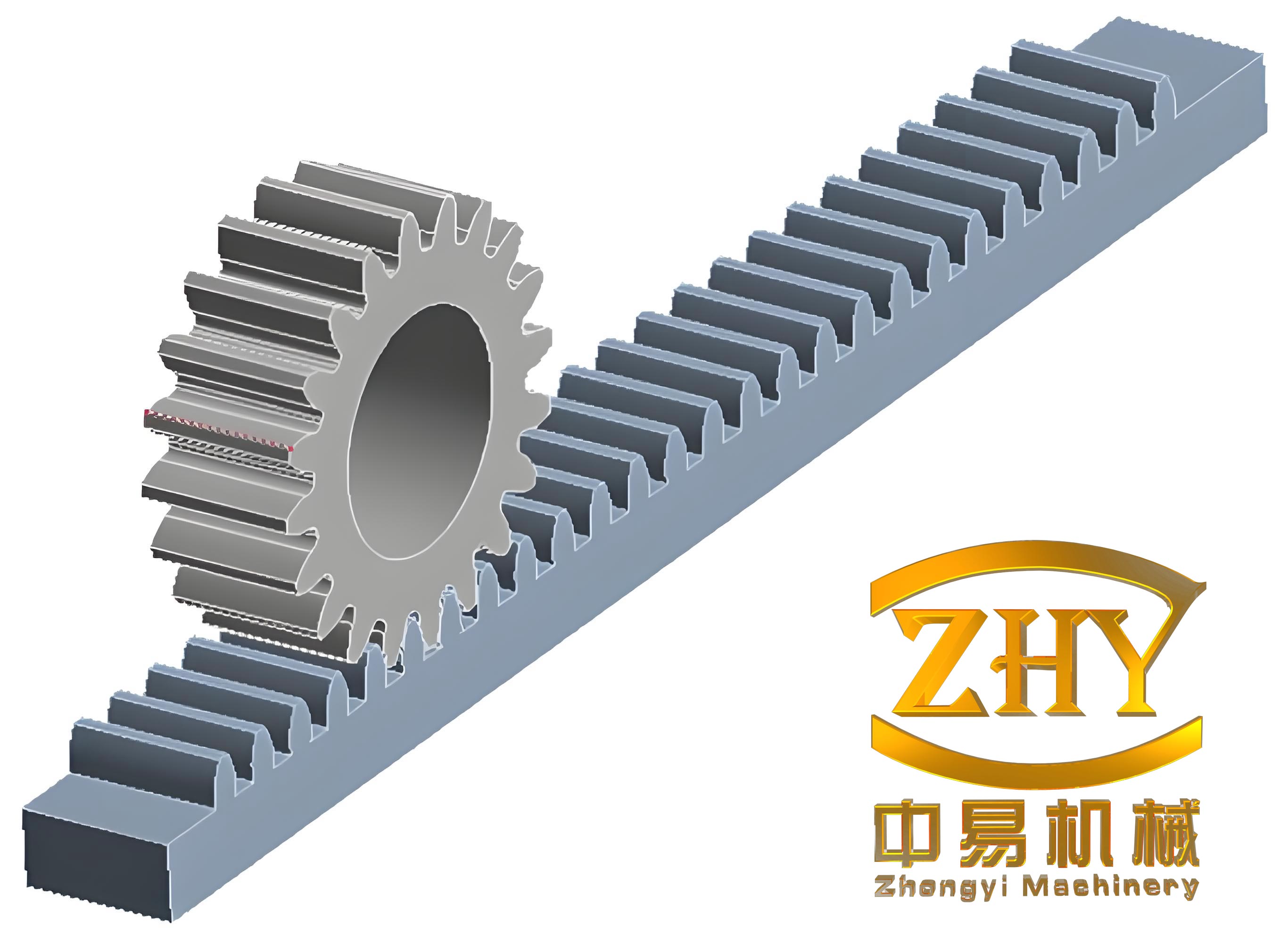
Parameter Design for the Rack and Pinion Gear System
Based on the functional requirements of lifting a typical monitor, the initial parameters for the rack and pinion gear pair are selected as follows:
| Parameter | Value | Notes |
|---|---|---|
| Module (m) | 2 mm | Standard metric gear parameters. |
| Number of Pinion Teeth (z₁) | 25 | |
| Pressure Angle (α) | 20° | |
| Addendum Coefficient (h*a) | 1.0 | |
| Dedendum Coefficient (c*) | 0.25 | |
| Pinion Material | 40Cr (Quenched & Tempered) | Chosen for good strength and wear resistance. |
| Rack Material | 45 Steel (Quenched & Tempered) | Chosen for good machinability and strength. |
| Gear Quality Grade | Grade 7 | Commercial quality suitable for this application. |
| Linear Velocity (v) | 0.1 m/s | Target speed for smooth, rapid升降. |
| Servo Motor Rated Torque (T_rated) | 1.27 N·m | Drive motor specifications. |
| Servo Motor Maximum Torque (T_max) | 3.81 N·m |
Calculations for Surface Durability and Bending Strength
The design must ensure that the gear teeth are strong enough to handle the load without surface pitting (contact stress failure) or tooth breakage (bending stress failure). The maximum motor torque (T_max = 3.81 N·m) is used for a conservative design check.
1. Contact Stress Calculation (Surface Durability)
The contact stress between the meshing rack and pinion gear teeth is calculated using the fundamental formula derived from Hertzian contact theory. For a spur gear pair (where the rack is treated as a gear with infinite radius), the formula is:
$$ \sigma_H = \sqrt{ \frac{2 K_H T_1}{\phi_d d_1^3} \cdot \frac{u \pm 1}{u} } \cdot Z_H Z_E Z_\epsilon \leq [\sigma_H] $$
Where:
\( K_H \) = Application factor (taken as 1.3)
\( T_1 \) = Pinion torque (3810 N·mm)
\( \phi_d \) = Face width coefficient (initially chosen as 0.6)
\( d_1 \) = Pinion pitch diameter = \( m \cdot z_1 = 2 \times 25 = 50 \) mm
\( u \) = Gear ratio. For a rack and pinion gear, this approaches infinity, so \( (u+1)/u \approx 1 \).
\( Z_H \) = Zone factor = \( \sqrt{ \frac{2 \cos \beta_b}{\sin \alpha_t \cos \alpha_t} } \). For spur gears (\( \beta=0 \), \( \alpha_t = \alpha=20° \)), \( Z_H \approx 2.5 \).
\( Z_E \) = Elasticity factor = \( \sqrt{ \frac{1}{\pi [ (1-\nu_1^2)/E_1 + (1-\nu_2^2)/E_2 ] }} \). For steel-steel contact, \( Z_E \approx 189.8 \sqrt{\text{MPa}} \).
\( Z_\epsilon \) = Contact ratio factor.
The transverse contact ratio must first be calculated. For a standard spur pinion meshing with a rack:
$$ \epsilon_\alpha = \frac{1}{2\pi} \left[ z_1 (\tan \alpha_{a1} – \tan \alpha’) + \frac{2 h_{a}^*}{\sin \alpha \cos \alpha} \right] $$
The tip pressure angle of the pinion is \( \alpha_{a1} = \arccos( d_b / d_{a1} ) \), where the base diameter \( d_b = d_1 \cos \alpha = 50 \cos 20° \approx 46.985 \) mm and the addendum diameter \( d_{a1} = d_1 + 2 h_a = 50 + 2 \times 2 = 54 \) mm. Therefore, \( \alpha_{a1} = \arccos(46.985 / 54) \approx 29.5° \). The operating pressure angle \( \alpha’ \) equals the standard pressure angle \( \alpha \) for a standard rack and pinion gear assembly with zero backlash. Substituting values:
$$ \epsilon_\alpha = \frac{1}{2\pi} \left[ 25 (\tan 29.5° – \tan 20°) + \frac{2 \times 1}{\sin 20° \cos 20°} \right] \approx 1.78 $$
The contact ratio factor is then:
$$ Z_\epsilon = \sqrt{ \frac{4 – \epsilon_\alpha}{3} } = \sqrt{ \frac{4 – 1.78}{3} } \approx 0.86 $$
Now, calculating the contact stress:
$$ \sigma_H = \sqrt{ \frac{2 \times 1.3 \times 3810}{0.6 \times 50^3} \times 1 } \times 2.5 \times 189.8 \times 0.86 $$
$$ \sigma_H \approx \sqrt{ \frac{9906}{75000} } \times 408.07 \approx \sqrt{0.1321} \times 408.07 \approx 0.3634 \times 408.07 \approx 148.3 \text{ MPa} $$
The allowable contact stress \( [\sigma_H] \) is determined from the material’s endurance limit and a safety factor. For 40Cr pinion and 45 steel rack, approximate bending fatigue limits are 600 MPa and 550 MPa respectively. Using a minimal safety factor of S=1 and life factor \( K_{HN}=1 \), the allowable stress is the lower of the two: \( [\sigma_H] \approx 550 \) MPa.
Since \( \sigma_H (148.3 \text{ MPa}) < [\sigma_H] (550 \text{ MPa}) \), the rack and pinion gear design is safe against surface pitting.
2. Tooth Bending Stress Calculation
The bending stress at the root of the pinion tooth is the critical check to prevent fatigue breakage. The fundamental formula is:
$$ \sigma_F = \frac{2 K_F T_1}{ \phi_d m^3 z_1^2} \cdot Y_{Fa} Y_{Sa} Y_\epsilon \leq [\sigma_F] $$
Where:
\( K_F \) = Application factor for bending (taken as 1.3)
\( Y_{Fa} \) = Tooth form factor (depends on number of teeth and profile). For \( z_1=25 \), \( Y_{Fa} \approx 2.62 \).
\( Y_{Sa} \) = Stress correction factor. For \( z_1=25 \), \( Y_{Sa} \approx 1.59 \).
\( Y_\epsilon \) = Bending contact ratio factor = \( 0.25 + 0.75 / \epsilon_\alpha = 0.25 + 0.75 / 1.78 \approx 0.671 \).
Substituting the values:
$$ \sigma_F = \frac{2 \times 1.3 \times 3810}{0.6 \times 2^3 \times 25^2} \times 2.62 \times 1.59 \times 0.671 $$
$$ \sigma_F = \frac{9906}{0.6 \times 8 \times 625} \times 2.795 = \frac{9906}{3000} \times 2.795 \approx 3.302 \times 2.795 \approx 9.23 \text{ MPa} $$
The allowable bending stress for the 40Cr pinion material, with a fatigue limit \( \sigma_{Flim} \approx 500 \) MPa, a life factor \( K_{FN}=1 \), and a safety factor \( S_F=1.4 \), is:
$$ [\sigma_F] = \frac{K_{FN} \sigma_{Flim}}{S_F} = \frac{1 \times 500}{1.4} \approx 357 \text{ MPa} $$
Since \( \sigma_F (9.23 \text{ MPa}) \ll [\sigma_F] (357 \text{ MPa}) \), the pinion teeth have a very high safety factor against bending failure. This initial calculation confirms the feasibility of the chosen rack and pinion gear parameters but also suggests potential for material and size optimization, as the stresses are far below the material limits.
Finite Element Analysis for Structural Optimization
The theoretical calculations confirm the design’s safety but do not provide detailed stress distribution, especially in complex areas like the rack body and its mounting features. FEA is employed to visualize these stress fields and identify opportunities to reduce the geometric dimensions (primarily face width) of the rack and pinion gear components, thereby saving material and reducing cost without compromising performance.
The first step in FEA is to discretize the continuous geometry into a finite number of small elements (mesh). A mathematical model then solves for displacements and stresses within this mesh. To reduce computational cost without sacrificing result accuracy, the 3D model is simplified by removing non-critical features like small fillets, chamfers, and decorative details that have negligible impact on the global stress state. The simplified model of the rack and pinion gear assembly is then prepared for analysis.
In the simulation setup, both the rack and pinion are assigned the material properties of Alloy Steel (approximating the specified grades). A friction coefficient of 0.1 is defined at the meshing interfaces. The pinion shaft hole is constrained to rotate only about its axis, and a pure torque of 3.81 N·m is applied to simulate the maximum motor output. The ends of the rack are fixed in all degrees of freedom, simulating its rigid mounting to the lift mechanism’s frame. A standard curvature-based mesh is generated with an element size of 2 mm, ensuring a good balance between solution accuracy and computation time.
The results from the FEA of the initial design (with a pinion face width derived from \( \phi_d = 0.6 \), i.e., \( b = \phi_d \times d_1 = 0.6 \times 50 = 30 \) mm, and a corresponding rack width of 25 mm) revealed important insights. The von Mises stress distribution showed that the highest stresses were concentrated on the rack, not the pinion. Specifically, the maximum stress occurred at the root fillet of the rack teeth in the region of highest load application, which is expected. More critically, a secondary but significant stress concentration was identified at the location where the rack is bolted to the lifting platform. This area becomes a potential failure point if not properly designed. Crucially, the magnitude of the maximum stress (approximately 40-50 MPa) was still significantly lower than the material’s yield strength (typically >600 MPa for alloy steel). This confirmed that the initial rack and pinion gear dimensions were overly conservative and could be reduced.
Structural Optimization Based on FEA Results
Guided by the FEA results, an optimization step was undertaken. The face width coefficient \( \phi_d \) was reduced from 0.6 to 0.4. This resulted in a new pinion face width of \( b_{pinion} = 0.4 \times 50 = 20 \) mm. The rack width was proportionally reduced to 15 mm. The models were updated, and a new FEA was conducted with identical boundary conditions and loading.
The results for the optimized rack and pinion gear model showed a predictable increase in stress levels due to the reduced load-bearing cross-section. The maximum von Mises stress on the rack teeth increased but remained well within the elastic limit of the material. The stress concentration at the rack’s bolt mounting holes became more pronounced, highlighting the need for adequate fillets or reinforcement in that specific area during detailed design. The primary achievement was that the optimized design, with approximately 33% less material in the face width dimension, still maintained a very high factor of safety. This validates the optimization goal of reducing cost and weight without sacrificing structural integrity.
Influence of Pinion Tooth Count Variation
With the optimized face width established, a further parametric study was conducted to investigate the influence of the pinion’s number of teeth on the system’s stress state. Keeping the module (m=2 mm), face widths (20/15 mm), applied torque (3.81 N·m), and all other conditions constant, a series of FEA simulations were run for pinion tooth counts (z₁) ranging from 20 to 25. The maximum von Mises stress extracted from each analysis is summarized below:
| Pinion Tooth Count (z₁) | Maximum von Mises Stress (MPa) | Pinion Pitch Diameter (mm) |
|---|---|---|
| 20 | 50.76 | 40 |
| 21 | 60.21 | 42 |
| 22 | 56.72 | 44 |
| 23 | 47.14 | 46 |
| 24 | 55.09 | 48 |
| 25 | 49.81 | 50 |
Plotting these values reveals that the maximum stress does not exhibit a strong, monotonic correlation with tooth count in this range; the variation appears relatively minor and somewhat scattered. Several factors contribute to this: minor differences in the precise meshing engagement at the instance captured in the static FEA, subtle changes in the contact ratio and load sharing, and inherent numerical noise from the meshing and solving process. However, the key takeaway is that within the practical range of 20 to 25 teeth, the change in tooth count does not drastically affect the peak stress magnitude in this rack and pinion gear system.
This finding provides additional design flexibility. While reducing tooth count decreases the pinion’s pitch diameter (allowing for a potentially more compact drive package), it also reduces tooth strength slightly. Given the stress results and considering a balance between size, strength, and smooth motion (higher tooth counts generally provide smoother operation), a pinion with 23 teeth can be selected as a robust and efficient choice. This offers a slight reduction in size compared to the initial 25-tooth design without incurring a significant stress penalty.
Conclusion and Discussion
Through a systematic process of theoretical parameter design, strength verification, and iterative finite element analysis, an optimal configuration for the rack and pinion gear drive in a hidden desktop monitor lift mechanism has been developed. The process began with standard gear design calculations, which confirmed the basic validity of selected parameters (m=2 mm, z₁=25) but indicated substantial over-design. Subsequent FEA provided a detailed visual and quantitative understanding of the stress distribution, pinpointing the rack tooth roots and mounting holes as critical areas.
Driven by the FEA insights, a significant optimization was achieved by reducing the face width coefficient from 0.6 to 0.4, yielding final component widths of 20 mm for the pinion and 15 mm for the rack. A further parametric study on pinion tooth count demonstrated that the system’s maximum stress is not highly sensitive to changes between 20 and 25 teeth, allowing the selection of 23 teeth as a balanced solution favoring a slightly more compact design.
Therefore, the recommended optimal parameters for manufacturing this cost-effective and reliable rack and pinion gear lift system are:
| Component | Optimal Parameter |
|---|---|
| Module (m) | 2 mm |
| Pinion Number of Teeth (z₁) | 23 |
| Pinion Face Width (b_pinion) | 20 mm |
| Rack Face Width (b_rack) | 15 mm |
| Pressure Angle (α) | 20° |
This optimized design provides a solid theoretical foundation for production, effectively achieving the goals of material savings and cost reduction while ensuring mechanical reliability and performance for the quick升降 function. For future work, the analysis could be expanded to include a coupled study of module and tooth count variations, dynamic load analysis during start-stop cycles, fatigue life prediction, and the optimization of the rack’s mounting geometry to mitigate the identified stress concentrations at the bolt holes. Furthermore, exploring alternative materials or surface treatments could lead to additional weight or cost benefits for the rack and pinion gear assembly.