
Traditional grinding operations for automotive gear shafts are predominantly manual, involving the handling of components, operation of machine tools, loading/unloading, and the critical alignment of gear teeth. This labor-intensive process is conducted in a harsh environment characterized by noise, heat, and coolant mist, leading to high worker fatigue, significant turnover rates, and complex production management. Consequently, consistent product output and quality are often difficult to guarantee. While some modern grinding machines incorporate simple linear mechanisms for part handling, they often remain dependent on manual intervention for tasks like alignment, are costly, and lack flexibility. This document details the first-person design and implementation of a comprehensive, flexible automation system based on an industrial robot to revolutionize the production grinding of automotive gear shafts.
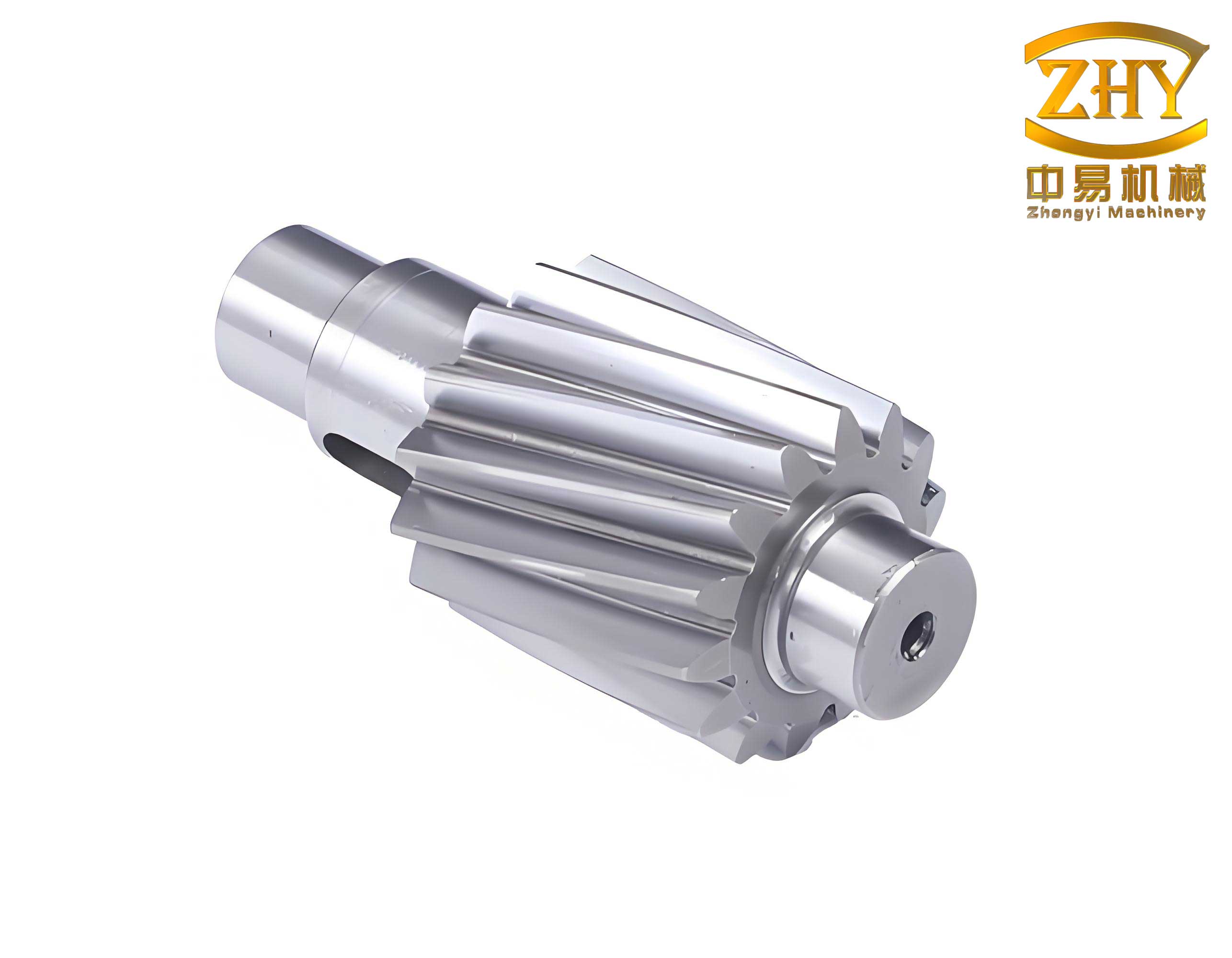
The primary processing step involves grinding specific outer cylindrical surfaces on the automotive gear shaft. Typically, two CNC cylindrical grinding machines are employed in sequence. The first machine grinds two surfaces (positions 2 and 3), after which a batch of gear shafts is transferred to a second machine for grinding the final surface (position 1). The core challenge was to automate the entire material flow and machining cycle between these stations.
The proposed system centers on a six-axis articulated industrial robot (model analogous to TX90) placed between two CNC grinders arranged in a face-to-face configuration. The robot is responsible for all part handling. An auxiliary feeding machine was designed to manage the storage and presentation of gear shafts in standardized containers. The system’s layout ensures a logical and efficient flow of gear shafts from raw material staging through both grinding processes.
The control architecture is built around a central Programmable Logic Controller (PLC), specifically a Siemens S7-1200 (CPU 1214C). This PLC acts as the master controller, coordinating all system components. The robot controller and a Human-Machine Interface (HMI) touch panel are connected to the PLC via a PROFINET industrial network. Communication between the PLC and the robot controller is established using the Modbus/TCP protocol over Ethernet, while communication with the legacy CNC grinders is achieved through discrete I/O signals, providing a robust and integrated control solution for the automated grinding of gear shafts.
Mechanical System Design and Analysis
Design of the Feeding Machine
The feeding machine is a critical subsystem designed to automate the supply and retrieval of gear shaft containers. Its key functions include: automatic transport of container pallets; precise detection, positioning, and clamping of pallets; and providing a safe, ergonomic interface for manual container exchange on the operator side.
The feeding machine comprises three main sections: a manual-side lifting mechanism, a central transport mechanism, and a robot-side lifting mechanism. Both lifting mechanisms utilize chains driven by variable-speed DC motors, with their vertical movement powered by pneumatic cylinders. The transport section features a dual-level chain conveyor system. Gear shafts are stored vertically in matrix-style containers, each holding 50 gear shafts. These containers are placed on dedicated pallets equipped with a rectangular steel block for positioning.
The workflow involves a manual loading sequence and an automatic retrieval sequence. An operator places a container with finished gear shafts onto the lowered manual-side lift. Upon initiation, the lift raises the container to the upper transport level. The upper conveyor chain then moves the container to a waiting position near the robot. For retrieval, an empty or finished-goods container from the robot side is lowered, transferred to the lower conveyor level, and transported back to the operator side.
Precise positioning and clamping at the robot pickup station are achieved through a combination of sensors, a pneumatic stopper cylinder, and a pneumatic clamping gripper. A proximity sensor detects the pallet’s arrival. The stopper cylinder extends to physically block the pallet’s steel block, achieving coarse positioning. Finally, a wedge-style two-finger parallel gripper clamps onto the steel block, providing a secure and repeatable locked position for the robot to access the gear shafts.
Actuator Sizing Calculations
Lifting Cylinder Selection: The total load \( F \) to be lifted includes the container, 50 gear shafts, and mechanical friction. The estimated mass is 40 kg. The cylinder operates at a pressure \( p = 0.6 \, \text{MPa} \). With a load factor \( \beta = 40\% \) for dynamic applications, the required theoretical force \( F_0 \) is:
$$ \beta = \frac{F}{F_0} \times 100\% $$
The theoretical force for a double-acting cylinder (considering the piston rod on the return stroke) is given by:
$$ F_0 = \frac{\pi}{4} (D^2 – d^2) p $$
Where \( D \) is the bore diameter and \( d \) is the piston rod diameter (typically \( d \approx 0.3D \)). Solving for \( D \):
$$ 0.4 = \frac{40 \times 9.81}{\frac{\pi}{4} (D^2 – (0.3D)^2) \times 0.6 \times 10^6} $$
$$ D \approx 0.0478 \, \text{m} = 47.8 \, \text{mm} $$
A standard 50 mm bore cylinder (e.g., model SC-50) is selected.
Conveyor Motor Power Calculation: Power requirement is calculated for the worst-case scenario. For the main transport conveyor carrying up to 7 containers (\( m = 30 \, \text{kg} \) each) at speed \( v = 0.6 \, \text{m/s} \), with a rolling friction coefficient \( \mu = 0.05 \), chain efficiency \( \eta_1 = 0.95 \), gearbox efficiency \( \eta_2 = 0.7 \), and a safety factor \( S = 1.2 \), the required motor power \( P_1 \) is:
$$ P_1 = \frac{7 \cdot \mu \cdot m \cdot g \cdot v \cdot S}{\eta_1 \cdot \eta_2} = \frac{7 \times 0.05 \times 30 \times 9.81 \times 0.6 \times 1.2}{0.95 \times 0.7} \approx 111.4 \, \text{W} $$
A 120 W motor is specified. For the lift conveyor carrying one container with a belt drive efficiency \( \eta_3 = 0.9 \):
$$ P_2 = \frac{\mu \cdot m \cdot g \cdot v \cdot S}{\eta_1 \cdot \eta_3} = \frac{0.05 \times 30 \times 9.81 \times 0.6 \times 1.2}{0.95 \times 0.9} \approx 12.4 \, \text{W} $$
A 15 W motor is sufficient.
Workholding Modification on CNC Grinders
The original workholding on the grinders used a drive plate with a fixed dog to engage the helical gear teeth of the gear shaft, requiring precise manual alignment (“clocking”) during loading. For robotic automation, this fixed dog was a major obstacle.
The modification involved two key changes: First, a proximity sensor was installed on the machine headstock, and a metal target was fitted to the drive plate. This allows the CNC to control the spindle to a predefined stop position, ensuring the drive dog is consistently oriented (e.g., at the bottom) for the robot. Second, the fixed dog was replaced with a spring-loaded, hinged dog. When the robot loads the gear shaft between centers, the initial rotation caused by contact with the grinding wheel allows this hinged dog to engage with the gear teeth automatically, eliminating the need for precise pre-alignment. This simple yet effective modification was crucial for enabling reliable automated loading of the gear shafts.
Design of Robot End-Effector and Transfer Station
A specialized end-of-arm tooling (EOAT) was designed to handle the unique requirements of the gear shaft grinding process. The EOAT features a modular base mounting three distinct grippers:
- Gripper 1 & 2: Two parallel two-finger grippers (e.g., SCHUNK DPG-plus type) for handling the gear shaft by its central cylindrical surfaces (Ø20 mm). Their strategic placement allows the robot to perform a combined unloading/loading operation in a single movement.
- Gripper 3: A three-finger centric gripper (e.g., SCHUNK MPZ type) for picking gear shafts from the vertical container by their top stem (Ø12 mm).
Since the gear shafts are stored vertically, direct gripping from the top for machine loading would interfere with the tailstock center. Therefore, a passive transfer station was designed and mounted adjacent to the feeding machine. The robot uses Gripper 3 to transfer a gear shaft from the container to this horizontal resting station. Subsequently, Grippers 1 and 2 can pick up the horizontally oriented gear shaft for machine loading. This two-step transfer is fundamental to the system’s workflow.
Gripping Force Analysis: For Gripper 3, the holding force must prevent the gear shaft from slipping under acceleration. The condition is:
$$ 3 \cdot \mu \cdot F \ge \alpha \cdot m \cdot g $$
Where:
- \( \mu = 0.15 \) (friction coefficient, steel on steel),
- \( \alpha = 4 \) (safety factor for dynamics),
- \( m = 0.35 \, \text{kg} \) (mass of one gear shaft),
- \( g = 9.81 \, \text{m/s}^2 \).
Solving for the required gripping force per finger \( F \):
$$ F \ge \frac{\alpha \cdot m \cdot g}{3 \cdot \mu} = \frac{4 \times 0.35 \times 9.81}{3 \times 0.15} \approx 30.5 \, \text{N} $$
The selected MPZ 38 gripper provides a clamping force of approximately 75 N at standard pressure with the given finger geometry, offering a sufficient safety margin for securely handling the gear shafts.
Pneumatic System Design
A centralized pneumatic system supplies air at approximately 0.6 MPa. The system controls eight pneumatic actuators: two lifting cylinders, two stopper cylinders, one pallet clamp cylinder, two parallel gripper cylinders, and one centric gripper cylinder. The grippers use 5/3-way solenoid valves to allow for separate open/close signals, while the other cylinders use 5/2-way valves. Each cylinder is equipped with two magnetic piston sensors to provide positional feedback (e.g., “extended” and “retracted”) to the PLC, ensuring reliable sequence control.
Automated Control System Design
Feeding Machine Control Logic
The PLC directly controls all sequences of the feeding machine. The logic, programmed in Ladder Diagram (LAD), manages the start/stop of conveyor motors, extension/retraction of cylinders, and monitors all sensor signals. A digital I/O expansion module was added to the PLC base unit to accommodate the numerous input (sensors, buttons) and output (motor contactors, valve solenoids) signals required for this subsystem. Interlocks and safety conditions (e.g., ensuring a lift is lowered before starting a conveyor) are integral parts of the control program.
PLC-Robot Communication via Modbus/TCP
High-level coordination between the PLC and the robot controller is essential. The PLC is configured as a Modbus TCP client, and the robot controller as a server. Two independent communication channels are established using the `MB_CLIENT` function block in the TIA Portal environment: one for the PLC to read status information from the robot, and another for the PLC to send commands to the robot.
Data is exchanged via holding registers. Each bit or word within these registers is mapped to a specific system signal. This bidirectional communication is the nerve center for coordinating the grinding cycle for gear shafts. The table below summarizes a subset of the critical signals exchanged, which govern the robot’s movement between stations and its actions.
| PLC Reads from Robot (Status) | PLC Writes to Robot (Commands) |
|---|---|
| Feeder Ready for “Home to Feeder” move | Cycle Start Command |
| Grinder 1 Ready for “Home to Grinder1” move | Gripper 1 Open/Close |
| Feeder “Place” Position Ready | Gripper 2 Open/Close |
| Feeder “Pick” Position Ready | Gripper 3 Open/Close |
| Grinder 1 “Unload/Load” Position Ready | Command for “Home to Feeder” move completion |
| Robot in Automatic Mode | Command for “Feeder to Grinder1” move completion |
PLC-Machine Tool Communication via I/O
Direct communication between the robot and the legacy CNC grinders was not feasible. The PLC acts as an intermediary, exchanging discrete signals via digital input and output modules. The grinders send signals such as “Alarm,” “Request Load,” “Request Unload,” and “Tailstock Advanced/Retracted.” The PLC sends signals like “Load in Position,” “Unload Completed,” etc., to the grinders. This simple but robust interface allows the PLC to synchronize the robot’s loading/unloading actions with the machine tool’s internal cycle, ensuring seamless automation of the gear shaft grinding process.
| Signal from Grinder to PLC (Input) | Signal from PLC to Grinder (Output) |
|---|---|
| Machine Alarm (Active High) | Part Presented for Loading |
| Request for New Workpiece | Loading Sequence Completed |
| Request to Unload Finished Part | Part Removed for Unloading |
| Tailstock Fully Advanced | Unloading Sequence Completed |
| Tailstock Fully Retracted |
Robot Trajectory and Sequence Programming
The robot’s program, developed in the VAL3 language, orchestrates the complete handling cycle for the gear shafts. The logic accounts for the 50 identical positions within a container. The program is structured into three main blocks to handle edge cases (first two and last two positions in a container) differently from the bulk of the middle positions, optimizing cycle time. Key instructions include:
- `CALL` to execute subroutines for specific actions like `Pick_From_Feeder` or `Load_Grinder1`.
- Nested `FOR` loops to iterate through all positions in the container.
- `COMPOSE` and `APPRO` commands to dynamically calculate offset positions relative to a taught base position, enabling the robot to access every gear shaft location in the matrix using a single programmed reference point.
The sequence for a middle gear shaft in the batch is: 1) Pick raw gear shaft from feeder container using Gripper 3. 2) Place it on the transfer station. 3) Pick the horizontal gear shaft from the transfer station using Grippers 1 and 2. 4) Move to Grinder 1, unload a finished part (if present) and load the raw part in one motion. 5) Place the finished part from Grinder 1 onto the transfer station. 6) Pick the next raw gear shaft, and so on. A similar logic handles the transfer to Grinder 2.
HMI Configuration and System Monitoring
A user-friendly interface was developed on the Siemens KTP HMI using TIA Portal. The screen is divided into three main areas:
- Start Conditions: A summary panel displaying essential system statuses (e.g., “E-Stop Released,” “No Machine Alarms,” “Robot in Home,” “Air Pressure OK”). All conditions must be met (indicated in green) before the automated cycle can be started, ensuring safe operation.
- Signal Monitoring: This section provides real-time visualization of key system signals for debugging and supervision. It is subdivided into:
- Hardware I/O: Status of all PLC inputs/outputs with the grinders, buttons, and grippers.
- Robot Status Words: Displays the data read from the robot via Modbus/TCP.
- Robot Command Words: Displays the data being sent to the robot via Modbus/TCP.
- Manual Jog & Diagnostics: Allows maintenance personnel to manually trigger specific machine or feeder signals for testing and setup. It also displays active alarm messages from the grinders or the pneumatic system.
This comprehensive HMI design provides operators with clear system state information and grants technicians powerful tools for troubleshooting, greatly enhancing the maintainability of the automated grinding cell for gear shafts.
Conclusion and System Impact
The implemented automated grinding system for automotive gear shafts, based on an industrial robot, successfully addresses the limitations of manual production. The integration of a custom-designed feeding machine, a multi-gripper end-effector, a passive transfer station, and targeted modifications to the CNC grinders’ workholding created a cohesive and flexible manufacturing cell. The hierarchical control architecture, with a central PLC coordinating the robot and machine tools via industrial network and discrete I/O, ensures robust and synchronized operation.
The primary outcomes of this automation project are significant. The system drastically reduces direct labor requirements and eliminates the need for highly skilled manual intervention in the harsh grinding environment. It standardizes cycle times, leading to a predictable and increased production output. The consistent, precise handling of gear shafts by the robot minimizes part damage and improves overall quality uniformity. Furthermore, the system’s flexibility allows it to be adapted to similar shaft-type components with minimal retooling. In summary, this robotic automation solution transforms the grinding process for automotive gear shafts from a manual, variable, and demanding operation into a reliable, efficient, and controllable modern manufacturing process.