
In the realm of heavy-duty industrial machinery, the reliability and longevity of gear shafts are paramount. Gear shafts serve as critical transmission components, directly influencing operational stability and maintenance cycles. This paper delves into the comprehensive redesign and enhancement of a specific pinion shaft utilized in an O-type coal unloader tumbling machine. Through firsthand analysis and application of mechanical design principles, we present a detailed account of identifying inherent flaws, formulating an improved design, and rigorously validating its performance using reliability assessment methods. The focal point is the transition from a three-point support system to a two-point support configuration, coupled with the integration of a universal coupling, aimed at ensuring superior meshing engagement, smoother transmission, and extended service life for the gear shaft.
The original design of the pinion shaft, which also functioned as the output shaft of the reducer, employed a three-point bearing support structure. In practical field operations, installation inaccuracies often led to misalignment among the three bearing pedestals. This misalignment induced undue stress concentrations and parasitic loads on the gear shaft, particularly at the third support point. Such conditions accelerated wear, fatigue, and eventual failure, compromising the entire drive system’s reliability. The primary defect was identified as the third bearing seat’s detrimental impact on the shaft’s lifespan. Therefore, our improvement strategy fundamentally reconfigures the support mechanism.
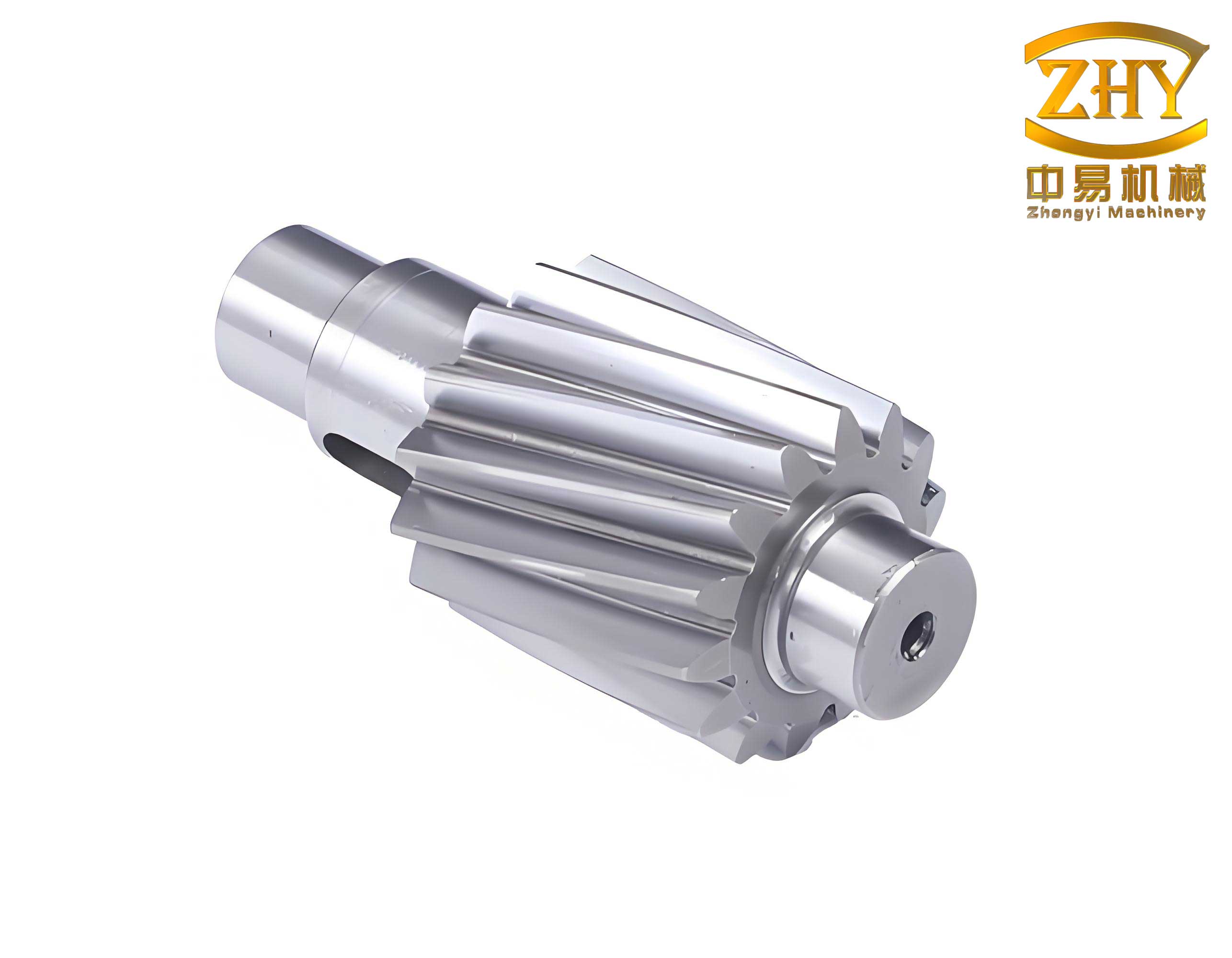
The revised design, as illustrated, adopts a two-point support system for the pinion section of the gear shaft. The input end of the shaft is now connected to the reducer via a universal joint (cardan shaft), which accommodates minor misalignments and reduces transmitted moments to the shaft. Two positioning collars are integrated onto the shaft to precisely maintain the optimal meshing alignment between the pinion and the large gear ring. This structural modification simplifies the support conditions, alleviates stress risers caused by misalignment, and forms the core of our enhanced gear shaft design. The subsequent sections elaborate on the material selection, dimensional design, and reliability verification of this improved gear shaft.
Material Selection for High-Performance Gear Shafts
The selection of material for gear shafts is governed by requirements for high strength, toughness, and fatigue resistance, especially when dimensional and weight constraints are present. For this application, we chose an alloy steel, 37SiMn2MoV, subjected to quenching and tempering (modulation) heat treatment. This material offers an excellent combination of mechanical properties suitable for承受 heavy loads and cyclic stresses common in coal unloader operations. The key material properties are summarized in Table 1.
| Property | Symbol | Value | Unit |
|---|---|---|---|
| Tensile Strength | $\sigma_B$ | 830 | MPa |
| Yield Strength | $\sigma_S$ | 785 | MPa |
| Bending Fatigue Limit (Symmetric) | $\sigma_{-1}$ | 395 | MPa |
| Torsional Fatigue Limit (Symmetric) | $\tau_{-1}$ | 230 | MPa |
| Surface Roughness | $R_a$ | ≤ 0.4 | μm |
The high fatigue limits are particularly crucial for gear shafts operating under fluctuating torsional and bending loads. The specified surface finish ($R_a \leq 0.4 \mu m$) is essential for minimizing stress concentrations at the surface, thereby enhancing the fatigue life of the components.
Preliminary Design and Dimensional Determination of the Gear Shaft
The initial design step for any gear shaft involves estimating the minimum shaft diameter based on transmitted torque, before the support reactions and bending moments are fully known. This diameter often corresponds to the shaft end or the smallest section. The formula for this torque-based preliminary calculation is:
$$ d \geq A \sqrt[3]{\frac{P}{n}} $$
where:
$d$ = estimated minimum shaft diameter (mm),
$P$ = power transmitted by the shaft (kW),
$n$ = rotational speed of the shaft (rpm),
$A$ = material-specific coefficient derived from empirical data.
For the alloy steel selected, referencing standard mechanical design manuals yields a coefficient $A = 98$ (for metric units, when stress is in MPa). The operational parameters for our gear shaft are:
$P = 191 \text{ kW}$,
$n = 31.47 \text{ rpm}$.
Substituting these values:
$$ d \geq 98 \times \sqrt[3]{\frac{191}{31.47}} = 98 \times \sqrt[3]{6.069} \approx 98 \times 1.823 \approx 178.7 \text{ mm} $$
Considering standard sizes and providing a margin, the preliminary minimum diameter is selected as $d = 190 \text{ mm}$.
The subsequent determination of radial dimensions along the gear shaft’s length follows principles of stress concentration minimization and assembly functionality. Diameter changes intended for fixing components or承受 axial loads require significant shoulders, while changes for mere assembly convenience can be more gradual. Accounting for bearing seat specifications and ensuring smooth stress flow, the stepped diameters are finalized. A primary diameter $d_1 = 200 \text{ mm}$ is chosen for critical sections, with generous transition fillet radii of $10 \text{ mm}$ to reduce stress concentration factors. The design of these gear shafts meticulously incorporates these features to enhance durability.
Detailed Stress Analysis and Safety Factor Verification
To ensure the reliability of the redesigned gear shaft, a safety factor approach based on fatigue strength analysis is employed. This method evaluates the shaft at its most critical cross-section, considering combined bending and torsional stresses under fluctuating loads.
The overall safety factor $S$ is calculated by combining the bending and torsional safety factors:
$$ S = \frac{S_\sigma \cdot S_\tau}{\sqrt{S_\sigma^2 + S_\tau^2}} \geq [S] $$
where $S_\sigma$ is the safety factor considering only bending moments, $S_\tau$ is the safety factor considering only torsional moments, and $[S]$ is the required allowable safety factor (typically 1.3 to 1.5 for reliable machinery).
The individual safety factors are given by:
$$ S_\sigma = \frac{\sigma_{-1}}{ \frac{K_\sigma}{\beta \varepsilon_\sigma} \sigma_a + \psi_\sigma \sigma_m } $$
$$ S_\tau = \frac{\tau_{-1}}{ \frac{K_\tau}{\beta \varepsilon_\tau} \tau_a + \psi_\tau \tau_m } $$
The parameters in these formulas are defined and their values selected as follows:
- Fatigue Limits: $\sigma_{-1} = 395 \text{ MPa}$, $\tau_{-1} = 230 \text{ MPa}$ (from Table 1).
- Life Factor ($K_N$): For infinite life design under assumed constant amplitude loading, $K_N = 1$.
- Stress Concentration Factors ($K_\sigma$, $K_\tau$): These are determined from charts based on geometry. For a diameter step from $D=260 \text{ mm}$ to $d=240 \text{ mm}$ with a fillet radius $r=5 \text{ mm}$:
- Bending stress concentration factor: $K_\sigma = 2.0$
- Torsional stress concentration factor: $K_\tau = 1.4$
- Surface Finish Factor ($\beta$): For a ground surface with $R_a \leq 0.4 \mu m$, $\beta = 0.9$.
- Size Factors ($\varepsilon_\sigma$, $\varepsilon_\tau$): For shaft diameters around 200-240 mm:
- Bending size factor: $\varepsilon_\sigma = 0.55$
- Torsional size factor: $\varepsilon_\tau = 0.60$
- Mean Stress Sensitivity Factors ($\psi_\sigma$, $\psi_\tau$): For the chosen alloy steel:
- $\psi_\sigma = 0.30$
- $\psi_\tau = 0.13$
- Stress Components ($\sigma_a$, $\sigma_m$, $\tau_a$, $\tau_m$): These are derived from the load analysis of the gear shaft under operational conditions. The two-point support design and universal joint connection simplify the load model. Based on force and moment diagrams:
- Bending stress is primarily alternating with a near-zero mean due to the rotating shaft ($\sigma_m \approx 0$). The stress amplitude $\sigma_a$ is calculated from the resultant bending moment $M$ at the critical section and the section modulus $W$: $\sigma_a = M / W$.
- Torsional stress is considered as pulsating. The shear stress amplitude $\tau_a$ and mean stress $\tau_m$ are derived from the transmitted torque $T$ and the polar section modulus $W_t$: $\tau_a = \tau_m = T / (2 W_t)$ for steady torque transmission.
For calculation, let the resultant bending moment at the critical notch section be $M = 45 \text{ kN·m}$, and the transmitted torque be $T = 58 \text{ kN·m}$. The section moduli for a diameter $d=240 \text{ mm}$ are:
$W = \frac{\pi d^3}{32} = \frac{\pi (0.240)^3}{32} \approx 1.357 \times 10^{-3} \text{ m}^3$,
$W_t = \frac{\pi d^3}{16} = 2.714 \times 10^{-3} \text{ m}^3$.
Thus,
$\sigma_a = \frac{45 \times 10^3}{1.357 \times 10^{-3}} \approx 33.16 \times 10^6 \text{ Pa} = 33.16 \text{ MPa}$, $\sigma_m \approx 0 \text{ MPa}$.
$\tau_a = \tau_m = \frac{58 \times 10^3}{2 \times 2.714 \times 10^{-3}} \approx 10.68 \times 10^6 \text{ Pa} = 10.68 \text{ MPa}$.
Substituting all values into the safety factor equations:
$$ S_\sigma = \frac{395}{ \frac{2.0}{0.9 \times 0.55} \times 33.16 + 0.30 \times 0 } = \frac{395}{ \frac{2.0}{0.495} \times 33.16 } = \frac{395}{4.040 \times 33.16} = \frac{395}{134.0} \approx 2.95 $$
$$ S_\tau = \frac{230}{ \frac{1.4}{0.9 \times 0.60} \times 10.68 + 0.13 \times 10.68 } = \frac{230}{ \frac{1.4}{0.54} \times 10.68 + 1.388 } = \frac{230}{2.593 \times 10.68 + 1.388} = \frac{230}{27.69 + 1.388} = \frac{230}{29.08} \approx 7.91 $$
The combined safety factor is:
$$ S = \frac{2.95 \times 7.91}{\sqrt{2.95^2 + 7.91^2}} = \frac{23.33}{\sqrt{8.70 + 62.57}} = \frac{23.33}{\sqrt{71.27}} = \frac{23.33}{8.44} \approx 2.76 $$
This result, $S \approx 2.76$, significantly exceeds the required safety factor $[S] = 1.3$ to $1.5$. Therefore, the fatigue strength of the redesigned gear shaft is more than adequate, confirming its structural integrity and potential for extended life.
Comparative Analysis and Life Extension Implications
The improvement from a three-point to a two-point support system fundamentally alters the load-bearing characteristics of the gear shaft. Table 2 summarizes the key comparative aspects before and after the redesign, highlighting the benefits for the gear shafts.
| Aspect | Original Design (Three-Point Support) | Improved Design (Two-Point Support + Universal Joint) |
|---|---|---|
| Support Structure | Statically indeterminate, three bearing seats. | Statically determinate, two bearing seats. |
| Alignment Sensitivity | High. Misalignment induces high bending moments and stresses. | Low. Universal joint absorbs misalignment; supports are self-aligning. |
| Stress Concentration | Potentially high at third support due to forced alignment. | Reduced and more predictable, primarily at designed notches. |
| Meshing Condition | Prone to variation due to shaft deflection from misalignment. | Positively controlled by positioning collars, ensuring constant optimal mesh. |
| Calculated Safety Factor (Fatigue) | Lower (theoretically below or near minimum allowable due to uncalculated stresses). | High ($S \approx 2.76$), indicating substantial strength reserve. |
| Expected Service Life | Shortened due to accelerated fatigue failure. | Significantly extended due to reduced stress amplitudes and better load distribution. |
The universal joint at the input decouples the gear shaft from direct moments due to reducer misalignment, allowing the two main bearings to support the shaft primarily under torsion and the bending moment generated solely by the gear mesh forces. This leads to a more favorable and predictable stress state. The positioning collars axially locate the pinion, maintaining the precise engagement with the large gear ring, which is critical for smooth power transmission and minimal noise and vibration. These collective improvements directly contribute to the enhanced durability and reliability of the gear shafts in this demanding application.
Discussion on Reliability and Further Optimization of Gear Shafts
The safety factor method provides a deterministic assessment. However, the reliability of gear shafts can be further analyzed probabilistically to account for uncertainties in material properties, loading, and manufacturing tolerances. The high deterministic safety factor ($S=2.76$) implies a very low probability of failure. The fatigue life $N_f$ of such gear shafts under cyclic stress can be estimated using the Basquin’s equation:
$$ \sigma_a = \sigma_f’ (2N_f)^b $$
where $\sigma_a$ is the stress amplitude, $\sigma_f’$ is the fatigue strength coefficient, and $b$ is the fatigue strength exponent. For high-strength alloy steels like 37SiMn2MoV, the large gap between operating stress amplitude and the material’s endurance limit suggests an exceptionally long fatigue life, potentially infinite for the designed stress levels.
Potential areas for further optimization of these gear shafts include:
- Surface Enhancement: Applying shot peening or nitriding to introduce compressive residual stresses on the surface, thereby further raising the effective fatigue limit.
- Fillet Optimization: Using larger transition radii or elliptical fillets to reduce the stress concentration factors $K_t$ even more.
- Condition Monitoring: Implementing vibration analysis or thermal monitoring on the bearing seats to detect any abnormal wear early, ensuring proactive maintenance.
The design philosophy emphasizes robustness. By simplifying the support conditions, we inherently reduce the number of potential failure modes. The reliability of these critical gear shafts is thus built into the architecture itself, rather than relying solely on precision manufacturing and installation. This is a significant advantage in harsh industrial environments like coal handling terminals.
Conclusion
Through detailed engineering analysis and redesign, we have successfully developed and validated an improved configuration for the pinion gear shaft in an O-type coal unloader tumbling machine. The core improvement lies in replacing the problematic three-point support with a robust two-point support system and integrating a universal coupling. This modification directly addresses the root cause of premature failure—misalignment-induced stress. The comprehensive design process, encompassing material selection, preliminary sizing based on torque, detailed dimensional planning, and rigorous fatigue safety factor verification, confirms that the new gear shaft design operates well within safe stress limits. The calculated combined safety factor of approximately 2.76 far exceeds industry standards, indicating a substantial margin of safety and a strong potential for extended service life. The enhanced design ensures more stable and reliable meshing between the pinion and the large gear ring, leading to smoother power transmission, reduced downtime, and lower maintenance costs. This case study underscores the importance of critical evaluation and innovative redesign of foundational components like gear shafts to achieve breakthrough improvements in the reliability and efficiency of heavy industrial machinery.