
The transmission of motion and power between parallel shafts is a fundamental requirement in mechanical systems, with spur and helical cylindrical gears serving as the predominant solutions. Among these, involute profiles have achieved near-universal adoption due to their advantageous properties, including smooth action, insensitivity to center distance variation (within limits), and the constancy of the pressure angle during meshing. A wide array of manufacturing processes, such as hobbing, shaping, and grinding, has been developed to produce these cylindrical gears efficiently and accurately.
However, conventional involute cylindrical gears are not without their significant drawbacks. They exhibit a high sensitivity to assembly errors, particularly angular misalignments. Such misalignments can lead to discontinuous linear transmission error (TE) functions, which are primary excitations for vibration and noise. Furthermore, they often result in edge loading, a condition that drastically reduces the service life of the gear drive. Another inherent limitation is the presence of sliding between the contacting tooth surfaces, which contributes to frictional losses, wear, and heat generation. These factors collectively drive the pursuit of alternative gear geometries that can offer improved performance characteristics.
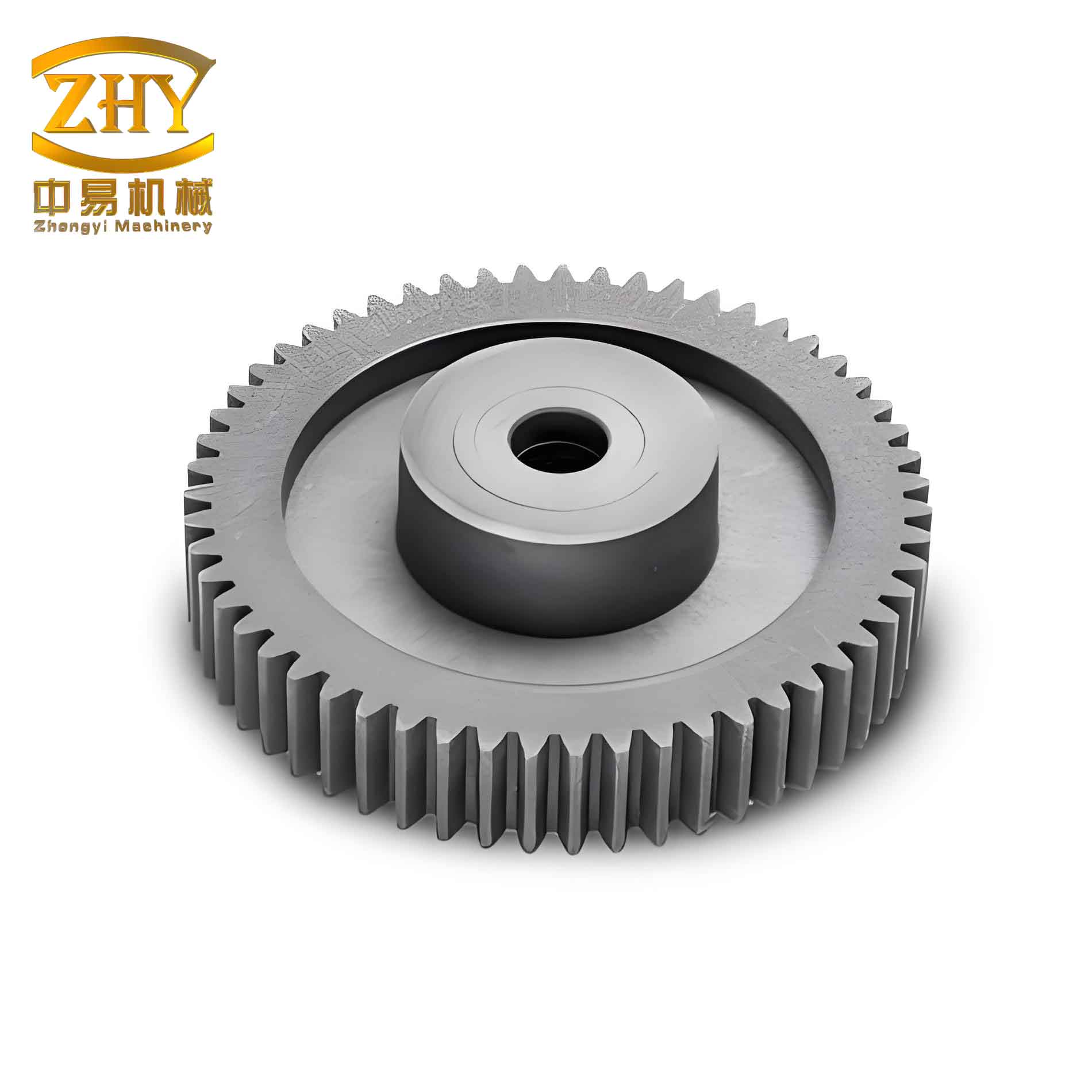
Curvilinear cylindrical gears, characterized by teeth that are curved along the face width direction, present a compelling alternative. The concept dates back over a century, finding early applications in heavy industries. Research has extensively covered their generation methods, mathematical modeling, and performance analysis, revealing benefits such as zero net axial thrust, superior lubrication conditions, enhanced misalignment accommodation, and localized contact patterns. Traditionally, these gears are manufactured via generation methods using specific cutters (e.g., face-mill cutters or hobs). While effective, this generative approach imposes constraints on the attainable tooth surface geometry, limiting it primarily to the parameters of the tool. This can lead to design limitations like undercutting or pointed teeth at certain parameter combinations.
This study introduces a novel design paradigm for pure rolling cylindrical gears with a circular arc tooth trace. This approach fundamentally departs from generative manufacturing. The tooth surface geometry is not a byproduct of a toolpath but is actively synthesized based on a pre-defined pure rolling contact condition. This grants unprecedented freedom in tooth surface design, unshackled from the constraints of tool geometry and minimum tooth number limits. The advent of additive manufacturing (AM) provides a viable, non-generative route for fabricating such complex geometries, opening possibilities for materials beyond traditional steels, including polymers, composites, and advanced alloys. As AM precision and throughput improve, research into novel, non-generated gear types, like the one proposed here, is gaining significant momentum.
The core methodology involves the active design of a meshing line function that enforces a pure rolling condition at the theoretical contact point. The entire tooth flank is then constructed by sweeping a specially crafted, combined transverse tooth profile along the path defined by this meshing line. This paper details the geometric design, establishes the complete mathematical model, and conducts a comprehensive meshing performance analysis through Tooth Contact Analysis (TCA) and stress evaluation via Finite Element Analysis (FEA). The performance of the proposed circular arc tooth trace cylindrical gears is benchmarked against both pure rolling cylindrical gears with a parabolic tooth trace and traditionally modified involute helical gears.
Fundamental Principle of Pure Rolling Meshing and Active Design
The foundational concept is to prescribe the path of the contact point between a pair of mating cylindrical gears such that relative sliding at the contact point is theoretically eliminated, leaving only pure rolling motion. This prescribed path is known as the meshing line or line of action in a fixed coordinate system.
Consider a gear pair with a center distance $a$, where the pinion and gear have base circle radii $r_{b1}$ and $r_{b2}$, and angular velocities $\omega_1$ and $\omega_2$, respectively. For a point $M$ on the meshing line, the condition for conjugate action (constant angular velocity ratio) is that it must lie on the common tangent to the two base cylinders. The pure rolling condition adds the constraint that the relative velocity at the contact point, tangential to the tooth surfaces, must be zero. This can be expressed as:
$$ \vec{v}_{12}^{(M)} = \vec{v}_{1}^{(M)} – \vec{v}_{2}^{(M)} = 0 $$
where $\vec{v}_{1}^{(M)}$ and $\vec{v}_{2}^{(M)}$ are the velocities of the material points on the pinion and gear that are in contact at $M$.
By defining the trajectory of point $M$ in a fixed coordinate system $S_f(x_f, y_f, z_f)$—where the $z_f$-axis is parallel to the gear axes—we can derive the corresponding tooth flanks. Let this trajectory, the meshing line, be parameterized by a variable $t$:
$$ \vec{r}_f^{(M)}(t) = [x_f(t), y_f(t), z_f(t)]^T $$
For parallel axis cylindrical gears, the meshing line lies in a plane parallel to the axes. A common and effective design is to have $x_f(t)=0$, placing the meshing line in the $y_f-z_f$ plane, symmetric about the $y_f$ axis. The function $z_f(t)$ directly controls the curvature of the tooth trace along the face width. In this work, we examine two specific functions:
- Parabolic Function (for comparison): $z_f(t) = \pm c_p \cdot (k_{\phi} t R_1)^2$, where $c_p$ is a parabolic coefficient, $k_{\phi}$ is a motion coefficient relating $t$ to pinion rotation $\phi_1$, and $R_1$ is the pinion pitch radius.
- Circular Arc Function (proposed): $z_f(t) = \pm \sqrt{r_c^2 – (k_{\phi} t R_1 – r_c)^2}$ for $0 \le t \le t_{max}$, where $r_c$ is the radius of the circular arc formed when the tooth trace is developed onto a plane.
The sign $\pm$ accounts for the two symmetric contact paths (upper and lower) originating from a single start point. The relationship between the parameter $t$ and the gear rotations is linear:
$$ \phi_1 = k_{\phi} t, \quad \phi_2 = \phi_1 / i_{12} $$
where $i_{12}$ is the gear ratio. The path of point $M$ on the rotating gear blanks defines the pre-designed contact curves, $C_1$ on the pinion and $C_2$ on the gear. The tooth surfaces $\Sigma_1$ and $\Sigma_2$ are then generated as the envelope of the transverse tooth profile as it is swept along these space curves $C_1$ and $C_2$, respectively.
Geometric Design and Mathematical Model of the Combined Transverse Tooth Profile
The transverse tooth profile, which is swept along the contact curve, is not a standard involute. It is a composite curve designed to provide a favorable root fillet and controlled contact region. The profile is constructed using four control points: $P_{ai}$ (addendum), $P_i$ (pitch point), $P_{di}$ (start of fillet), and $P_{ei}$ (root), where $i=1,2$ denotes pinion and gear. The composite profile from tip to root consists of three segments smoothly connected at $P_i$ and $P_{di}$:
- Circular Arc Segment ($\Sigma_{Cir}$): Connects $P_{ai}$ to $P_i$. It is a circular arc whose center lies on the perpendicular bisector of chord $P_i P_{ai}$.
- Involute Segment ($\Sigma_{Inv}$): Connects $P_i$ to $P_{di}$. This is a segment of a standard involute curve originating from the base circle of a reference gear with the same basic design parameters (module, pressure angle, number of teeth).
- Hermite Curve Segment ($\Sigma_{Her}$): Connects $P_{di}$ to $P_{ei}$, forming the root fillet. A cubic Hermite spline is used, defined by the positions ($P_{di}$, $P_{ei}$) and tangent vectors at these points, ensuring $G^1$ continuity with the involute segment at $P_{di}$.
The mathematical representation of these curves is established in specific local coordinate systems. For the involute segment $\Sigma_{Inv}^l$ of the left-side profile, in its local involute coordinate system $S_{Inv}$, the vector equation is:
$$ \vec{r}_{Inv}^{(l)}(u) =
\begin{bmatrix}
r_b (\sin u – u \cos u) \\
r_b (\cos u + u \sin u) \\
0 \\
\end{bmatrix}, \quad u_{di} \le u \le u_{pi}
$$
where $r_b$ is the base radius, $u$ is the involute roll angle, $u_{pi}$ corresponds to control point $P_i$, and $u_{di}$ corresponds to control point $P_{di}$.
The circular arc segment $\Sigma_{Cir}^l$ is defined in a local profile coordinate system $S_{pi}$ attached at point $P_i$:
$$ \vec{r}_{pi}^{(Cir,l)}(\xi) =
\begin{bmatrix}
\rho \sin \xi \\
\rho \cos \xi – \rho \\
0 \\
\end{bmatrix}, \quad \xi_{min} \le \xi \le \xi_{max}
$$
where $\rho$ is the radius of the circular arc and $\xi$ is its angular parameter.
The Hermite curve $\Sigma_{Her}^l$ between $P_{di}$ and $P_{ei}$ is defined parametrically by:
$$ \vec{r}_{Her}^{(l)}(s) = H_{00}(s)\vec{P}_{di} + H_{10}(s)\vec{T}_{di} + H_{01}(s)\vec{P}_{ei} + H_{11}(s)\vec{T}_{ei}, \quad 0 \le s \le 1 $$
where $H_{00}, H_{10}, H_{01}, H_{11}$ are the Hermite basis functions, and $\vec{T}_{di}$, $\vec{T}_{ei}$ are the tangent vectors at the endpoints, scaled by weight factors $T_H$.
The final tooth surface $\Sigma_1$ for the pinion is obtained by transforming the transverse profile coordinates to the global pinion coordinate system $S_1$, while simultaneously subjecting the control point $P_i$ (and thus the entire profile) to the spatial motion defined by the pre-designed contact curve $C_1(\phi_1)$. This is a sweeping operation. If $\vec{r}_{p}^{(j)}(\theta)$ represents a point on the transverse profile segment $j$ (where $j$ denotes Cir, Inv, or Her) in the mid-plane coordinate system, the corresponding point on the 3D tooth surface is:
$$ \vec{r}_1^{(j)}(\theta, \phi_1) = M_{1p}(\phi_1) \cdot \vec{r}_{p}^{(j)}(\theta) $$
where $M_{1p}(\phi_1)$ is a coordinate transformation matrix that includes the rotation $\phi_1$ of the pinion and the translation $z_f(\phi_1/k_{\phi})$ along its axis. A similar process defines the gear tooth surface $\Sigma_2$.
Design Parameters and Case Studies for Performance Comparison
To rigorously evaluate the proposed gear design, four distinct cases are defined and analyzed. The common basic design parameters for all cases are listed in Table 1.
| Parameter | Symbol | Value |
|---|---|---|
| Pinion Tooth Number | $Z_1$ | 30 |
| Gear Ratio | $i_{12}$ | 2.0 |
| Normal Module | $m_n$ | 2.0 mm |
| Normal Pressure Angle | $\alpha_n$ | 20° |
| Helix Angle (for helical gears) | $\beta$ | 22.1474° |
| Addendum Coefficient | $h_{a}^{*}$ | 1.0 |
| Dedendum Coefficient | $c^{*}$ | 0.25 |
| Face Width | $b$ | 50 mm |
Based on these, key derived geometric parameters are calculated:
$$ m_t = \frac{m_n}{\cos \beta}, \quad \alpha_t = \arctan\left(\frac{\tan \alpha_n}{\cos \beta}\right), \quad R_i = \frac{Z_i m_t}{2} $$
$$ R_{ai} = R_i + h_{a}^{*}m_n, \quad R_{fi} = R_i – (h_{a}^{*} + c^{*})m_n $$
where $m_t$ is the transverse module, $\alpha_t$ is the transverse pressure angle, $R_i$ is the pitch radius, $R_{ai}$ is the addendum radius, and $R_{fi}$ is the dedendum radius.
The specific parameters for the two types of pure rolling cylindrical gears are detailed in Table 2. The parameters $k_{\chi a}$, $k_d$, $k_{\eta}$, and $k_{\lambda}$ control the positions of the key profile control points $P_{ai}$, $P_{di}$, $P_{ei}$, and the tooth thickness, respectively.
| Parameter | Symbol | Value |
|---|---|---|
| Motion Coefficient | $k_{\phi}$ | $\pi$ |
| Parameter Range | $t_{max}$ | 0.1 |
| Point $P_d$ Position Coefficient | $k_d$ | 0.75 |
| Pinion Arc Rotation Coefficient | $k_{\chi a1}$ | 0.11 |
| Gear Arc Rotation Coefficient | $k_{\chi a2}$ | 0.04 |
| Pinion Hermite Tangent Weight | $T_{Hp}$ | 0.5 |
| Gear Hermite Tangent Weight | $T_{Hg}$ | 0.7 |
| Tooth Space Angle Coefficient | $k_{\eta}$ | 0.02 |
| Tooth Thickness Angle Coefficient | $k_{\lambda}$ | 0.02 |
Case 1 represents the proposed cylindrical gears with a circular arc tooth trace ($r_c$ derived from design). Case 2 represents the pure rolling cylindrical gears with a parabolic tooth trace ($c_p$ derived from design). To provide a meaningful benchmark, Cases 3 and 4 are traditional involute helical gears with different micro-geometry modifications applied to achieve a contact pattern size comparable to Cases 1 and 2. The modification schemes are summarized in Table 3.
| Case | Gear Type | Lead Modification | Profile Modification |
|---|---|---|---|
| 1 | Circular Arc Trace | Parabolic, 2 µm | None (by design) |
| 2 | Parabolic Trace | Parabolic, 2 µm | None (by design) |
| 3 | Helical Gear | Crowned, 10 µm | Tip Relief, 60 µm |
| 4 | Helical Gear | Parabolic, 10 µm | Crowned, 60 µm |
Meshing Performance Analysis: Methodology and Results
The performance of the four gear sets is evaluated through two computational techniques: Tooth Contact Analysis (TCA) and Finite Element Analysis (FEA).
Tooth Contact Analysis (TCA)
TCA is performed under ideal alignment conditions to simulate the unloaded meshing behavior. The algorithm solves the system of equations representing the contact condition between the theoretical pinion and gear surfaces, including the equation of meshing. The outputs are the path of contact on the tooth flanks (contact pattern) and the unloaded transmission error (TE), defined as $\Delta \phi_2 = \phi_2 – \phi_1 / i_{12}$.
The contact patterns for the pinion of all four cases are illustrated conceptually. The patterns for Cases 1 and 2 are nearly identical, showing a symmetric, semi-elliptical contact area centered on the tooth mid-plane. The instantaneous contact ellipses align such that their major axes are oriented more across the face width near the ends and more along the face width near the center. This is a direct consequence of the pure rolling design and the parabolic/arc-shaped contact path. Critically, the contact pattern is symmetric, indicating no net axial thrust is generated.
For Cases 3 and 4 (helical gears), the contact pattern consists of parallel, straight-ish ellipses running diagonally across the face width, typical of helical gears with crowning. The pattern shape is very similar between the two modification schemes in this study.
The unloaded TE curves for Cases 1 and 2 are parabolic in shape, with a significant amplitude (on the order of tens of arc-seconds). This parabolic TE is intentionally designed through the lead modification and is beneficial as it provides a forgiving “absorption region” for small misalignments, preventing edge contact and avoiding discontinuous, impulse-like TE that excites vibration. Cases 3 and 4 also exhibit parabolic TE functions due to their applied modifications, but with a much smaller amplitude (around 1.5 arc-seconds).
Finite Element Analysis (FEA) for Loaded Performance
To assess the structural performance under load, 3D finite element models are constructed. For the pure rolling cylindrical gears (Cases 1 & 2), a model of five tooth pairs is used. For the helical gears (Cases 3 & 4), a model of seven tooth pairs is used to account for their higher contact ratio. A torque of 300 Nm is applied to the pinion shaft. The analysis is performed over 21 discrete, successive mesh positions covering two pinion angular pitches. Key results extracted are:
- Maximum Surface Contact Stress (von Mises): Evaluated on the pinion tooth flank.
- Maximum Bending Stress (Principal Stress): Evaluated at the root fillet of both pinion and gear.
- Loaded Transmission Error: Calculated from the angular displacement of the gear relative to its rigid-body position under load, incorporating tooth bending and contact deformations.
The variation of the maximum von Mises contact stress on the pinion over the mesh cycle is plotted. The curves for Cases 1 and 2 are very close, with Case 1 showing a slightly higher peak. The curves for Cases 3 and 4 are virtually superimposed. The peak contact stress values for all four cases are relatively similar, with differences within 6%. The contact stress distribution on the pinion surface at a mid-mesh position visually confirms the contact patterns predicted by TCA. For Cases 1 and 2, the load is shared between two pairs: one pair carries load near the center of the face width with a large contact ellipse, while the adjacent pairs carry load near the ends with smaller ellipses. For Cases 3 and 4, the load is distributed among three pairs of teeth.
The variation of the maximum root bending stress is a critical indicator of gear strength. The results, plotted separately for pinion and gear, reveal significant insights:
- Pinion Root Stress: Cases 1 and 2 exhibit nearly identical, low-stress curves. Cases 3 and 4 show superimposed curves with peak stresses approximately 25% higher than those of Cases 1 and 2.
- Gear Root Stress: Again, Cases 1 and 2 are similar. Interestingly, for the pure rolling cylindrical gears, the gear experiences a slightly higher root stress than the pinion. For Cases 3 and 4, the gear root stress is lower than the pinion root stress but still about 12-13% higher than the gear root stress in Cases 1/2.
This demonstrates a clear bending stress advantage for the novel pure rolling cylindrical gears.
The loaded transmission error (LTE) curves under the applied torque maintain the parabolic shape but with reduced amplitude compared to the unloaded TE, as tooth compliance allows some “absorption” of the kinematic error. Crucially, the LTE amplitude for Cases 1 and 2 (approx. 29″ and 27″) remains much larger than that for Cases 3 and 4 (approx. 1.5″). A larger, smooth parabolic LTE can be more effective in accommodating misalignments without losing contact or generating impulsive loads.
Synthesis of Results and Discussion
The comprehensive analysis allows for a consolidated performance comparison, summarized in Table 4.
| Performance Indicator | Case 1: Circular Arc | Case 2: Parabolic | Case 3: Helical (Crowned Lead) | Case 4: Helical (Parabolic Lead) |
|---|---|---|---|---|
| Contact Pattern Shape | Symmetric, central elliptical | Symmetric, central elliptical | Diagonal, straight band | Diagonal, straight band |
| Axial Thrust | Theoretically Zero | Theoretically Zero | Present (balanced in pair) | Present (balanced in pair) |
| Peak Contact Stress | Highest | ~3% lower than Case 1 | ~5% lower than Case 1 | ~5% lower than Case 1 |
| Peak Pinion Bending Stress | Low | Lowest (~3% lower than Case 1) | High (~25% higher than Case 2) | High (~25% higher than Case 2) |
| Peak Gear Bending Stress | Low (slightly > Pinion) | Lowest (~2% lower than Case 1) | Moderate (~13% higher than Case 2) | Moderate (~13% higher than Case 2) |
| Loaded TE Amplitude | ~29 arc-seconds | ~27 arc-seconds | ~1.5 arc-seconds | ~1.5 arc-seconds |
| Misalignment Sensitivity | Low (due to large designed parabolic TE) | Low (due to large designed parabolic TE) | Moderate (controlled by small modifications) | Moderate (controlled by small modifications) |
The results lead to several important conclusions. First, the two pure rolling cylindrical gears (circular arc and parabolic trace) exhibit remarkably similar performance across all metrics—contact pattern, stresses, and TE. This suggests that the specific function governing the tooth trace curvature (arc vs. parabola) has a secondary effect when the fundamental principle of pure-rolling-based active design is employed.
Second, and more significantly, the pure rolling cylindrical gears demonstrate a distinct advantage in root bending stress compared to the modified helical gears. The reduction in pinion root stress is particularly beneficial as the pinion typically undergoes more stress cycles and is the more critical component for bending fatigue life. The contact stresses are comparable, indicating no penalty in surface durability.
Third, the inherently large, parabolic loaded transmission error of the pure rolling designs is a deliberate feature. While often minimized in traditional high-precision gear design, a smooth, parabolic LTE of significant amplitude is highly effective in mitigating the effects of installation errors and manufacturing deviations, preventing edge contact and ensuring a stable, albeit slightly less kinematically precise, meshing condition. This makes such gears robust for applications where perfect alignment cannot be guaranteed.
Finally, the active design methodology, decoupled from generative manufacturing constraints, provides exceptional flexibility. The geometry can be optimized for specific load cases, weight targets, or material properties, making it highly suitable for advanced manufacturing techniques like additive manufacturing.
Conclusion and Future Work
This study has presented a complete framework for the design, modeling, and analysis of a novel type of pure rolling cylindrical gear with a circular arc tooth trace. The gears are actively designed based on a prescribed pure rolling meshing line, and their tooth surfaces are synthesized by sweeping a composite transverse profile along the resulting contact path. A detailed mathematical model has been developed.
Performance analysis confirms that the proposed cylindrical gears offer a compelling combination of attributes: significantly reduced tooth root bending stress (especially for the pinion), contact stress levels comparable to state-of-the-art modified helical gears, and a robust meshing behavior characterized by a large, forgiving parabolic transmission error that accommodates misalignment. These features, combined with the potential for zero axial thrust, make this gear topology attractive for applications requiring high durability, compact design, and reliability under less-than-ideal mounting conditions.
Future work will focus on several key areas:
- Investigating the sensitivity of the design to variations in the control point positions and the arc/parabola parameters to establish optimization guidelines.
- Conducting detailed analysis under misaligned conditions (parallel, angular, and combined) to quantitatively validate the misalignment insensitivity.
- Exploring efficient additive manufacturing processes for these complex geometries and experimentally validating the performance predictions through physical testing of manufactured prototypes.
- Extending the active design methodology to other gear types, such as crossed-axis helical gears or non-parallel axis configurations, further expanding the potential applications of this innovative design philosophy.
The evolution of gear design, fueled by advanced computational tools and novel manufacturing methods like AM, continues to open new frontiers. The pure rolling cylindrical gears studied here represent a meaningful step towards higher-performance, application-tailored gear drives.