
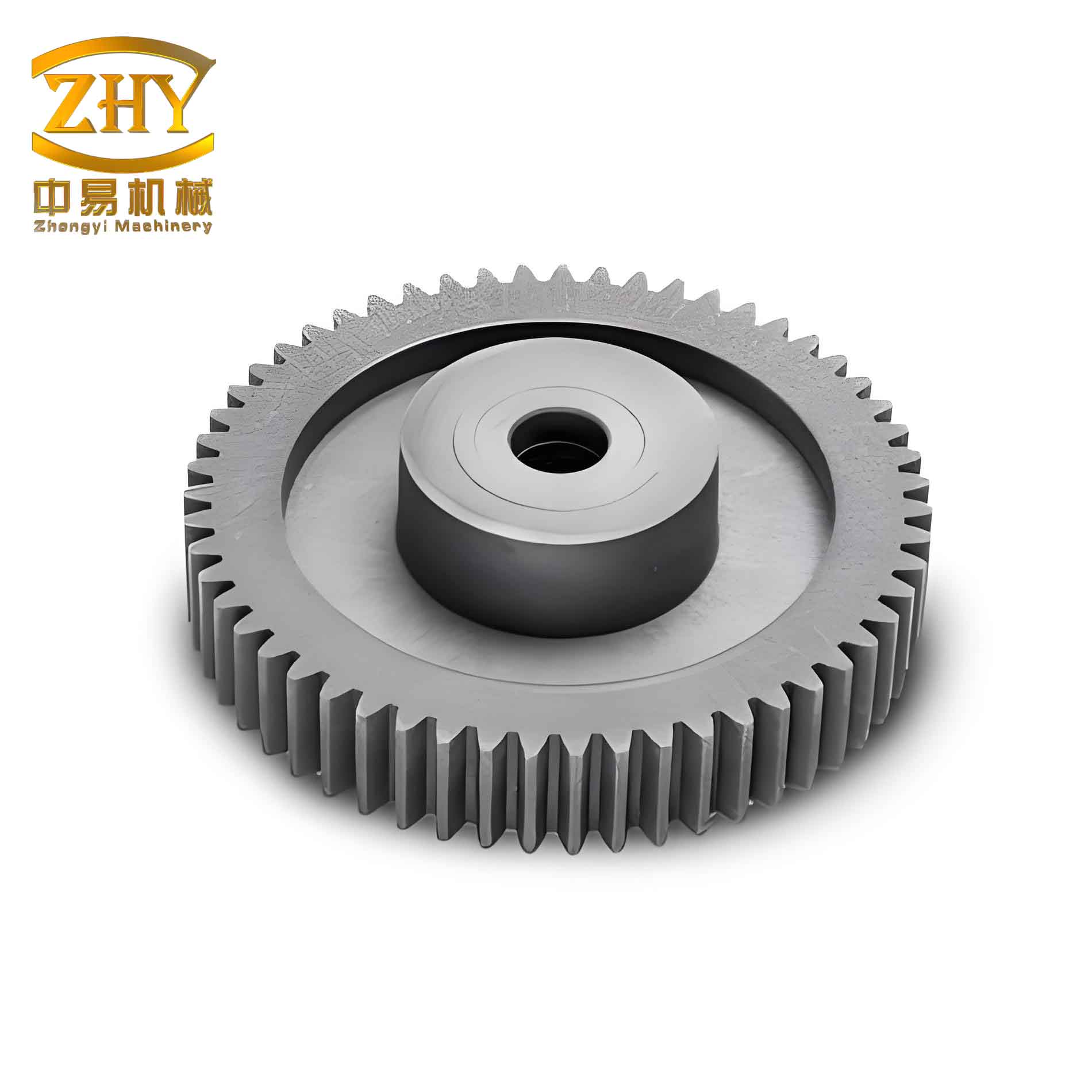
In the realm of power transmission, the cylindrical gear is the most ubiquitous component. Traditional variants such as spur, helical, and double-helical (herringbone) gears each present a well-known set of compromises between manufacturability, load capacity, noise, and axial thrust. This study introduces a novel configuration for a cylindrical gear that seeks to reconcile these trade-offs: a cylindrical gear whose tooth trace in the axial direction follows a cycloidal curve. This geometry enables a highly efficient manufacturing process known as continuous-index milling, while simultaneously offering performance benefits such as smooth meshing, high load capacity, and the absence of net axial force. The core of this innovation lies not only in the gear’s unique geometry but also in the symbiotic design of a specialized disc milling cutter, which facilitates rapid, standardized production. This treatise details the mathematical foundation, geometric modeling, and manufacturing principles of this new class of cylindrical gear.
Geometric Generation and Mathematical Model
1.1 Geometry of the Generating Rack and the Cycloidal Curve
The proposed cylindrical gear is generated from an imaginary rack whose tooth flank, in the direction of the gear axis, is a cycloid. This is fundamentally different from the straight or helical lines found in standard racks for spur or helical cylindrical gears. To understand the generating rack, we first derive the cycloidal curve.
Consider a circle C of radius \(R_b\) rolling without slipping along a straight line \(P\), which represents the pitch line of the imaginary rack. A point \(M\) is fixed at a distance \(R_t\) from the center \(O_0\) of circle \(C\). As the circle rolls, point \(M\) traces an extended epicycloid (or simply a cycloid for this path) relative to the stationary frame. The derivation begins by defining coordinate systems \(S_0(O_0, X_0, Y_0)\) fixed to the circle’s center and \(S_t(O_t, X_t, Y_t)\) fixed to the translating/rotating circle.
The position vector of point \(M\) in \(S_t\) is:
$$ \mathbf{r}_t = \begin{pmatrix} 0 \\ -R_t \\ 1 \end{pmatrix} $$
After the circle has rolled through an angle \(\theta\), the transformation from \(S_t\) to the fixed frame \(S_0\) is given by the homogeneous transformation matrix \(\mathbf{M}_{0t}\):
$$ \mathbf{M}_{0t} = \begin{bmatrix} \cos\theta & -\sin\theta & 0 & -L_1 \\ \sin\theta & \cos\theta & 0 & -R_b \\ 0 & 0 & 1 & 0 \\ 0 & 0 & 0 & 1 \end{bmatrix} $$
where \(L_1 = \theta R_b\), representing the linear displacement of the circle’s center. The coordinates of the cycloid in \(S_0\) are found by \(\mathbf{r}_0 = \mathbf{M}_{0t} \mathbf{r}_t\):
$$ \begin{cases} X_0 = R_b\theta – R_t \sin\theta \\ Y_0 = -R_t \cos\theta \end{cases} $$
To position this curve as one flank of the generating rack, we translate it to a coordinate system \(S_1(O_1, X_1, Y_1)\) fixed at the rack’s datum line. The final expression for a point on the rack surface in \(S_1\) is:
$$ \mathbf{r}_1(u, \theta) = \begin{pmatrix} R_b\theta – (R_t + u \tan\alpha) \sin\theta + L_2 \\ R_b – (R_t + u \tan\alpha) \cos\theta \\ u \end{pmatrix} $$
where:
\(u\): Parameter along the gear axis (width direction).
\(\alpha\): Profile pressure angle of the rack (constant along the cycloidal trace).
\(L_2 = \dfrac{R_b}{\tan[\arcsin(R_b/R_t)]} – R_b \arccos(R_b/R_t)\): A constant offset to align the curve correctly on the rack pitch line.
Equation (1) defines a ruled surface. For a fixed \(u\), the cross-section is a cycloid. As \(u\) varies, the amplitude of the cycloid scales linearly, creating the three-dimensional flank of the imaginary rack used to generate the novel cylindrical gear.
1.2 Meshing Theory and Derivation of the Gear Tooth Surface
The tooth surface of the generated cylindrical gear is the envelope of the family of rack surfaces defined by Eq. (1) in its relative motion with respect to the gear blank. The meshing process follows the fundamental law of gearing: at any point of contact, the common normal vector \(\mathbf{n}\) to the two surfaces must be perpendicular to their relative velocity vector \(\mathbf{v}_{12}\). This ensures continuous, sliding contact without interference or separation.
We establish a fixed coordinate system \(S_f\) and moving systems \(S_1\) (rack) and \(S_2\) (gear). The rack translates with velocity \(v = r_p \dot{\phi}\) along \(X_f\), where \(r_p\) is the gear’s pitch radius and \(\dot{\phi}\) is the gear’s angular velocity. The gear rotates with angular velocity \(\boldsymbol{\omega} = (0, 0, \dot{\phi})^T\). The equation of meshing is:
$$ \mathbf{v}_{12} \cdot \mathbf{n} = 0 $$
The rack surface in the fixed frame \(S_f\) at time \(t\) (or for a gear rotation \(\phi = \dot{\phi}t\)) is:
$$ \mathbf{r}_f(u, \theta, t) = \begin{pmatrix} R_b\theta – (R_t + u \tan\alpha) \sin\theta + L_2 + r_p \dot{\phi}t \\ R_b – (R_t + u \tan\alpha) \cos\theta \\ u \end{pmatrix} $$
The relative velocity at a point on the rack surface is \(\mathbf{v}_{12} = \boldsymbol{\omega} \times \mathbf{r}_f = (-\dot{\phi}y_f, \dot{\phi}x_f, 0)^T\). The normal vector \(\mathbf{n}\) is calculated from the partial derivatives of \(\mathbf{r}_f\) with respect to \(u\) and \(\theta\). Substituting into the equation of meshing yields, after simplification, a quadratic equation in \(u\):
$$ A u^2 + B u + C = 0 $$
where the coefficients \(A, B, C\) are functions of \(\theta\) and \(t\) (or \(\phi\)):
$$
\begin{aligned}
A &= -\sin\theta (\tan^3\alpha + \tan\alpha) \\
B &= \tan^2\alpha [L_2 + r_p \dot{\phi}t + R_b\theta – R_t \sin\theta – \sin\theta(R_t – R_b\cos\theta)] – R_t \sin\theta \\
C &= \tan\alpha (R_t – R_b\cos\theta) (L_2 + r_p \dot{\phi}t + R_b\theta – R_t \sin\theta)
\end{aligned}
$$
Solving Eq. (3) provides the relation \(u = u(\theta, t)\) for points on the rack that are in contact with the gear at instant \(t\). The two roots correspond to the two contact lines (one on each flank of the rack tooth) existing simultaneously. Selecting the appropriate root defines the active flank. Substituting \(u(\theta, t)\) back into Eq. (2) gives the locus of contact points (line \(L_c\)) in \(S_f\) at time \(t\):
$$ \mathbf{r}_f^c(\theta, t) = \mathbf{r}_f(u(\theta, t), \theta, t) $$
Finally, the tooth surface of the cylindrical gear in its own coordinate system \(S_2\) is obtained by transforming the contact line \(L_c\) from \(S_f\) to \(S_2\) via the coordinate transformation \(\mathbf{M}_{2f}(\phi)\):
$$ \mathbf{r}_2(\theta, \phi) = \mathbf{M}_{2f}(\phi) \cdot \mathbf{r}_f^c(\theta, \phi) $$
where \(\mathbf{M}_{2f}(\phi)\) represents rotation by angle \(\phi\) about the gear axis. This \(\mathbf{r}_2(\theta, \phi)\) is the parametric equation of the novel cycloidal cylindrical gear tooth surface. According to Camus’ theorem, any two gears generated by the same imaginary rack under pure rolling conditions will be conjugate to each other, forming a valid gear pair.
Case Study: Modeling a Gear Pair
To illustrate the concept, a pair of mating cycloidal cylindrical gears and their common generating rack are modeled. The primary geometric parameters are listed in Table 1.
| Parameter | Gear 1 | Gear 2 | Generating Rack |
|---|---|---|---|
| Number of Teeth, \(z\) | 30 | 20 | – |
| Module, \(m_n\) (mm) | 5 | 5 | 5 |
| Pressure Angle, \(\alpha\) (°) | 20 | 20 | 20 |
| Reference Helix Angle* \(\beta\) (°) | 16.2 | 16.2 | 16.2 |
| Center Distance, \(a\) (mm) | 125 | – | |
| Addendum Coefficient | 1.0 | 1.0 | 1.25 |
| Dedendum Coefficient | 1.25 | 1.25 | 1.35 |
| Pitch Diameter, \(d_p\) (mm) | 150 | 100 | – |
| Face Width, \(b\) (mm) | 50 | 52 | 60 |
| Transverse Contact Ratio | 2.34 | – | |
* The “reference helix angle” is a nominal value derived from the cycloid parameters at the pitch point, providing a conventional metric for comparison with helical cylindrical gears.
The cycloid-specific parameters, chosen based on face width, gear diameter, and the desired meshing behavior, are: Base circle radius \(R_b = 30\) mm and Trace point radius \(R_t = 105\) mm. The variable ranges for generating the 3D discrete point cloud are given in Table 2.
| Parameter | Symbol | Range |
|---|---|---|
| Axial Parameter | \(u\) | -7 mm to 7 mm |
| Cycloid Angle | \(\theta\) | 52° to 92° |
| Motion Parameter (Time) | \(t\) | -25 s to 25 s |
| Pressure Angle | \(\alpha\) | 20° |
The 3D modeling process involved:
1. Developing calculation software to solve Eqs. (1), (3), and (4), generating dense point clouds for the rack and gear tooth surfaces.
2. Importing the point clouds into SolidWorks.
3. Using curve and surface fitting tools to create smooth surfaces from the points.
4. Employing solid modeling operations (extrude, cut) to construct the complete 3D solids of the rack and the cylindrical gears.
The resulting models visually confirm the unique cycloidal tooth trace and the conjugate nature of the generated gear pair.
Manufacturing Principle: Continuous-Index Milling
The most significant advantage of this novel cylindrical gear is its suitability for highly efficient manufacturing via continuous-index milling, simulating the kinematic relationship between the generating rack and the gear.
3.1 Geometric Design of the Disc Milling Cutter
The gear is machined using a specially designed disc milling cutter. The cutter body holds multiple replaceable blade inserts, categorized as “inner” and “outer” blades to generate the two flanks of a tooth space. The inserts are mounted such that their cutting edges lie on the surface of a hyperboloid. When the cutter rotates, the cutting edges of the inserts sweep out the same cycloidal surface as the imaginary generating rack described in Section 1.1. The key parameters of a blade insert and the disc cutter are summarized in Tables 3 and 4.
| Parameter | Symbol | Typical Value/Range |
|---|---|---|
| Profile Pressure Angle | \(\alpha\) | 18° – 25° |
| Total Height | \(h\) | Determined by gear module and addendum/dedendum |
| Top Width | \(b_1\) | Designed such that \(b_1 + b_2 \approx 1.35h\) to form the correct rack tooth thickness. |
| Bottom Width | \(b_2\) |
| Parameter | Symbol | Description |
|---|---|---|
| Disc Diameter | \(D_d\) | Major diameter of the cutter body. |
| Arbor Diameter | \(D_a\) | Diameter of the central mounting shank. |
| Disc Thickness | \(H_d\) | Axial width of the cutter body. |
| Mounting Pitch Diameter | \(D_m\) | Diameter at which blade inserts are mounted. |
| Number of Blade Inserts | \(Z_b\) | Must be evenly distributed. More inserts allow finer indexing but reduce individual chip load. |
| Blade Inclination Angle | \(\alpha\) | Equal to the rack pressure angle. |
| Radial Adjustment Range | \(\Delta r\) | Allows adjustment of the cutting edge radius \(R_t\). |
| Circumferential Adjustment Range | \(\Delta c\) | Allows phasing of the cycloidal trace for proper tooth spacing. |
A major advantage is the high degree of standardization: one disc cutter body can machine all cylindrical gears of the same module. For different modules, only the blade inserts need to be replaced, not the entire cutter assembly.
3.2 The Continuous-Index Milling Process
The machining process replicates the mathematical generation model. The workpiece (gear blank) and the disc cutter rotate synchronously with a fixed angular velocity ratio, while the cutter feeds axially along the gear blank. There is no disengagement, retraction, or separate indexing motion between teeth. The synchronized rotation and axial feed combine to simulate the pure rolling of the generating rack against the gear. The relationship between the cutter rotational speed \(\omega_c\) and the workpiece rotational speed \(\omega_w\) is critical and is derived from the rolling condition of the base circle of the cycloid:
$$ \frac{\omega_w}{\omega_c} = \frac{R_b}{r_p} $$
where \(r_p\) is the pitch radius of the cylindrical gear being cut. For a given cutter (\(R_b\) fixed), machining different gears simply requires adjusting this speed ratio according to their pitch radii. This continuous process dramatically reduces non-cutting time compared to traditional hobbing or shaping of special geometry cylindrical gears, leading to a substantial increase in production efficiency.
Conclusion
This study has presented a comprehensive framework for a novel cylindrical gear with a cycloidal tooth trace. The investigation covers its foundational mathematical model based on gear meshing theory, the method for constructing its three-dimensional geometry, and the innovative manufacturing process that leverages its unique form for high efficiency.
The advantages of this cycloidal cylindrical gear are multi-faceted:
1. Performance: It combines favorable attributes of existing cylindrical gear types. Like helical gears, it offers gradual engagement and smooth, quiet operation due to a high transverse contact ratio. Critically, it generates no net axial thrust, a significant advantage over helical gears. Unlike herringbone gears, it utilizes the full face width without a central groove, maximizing load capacity and structural simplicity.
2. Manufacturing Efficiency: The enabling continuous-index milling process eliminates intermittent indexing and tool retraction, leading to a drastic reduction in machining cycle times for this type of cylindrical gear.
3. Standardization and Economy: The modular design of the disc milling cutter (standard body with replaceable blades) promotes tool standardization, reducing inventory costs and setup times for producing gears of various sizes within the same module.
The primary limitation of this method is practical: it may not be suitable for machining very large-diameter cylindrical gears (e.g., >1 meter), as the required disc cutter diameter could become impractically large, leading to dynamics and cost issues. For such applications, alternative generative methods would need to be explored.
In summary, this research provides a new paradigm for the design and manufacturing of cylindrical gears. By fundamentally rethinking the tooth trace geometry, it unlocks a pathway to gears that are both high-performing and highly manufacturable, offering a compelling alternative for applications where efficiency, smoothness, and load capacity are paramount.