
In my experience working with gear transmission systems, the complexity and superior performance of hypoid gears have always fascinated me. These gears are pivotal in modern machinery, especially where high torque, smooth operation, and compact design are required. The journey to master the design and manufacturing of hypoid gears began with a practical challenge: replicating a pair of hypoid gears from an American Gleason N0724 gear lapping machine. This task underscored the intricate nature of hypoid gears and pushed me to delve deep into their theoretical foundations and practical machining techniques. Through this process, I gained invaluable insights into single-piece machining of hypoid gears, which I believe can aid in their broader adoption across industries.
Hypoid gears, often confused with spiral bevel gears, are fundamentally different in their geometric and kinematic principles. While spiral bevel gears operate with intersecting axes, hypoid gears feature offset axes, typically in a perpendicular but non-intersecting arrangement. This offset introduces a unique set of advantages and challenges. The basic concept stems from the need to transmit rotational motion between skewed shafts efficiently. If we consider two friction cones representing gear surfaces, pure rolling contact occurs only when their vertices coincide at the axis intersection point. However, with an offset, the generating lines of these cones shift from line contact to point contact, which is inadequate for reliable power transmission. To achieve line contact, the generating surface must be a hyperboloid of revolution—a single-sheet hyperboloid. Hypoid gears are essentially segments of this hyperboloid, shaped into conical forms for practical manufacturing. This geometric foundation ensures that hypoid gears maintain continuous contact along tooth flanks, enabling robust and quiet operation.
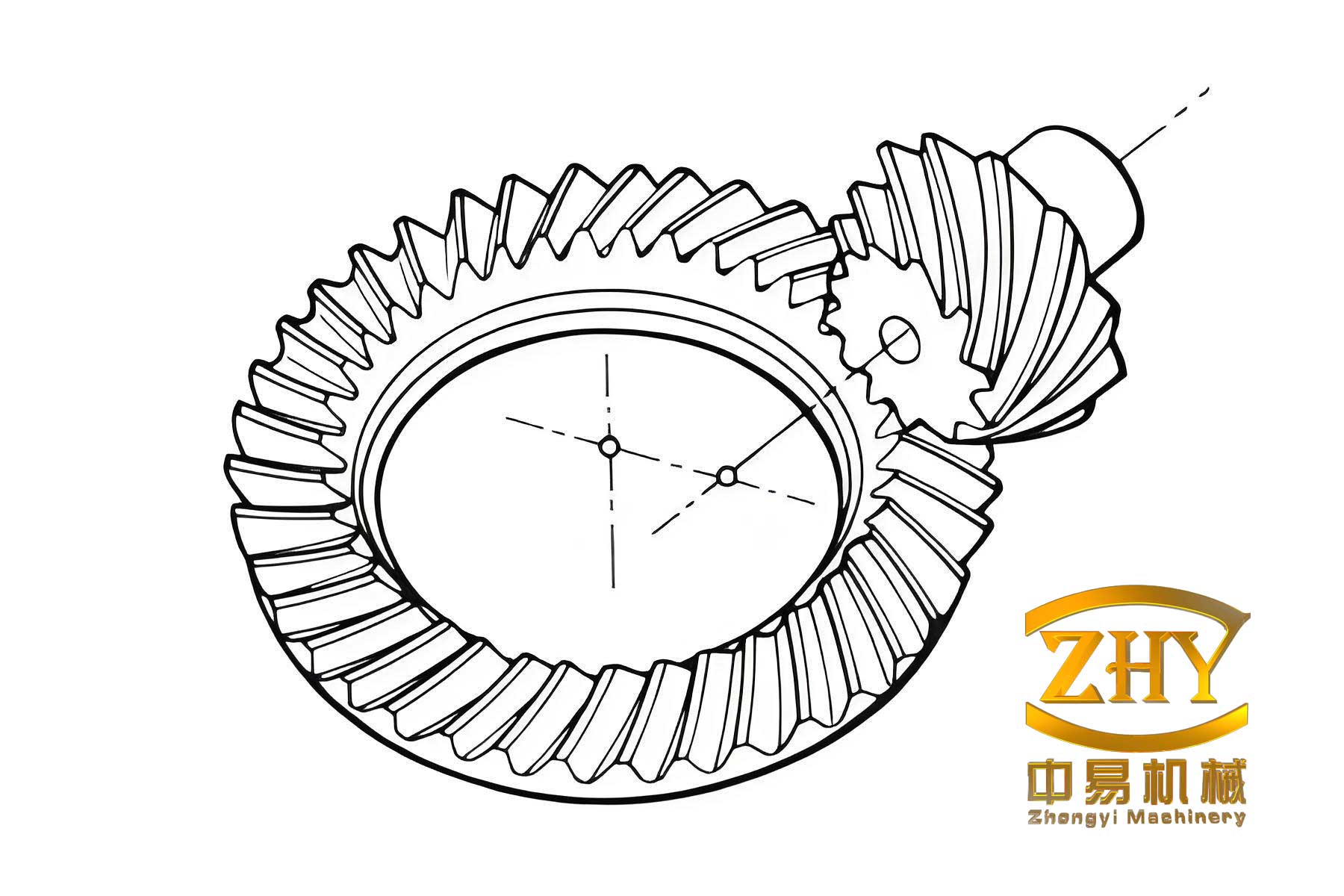
The advantages of hypoid gears are numerous and significant. First, the spiral angle of the pinion ($\beta_1$) is greater than that of the gear ($\beta_2$), which increases the overlap ratio and enhances motion uniformity. This results in smoother transmission and reduced noise, making hypoid gears ideal for high-speed applications like automotive differentials. Second, the pinion diameter ($d_1$) is larger compared to spiral bevel gears with the same number of teeth and transmission ratio. This allows for larger bearing supports on the pinion shaft, enabling higher load capacity. Third, the offset ($E$) can be positive or negative—meaning the pinion axis can be shifted above or below the gear axis. In automotive contexts, this facilitates adjustments to vehicle height, improving stability and off-road capability. Fourth, hypoid gears can achieve higher transmission ratios ($i$), sometimes replacing worm gear sets in indexing mechanisms. Fifth, sliding occurs on the tooth surfaces in both the lengthwise and profile directions, promoting even wear and facilitating lapping processes for surface finishing.
However, hypoid gears also exhibit distinct characteristics. They typically employ a Duplex tooth form, which is a double-curvature design with both tooth tip and root contraction. This means the face cone, pitch cone, and root cone vertices do not intersect; the face cone vertex lies inside the pitch cone vertex, and the root cone vertex lies outside. This design allows for rough cutting with larger feed rates using dedicated cutter heads. Additionally, for a left-hand gear, the offset must be negative (downward), while for a right-hand pinion, it must be positive (upward). Due to the offset, tooth pressure angles are unequal on both sides, often referred to as the mean pressure angle. The pinion lacks conventional concepts of module and pitch diameter, complicating design calculations. Tooth thickness measurement differs: for the gear, it is taken at the midpoint of the tooth width in the normal direction, while for the pinion, it is inferred from backlash measurements when meshed with the gear at the theoretical mounting distance. The design calculations for hypoid gears are notoriously complex, often following established programs like the Gleason 150-item calculation sheet.
Manufacturing hypoid gears involves a meticulous process chain. From my hands-on work, the typical process flow includes: casting and normalizing the blank, rough turning all surfaces, performing non-gear-related operations, re-establishing datum surfaces before cutting, milling teeth and matching contact patterns, deburring and chamfering, tooth surface induction hardening, grinding external diameters, re-establishing datums again, and finally, grinding or lapping the teeth before pairing and storage. For the Gleason N0724 machine gears, we adapted this流程 due to equipment constraints. Since we only had a YS2250 spiral bevel gear milling machine and no dedicated grinder, achieving a surface finish of ▽7 (approximately Ra 0.8 μm) and JB180-60 grade 7-Dc accuracy required innovation. We opted for a “milling-lapping” approach, leveraging the inherent sliding action of hypoid gears to refine surfaces. Additionally, to mitigate heat treatment distortion—especially critical given the large gear diameter and high pinion spiral angle—we implemented double normalizing: first after casting to relieve stresses and refine grain structure, and second after rough turning, using high-frequency normalizing on the tooth ring to introduce compressive pre-stresses. We also designed three专用 cutter heads:刀 27, 刀 28, and 刀 29, for roughing and finishing both gears.
Selecting the appropriate tooth-cutting method is crucial for hypoid gears. The cutting原理 generally aligns with that of spiral bevel gears, based on either the planar gear principle or the face-milled gear principle. For the planar gear principle, the workpiece installation angle is $\delta = \phi$, where $\phi$ is the pitch cone angle, and the machine roll ratio is $i_0 = Z_C / Z_{1,2}$, with $Z_C = \sqrt{Z_1^2 + Z_2^2}$ being the planar gear tooth count. For the face-milled gear principle, common in Gleason systems, the installation angle is $\delta = \phi_i$ (root cone angle), and the roll ratio is $i_0 = Z_C \cos \gamma / Z_{1,2}$, where $\gamma$ is the dedendum angle. This principle produces contracted teeth. Cutting methods fall into two categories: form cutting and generating cutting. Form cutting assumes no rolling motion between the imaginary crown gear and workpiece—only cutter rotation and feed motion—so the tooth profile mirrors the cutter blade shape. Generating cutting involves simulated啮合 motion between the crown gear and workpiece, with the cutter blades enveloping the tooth profile progressively. When the gear is cut via form cutting and the pinion via generating, it is termed semi-generating. In practice, roughing and finishing steps are separate. Roughing typically uses double-sided cutter heads to remove both tooth flanks simultaneously. Finishing can employ single-side cutting, double-side cutting (simple or fixed-setting), or duplex double-side cutting. Based on our resources, we chose: for the gear, roughing via form cutting with double-side cutting, and finishing via generating with single-side cutting; for the pinion, roughing via generating with double-side cutting, and finishing via form cutting with single-side cutting.
Machine setup calculations for hypoid gears are intricate due to their spatial geometry. We relied on the Gleason-recommended computation sheets. The adjustment parameters for the YS2250 machine are summarized in the table below, which includes key settings like workpiece installation angle, vertical and horizontal wheel positions, bed position, cradle angle, eccentric angle, and change gears for roll and division. These parameters ensure precise toolpath generation for each cutting phase.
| Adjustment Item | Gear Roughing | Gear Finishing | Pinion Roughing | Pinion Finishing Convex | Pinion Finishing Concave |
|---|---|---|---|---|---|
| Workpiece Installation Angle | 69°50′ | 69°50′ | 14°39′ | 14°39′ | 14°39′ |
| Vertical Wheel Position (mm) | 0 | 0 | +52.056 | +56.389 | +56.389 |
| Horizontal Wheel Position (mm) | 77.096+ | 77.096+ | 162.586+ | 149.736+ | 149.736+ |
| Bed Position (mm) | -5.471 | +2.5 | +5.748 | +5.748 | +5.748 |
| Bed Saddle Setback (mm) | 12 | 12 | 12 | 12 | 12 |
| Cradle Angle | 81°06′ | 314°09′ | 310°05′ | 310°05′ | 310°05′ |
| Eccentric Angle | 56°38′ | 59°23′ | 56°02′ | 56°02′ | 56°02′ |
| Reduction Ratio | 1:5 | 1:1 | 1:1 | 1:1 | 1:1 |
| Index Jump Tooth Count | 1 | 13 | 7 | 7 | 7 |
| Roll Change Gears | 34/58 – 41/80 | 66/72 – 74/90 | 37/58 – 60/91 | 30/58 – 62/80 | 46/71 – 54/86 |
| Index Change Gears | 32/57 – 30/96 | 35/70 – 52/57 | 56/48 | 56/48 | 56/48 |
| Speed (m/min) | 40 | 85 | 40 | 85 | 85 |
| Feed (teeth/s) | 50 | 63 | 50 | 63 | 63 |
| Tooth Thickness Reduction (mm) | 0.032 | 0.006 | – | – | – |
| Roll Check Angle (Cradle/Workpiece) | 4°30′ / 4°36′ | 20° / 21°11′ | 20° / 97°05′ | 20° / 101°52′ | 20° / 100°23′ |
The mathematical underpinnings of these adjustments involve coordinate transformations and kinematic equations. For instance, the relationship between the machine coordinate system and workpiece coordinate system can be expressed using rotation matrices. If we denote the tool position in machine coordinates as $(X_m, Y_m, Z_m)$ and the workpiece rotation angle as $C$, the transformed position in workpiece coordinates $(X_w, Y_w, Z_w)$ is given by:
$$ \begin{bmatrix} X_w \\ Y_w \\ Z_w \end{bmatrix} = \mathbf{R}_z(C) \begin{bmatrix} X_m \\ Y_m \\ Z_m \end{bmatrix} + \mathbf{T} $$
where $\mathbf{R}_z(C)$ is the rotation matrix about the Z-axis:
$$ \mathbf{R}_z(C) = \begin{bmatrix} \cos C & -\sin C & 0 \\ \sin C & \cos C & 0 \\ 0 & 0 & 1 \end{bmatrix} $$
and $\mathbf{T}$ is the translation vector accounting for offsets. For hypoid gears, additional adjustments like vertical wheel position ($V$), horizontal wheel position ($H$), and bed position ($B$) are incorporated, leading to complex formulae such as:
$$ X_w = (X_m + H) \cos C – (Y_m + V) \sin C + B_x $$
$$ Y_w = (X_m + H) \sin C + (Y_m + V) \cos C + B_y $$
$$ Z_w = Z_m + B_z $$
These equations ensure accurate tool positioning during cutting. The roll ratio $i_0$ is critical for generating correct tooth profiles and is derived from the basic gear geometry:
$$ i_0 = \frac{Z_C \cos \gamma}{Z_{1,2}} $$
where $Z_C$ is the virtual crown gear tooth count, $\gamma$ is the dedendum angle, and $Z_{1,2}$ is the actual tooth count. For roughing, we often use simplified versions, but finishing requires precise values from calculation sheets.
Cutting hypoid gears demands strict adherence to setup protocols. From my experience, several points are vital: First, every cutting step must follow the pre-computed “machine adjustment card” meticulously, with verification of each parameter. Second,专用 cutting arbors must be checked and hydraulic clamping forces calibrated. Third, gear blanks should be inspected for dimensional accuracy and datum surface quality. Fourth, cutter blade radial runout must be minimized—typically within 0.01 mm—to ensure uniform cutting. For the gear, roughing used form cutting with a double-sided cutter head (10-inch diameter,刀 27, blade group 9″w1.27). We took two passes to reach full depth, leaving a 0.80 mm finishing allowance measured at the tooth midpoint. Finishing employed generating cutting with the same cutter head, but due to feed rate limitations, we cut convex and concave sides separately, retracting the bed by 0.10 mm to avoid blade interference. For the pinion, roughing used generating cutting with a double-sided cutter head (10-inch,刀 28, 9″w1.02), leaving 1.00 mm allowance. Finishing used form cutting: convex side first with inner blades only (after removing outer blades from刀 28), followed by contact pattern testing and iterative corrections; concave side used a dedicated outer cutting head (10-inch,刀 29) with similar pattern matching. Pinion tooth thickness was最终 determined via backlash measurement on a gear checker at theoretical mounting distance.
Lapping is essential after heat treatment, as induction hardening degrades surface finish and alters tooth curvature, worsening contact patterns and noise. Lapping cannot improve kinematic accuracy or smoothness but restores surface quality. We used a simple lapping machine with abrasive compounds, running the meshed hypoid gears under light load to polish surfaces. The sliding action of hypoid gears aids in this process. However, for high-precision applications, grinding is preferred if equipment is available.
Reflecting on this project, I recognize that hypoid gears represent a pinnacle in gear technology, offering unmatched benefits for power transmission in offset shafts. Their design and manufacturing are fraught with challenges, from complex calculations to precise machining. Our successful replication of Gleason hypoid gears provided hands-on lessons in single-piece production, particularly in adapting methods like milling-lapping and double normalizing. However, limitations persist—for instance, achieving ideal contact patterns remains tricky without advanced grinding. Future efforts should explore computer-aided design (CAD) simulations and CNC-based adjustments to optimize hypoid gear performance. The journey with hypoid gears is ongoing, and as manufacturing technologies evolve, so too will our ability to harness their full potential in automotive, aerospace, and industrial machinery.
To further elucidate the design considerations, let’s delve into some key formulas. The mean spiral angle $\beta_m$ for hypoid gears can be approximated as:
$$ \beta_m = \frac{\beta_1 + \beta_2}{2} $$
where $\beta_1$ and $\beta_2$ are pinion and gear spiral angles, respectively. The offset distance $E$ relates to pitch diameters $d_1$ and $d_2$ and shaft angle $\Sigma$ (usually 90°):
$$ E = \frac{d_2}{2} \sin \Sigma – \frac{d_1}{2} \tan \beta_1 $$
For tooth strength calculations, the bending stress $\sigma_b$ can be estimated using the Lewis formula modified for hypoid gears:
$$ \sigma_b = \frac{F_t}{b m_n Y} K_v K_o K_m $$
where $F_t$ is tangential force, $b$ is face width, $m_n$ is normal module, $Y$ is tooth form factor, and $K_v$, $K_o$, $K_m$ are velocity, overload, and mounting factors, respectively. Contact stress $\sigma_H$ follows the Hertzian theory:
$$ \sigma_H = Z_E \sqrt{\frac{F_t}{b d_1} \cdot \frac{u \pm 1}{u} \cdot K_H} $$
with $Z_E$ as elasticity factor, $u = Z_2/Z_1$ gear ratio, and $K_H$ as load distribution factor. These formulas, while simplified, underscore the analytical depth required for hypoid gears.
In summary, the manufacturing of hypoid gears is a symphony of geometry, mechanics, and precision engineering. From blank preparation to final lapping, each step must be orchestrated with care. The tables and equations presented here encapsulate decades of industry knowledge, yet practical experience remains irreplaceable. As I continue to work with hypoid gears, I am reminded that innovation often lies at the intersection of theory and hands-on experimentation. The future of hypoid gears will likely see more integration with digital twins and additive manufacturing, but for now, mastering traditional methods is key to unlocking their advantages in real-world applications.