
In my extensive experience in precision mold engineering, the fabrication of spiral gears through injection molding represents a fascinating intersection of mechanical design, material science, and advanced manufacturing techniques. Spiral gears, with their helical tooth profiles, are critical components in many mechanical systems, offering smoother engagement and higher load capacity compared to spur gears. However, molding these intricate geometries in plastics like reinforced nylon presents significant challenges, primarily due to the need for a complex mold cavity that can facilitate the ejection of the part along its spiral path. This article delves into the comprehensive process of designing and manufacturing injection molds for spiral gears, drawing from practical insights and methodologies developed over years of hands-on work. I will explore material selection, precision machining strategies, the pivotal role of electrical discharge machining (EDM), and the optimization of injection molding parameters, all while emphasizing the unique considerations for spiral gear production.
The core challenge in spiral gear molding lies in the mold’s core and cavity design. Unlike standard gears, a spiral gear cannot be ejected with a simple linear motion; the ejection mechanism must impart a combined axial and rotational movement to follow the helix angle of the teeth. Failure to account for this results in damaged parts or mold seizure. In my practice, I have successfully implemented a mold structure utilizing a bearing-assisted rotating cavity block. This design allows the spiral gear cavity to rotate during the ejection stroke, precisely tracking the part’s spiral angle and ensuring a smooth, force-minimized release. The fundamental kinematics can be described by relating the axial ejection distance $s$ to the rotational angle $\theta$ via the spiral gear’s lead $L$: $$\theta = \frac{2\pi s}{L}$$ where $L = \frac{\pi d}{\tan \beta}$, $d$ is the pitch diameter, and $\beta$ is the helix angle. This relationship is paramount for designing the ejection system’s travel and rotation coupling.
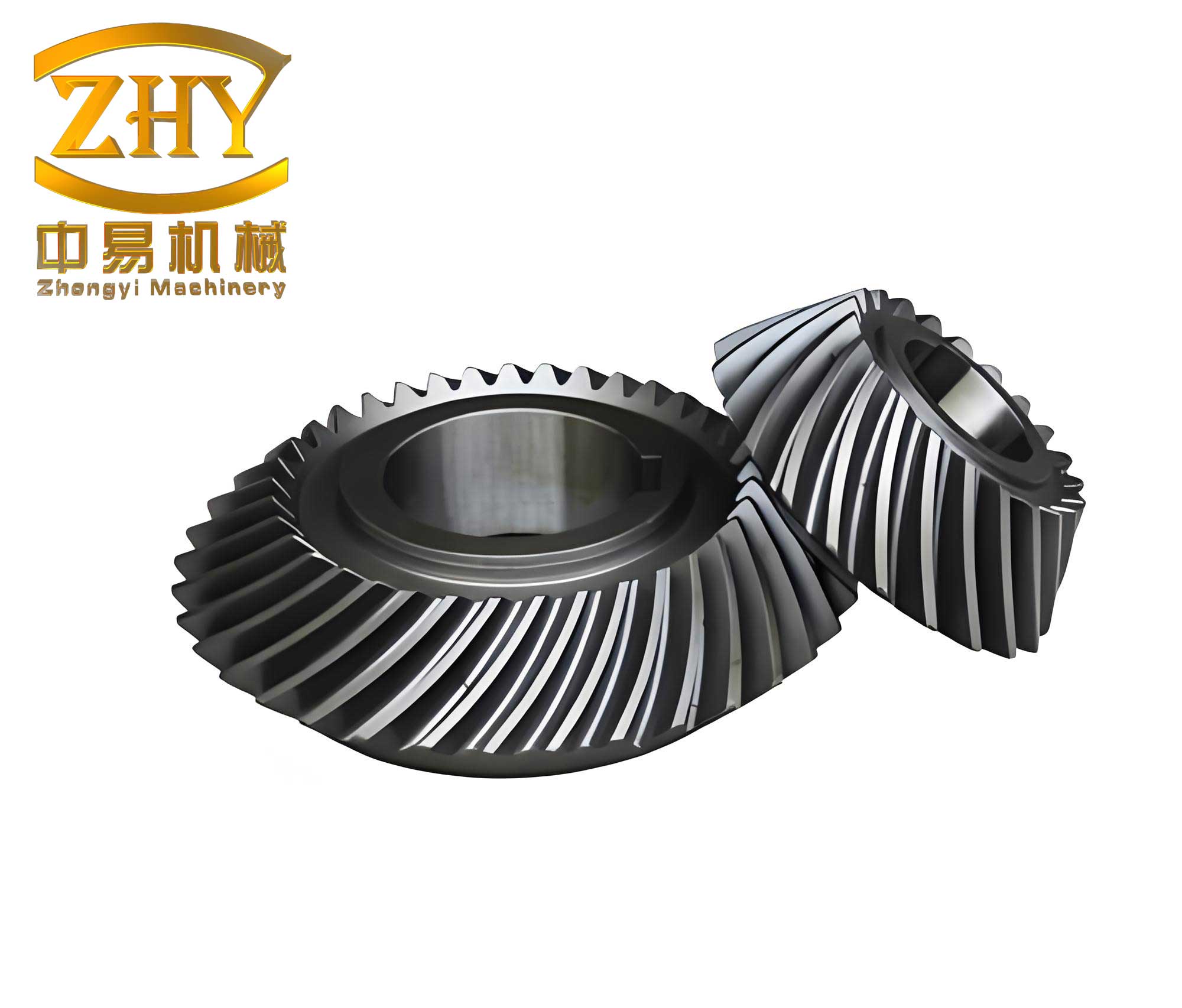
Specifications for a typical spiral gear, such as one used in actuator systems, must be meticulously defined. The table below summarizes key technical requirements that govern both the part design and the mold fabrication for a high-performance spiral gear.
| Parameter | Symbol | Value | Unit |
|---|---|---|---|
| Number of Teeth | $z$ | 30 | – |
| Module (Normal) | $m_n$ | 1.5 | mm |
| Radial Clearance Coefficient | $c^*$ | 0.25 | – |
| Helix Direction | – | Right-hand | – |
| Pitch Diameter | $d$ | 46.19 | mm |
| Helix Angle at Pitch Circle | $\beta$ | 15° | degree |
| Normal Pressure Angle | $\alpha_n$ | 20° | degree |
| Accuracy Grade | – | 8-8-7 per AGMA | – |
| Addendum Coefficient | $h_a^*$ | 1.0 | – |
| Material | – | Reinforced Nylon 66 (PA66-GF30) | – |
Selecting the appropriate mold material is the first critical step in ensuring the longevity and performance of a spiral gear injection mold. Based on rigorous testing, I invariably specify high-speed steel (HSS), such as M2 or equivalent grades, for both the core and cavity inserts. The primary rationale is superior wear resistance, which is essential given the abrasive nature of glass-filled polymers and the fine, intricate details of the spiral gear teeth. To achieve optimal mechanical properties, the HSS stock must undergo a specific forging regimen. I mandate a three-step forging process to refine the grain structure and align the fiber flow parallel to the primary forming direction of the final mold insert. This is followed by a precise heat treatment cycle involving quenching and triple tempering. The tempering process, typically conducted between 550°C and 600°C, relieves stresses and transforms retained austenite to martensite, enhancing toughness and dimensional stability. The resulting hardness should be in the range of 60-62 HRC. The relationship between tempering temperature $T$ (in Kelvin), time $t$, and final hardness $H$ can be approximated by empirical kinetics models like the Hollomon-Jaffe equation: $$H = C – k \cdot \log(t) \cdot \left(\frac{1}{T}\right)$$ where $C$ and $k$ are material constants.
Precision machining of the spiral gear mold components demands exceptionally tight tolerances. When employing a split-block or insert construction for the core and cavity—a common practice for complex shapes—each segment is machined individually. Consequently, the required dimensional and geometric accuracies are stringent. Critical dimensions, especially those defining the spiral gear tooth profile, must be held within ±0.005 mm. The form tolerance of the tooth flank should not exceed 0.008 mm. Furthermore, the guiding tapers on the core (draft angles) are crucial; I specify a minimum draft of 1.5° to ensure the plastic part reliably adheres to the core side during mold opening, which is vital for the success of the rotational ejection system. If a matched-set machining approach (where one half is machured based on the other) is adopted, some tolerance relaxation is permissible, but for spiral gears, independent machining of high-precision inserts is generally preferred to guarantee interchangeability and simplify maintenance.
The heart of spiral gear mold manufacturing is the creation of the internal helical tooth form in the cavity insert. Several methods exist, but I have found electrical discharge machining (EDM) to be the most cost-effective and flexible solution for low to medium production volumes. The alternative of commissioning a special spiral gear hob is prohibitively expensive and time-consuming. The EDM process employs a formed copper electrode, which is itself a precise male spiral gear. This electrode is fabricated on a precision gear hobbing machine. To account for the uniform spark gap during EDM, the electrode must be undersized. In my process, I chemically etch the copper electrode using a solution of 40% nitric acid and 60% water to uniformly remove 0.15-0.20 mm from all tooth surfaces. This “overburn” compensates for the machining gap. The electrode is then mounted on a dedicated fixture that facilitates its rotation during the sinking operation, as shown in the conceptual diagram below. The fixture uses a bearing connection between the electrode mandrel and a drive pin, allowing the electrode to be indexed by the helical path as the EDM ram descends.
| Processing Stage | Pulse Width ($\tau_{on}$) | Pulse Interval ($\tau_{off}$) | Peak Current ($I_p$) | Estimated Electrode Wear Ratio | Machining Time |
|---|---|---|---|---|---|
| Roughing | 100 µs | 50 µs | 25 A | ~3% | ~8 hours |
| Semi-Finishing | 30 µs | 20 µs | 12 A | ~1.5% | ~4 hours |
| Finishing | 6 µs | 10 µs | 4 A | < 1% | ~3 hours |
The total depth of cut $Z_{total}$ must be calculated precisely, considering both the final cavity depth and the cumulative electrode wear: $$Z_{total} = h_{cavity} + \sum_{i}(W_i \cdot D_i)$$ where $h_{cavity}$ is the cavity depth, $W_i$ is the wear ratio for the i-th EDM pass, and $D_i$ is the depth removed in that pass. Proper flushing is critical to evacuate debris from the deep, narrow spiral gear tooth gaps; I use a combination of external and submerged flushing with a dielectric fluid.
Once the mold is assembled, the injection molding process for spiral gears requires careful parameter tuning. The material, often glass-reinforced nylon, has high viscosity and is prone to shrinkage and warpage. The gate design should minimize flow resistance and avoid weld lines on critical tooth load-bearing surfaces. I typically use a pinpoint or submarine gate directed at the gear’s hub. Injection pressure $P_{inj}$ must be sufficient to fill the thin, helical sections and can be estimated using a modified Poiseuille flow equation for non-Newtonian fluids: $$\Delta P = \frac{2L \eta_{app} \dot{\gamma}}{R_h}$$ where $L$ is the flow length through the spiral gear section, $\eta_{app}$ is the apparent viscosity, $\dot{\gamma}$ is the shear rate, and $R_h$ is the hydraulic radius of the tooth space. Packing pressure and time are crucial for dimensional stability; for a spiral gear with a wall thickness of 2 mm, I recommend a pack time of 15-20 seconds. Under-packing leads to excessive shrinkage and poor tooth form, while over-packing increases internal stress and ejection force.
The ejection of the spiral gear part is the most delicate phase. The required ejection force $F_e$ is significantly higher than for a simple cylindrical part due to the friction and mechanical interlocking along the helix. It can be modeled as: $$F_e = \mu N + F_s \approx \mu \cdot (A_c \cdot P_{res} \cdot \sin \beta) + \epsilon \cdot E \cdot A_s$$ where $\mu$ is the coefficient of friction, $N$ is the normal force due to residual cavity pressure $P_{res}$ acting on the projected contact area $A_c$ at the helix angle $\beta$, $F_s$ is the force due to shrinkage, $\epsilon$ is the shrinkage strain, $E$ is the polymer’s modulus, and $A_s$ is the shear area. The bearing-based rotating core system effectively converts a large portion of this axial force into torque, reducing stress on the part. After ejection, spiral gears must be handled with care. I insist on placing them on two parallel support blocks to prevent distortion under their own weight while cooling to room temperature; arbitrary stacking leads to unacceptable out-of-plane runout, often exceeding the 0.05 mm specification.
Despite meticulous execution, the EDM process for spiral gear cavities has inherent limitations. The surface finish in the deep recesses of the teeth is typically in the range of Ra 1.6-3.2 µm, which may require post-polishing for applications demanding ultra-smooth meshing. Furthermore, statistical process control often shows that the composite error $F_\beta$ (helix slope deviation) of molded spiral gears tends to cluster near the upper tolerance limit. This is attributable to minor electrode wear inconsistencies and plastic shrinkage anisotropy. The table below summarizes common quality issues and their potential root causes in spiral gear molding.
| Defect | Potential Cause | Corrective Action |
|---|---|---|
| Excessive Tooth Form Error | Inaccurate electrode, improper EDM parameters, insufficient packing. | Re-machine electrode with tighter tolerance; optimize EDM finishing pass; increase pack pressure/time. |
| High Surface Roughness in Tooth Flanks | Poor EDM surface integrity, inadequate dielectric flushing. | Implement multi-stage finishing with lower current; improve flush flow dynamics; consider vapor honing of cavity. |
| Out-of-Plane Runout (Wobble) | Non-uniform cooling, warpage due to residual stress, improper handling post-ejection. | Optimize cooling channel layout for symmetry; use conformal cooling if possible; implement a controlled cooling jig. |
| Short Shots in Tooth Tips | Insufficient injection speed/pressure, high melt viscosity, venting issues. | Increase injection rate; raise melt temperature within limits; add micro-vents at the end of fill. |
| Difficulty in Ejection / Part Damage | Insufficient draft, misalignment in rotating core mechanism, excessive undercuts. | Verify and increase draft angles to ≥1.5°; ensure smooth bearing operation and precise alignment of the ejection system. |
For future advancements, I am exploring additive manufacturing techniques like metal 3D printing (e.g., DMLS) to produce spiral gear cavity inserts with conformal cooling channels. This could dramatically reduce cycle times and mitigate warpage. Additionally, simulation software for mold filling, cooling, and structural analysis of spiral gears under ejection forces has become indispensable. These tools allow for virtual prototyping of the spiral gear mold, predicting air traps, weld lines, and shrinkage patterns before steel is cut.
In conclusion, the successful design and manufacture of injection molds for spiral gears is a demanding yet rewarding endeavor that integrates advanced engineering principles. The spiral gear, with its complex geometry, dictates a mold design that creatively combines linear and rotational motion for part release. Material science guides the selection and treatment of high-speed steel for durability. Precision manufacturing, particularly through the nuanced application of EDM with a formed electrode, is the cornerstone of creating the accurate internal helix. Finally, a deep understanding of polymer behavior and process optimization is essential for producing high-quality, dimensionally stable spiral gears. Every spiral gear that emerges from a well-engineered mold is a testament to the synergy of these disciplines. As technologies evolve, so too will the methods for producing these essential mechanical components, but the fundamental challenges and solutions surrounding the spiral gear will remain a central topic in precision molding.
The mathematical modeling of spiral gear properties continues to be an area of deep interest. For instance, the bending stress at the root of a spiral gear tooth, a critical design factor, can be estimated using the Lewis formula modified for helix angle: $$\sigma_b = \frac{F_t}{b m_n Y} \cdot \frac{1}{\cos \beta}$$ where $F_t$ is the tangential transmitted load, $b$ is the face width, $m_n$ is the normal module, $Y$ is the Lewis form factor (adjusted for helical teeth), and $\beta$ is the helix angle. Similarly, the contact stress (Hertzian stress) between mating spiral gears is given by: $$\sigma_H = Z_E \sqrt{\frac{F_t}{b d_1} \cdot \frac{u+1}{u} \cdot \frac{1}{\cos^2 \beta}}$$ where $Z_E$ is the elasticity factor, $d_1$ is the pitch diameter of the pinion, and $u$ is the gear ratio. These formulas underscore the importance of precise geometry—directly imparted by the mold—on the final performance of the plastic spiral gear. Through continuous refinement of these interconnected processes, the production of reliable, high-performance spiral gears via injection molding becomes not just feasible, but highly efficient and repeatable.