
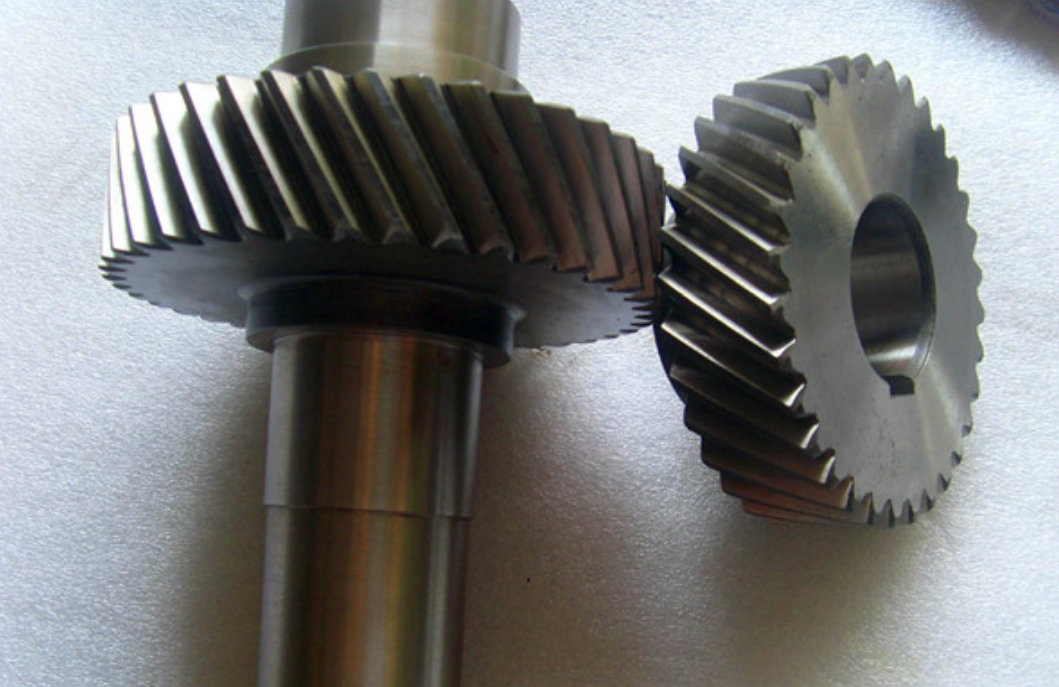
The pursuit of higher efficiency, lower vibration, and reduced noise in power transmission systems remains a central focus in gear design and manufacturing. Among cylindrical gears, the helical gear is widely preferred for its smooth and quiet operation due to the gradual engagement of its teeth. However, under load, manufacturing inaccuracies, and assembly misalignments can lead to edge contact, elevated stress concentrations, and increased transmission error—the primary excitation source for gear noise and vibration. To mitigate these issues, intentional tooth surface modifications, known as topological modifications or ease-off, are applied. These modifications deviate the actual tooth surface from the theoretical conjugate geometry to distribute load evenly and compensate for errors. This article presents a comprehensive methodology for designing and analyzing topologically modified helical gear tooth surfaces manufactured efficiently through a three-degree-of-freedom tangential hobbing process.
The core of the proposed method lies in the synergistic design of a modified hob cutter profile and controlled machine tool kinematics during the tangential hobbing operation. Unlike conventional two-axis hobbing, tangential hobbing incorporates a feed motion along the hob axis in addition to the rotational and axial feed motions. This third degree of freedom, when properly coordinated, allows for the generation of sophisticated tooth flanks with longitudinal crowning and profile modifications without inducing unwanted twist, a common artifact in simpler modification strategies. The fundamental relationship between the hob’s tangential feed \( l_y \) and the workpiece’s axial feed \( l_z \) is defined by a linear coefficient \( a_3 \):
$$ l_y = a_3 l_z $$
The corresponding additional rotation \( \Delta \phi_2 \) required for the workpiece to maintain the correct lead is a function of the hob rotation \( \phi_1 \), the axial feed, and the machine setup angles:
$$ \phi_2(\phi_1, l_z) = \frac{Z_1}{Z_2} \phi_1 + \left( \frac{\tan \beta_1}{r_2} \pm \frac{a_3 \tan \beta_2}{r_1} \right) l_z $$
where \( Z_1, Z_2 \) are the number of hob threads and gear teeth, \( \beta_1, \beta_2 \) are the helix angles, and \( r_1, r_2 \) are the pitch radii. The sign depends on the hand combination of the hob and the workpiece helical gear.
The modification is introduced through two primary mechanisms: the geometry of the rack-cutter that generates the hob and the real-time variation of machine settings during the cut. The rack-cutter profile is defined with 4th-order polynomial relief in the profile direction and 2nd-order in the longitudinal direction. Its surface vector \( \mathbf{r}_t(u_t, l_t) \) and normal vector \( \mathbf{n}_t(u_t, l_t) \) are defined in its own coordinate system. The hob tooth surface \( \mathbf{R}_h \) is then generated by enveloping this rack-cutter surface through a simulating gear generation process, satisfying the equation of meshing:
$$ f_h(\theta_h) = \mathbf{N}_h \cdot \frac{\partial \mathbf{R}_h}{\partial \theta_h} = 0 $$
where \( \theta_h \) is the generating rotation parameter of the hob.
Subsequently, the workpiece helical gear tooth surface is generated by the hob. The coordinate transformation from the hob system \( S_h \) to the gear system \( S_2 \) involves a series of transformations accounting for the axis crossing angle \( \gamma \), the center distance \( E \), and the machine motions \( \phi_1, l_z, l_y \). The position vector \( \mathbf{R}_2 \) and unit normal \( \mathbf{n}_2 \) of the generated pinion surface are given by:
$$ \mathbf{R}_2(u_p, l_p, \theta_p, \phi_1, l_z) = \mathbf{M}_{2a}(\phi_2) \mathbf{M}_{ab} \mathbf{M}_{bc} \mathbf{M}_{cd}(l_z) \mathbf{M}_{dh}(l_y) \mathbf{R}_h(u_p, l_p, \theta_p) $$
$$ \mathbf{n}_2(u_p, l_p, \theta_p, \phi_1, l_z) = \mathbf{L}_{2a}(\phi_2) \mathbf{L}_{ab} \mathbf{L}_{bc} \mathbf{L}_{cd}(l_z) \mathbf{L}_{dh}(l_y) \mathbf{n}_h(u_p, l_p, \theta_p) $$
This is a two-parameter enveloping process. The two independent meshing conditions that must be simultaneously satisfied for the surface to be regular are:
$$ f_p^{(1)} = \mathbf{n}_2 \cdot \frac{\partial \mathbf{R}_2}{\partial \phi_1} = 0, \quad f_p^{(2)} = \mathbf{n}_2 \cdot \frac{\partial \mathbf{R}_2}{\partial l_z} = 0 $$
To achieve a crowned tooth surface, the basic machine settings are also varied as functions of the axial feed \( l_z \). The center distance \( E \) and the workpiece’s rotational correction \( \Delta \phi_2^{*} \) are defined as:
$$ E(l_z) = E_0 + a_4 l_z^2 $$
$$ \Delta \phi_2^{*}(l_z) = a_5 \phi_1^2 + a_6 \phi_1 l_z + a_7 l_z^2 $$
Here, \( a_4 \) controls the amount of longitudinal crowning, while \( a_5, a_6, a_7 \) provide additional control over the tooth profile. The total ease-off topography \( \delta_{ij} \) at a grid point on the pinion surface is calculated as the normal deviation from the perfect conjugate helical gear surface generated with standard settings.
| Parameter | Symbol | Role in Modification |
|---|---|---|
| Hob Profile Curvature | \(a_1\) | Controls profile crowning/modification. |
| Hob Lead Curvature | \(a_2\) | Controls basic longitudinal crowning. |
| Tangential Feed Coefficient | \(a_3\) | Coordinates motion to prevent twist from \(a_2\). |
| Center Distance Variation | \(a_4\) | Primary coefficient for longitudinal crowning. |
| Workpiece Rotation Corrections | \(a_5, a_6, a_7\) | Fine-tune tooth profile under crowning. |
The optimal set of modification coefficients \( \mathbf{x} = [a_1, a_2, a_3, a_4, a_5, a_6, a_7] \) is determined by minimizing the amplitude of the Loaded Transmission Error (LTE). The LTE is a critical performance metric, directly correlating with dynamic excitations. The optimization process integrates Tooth Contact Analysis (TCA) and Loaded Tooth Contact Analysis (LTCA).
TCA simulates the kinematic meshing of the unloaded gears. The fundamental equations require the position vectors and unit normals of the pinion and gear surfaces to be equal at the contact point in a fixed coordinate system \( S_f \):
$$ \mathbf{R}_f^{(1)}(u_p, l_p, \theta_p, \phi_1, l_z, \phi_1^m) – \mathbf{R}_f^{(2)}(u_g, l_g, \theta_g, \phi_2^m) = 0 $$
$$ \mathbf{n}_f^{(1)}(u_p, l_p, \theta_p, \phi_1, l_z, \phi_1^m) – \mathbf{n}_f^{(2)}(u_g, l_g, \theta_g, \phi_2^m) = 0 $$
These vector equations, combined with the four meshing conditions (two from gear generation, two from pinion hobbing), are solved numerically for a given pinion rotation angle \( \phi_1^m \) to determine the unloaded transmission error (UTE) path.
LTCA extends TCA by accounting for tooth compliance under load. A realistic load distribution along the potential contact lines is calculated by solving a system of nonlinear equations ensuring compatibility of deformations and equilibrium of forces. The total deformation normal to the tooth surface is converted into an equivalent angular error on the gear, yielding the LTE \( \Delta \Theta \):
$$ \Delta \Theta = \frac{3600 \times 180}{\pi} \cdot \frac{\delta_n}{R_{b2} \cos \beta_2} \quad \text{[arcsec]} $$
where \( \delta_n \) is the normal deformation at the contact point and \( R_{b2} \) is the base radius of the driven helical gear.
The objective function for optimization is defined as minimizing the peak-to-peak value of the LTE curve over one mesh cycle under a specified design load \( T \):
$$ \min \, F(\mathbf{x}) = \max(\Delta \Theta(\mathbf{x}, T)) – \min(\Delta \Theta(\mathbf{x}, T)) $$
$$ \text{subject to} \quad \mathbf{x}_l \leq \mathbf{x} \leq \mathbf{x}_u $$
Given the nonlinear relationship between \( \mathbf{x} \) and \( F(\mathbf{x}) \) and the likelihood of multiple local minima, a global optimization algorithm like Particle Swarm Optimization (PSO) is employed to find the best modification parameters.
| Component | Number of Teeth | Normal Module (mm) | Normal Pressure Angle (°) | Helix Angle (°) | Face Width (mm) |
|---|---|---|---|---|---|
| Gear (Driven) | 50 | 3 | 20 | -20 (Left Hand) | 15 |
| Pinion (Workpiece) | 50 | 3 | 20 | 20 (Right Hand) | 15 |
| Hob Cutter | 1 (Thread) | 3 | 20 | 20 | 50 |
Using the described methodology, the optimal coefficients for manufacturing a modified pinion were determined with a target load of 500 Nm. The hob’s lead curvature coefficient \( a_2 \) was initially set to a nominal value to induce basic crowning, and the remaining six coefficients were optimized.
| Coefficient | Optimal Value |
|---|---|
| \(a_1\) | -1.2 × 10⁻² |
| \(a_2\) | -1.0 × 10⁻⁸ |
| \(a_3\) | -2.5 |
| \(a_4\) | 5.0 × 10⁻⁴ |
| \(a_5\) | 2.0 × 10⁻⁷ |
| \(a_6\) | 1.0 × 10⁻⁶ |
| \(a_7\) | 1.0 × 10⁻⁶ |
The analysis of individual coefficient effects reveals critical insights for manufacturing a high-performance helical gear. Applying only profile modification (\(a_1\)) results in a purely profile-crowned tooth. Applying longitudinal modification via the hob lead (\(a_2\)) alone, without the coordinating tangential feed (\(a_3\)), causes a severe twist in the generated tooth profile. The role of \(a_3\) is precisely to compensate for this; an optimal \(a_3\) value ensures the hob’s cutting edges engage progressively along its axis, generating a pure, twist-free longitudinal crown. Similarly, varying the center distance (\(a_4\)) or the workpiece rotation coefficients (\(a_5, a_6, a_7\)) independently also induces profile distortion. Therefore, the success of the tangential hobbing process for topological modification hinges on the *simultaneous and coordinated application* of both geometric (hob form) and kinematic (machine motions) corrections.
The performance benefits of the optimally modified helical gear pair are substantial. TCA results under misalignment conditions demonstrate significantly improved tolerance. While an unmodified gear pair would immediately develop edge contact under minor misalignments, the modified pair maintains a centered, elliptical contact pattern even with shaft angle errors (Δγ = 5 arcmin) or center distance errors (ΔE = -1 mm). The contact patch smoothly shifts within the tooth boundaries without reaching the edges, preventing high-stress concentrations and reducing sensitivity to assembly errors.
The most significant improvement is observed in the dynamic excitation potential, quantified by the LTE. Under the 500 Nm design load, the optimized tooth topography reduces the LTE amplitude by approximately 44% compared to the unmodified conjugate pair. The behavior of LTE under varying loads further elucidates the mechanism. For an unmodified helical gear with a fixed theoretical contact ratio, the LTE amplitude increases monotonically with load as teeth deflect. For the modified pair, the load-deflection behavior has three distinct regimes governed by the initial ease-off gap. At very low loads, only one tooth pair may be in contact as the gap is not fully closed, leading to a high but rapidly decreasing LTE amplitude as the gap closes. As the load increases further, a second tooth pair comes into contact (increasing the operating contact ratio), and the LTE amplitude continues to decrease. Finally, at loads high enough to fully compress the intentional ease-off, the contact ratio stabilizes, and the LTE amplitude begins to increase linearly with load, similar to the unmodified gear but from a much lower baseline. This nonlinear load-sharing effectively “softens” the mesh stiffness variation, leading to lower vibration excitation across a wide load range.
In conclusion, the integrated design and manufacturing methodology for topologically modified helical gear surfaces via tangential hobbing presents a powerful solution for advanced gear applications. By coupling the design of a modified hob cutter with precisely controlled multi-axis hobbing kinematics, it is possible to generate optimized tooth flanks with tailored longitudinal and profile corrections. This process efficiently produces gears that are inherently robust to assembly misalignments, avoiding detrimental edge contact. Most importantly, through systematic optimization targeting minimum Loaded Transmission Error amplitude, the dynamic excitations within the gear mesh are substantially reduced. The resulting decrease in vibration and noise, coupled with the high productivity of the hobbing process, makes this approach highly valuable for manufacturing high-performance, quiet, and reliable helical gear drives for automotive, aerospace, and industrial machinery.