
In this paper, I explore the comprehensive technology behind the design and manufacturing of bevel gears, focusing on structural optimization, precise machining, and assembly techniques to ensure reliability and smooth operation. Bevel gears are critical components in power transmission systems, especially in applications with spatial constraints such as gearboxes. The challenge lies in enhancing power capacity without increasing gear size, necessitating compact, lightweight, and high-efficiency designs. Through first-hand experience and analysis, I delve into key aspects including design principles, computational methods, manufacturing controls, and assembly adjustments. The goal is to provide a detailed guide that emphasizes the importance of bevel gear performance in industrial applications, with repeated emphasis on bevel gear terminology to underscore its significance. I incorporate tables and formulas to summarize critical parameters and processes, aiming for an in-depth discussion exceeding 8000 tokens.
The design of bevel gears begins with fundamental principles tailored to specific operational demands. Given limited space in gearboxes, I prioritize minimizing gear volume while meeting increased power requirements. This involves selecting appropriate tooth numbers, materials, and tooth forms. For instance, I opt for an equal-depth shrinking tooth design, where tooth height decreases from the large end to the small end. This approach enhances the root strength by increasing the fillet radius at the small end, reduces stress concentration, and improves tool life. Material selection is crucial; I choose nickel-chromium steel for its high mechanical properties and minimal heat treatment deformation. The carburizing depth must be carefully controlled based on the face module: too shallow leads to surface spalling, while too deep increases brittleness. Core hardness is equally vital; low hardness causes plastic deformation under load, leading to deep peeling and pitting, whereas high hardness results in brittle fracture. To mitigate deformation and boost load capacity, I adopt a simply supported design for bevel gear mounts, preventing distortion under heavy loads.
In terms of design calculations, I follow the Gleason system for spiral bevel gears, utilizing an equal-depth shrinking tooth profile with high shear displacement. The initial step involves determining the pitch diameter at the large end for the pinion. The calculations for overlap ratio and strength are simplified by converting to equivalent spur gears at the mean point of the tooth width. Key formulas include the minimum tooth number to avoid undercutting, given by:
$$ z_{\min} = \frac{2}{\sin^2 \alpha} $$
where $\alpha$ is the pressure angle. For bevel gears, I adjust this based on practical constraints. The face module at the large end is derived via analogy, ensuring it meets load requirements. The circular tooth thickness at the pitch circle is calculated as:
$$ S_1 = m \left( \frac{\pi}{2} + 2x_1 \tan \alpha + x_{t1} \right) $$
and
$$ S_2 = p – S_1 $$
where $m$ is the module, $x_1$ is the addendum modification coefficient, $x_{t1}$ is the transverse displacement coefficient, and $p$ is the circular pitch. Parameters such as pitch angle, addendum angle, and dedendum angle are then determined. The tooth width factor must be optimized; excessive width leads to thin tips at the small end and increased stress concentration. Table 1 summarizes typical design parameters for a bevel gear pair in a gearbox application.
| Parameter | Pinion | Gear | Unit |
|---|---|---|---|
| Number of Teeth | 15 | 18 | – |
| Module (Large End) | 4.5 | 4.5 | mm |
| Pressure Angle | 20° | 20° | – |
| Spiral Angle | 35° | 35° | – |
| Face Width | 25 | 25 | mm |
| Carburizing Depth | 0.8-1.2 | 0.8-1.2 | mm |
| Core Hardness | 30-40 | 30-40 | HRC |
The manufacturing of spiral bevel gears involves precise processes to achieve desired tolerances and performance. One critical aspect is controlling the carburizing depth after grinding. As a manufacturer, I ensure that the carbon content reduction on the tooth surface does not exceed 0.2%. This requires uniform grinding allowances and consistent carburizing depth. To achieve this, I optimize the cutting path during gear milling, maintaining tooth profile errors within 0.05 mm. Increasing the cutter blade diameter is often necessary, as the adjustment range of the blade tip is limited. Custom shims are fabricated to enlarge the effective cutter diameter, meeting specific processing needs. This attention to detail is vital for bevel gear longevity and reliability.
Adjusting the contact pattern is another key manufacturing step. The contact pattern on the tooth surface serves as a crucial indicator of bevel gear meshing quality. During static adjustment, I observe patterns on the pinion convex side, which may appear near the toe or heel, root or tip, or diagonally. To correct these, I modify the tool position. For example, if the pattern is biased toward the toe, I adjust the machine settings to shift it toward the center. This process relies on iterative testing and expertise, ensuring that the bevel gear operates smoothly under load. Heat treatment deformation poses a significant challenge in bevel gear production. Due to complex tooth geometry, improper machining paths can create stress concentrations. During heat treatment, residual stresses release freely, leading to unpredictable deformation. This can result in uneven carburizing layer thickness, compromising overall bevel gear strength. If deformation exceeds grinding allowances, the gear may become unmanufacturable. Thus, I select appropriate cutting paths and heat treatment parameters, such as temperature and cooling rates, to minimize distortion. Table 2 outlines common heat treatment parameters for bevel gears.
| Process Step | Temperature (°C) | Time (hours) | Atmosphere |
|---|---|---|---|
| Carburizing | 900-950 | 4-8 | Endothermic |
| Quenching | 800-850 | 0.5-1 | Oil |
| Tempering | 150-200 | 2-4 | Air |
Parameter measurement is essential for quality assurance. I employ topographic analysis to evaluate bevel gear tooth surfaces. This involves measuring 45 coordinate points across the surface, arranged in a 9×5 grid. Starting from points approximately 5% from the edges, I compare actual values to theoretical ones. The midpoint column serves as a reference, with deviations expressed in micrometers. Positive values indicate higher actual points, while negative values indicate lower ones. This data helps identify manufacturing errors and guides corrective actions. For instance, if deviations exceed ±10 μm, I recalibrate the machining setup. This meticulous approach ensures that each bevel gear meets stringent specifications.
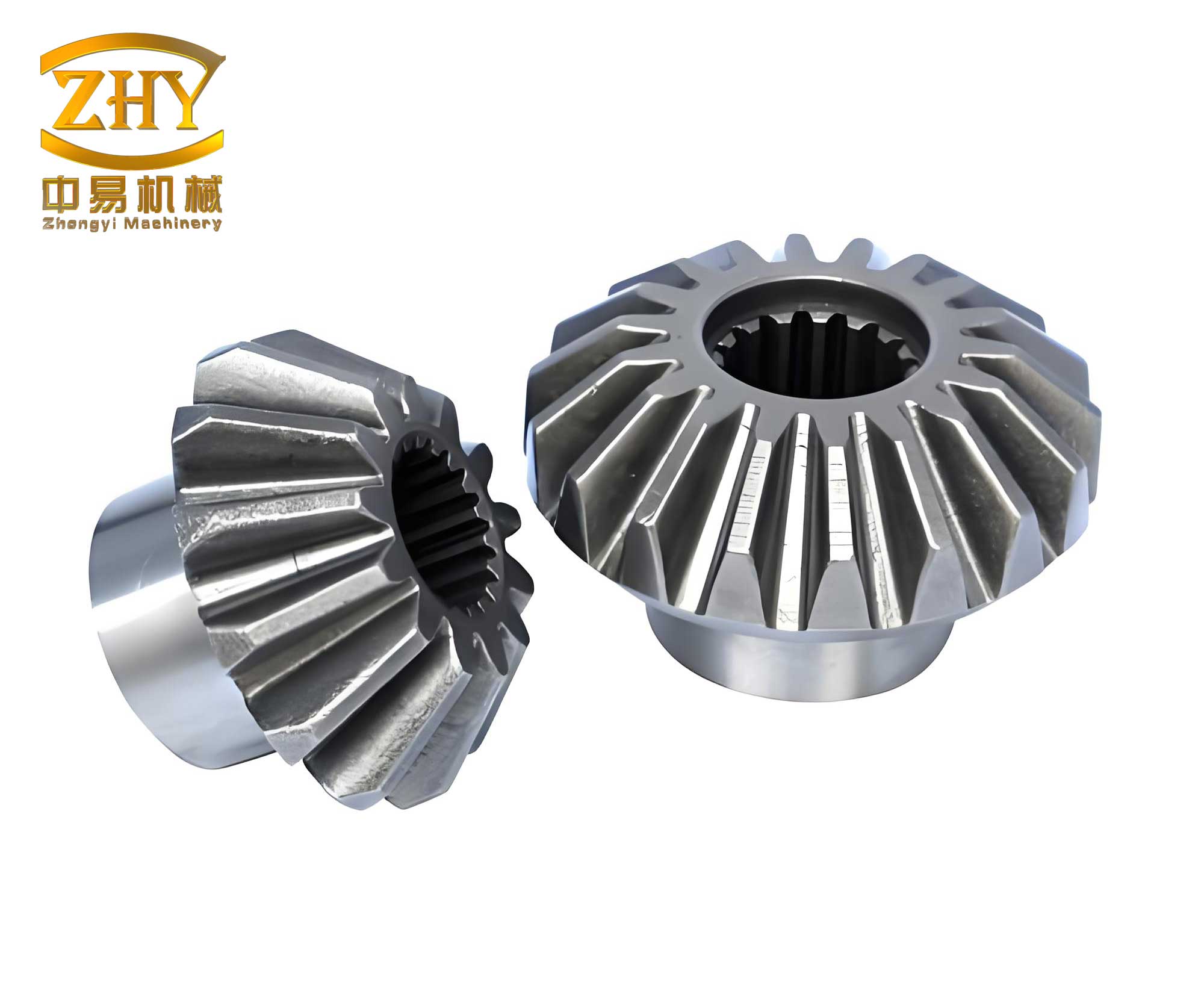
Moving to assembly and pattern adjustment, the installation of bevel gears requires precise alignment to achieve optimal meshing. I adjust the mounting distance—the axial distance from the cone apex to the gear’s mounting surface—using shims. This compensates for cumulative tolerances in gears, bearings, and housings. Typically, mounting surfaces are on the back of gears, with parallel reference surfaces for measurement. During assembly, I fine-tune shim thickness to control backlash and contact patterns. In practice, due to part variations, the mounting distance has a permissible range. For example, I might use shims ranging from 0.1 mm to 0.5 mm to achieve desired settings. The contact pattern adjustment is performed under static conditions. I apply a braking force to the driven bevel gear to obtain a static imprint on the tooth surfaces. Comparing this to design specifications, I aim for a large contact area to enhance durability, but not so large as to reduce adjustability or cause overrun under load. Using proper tools, I ensure the pattern is centered on the tooth. Certain patterns indicate manufacturing defects; for instance, if one side shows contact at the tip and the other at the root with correct backlash, or if patterns are biased toward the toe or heel on both sides, the bevel gear pair may need replacement. This underscores the importance of quality control in bevel gear production.
Other factors influence bevel gear performance. The type of marking compound affects pattern clarity; I prefer compounds with low oil content to avoid smudging and better reveal contact areas. Backlash also plays a role; after assembly, cumulative errors from components can alter backlash. I adjust it to approach standard values, preventing non-working surface contact, noise, and scoring. Typically, backlash for bevel gears ranges from 0.1 mm to 0.3 mm, depending on size and application. I use the formula for backlash adjustment:
$$ B = \Delta L \cdot \tan \beta $$
where $\Delta L$ is the axial displacement and $\beta$ is the spiral angle. This ensures proper meshing and longevity of the bevel gear system. Throughout this process, I reiterate that bevel gear technology hinges on interdisciplinary knowledge, from material science to precision engineering.
In conclusion, optimizing bevel gear design and manufacturing involves a holistic approach. I have detailed how structural enhancements, such as equal-depth shrinking teeth and nickel-chromium steel selection, improve performance. Manufacturing controls, including carburizing depth management and heat treatment parameter optimization, are critical for quality. Assembly techniques, particularly pattern adjustment and backlash control, ensure reliable operation. The integration of formulas and tables, as shown, provides a quantitative foundation for these practices. This research highlights that bevel gears, when designed and produced with care, offer robust solutions for power transmission challenges. Future work may explore advanced materials or digital twin simulations for bevel gear systems, but the principles outlined here remain fundamental. Through continuous refinement, the bevel gear industry can achieve higher efficiency and durability, supporting diverse mechanical applications.