
In the field of mechanical engineering, bevel gears play a critical role in transmitting torque between intersecting shafts, with applications ranging from industrial machinery to automotive systems. Unlike cylindrical gears, bevel gears offer unique advantages, such as the ability to operate at shaft angles from 0° to 90°, smoother operation under high torque, and a variable module across the tooth width. However, the performance of bevel gears heavily relies on precise meshing conditions, which cannot be fully assessed through individual gear inspections alone. Parameters like backlash, contact patterns, and apex clearance require paired gear testing. This article presents the design and analysis of a specialized fixture for evaluating the meshing behavior of bevel gears, focusing on key factors like cone distance and pitch angle. Through this fixture, we aim to enhance the reliability and longevity of bevel gears in practical applications.
The necessity for this fixture arose from challenges in assembly processes, where mismatched bevel gears led to uneven wear and premature failure. Individual gear inspections, such as tooth height or chordal thickness measurements, are insufficient for detecting meshing issues like uneven backlash across the tooth face. For instance, in our experience with double-screw extruders, improper meshing resulted in significant differences in backlash between the large and small ends of the gears, reducing contact area and accelerating wear. This fixture allows for pre-assembly testing, minimizing the need for costly disassembly of tightly fitted components. By simulating real-world meshing conditions, it enables comprehensive evaluation of bevel gears, ensuring optimal performance before final installation.
The fixture is designed to accommodate a range of bevel gears, from 800 mm to 1200 mm in diameter and weights up to 5 tons per gear. Its modular structure includes components like a base, guide rails, sliders, mounting plates, and adjustable supports, allowing for precise control over pitch angles from 0° to 20°. This flexibility makes it suitable for both straight bevel gears and straight cylindrical gears, providing a versatile solution for various industrial needs. The following sections detail the fixture’s design, operation, and analytical approach to meshing evaluation, incorporating formulas and tables to summarize key concepts.
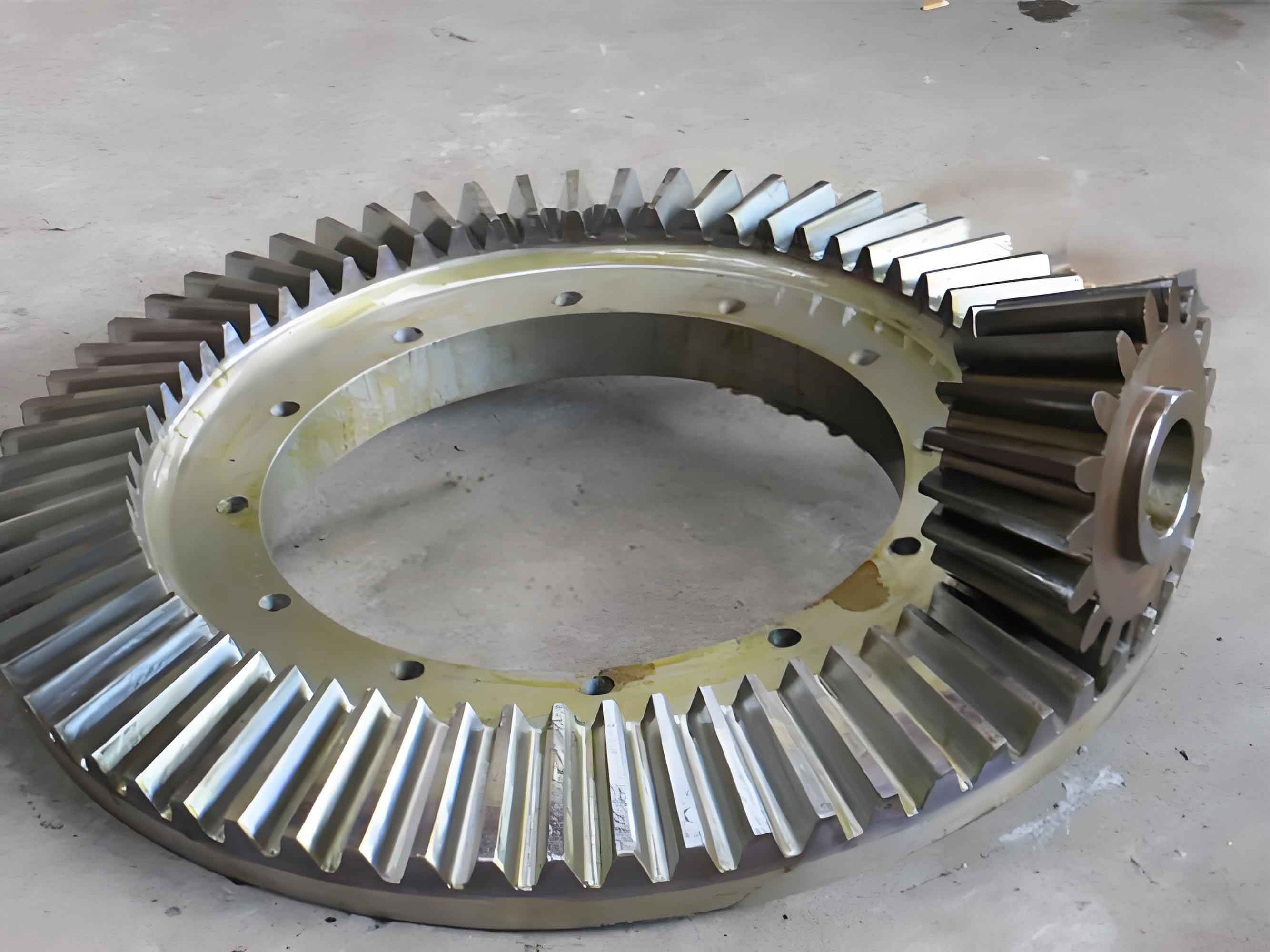
The structural design of the bevel gear meshing fixture emphasizes adjustability and stability. Key components include a robust base that supports the entire assembly, guide rails for lateral movement, and sliders that lock into position to prevent displacement during testing. Mounting plates and shafts hold the bevel gears in place, with bearings such as cylindrical self-aligning roller bearings and thrust roller bearings ensuring smooth rotation. Adjustable support bolts and fixed blocks enable fine-tuning of the pitch angle, which is critical for simulating different meshing scenarios. For example, the pitch angle adjustment mechanism uses a pivot pin to rotate the fixed block, allowing us to set angles accurately based on gear specifications. This design not only facilitates easy installation and removal of gears but also replicates the dynamic conditions of actual assemblies, making it an invaluable tool for quality control.
To operate the fixture, we follow a systematic procedure. First, we ensure that the fixed block is level before mounting the bevel gears. The gears are installed on the mounting shafts with a clearance fit, rather than the standard interference or transition fit, to simplify handling. Lubrication is applied to the gear bores to reduce friction during installation. Keys are inserted to secure the gears to the shafts, preventing free rotation. The tail nuts of the mounting shafts are pre-tightened to eliminate play in the bearings. Next, we adjust the support bolts to achieve the desired pitch angle, as specified in the gear design. For instance, a pitch angle of 0° allows for testing straight cylindrical gears. The支架 is moved along the guide rails to engage the gears, and the sliders are locked to secure the position. Finally, we use a hex wrench in the shaft end to manually rotate the gears, observing the meshing behavior under controlled conditions.
The fixture’s key parameters are summarized in the table below, highlighting its adaptability for various gear types and sizes. These specifications ensure that the fixture can handle a wide range of industrial applications, from heavy machinery to precision equipment.
| Parameter | Value |
|---|---|
| Overall Dimensions | 2000 mm × 1020 mm × 1300 mm |
| Applicable Gear Types | Straight Bevel Gears, Straight Cylindrical Gears |
| Adjustable Pitch Angle Range | 0° to 20° |
| Gear Diameter Range | Φ800 mm to Φ1200 mm |
| Maximum Gear Weight | 5 tons per piece |
Meshing analysis of bevel gears involves evaluating factors beyond tooth profile, such as cone distance and pitch angle. Cone distance, analogous to the center distance in cylindrical gears, determines the axial position of the gears and influences backlash. The pitch angle, defined as the angle between the gear axis and the pitch cone element, directly affects the contact pattern and load distribution. In ideal conditions, the pitch cones of paired bevel gears should coincide, but practical considerations like manufacturing tolerances require controlled backlash to prevent jamming. The relationship between cone distance (R), pitch angle (δ), and backlash (j) can be expressed using fundamental gear geometry formulas. For example, the cone distance for a bevel gear is given by:
$$ R = \frac{m \cdot z}{2 \cdot \sin(\delta)} $$
where \( m \) is the module at the large end, \( z \) is the number of teeth, and \( \delta \) is the pitch angle. Adjusting R allows for backlash control, but only if the pitch angles are matched. If the pitch angles deviate, the meshing becomes uneven, leading to partial contact and accelerated wear.
We categorize the meshing of bevel gears into four primary states based on pitch angle alignment and backlash distribution. Each state has distinct characteristics, as summarized in the table below, which compares backlash values at the large and small ends of the gears.
| Meshing State | Backlash at Small End | Backlash at Large End | Contact Pattern |
|---|---|---|---|
| Ideal Meshing | Zero | Zero | Full face contact |
| Parallel Meshing | Equal to design value | Equal to design value | Uniform across face |
| Pitch Angle Too Large | Less than large end | Greater than small end | Concentrated at small end |
| Pitch Angle Too Small | Greater than large end | Less than small end | Concentrated at large end |
In ideal meshing, the pitch cones of the bevel gears fully overlap, resulting in zero backlash and complete tooth contact. However, this state is impractical due to the risk of seizure under thermal expansion or load variations. The mathematical representation of ideal meshing involves the coincidence of pitch surfaces, where the cone distances and pitch angles satisfy the gear design equations. For a pair of bevel gears with pitch angles δ₁ and δ₂, and shaft angle Σ, the relationship is:
$$ \Sigma = \delta_1 + \delta_2 $$
and the cone distances should be equal for both gears. In practice, we aim for a slight backlash to ensure smooth operation, typically defined by design specifications.
Parallel meshing represents the optimal practical scenario, where backlash is uniform across the tooth face and matches the design value. This state is achieved when the pitch angles are correctly aligned, and the cone distance is adjusted to the specified value. The backlash j can be related to the axial displacement Δx of the gears using the formula:
$$ j = k \cdot \Delta x $$
where k is a proportionality constant derived from the gear geometry. By measuring backlash with feeler gauges, we can calculate the required axial adjustment to achieve parallel meshing. For example, if the measured backlash is larger than designed, we reduce the cone distance by moving the gears inward, and vice versa.
When the pitch angle is too large, the backlash at the small end of the bevel gears is less than at the large end, indicating that contact is concentrated near the small end. This imbalance leads to localized stress and wear, reducing the gear’s service life. The deviation in pitch angle Δδ can be quantified as:
$$ \Delta \delta = \delta_{\text{actual}} – \delta_{\text{design}} $$
where a positive Δδ indicates an oversized pitch angle. The resulting uneven backlash distribution can be modeled using the gear tooth geometry, where the effective cone distance varies along the face width. In such cases, the gears may need to be scrapped or reworked, depending on the severity of the deviation.
Conversely, if the pitch angle is too small, the backlash at the small end exceeds that at the large end, causing contact to focus on the large end. This state similarly results in uneven wear and potential noise during operation. The relationship between pitch angle error and backlash asymmetry can be expressed as:
$$ \frac{j_{\text{small}}}{j_{\text{large}}} = f(\Delta \delta) $$
where f is a function that depends on the gear design parameters. Through the fixture, we can detect this condition early and take corrective actions, such as modifying the pitch angle or replacing the gears.
The fixture enables us to perform detailed meshing analysis by simulating these states and measuring key parameters. For instance, we use the fixture to set specific pitch angles and cone distances, then rotate the gears manually to observe contact patterns using marking compounds. The backlash is measured at multiple points along the tooth face, and the data is compared to design tolerances. This process helps identify deviations in pitch angle or cone distance, allowing for adjustments before final assembly. Additionally, the fixture supports the evaluation of other meshing parameters, such as tooth top clearance and contact ratio, which are essential for predicting gear performance under load.
In summary, the development of this bevel gear meshing fixture addresses a critical need in gear manufacturing and assembly. By facilitating pre-assembly testing, it reduces the risk of field failures and extends the life of bevel gears. The analytical approach, combining geometric formulas and empirical measurements, provides a comprehensive understanding of meshing behavior. As bevel gears continue to be integral in various industries, tools like this fixture play a vital role in ensuring their reliability and efficiency. Future work could involve automating the measurement process or integrating digital sensors for real-time data analysis, further enhancing the capability to optimize bevel gear performance.