
In this study, we investigate the mathematical modeling and meshing characteristics of spur gears, which are fundamental components in parallel-axis transmissions widely used in industrial applications for motion and power transfer. Spur gears offer advantages such as simplicity in design, ease of manufacturing, and high efficiency, but they are often limited by issues like sensitivity to misalignment, edge contact, and sliding-induced wear. To address these challenges, we focus on the design and analysis of spur gears with optimized tooth profiles, emphasizing pure rolling contact to minimize sliding and improve performance. We develop a comprehensive mathematical model for spur gears based on preset contact curves and combined tooth profiles, and analyze their meshing performance through tooth contact analysis (TCA) and stress evaluation. The results are compared with other gear types to highlight the benefits of our approach.
Spur gears are characterized by their straight teeth parallel to the axis of rotation, making them one of the most common gear types. However, traditional spur gears with involute profiles exhibit significant sliding at the tooth interfaces, leading to increased wear, noise, and vibration. In our work, we propose an enhanced design for spur gears that incorporates a combination of circular arcs, involute curves, and Hermite transitions in the transverse tooth profile. This design aims to achieve near-pure rolling contact, reducing relative sliding and improving load distribution. The tooth surface is generated by sweeping the combined transverse profile along a predefined contact path, controlled by meshing functions that ensure theoretical pure rolling conditions.
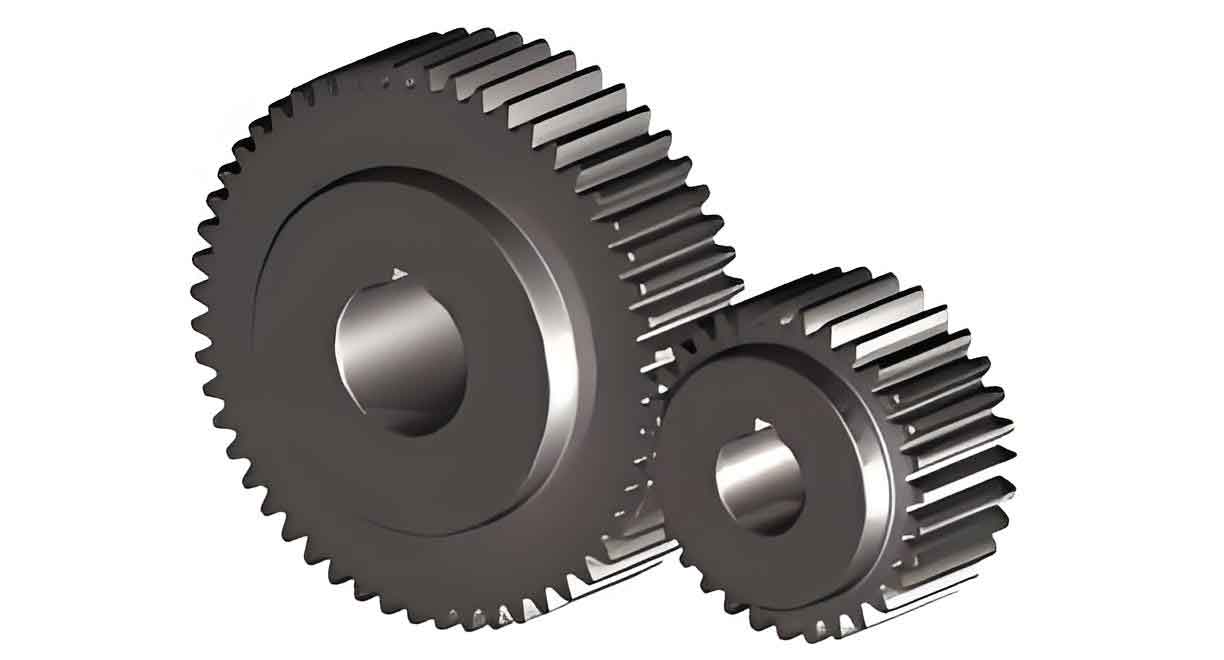
The mathematical model for spur gears begins with the definition of coordinate systems and meshing parameters. We consider a pair of spur gears with pinion and gear rotating about parallel axes. The fixed coordinate system is used to describe the motion of meshing points, while body-fixed coordinates are attached to the pinion and gear. The meshing points move along the line of action, and their trajectory is governed by parametric equations derived from pure rolling conditions. For spur gears, the transverse tooth profile is critical, and we define it using control points that ensure smooth transitions between different curve segments. The entire tooth profile consists of a circular arc near the tip, an involute curve in the active region, and a Hermite curve at the fillet, all connected smoothly at control points.
The position vectors for points on the pinion and gear tooth surfaces are expressed in their respective coordinate systems. For the pinion, the position vector \(\mathbf{r}_1\) for a point on the tooth surface is given by:
$$ \mathbf{r}_1 = \begin{bmatrix} x_p \cos \phi_1 – y_p \sin \phi_1 \\ x_p \sin \phi_1 + y_p \cos \phi_1 \\ z_k(t) \\ 1 \end{bmatrix} $$
where \(x_p\) and \(y_p\) are coordinates in the transverse plane, \(\phi_1\) is the rotation angle of the pinion, and \(z_k(t)\) is the parameter along the tooth width, controlled by the meshing function. Similarly, for the gear, the position vector \(\mathbf{r}_2\) is:
$$ \mathbf{r}_2 = \begin{bmatrix} -x_g \cos \phi_2 + y_g \sin \phi_2 \\ x_g \sin \phi_2 + y_g \cos \phi_2 \\ z_k(t) \\ 1 \end{bmatrix} $$
where \(\phi_2\) is the gear rotation angle, and \(x_g\), \(y_g\) are transverse coordinates. The parameter \(t\) varies from 0 to \(t_{\text{max}}\), and the function \(z_k(t)\) defines the contact path. For spur gears, we use a linear function for \(z_k(t)\) to represent straight teeth, but optimized designs may incorporate slight curvatures to enhance meshing.
The transverse tooth profile is constructed using four control points: \(P_a\) at the tip, \(P_i\) at the pitch point, \(P_d\) at the transition to the fillet, and \(P_e\) at the root. The profile segments are defined as follows:
- Circular Arc Segment: This segment extends from the tip control point \(P_a\) to the pitch control point \(P_i\). In a local coordinate system centered at the pitch point, the parametric equations for the circular arc are:
$$ x_{\text{arc}} = \rho \sin \xi, \quad y_{\text{arc}} = \rho \cos \xi – \rho, \quad \xi_{\min} \leq \xi \leq \xi_{\max} $$
where \(\rho\) is the radius of the arc, and \(\xi\) is the angular parameter.
- Involute Segment: The involute curve runs from \(P_i\) to \(P_d\) and is defined in an involute coordinate system as:
$$ x_{\text{inv}} = r_b (\sin u – u \cos u), \quad y_{\text{inv}} = r_b (\cos u + u \sin u), \quad u_d \leq u \leq u_i $$
where \(r_b\) is the base circle radius, and \(u\) is the involute parameter.
- Hermite Segment: The fillet region from \(P_d\) to \(P_e\) is modeled using a Hermite curve, which ensures a smooth transition and controlled curvature. The Hermite curve is defined by:
$$ \mathbf{r}_{\text{herm}}(s) = (2s^3 – 3s^2 + 1) \mathbf{P}_d + (-2s^3 + 3s^2) \mathbf{P}_e + (s^3 – 2s^2 + s) \mathbf{T}_d + (s^3 – s^2) \mathbf{T}_e $$
where \(s\) is the parameter from 0 to 1, \(\mathbf{P}_d\) and \(\mathbf{P}_e\) are the end points, and \(\mathbf{T}_d\), \(\mathbf{T}_e\) are tangent vectors at these points.
To illustrate the design parameters, we present a table summarizing key geometric values for a typical spur gear set. These parameters include number of teeth, module, pressure angle, and profile coefficients, which are essential for defining the tooth geometry and meshing behavior.
| Parameter | Symbol | Value |
|---|---|---|
| Number of teeth (pinion) | \(Z_1\) | 30 |
| Number of teeth (gear) | \(Z_2\) | 60 |
| Module | \(m\) | 2 mm |
| Pressure angle | \(\alpha\) | 20° |
| Face width | \(b\) | 50 mm |
| Addendum coefficient | \(h_a^*\) | 1.0 |
| Dedendum coefficient | \(h_f^*\) | 1.25 |
| Profile shift coefficient | \(x\) | 0 |
The geometric dimensions of spur gears are calculated using standard formulas. The pitch diameter \(d\) is given by \(d = m Z\), where \(m\) is the module and \(Z\) is the number of teeth. The base circle diameter \(d_b\) is \(d_b = d \cos \alpha\), and the addendum and dedendum diameters are \(d_a = d + 2 m h_a^*\) and \(d_f = d – 2 m h_f^*\), respectively. For spur gears, the contact ratio is a critical parameter, defined as the ratio of the length of action to the base pitch, and it must be greater than 1 to ensure continuous meshing. The contact ratio \(CR\) for spur gears is calculated as:
$$ CR = \frac{\sqrt{d_{a1}^2 – d_{b1}^2} + \sqrt{d_{a2}^2 – d_{b2}^2} – a \sin \alpha}{\pi m \cos \alpha} $$
where \(a\) is the center distance, and subscripts 1 and 2 refer to pinion and gear, respectively.
In our analysis, we perform tooth contact analysis (TCA) to evaluate the meshing performance of spur gears. TCA involves solving the equations of meshing to determine the contact patterns and transmission errors under no-load conditions. We use a numerical approach to simulate the contact between pinion and gear teeth over a range of rotation angles. The non-loaded transmission error (TE) is computed as the difference between the actual and theoretical rotation angles of the gear, and it is a key indicator of meshing smoothness. For spur gears, the TE is typically small due to the simplicity of the tooth form, but it can be influenced by profile modifications and misalignments.
We also conduct stress analysis using finite element methods to determine the bending and contact stresses in spur gears. The maximum bending stress occurs at the tooth root, and it is evaluated using the Lewis equation modified for dynamic effects. The Lewis form factor \(Y\) is used to account for tooth geometry, and the bending stress \(\sigma_b\) is given by:
$$ \sigma_b = \frac{F_t}{b m} Y K_a K_v K_m $$
where \(F_t\) is the tangential load, \(b\) is the face width, \(m\) is the module, and \(K_a\), \(K_v\), \(K_m\) are application, velocity, and mounting factors, respectively. The contact stress \(\sigma_c\) on the tooth surface is calculated using the Hertzian contact theory:
$$ \sigma_c = \sqrt{\frac{F_t E_{\text{eq}}}{\pi b R_{\text{eq}} \cos \alpha}} $$
where \(E_{\text{eq}}\) is the equivalent Young’s modulus, and \(R_{\text{eq}}\) is the equivalent radius of curvature at the contact point.
To compare the performance of our optimized spur gears with traditional designs, we consider multiple cases. Case 1 represents standard spur gears with full involute profiles. Case 2 involves spur gears with profile modifications to reduce stress concentration. Case 3 and Case 4 include spur gears with different micro-geometry adjustments, such as tip and root relief. The following table outlines the modification parameters used in these cases.
| Case | Profile Modification | Amount (μm) | Lead Modification | Amount (μm) |
|---|---|---|---|---|
| 1 | None | 0 | None | 0 |
| 2 | Linear tip relief | 20 | None | 0 |
| 3 | Parabolic relief | 30 | Crowning | 10 |
| 4 | Composite relief | 40 | Linear lead | 15 |
The TCA results for these cases show that spur gears with profile modifications (Cases 2-4) exhibit improved contact patterns and reduced transmission errors compared to standard spur gears. The contact ellipses are more centralized on the tooth surface, minimizing edge contact and stress concentration. For instance, in Case 3, the contact pattern covers a larger area near the pitch line, leading to better load distribution. The transmission error curves for modified spur gears are smoother, with lower amplitude fluctuations, indicating reduced vibration and noise.
Stress analysis reveals that the maximum bending stress in spur gears is significantly influenced by the fillet radius and profile shape. In our optimized design, the use of Hermite curves in the fillet region reduces stress concentration, resulting in lower bending stresses compared to traditional spur gears with sharp transitions. The following equation estimates the bending stress at the critical section:
$$ \sigma_b = \frac{6 F_t h}{b t^2} K_f $$
where \(h\) is the moment arm, \(t\) is the tooth thickness at the root, and \(K_f\) is the stress concentration factor. For spur gears with enhanced fillets, \(K_f\) is lower, leading to a 10-15% reduction in bending stress.
Contact stress analysis shows that spur gears with optimized profiles have similar maximum contact stresses as traditional designs, but the stress distribution is more uniform. This is due to the controlled curvature of the tooth flanks, which improves the conformity between mating teeth. The equivalent radius of curvature \(R_{\text{eq}}\) for spur gears is given by:
$$ \frac{1}{R_{\text{eq}}} = \frac{1}{R_1} + \frac{1}{R_2} $$
where \(R_1\) and \(R_2\) are the radii of curvature of the pinion and gear teeth at the contact point. For involute spur gears, \(R_1 = \frac{d_{b1} \theta}{2}\) and \(R_2 = \frac{d_{b2} \theta}{2}\), where \(\theta\) is the roll angle.
We further analyze the loaded transmission error (LTE) of spur gears under operating conditions. LTE is computed by incorporating tooth deflections and contact deformations into the TCA model. The results indicate that spur gears with profile modifications exhibit lower LTE amplitudes, which correlates with better dynamic performance. The LTE function for a spur gear pair can be expressed as a Fourier series:
$$ \text{LTE}(\phi) = \sum_{n=1}^{\infty} A_n \sin(n \phi + \phi_n) $$
where \(A_n\) are amplitudes, and \(\phi_n\) are phase angles. For optimized spur gears, the fundamental amplitude \(A_1\) is reduced by up to 20% compared to standard designs.
In conclusion, our study demonstrates that spur gears with combined tooth profiles and pure rolling contact design offer improved meshing performance, including lower bending stresses, uniform contact patterns, and reduced transmission errors. These advantages make them suitable for high-performance applications where reliability and efficiency are critical. The mathematical models and analysis methods presented here provide a foundation for further optimization of spur gears in various industrial contexts.
The design of spur gears involves careful selection of parameters to balance strength, durability, and noise requirements. Future work could explore the integration of advanced materials and manufacturing techniques, such as additive manufacturing, to produce spur gears with complex profiles that further enhance performance. Additionally, dynamic modeling and experimental validation would help refine the design guidelines for spur gears in real-world applications.
Overall, spur gears remain a vital component in mechanical systems, and ongoing research into their design and analysis continues to yield significant improvements. By leveraging modern computational tools and innovative profile modifications, we can overcome traditional limitations and unlock new potentials for spur gears in demanding environments.