
As an engineer focused on the advancement of agricultural machinery, particularly water-saving irrigation equipment, I have long been intrigued by the performance bottlenecks of traditional hose reel irrigators. The widespread use of hydraulic turbines as prime movers, while simple, presents a fundamental limitation: exceptionally low operational efficiency, often below 20%. This inefficiency stems from the turbine’s poor performance at low rotational speeds, which are required to achieve the slow, precise travel speeds of the sprinkler cart (8-60 m/h). This necessitates a massive speed reduction ratio between the prime mover and the reel, typically ranging from roughly 6,000 to over 60,000. Conventional transmission systems, relying on multi-stage spur gear trains combined with belt and chain drives, become overly complex, bulky, and suffer from compounded power losses across each stage. My goal was to fundamentally redesign this transmission system to achieve a wider speed ratio range, a more compact structure, and significantly higher overall efficiency. The solution I arrived at centers on the strategic integration of a screw gear (worm gear) drive, replacing several stages of traditional gearing and enabling a more elegant two-speed transmission architecture.
The core of the new design replaces the original hydraulic turbine with a high-performance permanent magnet brushless DC motor, chosen for its excellent torque characteristics, wide speed range, and high operational efficiency. This change alone addresses the primary mover’s inefficiency. The greater challenge lay in the speed reduction mechanism. A pure spur gear train to achieve the required ratio would be prohibitively large and involve many meshing stages, each contributing to friction losses. The screw gear drive is uniquely suited for this application because it can provide a very high single-stage reduction ratio (often up to 80:1 or more in power transmission) with compactness and quiet operation. The new transmission scheme, therefore, employs a hybrid approach: a primary high-ratio screw gear stage followed by a secondary spur gear stage and a final chain drive to the reel. Furthermore, to cover the broad speed range efficiently, I designed a two-speed selector within the spur gear stage. This allows the transmission to operate in a high-torque, low-speed mode (for cart speeds ~8-34 m/h) and a lower-torque, higher-speed mode (for cart speeds ~34-60 m/h), optimizing performance across the entire operational envelope.
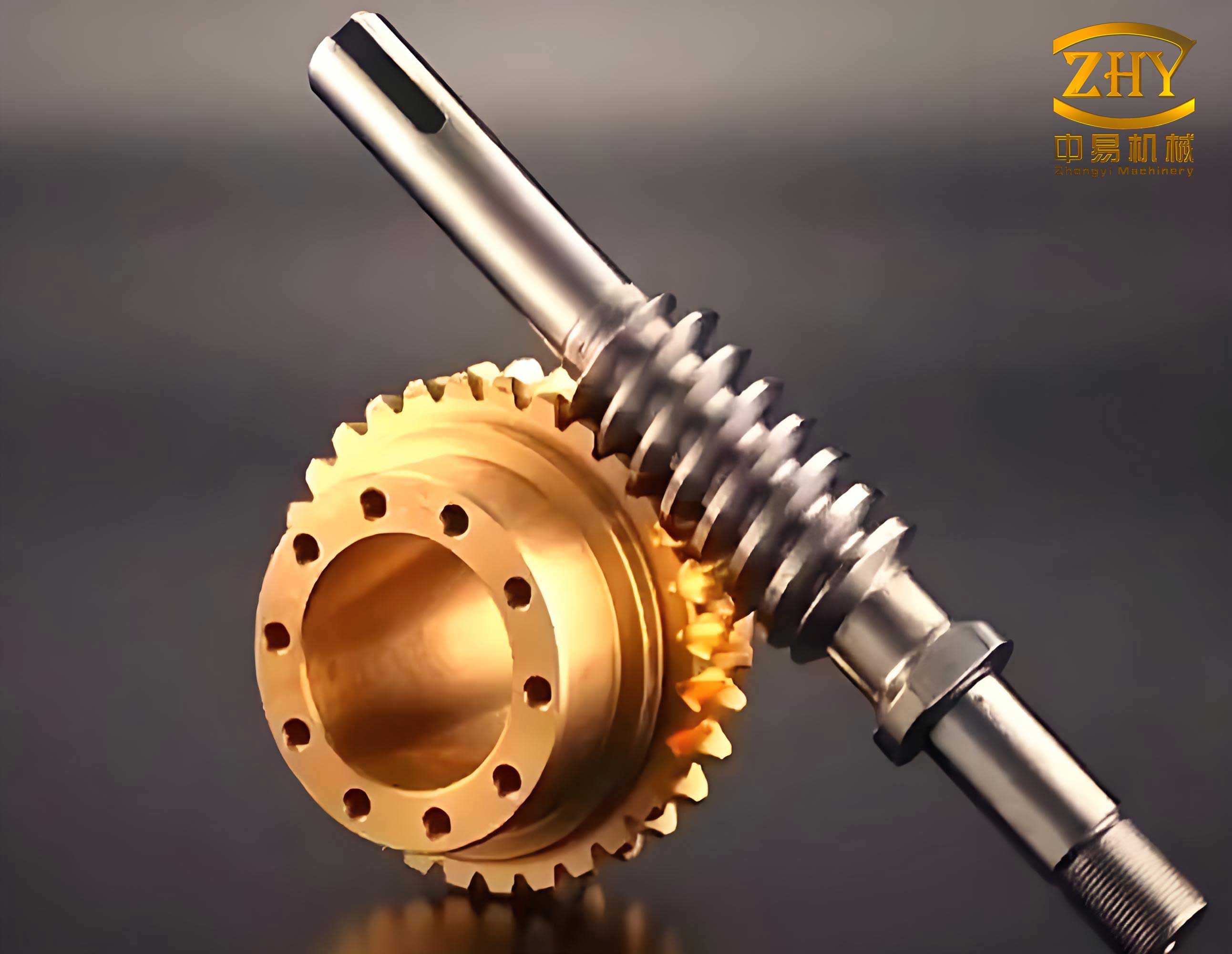
The schematic of the proposed system is based on this hybrid principle. The motor shaft is directly coupled to the input screw gear (worm). This worm engages with a worm wheel, achieving the first major speed reduction. The output shaft of the worm wheel carries two freely rotating gears of different sizes. A sliding dog clutch or gear, actuated by a lever, can engage with one of these two gears, selecting the transmission path. The power then flows through another pair of spur gears and finally to the output chain sprocket that drives the reel. This design drastically reduces the number of spur gear meshes compared to the traditional 4- or 5-stage design. The two total transmission ratios, iI and iII, can be expressed as:
$$ i_I = \frac{z_{w2}}{z_{w1}} \cdot \frac{z_{s5}}{z_{s3}} \cdot \frac{z_{s9}}{z_{s7}} \cdot \frac{z_{c11}}{z_{c10}} $$
$$ i_{II} = \frac{z_{w2}}{z_{w1}} \cdot \frac{z_{s6}}{z_{s4}} \cdot \frac{z_{s9}}{z_{s7}} \cdot \frac{z_{c11}}{z_{c10}} $$
where \( z_{w1}, z_{w2} \) are the number of worm threads and worm wheel teeth, \( z_{s3} \) to \( z_{s9} \) are the teeth of the spur gears, and \( z_{c10}, z_{c11} \) are the teeth of the chain sprockets. The central design task was to determine the optimal values for all these gear teeth numbers, as well as other critical parameters like module, face width, and the screw gear lead angle, to maximize efficiency and minimize size.
To tackle this complex multi-variable, multi-objective optimization problem, I formulated it mathematically and employed a genetic algorithm (GA). The GA is ideal for this as it can handle a mix of continuous variables (like lead angle, face width coefficients) and discrete variables (like gear teeth numbers, which are integers, and module, which is selected from a standard series). The design variables for the optimization were defined as the vector X:
$$ \mathbf{X} = [\gamma, m_w, z_{w1}, q, z_{w2}, z_{s3}, z_{s4}, z_{s5}, z_{s6}, z_{s7}, z_{s9}, \phi_{d2}, \phi_{d3}, \phi_{d4}, \phi_{d7}, m_3, m_4, m_7]^T $$
where \( \gamma \) is the worm lead angle, \( m_w \) is the worm module, \( z_{w1} \) is the number of worm starts, \( q \) is the worm diameter factor, \( \phi_{di} \) are face width coefficients for various gears, and \( m_3, m_4, m_7 \) are the modules of the spur gear pairs.
The two primary objectives were to maximize the total transmission efficiency for both speed ranges and to minimize the total volume of the gearbox. The total efficiency \( \eta_{total} \) for each range is a product of the efficiencies of all stages. The screw gear efficiency \( \eta_w \) is a key term and is calculated approximately for a worm-led drive as:
$$ \eta_w = \frac{\tan \gamma}{\tan \gamma + \arctan\left( \frac{0.3979 \pi d_1 n_1}{60000 \cos \gamma} – 0.03407 \right)^{-0.353}} $$
where \( d_1 \) is the worm pitch diameter and \( n_1 \) is the worm speed. The spur gear mesh efficiency uses a formula accounting for sliding friction losses. The total volume V is approximated as the sum of the volumes of the gear blanks and the worm wheel rim:
$$ V = V_g + V_w = \sum_{i} \frac{\pi b_i d_{ai}^2}{4} + \frac{\pi \psi m_w^3 (q+2)}{4} \left[ (u z_{w1} + 2 + \frac{6}{z_{w1}+2})^2 – (u z_{w1} + 6.4)^2 \right] $$
where \( b_i \) is face width, \( d_{ai} \) is gear addendum diameter, \( \psi \) is the worm wheel face width coefficient, and \( u = z_{w2}/z_{w1} \). Thus, the multi-objective optimization problem is:
$$ \text{min } F(\mathbf{X}) = ( -\eta_{I}(\mathbf{X}), -\eta_{II}(\mathbf{X}), V(\mathbf{X}) ) $$
subject to a comprehensive set of engineering constraints. These constraints ensure the design is practical and reliable:
- Gear Design Constraints: Bending and contact stress for all gears (spur and screw gear) must be below the material’s allowable limits. For spur gears:
$$ \sigma_F = \frac{2 K T}{b m_n z} Y_{Fa} Y_{Sa} \leq [\sigma_F] $$
$$ \sigma_H = Z_E Z_H \sqrt{\frac{2 K T (u+1)}{b d_1^2 u}} \leq [\sigma_H] $$ - Geometric and Assembly Constraints: Minimum tooth count to avoid undercutting (z ≥ 17 for spur gears), bounded face width coefficients (0.4 to 0.9), center distance matching for the two gear paths in the selector stage (\( m_3(z_{s3}+z_{s5}) = m_4(z_{s4}+z_{s6}) \)).
- Screw Gear Specific Constraints: The lead angle \( \gamma \) must be within a practical range (3° to 28°). The number of worm starts \( z_{w1} \) is typically 1 or 2 for high-ratio applications. The diameter factor \( q \) is bounded between standard limits.
- Transmission Ratio Constraints: The stage ratios for spur gears should lie within a recommended range of 2 to 5.
I implemented this optimization model using MATLAB’s Global Optimization Toolbox, utilizing the `gamultiobj` function for multi-objective GA. The discrete nature of variables like module (selected from the series [1.25, 1.5, 2, 2.5, 3, 4, 5, 6, 8, 10, 12, 16]) was handled by defining them as integer variables that index into this predefined list. The algorithm was run with a substantial population size over many generations to adequately explore the design space.
The optimization yielded a significantly improved set of design parameters. The results are most clearly presented by comparing the initial, manually chosen parameters against the GA-optimized solution, as shown in the table below.
| Design Parameter | Initial Design | Optimized Design |
|---|---|---|
| Worm Lead Angle, \( \gamma \) | 3° 13′ 28″ | 9° 11′ 17″ |
| Worm Module, \( m_w \) | 3 mm | 2 mm |
| Worm Starts, \( z_{w1} \) | 1 | 1 |
| Wheel Teeth, \( z_{w2} \) | 46 | 61 |
| Spur Gear Teeth, \( z_{s3} / z_{s4} / z_{s5} / z_{s6} / z_{s7} / z_{s9} \) | 40 / 23 / 100 / 117 / 32 / 96 | 25 / 29 / 111 / 73 / 37 / 111 |
| Face Width Coeff., \( \phi_{d2} / \phi_{d3} / \phi_{d4} / \phi_{d7} \) | 0.30 / 0.30 / 0.40 / 0.45 | 0.45 / 0.50 / 0.50 / 0.50 |
| Spur Gear Modules, \( m_3 / m_4 / m_7 \) | 2.0 / 2.0 / 2.5 mm | 1.5 / 2.0 / 2.0 mm |
| Total Efficiency, \( \eta_I \) | 0.6058 (60.58%) | 0.7435 (74.35%) |
| Total Efficiency, \( \eta_{II} \) | 0.6253 (62.53%) | 0.7564 (75.64%) |
| Estimated Gearbox Volume, V | 0.0136 m³ | 0.0122 m³ |
The optimization results are compelling. The total transmission efficiency saw an increase of over 13 percentage points for both speed ranges, a massive improvement largely attributable to the more efficient configuration of the screw gear (with a higher, more optimal lead angle) and the better-proportioned spur gear stages. Concurrently, the overall gearbox volume was reduced by approximately 10.3%. This demonstrates a successful trade-off where both primary objectives—higher efficiency and smaller size—were improved simultaneously. The optimization favored a smaller worm module but a larger lead angle and more teeth, leading to a more compact and efficient primary reduction stage. The spur gear stages were also resized with more appropriate face widths, contributing to better load distribution and reduced bending stresses.
To validate the performance gains predicted by the optimization, a prototype of the new transmission system was built and tested against the original hydraulic turbine-driven system on a dedicated test bench. The bench simulated the variable load on the reel by using a cable and weight system. Input power (torque and speed) and output power (force and speed at the reel) were measured to calculate the overall system efficiency under various load and speed conditions. The results, summarized in the table below, confirm the superiority of the new design.
| Simulated Load (kg) | Original Hydraulic Turbine System | New Electric Motor + Optimized Gearbox | ||||
|---|---|---|---|---|---|---|
| Input Speed (rpm) | ηI (%) | ηII (%) | Input Speed (rpm) | ηI (%) | ηII (%) | |
| 1000 | 700 | 50.1 | 42.9 | 1400 | 75.1 | 73.9 |
| 800 | 700 | 46.4 | 40.7 | 1400 | 73.0 | 70.9 |
| 600 | 700 | 41.3 | 36.5 | 1400 | 66.0 | 66.7 |
| 400 | 700 | 33.8 | 30.2 | 1400 | 59.0 | 60.3 |
| 200 | 700 | 22.7 | 19.0 | 1400 | 47.9 | 49.6 |
The experimental data unequivocally shows that the new system, driven by the electric motor and the optimized screw gear-based transmission, operates at dramatically higher efficiency levels across all tested loads. Even at lower motor speeds (simulating lower cart speeds), the efficiency remains substantially higher than the peak efficiency of the traditional system. This validates the core premise: replacing the inefficient turbine and redesigning the transmission around a high-ratio, optimized screw gear drive is a highly effective strategy for modernizing hose reel irrigators.
In conclusion, this design and optimization exercise demonstrates a clear pathway for enhancing the performance of hose reel irrigation machines. The integration of a screw gear as the primary reduction element, combined with a two-speed selective spur gear stage, successfully addresses the conflicting demands of extremely high reduction ratios, compact packaging, and operational efficiency. The application of a multi-objective genetic algorithm was instrumental in navigating the complex design space to find a Pareto-optimal solution that significantly boosts efficiency while reducing the physical volume of the gearbox. This approach not only provides a viable upgrade path for existing machines like the JP75 model but also establishes a valuable design framework for the next generation of energy-efficient, high-performance irrigation equipment. The principles of using optimized screw gear drives for compact, high-ratio power transmission have broad applicability in agricultural machinery and beyond.