
The pursuit of precision in motion control systems has consistently driven the evolution of specialized gearing technologies. Among these, the harmonic drive gear stands out for its exceptional capabilities, offering high reduction ratios, compact size, and zero-backlash operation within a single stage. This article delves into the detailed engineering process for designing a zero-backlash harmonic drive gear transmission, with a primary focus on the critical selection and optimization of profile shift coefficients for the flexspline and circular spline. The methodology centers on utilizing standard, readily manufacturable tooth profiles and strategically modifying their meshing parameters to approximate conjugate action while eliminating all forms of interference and minimizing operational clearance.
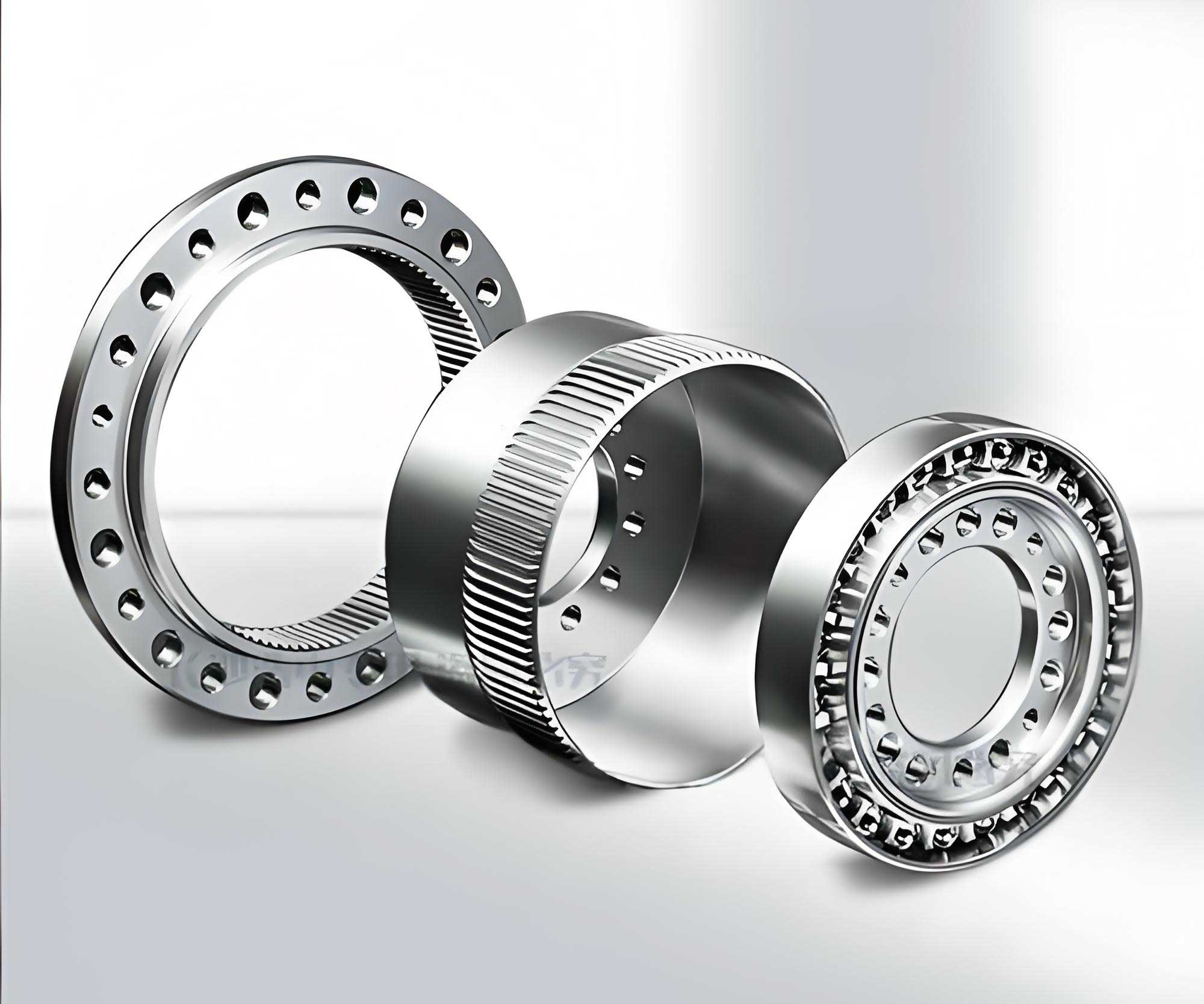
The fundamental principle of a harmonic drive gear involves three key components: a rigid circular spline with internal teeth, a non-rigid flexspline with external teeth, and an elliptical or cam-type wave generator inserted into the flexspline. The wave generator deforms the flexible flexspline into an elliptical shape, causing its external teeth to engage with the internal teeth of the circular spline at two diametrically opposite regions. As the wave generator rotates, the points of engagement travel, resulting in a slow relative rotation between the flexspline and the circular spline. The high gear reduction ratio is defined by the difference in the number of teeth between the two splines.
The Operational Principle and the Challenge of Zero Backlash
For a harmonic drive gear to achieve the highly desired characteristic of zero backlash or minimal lost motion, the meshing condition between the flexspline and circular spline teeth must be precisely controlled. Simply using standard gear teeth designed for parallel-shaft applications will lead to excessive clearance or, conversely, binding and interference due to the unique kinematics of the harmonic drive. The deformation of the flexspline means the effective center distance and pressure angles at the meshing points are constantly changing. Therefore, the tooth profiles of the flexspline and circular spline must be specially modified to accommodate this dynamic engagement and ensure continuous, tight contact across the entire arc of action.
Key Design Parameters and Gear Ratio
The foundation of the design begins with the selection of fundamental gear parameters that leverage existing manufacturing and inspection infrastructure for high precision.
- Tooth Profile: A standard involute profile with a pressure angle of $\alpha = 20^\circ$ is adopted for both the flexspline and the circular spline. This allows the use of mature, high-precision machining and measurement equipment commonly available for fine-pitch gears.
- Module: A fine module of $m = 0.3 \text{ mm}$ is selected, suitable for compact, high-precision harmonic drive gear assemblies.
- Tooth Numbers: The circular spline has $Z_G = 172$ teeth, and the flexspline has $Z_R = 170$ teeth. The difference, or wave number, is $Z_d = Z_G – Z_R = 2$, indicating a two-wave generator.
- Gear Ratio: With the circular spline fixed, the wave generator as input, and the flexspline as output, the transmission ratio $i_{HG}$ is calculated as follows:
$$i_{HG} = \frac{Z_R}{Z_R – Z_G} = \frac{170}{170 – 172} = -85$$
The negative sign indicates a reversal in the direction of rotation between the input and output. - Accuracy Class: The manufacturing accuracy for both gear components is specified at GB/T 2363-1990 Grade 6, setting a high standard for dimensional control.
Internal Gear Interference and the Selection of Addendum Coefficients
When both mating gears in an internal pair are involute gears, several types of interference can occur: profile interference (tip interference), trochoidal interference (undercutting at the root), and trimming interference. To prevent these issues, particularly the critical radial interference in a harmonic drive gear, strategic modifications to the standard tooth proportions are essential.
The primary strategy involves applying positive profile shift to both gears and significantly reducing the addendum of the flexspline tooth. A negative transmission type (where the sum of profile shift coefficients is less than zero) is employed, specifically with the circular spline’s shift coefficient $\xi_G$ being less than the flexspline’s $\xi_R$. This combination ($\xi_R > \xi_G$) helps to avoid interference and can also improve the contact ratio. The chosen addendum and dedendum coefficients are summarized in Table 1.
| Component | Addendum Coefficient $h_a^*$ | Dedendum Coefficient $c^*$ | Tooth Type |
|---|---|---|---|
| Circular Spline | 1.0 | 0.25 | Standard Full-Depth Tooth |
| Flexspline | 0.408 | 0.25 | Extra-Short Tooth (Stub Tooth) |
The use of an extra-short tooth ($h_{aR}^*=0.408$) for the flexspline is crucial. It minimizes the risk of the flexspline tooth tip digging into the root fillet of the circular spline tooth during the complex meshing cycle of the harmonic drive gear. The clearance between the tooth tip of one gear and the root of the other must be carefully controlled—it must be greater than zero to prevent interference but also less than a maximum allowable value to ensure minimal backlash. Determining the precise combination of $\xi_R$ and $\xi_G$ that satisfies the tip clearance equation, a transcendental equation, requires numerical methods and iterative approximation using computational tools.
Determination of Initial Profile Shift Coefficients $\xi_{R0}$ and $\xi_{G0}$
To initiate the design process, empirical formulas provide a reliable starting point for the profile shift coefficients in a $20^\circ$ pressure angle harmonic drive gear. The initial value for the flexspline is given by:
$$\xi_{R0} = K_a \cdot K_i \cdot \sqrt[3]{2 \cdot i_{HG}}$$
Where:
- $K_a$ is a coefficient related to the standard pressure angle $\alpha$.
- $K_i$ is a coefficient related to the gear ratio $i_{HG}$.
The values for these coefficients are listed in Tables 2 and 3 below.
| Pressure Angle $\alpha$ | $K_a$ |
|---|---|
| $20^\circ$ | 0.59 |
| Gear Ratio $i_{HG}$ | $K_i$ |
|---|---|
| 85 | 1.0 |
For the circular spline, the initial profile shift coefficient is set relative to the flexspline’s value. To provide a greater safety margin against radial interference in this precision application, a larger offset is used compared to conventional guides:
$$\xi_{G0} = \xi_{R0} + (0.20 \sim 0.25)m$$
Substituting the known values ($K_a=0.59$, $K_i=1.0$, $i_{HG}=85$, $m=0.3$):
$$
\begin{aligned}
\xi_{R0} &= 0.59 \times 1.0 \times \sqrt[3]{2 \times 85} \\
&= 0.59 \times \sqrt[3]{170} \\
&= 0.59 \times 5.5396 \quad \text{(approx.)} \\
&= 3.2684
\end{aligned}
$$
Choosing an offset of $0.22m$:
$$
\begin{aligned}
\xi_{G0} &= 3.2684 + 0.22 \times 0.3 \\
&= 3.2684 + 0.066 \\
&= 3.3344 \approx 3.335
\end{aligned}
$$
These values, $\xi_{R0} = 3.2684$ and $\xi_{G0} = 3.335$, serve as the baseline for subsequent refinement.
Analysis of Tooth Flank Clearance and Determination of the Correction Factor $\Delta\xi_R$
Tooth Flank Clearance (Side Clearance) Analysis
The core of achieving zero-backlash operation in a harmonic drive gear lies in analyzing the instantaneous clearance between the engaged tooth flanks throughout the entire meshing cycle. A mathematical model for the side clearance $H_{RG}$ is established. This model calculates the distance between the flexspline tooth flank and the circular spline tooth flank at discrete points (e.g., 210 points) across the engagement arc. The coordinates of the flexspline tooth tip $(x_{aR}^G, y_{aR}^G)$ and the corresponding point on the circular spline tooth flank $(x_{RG}, y_{RG})$ are determined in a coordinate system fixed to the circular spline. The clearance is then given by:
$$H_{RG} = \sqrt{ (x_{aR}^G – x_{RG})^2 + (y_{aR}^G – y_{RG})^2 }$$
where a positive value indicates a gap, and a negative value indicates penetration or overlap (interference).
For the initial coefficients $\xi_{R0}$ and $\xi_{G0}$, the calculation reveals that all clearance values across the 210 points are positive, with a minimum clearance $H_{RGmin} = 0.00539 \text{ mm}$ at a specific flexspline rotation angle $\phi_R$. This positive clearance, while preventing interference, would result in operational backlash, which is undesirable for a precision harmonic drive gear.
Determining the Profile Shift Correction $\Delta\xi_R$
To transition from a design with clearance to one with zero functional backlash, the flexspline profile shift coefficient must be increased. This correction, $\Delta\xi_R$, is determined by iteratively seeking a condition where the calculated side clearance becomes zero or slightly negative (indicating a light press fit or “negative clearance”) over a controlled portion of the meshing cycle. The goal is not to create interference across the entire arc, which would cause jamming, but to strategically induce light contact over a significant percentage (e.g., 30-40%) of the meshing positions.
The optimization process involves the following logic:
- A small negative clearance (e.g., -0.005 mm to 0 mm) is acceptable as elastic deformation in the flexspline will absorb it without hindering motion.
- This condition should occur in roughly 30-40% of the meshing positions, ensuring multiple teeth are in load-sharing contact at any time, which is intrinsic to the harmonic drive gear operation.
- The remaining positions should have a small positive clearance.
Using an optimization method (like the golden-section search) around a target clearance value derived from the initial maximum clearance, the optimal correction is found. After multiple iterations, the value $\Delta\xi_R = 0.1066$ is determined. With this correction applied ($\xi_R = \xi_{R0} + \Delta\xi_R = 3.375$), the clearance analysis yields:
- Negative Clearance Positions: Approximately 76 out of 210 positions (36%) exhibit negative clearance, with a maximum interference (most negative value) of $H_{RGmin} = -0.00563 \text{ mm}$.
- Positive Clearance Positions: The remaining 134 positions (64%) show positive clearance, with a maximum gap of $H_{RGmax} = 0.01172 \text{ mm}$.
This configuration ensures that at any given moment, several tooth pairs are in a state of light contact or zero clearance, effectively eliminating operational backlash, while other pairs have a small safety gap, preventing overall seizure of the harmonic drive gear assembly.
Final Determination of Profile Shift Coefficients $\xi_R$ and $\xi_G$
With the initial value and the meticulously calculated correction factor, the final, optimized profile shift coefficients for the zero-backlash harmonic drive gear are confirmed:
| Component | Initial Coefficient | Correction $\Delta$ | Final Coefficient |
|---|---|---|---|
| Flexspline ($\xi_R$) | 3.2684 | +0.1066 | 3.3750 |
| Circular Spline ($\xi_G$) | 3.3350 | 0 (Unchanged) | 3.3350 |
These coefficients, combined with the selected module ($m=0.3$), pressure angle ($\alpha=20^\circ$), and the non-standard addendum coefficients, define the tooth geometry that enables the assembly to function as a high-precision, effectively zero-backlash harmonic drive gear transmission.
Design Summary and Implementation Path
The successful design of a zero-backlash harmonic drive gear hinges on a systematic approach that balances theoretical conjugate action with practical manufacturing constraints. The process can be summarized in the following key steps, which form a replicable methodology for engineers:
- Foundation Parameters: Select standard, manufacturable base parameters (module, pressure angle, tooth numbers) and calculate the fundamental gear ratio.
- Interference Prevention: Choose addendum coefficients strategically, typically using a stub tooth for the flexspline and a standard tooth for the circular spline, to proactively avoid radial and trochoidal interference.
- Initial Shift Estimation: Use empirical formulas based on pressure angle and gear ratio to calculate initial profile shift coefficients $\xi_{R0}$ and $\xi_{G0}$, setting $\xi_G < \xi_R$ for a negative transmission type.
- Clearance Modeling: Develop or utilize a mathematical model to calculate the tooth flank clearance $H_{RG}$ between the flexspline and circular spline across the entire meshing cycle for the initial coefficients.
- Optimization for Zero Backlash: Employ numerical optimization techniques to determine a correction factor $\Delta\xi_R$ for the flexspline. The objective is to adjust the clearance profile so that a significant portion (30-40%) of the meshing positions exhibit near-zero or slightly negative clearance (controlled interference), while the rest maintain a small positive clearance.
- Final Parameter Definition: Apply the correction to obtain the final profile shift coefficients. These coefficients, along with the other geometric parameters, fully define the cutting tool settings (e.g., hob offset) required to manufacture the flexspline and circular spline gears.
This methodology demonstrates that a zero-backlash condition in a harmonic drive gear is not achieved by using theoretically perfect conjugate profiles (which are difficult and costly to manufacture), but rather by intelligently modifying standard involute profiles via profile shifting and addendum adjustment. The resulting design is a pragmatic compromise that delivers exceptional kinematic performance—minimal lost motion, high positional accuracy, and smooth torque transmission—while remaining within the bounds of standard high-precision gear manufacturing and inspection processes. The calculated coefficients ensure the gears will mesh with multiple tooth contacts under light elastic deformation of the flexspline, effectively eliminating functional backlash and making the harmonic drive gear an indispensable component in robotics, aerospace, and optical positioning systems.