
In my experience as an engineer specializing in mechanical transmission systems, I have observed that gear drives are pivotal in various industries due to their high load-bearing capacity, reliability, efficiency, and precise speed ratios. Among these, helical gears stand out for their smooth operation, reduced vibration, and enhanced noise, vibration, and harshness (NVH) performance, making them ideal for applications in automotive, engineering machinery, and aerospace sectors. The axial overlap ratio, a critical parameter in helical gear design, significantly influences the contact pattern and overall performance. However, dedicated studies on this aspect are limited, prompting me to explore its impact through simulation and optimization. This article delves into the design and optimization of helical gears by focusing on axial overlap ratio, using virtual modeling tools to derive practical insights.
Helical gears, characterized by their angled teeth, offer superior meshing continuity compared to spur gears. This continuity is quantified by the total contact ratio, which comprises the transverse contact ratio and the axial contact ratio. The axial contact ratio, often referred to as axial overlap ratio, dictates how many tooth pairs are in contact along the gear axis simultaneously. Ensuring an adequate axial overlap ratio is essential for minimizing load fluctuations, reducing stress concentrations, and improving NVH characteristics. In engineering machinery, such as loaders, where operational conditions are demanding, optimizing helical gears for better contact patterns can lead to enhanced durability and performance. My investigation centers on how adjusting macro-parameters like helix angle and tooth width affects the axial overlap ratio and, consequently, the contact area under load.
To begin, I define the axial overlap ratio for helical gears. The total contact ratio, denoted as $\varepsilon_{\gamma}$, is the sum of the transverse contact ratio $\varepsilon_{\alpha}$ and the axial contact ratio $\varepsilon_{\beta}$. The axial overlap ratio $\varepsilon_{\beta}$ represents the overlap along the axis of rotation and is calculated using the formula: $$ \varepsilon_{\beta} = \frac{b \sin \beta}{\pi m_n} $$ where $b$ is the face width, $\beta$ is the helix angle at the pitch circle, and $m_n$ is the normal module. This equation highlights that $\varepsilon_{\beta}$ increases linearly with face width and helix angle but inversely with normal module. For efficient and quiet operation of helical gears, it is generally recommended that $\varepsilon_{\beta} \geq 1$. In practical designs, a higher axial overlap ratio can promote smoother torque transmission and lower dynamic loads, which is crucial for high-stress applications like those in construction equipment.
The axial overlap ratio directly influences the contact pattern on gear tooth flanks. The contact pattern, defined as the instantaneous area of contact between meshing teeth under load, serves as a macroscopic indicator of load distribution uniformity. Irregular contact patterns, such as edge-loading or root contact, can lead to premature wear, pitting, and increased noise. Traditionally, contact patterns are assessed using physical roll testers, but this method is costly and time-consuming. With advancements in simulation software, such as Romax Designer, virtual contact analysis based on Hertzian contact theory has become feasible. This allows for predictive optimization during the design phase, enabling engineers to refine helical gears for optimal performance before manufacturing.
In my analysis, I established a conceptual model of a transmission system for an engineering machinery loader using Romax Designer software. This model simulates a two-speed, fixed-shaft gearbox with two reduction stages, focusing on the input-stage helical gear pair. The virtual environment facilitates detailed parameterization and load condition application, providing a robust platform for studying the effects of axial overlap ratio. The model incorporates gear geometries, material properties, and boundary conditions to replicate real-world operating scenarios.
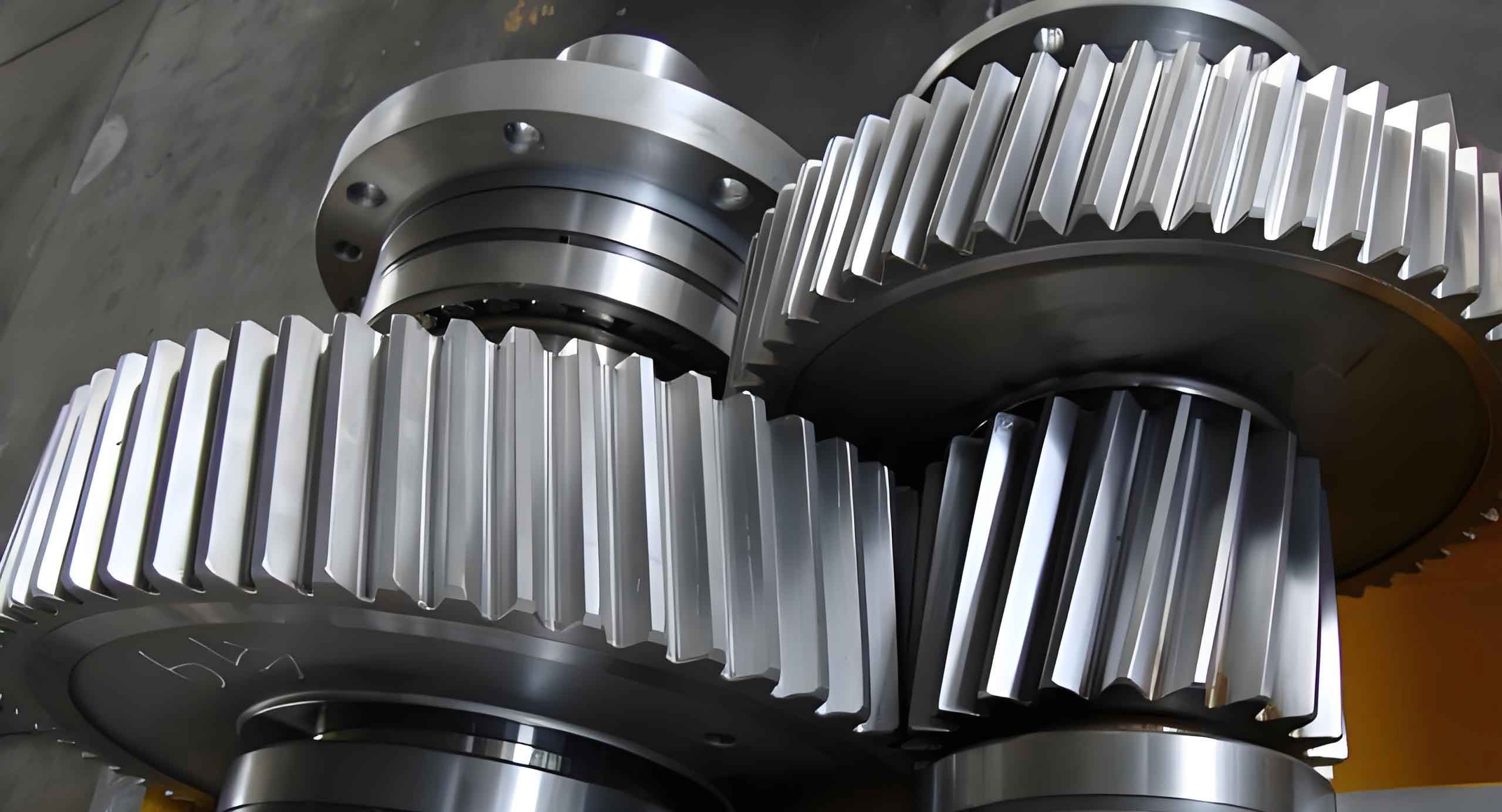
For the detailed design, I compared two sets of helical gear parameters to evaluate the impact of axial overlap ratio. The initial design and an optimized design were developed, with key macro-parameters summarized in tables below. Micro-geometry modifications, such as profile crowning and lead crowning, were applied to both designs to compensate for manufacturing errors and assembly misalignments. These modifications are standard in helical gear manufacturing to enhance contact patterns and reduce stress concentrations.
| Parameter | Pinion (Z1) | Gear (Z2) |
|---|---|---|
| Normal Module $m_n$ (mm) | 3.5 | 3.5 |
| Number of Teeth | 32 | 77 |
| Pressure Angle $\alpha$ (°) | 20 | 20 |
| Helix Angle $\beta$ (°) | 15 | 15 |
| Face Width $b$ (mm) | 44 | 46 |
| Center Distance (mm) | 198 | |
| Axial Overlap Ratio $\varepsilon_{\beta}$ | 1.036 | |
| Profile Crowning (μm) | 10 | 0 |
| Lead Crowning (μm) | 10 | 0 |
| Parameter | Pinion (Z1) | Gear (Z2) |
|---|---|---|
| Normal Module $m_n$ (mm) | 3.5 | 3.5 |
| Number of Teeth | 32 | 77 |
| Pressure Angle $\alpha$ (°) | 20 | 20 |
| Helix Angle $\beta$ (°) | 18 | 18 |
| Face Width $b$ (mm) | 44 | 46 |
| Center Distance (mm) | 198 | |
| Axial Overlap Ratio $\varepsilon_{\beta}$ | 1.237 | |
| Profile Crowning (μm) | 10 | 0 |
| Lead Crowning (μm) | 10 | 0 |
The axial overlap ratio for the optimized helical gears is higher due to the increased helix angle, calculated as: $$ \varepsilon_{\beta} = \frac{44 \sin 18^\circ}{\pi \times 3.5} \approx 1.237 $$ compared to the initial design: $$ \varepsilon_{\beta} = \frac{44 \sin 15^\circ}{\pi \times 3.5} \approx 1.036 $$ This increase enhances the meshing continuity, which is expected to improve the contact pattern distribution.
Next, I defined the boundary conditions for the simulation. The material properties and heat treatment parameters for the helical gears are critical for accurate stress analysis. The gears are made from 20CrMnTi steel, subjected to carburizing and quenching to achieve high surface hardness. The mechanical properties are summarized in the table below.
| Property | Value |
|---|---|
| Material Grade | 20CrMnTi |
| Heat Treatment | Carburizing and Quenching |
| Surface Hardness (HRC) | 60 |
| Core Hardness (HRC) | 35 |
| Yield Strength (MPa) | 850 |
| Tensile Strength (MPa) | 1050 |
| Elastic Modulus (MPa) | 2.07 × 10⁵ |
| Poisson’s Ratio | 0.29 |
The operational load conditions represent a rated scenario typical for engineering machinery. The applied torque, speed, and power are specified to simulate real-world stresses on the helical gears.
| Condition | Speed (rpm) | Torque (Nm) | Power (kW) |
|---|---|---|---|
| Rated Operation | 2800 | 480 | 140.7 |
With these parameters set, I ran the simulation in Romax Designer to analyze the contact stress patterns on the helical gears. The results revealed significant differences between the initial and optimized designs. For the initial helical gears with a lower axial overlap ratio, the contact stress was concentrated near the left edge of the tooth flank and extended toward the root region. This indicates edge-loading and non-uniform stress distribution, which can lead to premature failure and increased vibration. In contrast, the optimized helical gears with a higher axial overlap ratio exhibited a more centered contact pattern along the face width, avoiding the root area and distributing stress more evenly. This alignment reduces impact during meshing engagement and disengagement, thereby enhancing NVH performance and longevity.
The contact stress distribution can be mathematically described using Hertzian contact theory. For helical gears, the maximum contact stress $\sigma_H$ is given by: $$ \sigma_H = \sqrt{\frac{F_t}{b} \cdot \frac{1}{\pi \left( \frac{1-\nu_1^2}{E_1} + \frac{1-\nu_2^2}{E_2} \right)} \cdot \frac{1}{\rho_{eq}}} $$ where $F_t$ is the tangential force, $b$ is the face width, $\nu$ and $E$ are Poisson’s ratio and elastic modulus for each gear, and $\rho_{eq}$ is the equivalent radius of curvature. A higher axial overlap ratio increases the effective contact length, reducing $\sigma_H$ and improving load sharing among multiple tooth pairs.
Furthermore, I explored the relationship between axial overlap ratio and dynamic behavior. Helical gears with higher $\varepsilon_{\beta}$ values exhibit lower transmission error, which is a key contributor to noise and vibration. Transmission error $\Delta \theta$ can be approximated as: $$ \Delta \theta \propto \frac{1}{\varepsilon_{\beta}} \cdot \frac{\delta}{R_b} $$ where $\delta$ represents manufacturing deviations and $R_b$ is the base radius. Thus, increasing $\varepsilon_{\beta}$ mitigates the effects of errors, leading to smoother operation.
To generalize the optimization process for helical gears, I derived a parametric approach. The goal is to maximize axial overlap ratio within constraints such as center distance, strength, and manufacturing limits. The objective function can be formulated as: $$ \text{Maximize } \varepsilon_{\beta} = \frac{b \sin \beta}{\pi m_n} $$ subject to: $$ a = \frac{m_n (Z_1 + Z_2)}{2 \cos \beta} $$ $$ \sigma_b \leq \sigma_{\text{allowable}} $$ where $a$ is the center distance, $Z_1$ and $Z_2$ are tooth numbers, and $\sigma_b$ is the bending stress. Using numerical methods, designers can iterate through helix angles and face widths to achieve an optimal balance.
In practice, the design of helical gears often involves trade-offs. For instance, increasing helix angle boosts axial overlap ratio but also raises axial thrust forces, requiring robust bearing support. Similarly, widening face width improves $\varepsilon_{\beta}$ but adds weight and cost. Through simulation, I evaluated multiple design variants beyond the two presented, adjusting parameters like pressure angle and module. The results consistently showed that helical gears with $\varepsilon_{\beta} > 1.2$ yielded superior contact patterns when combined with micro-geometry modifications. This underscores the importance of holistic design that integrates macro-parameters and micro-corrections.
Another aspect I considered is the effect of load variations on helical gears. Under fluctuating torques, a higher axial overlap ratio provides better load distribution across teeth, reducing stress peaks. This is particularly beneficial in engineering machinery where shock loads are common. The dynamic factor $K_v$ for helical gears can be expressed as: $$ K_v = 1 + \frac{v}{C} $$ where $v$ is the pitch line velocity and $C$ is a constant dependent on gear accuracy. With increased $\varepsilon_{\beta}$, the dynamic excitation decreases, leading to lower $K_v$ and enhanced reliability.
Moreover, the manufacturing tolerances for helical gears play a crucial role in realizing the designed contact pattern. Profile and lead modifications, as applied in this study, compensate for misalignments and deformations. The optimal crowning amounts depend on the axial overlap ratio; for higher $\varepsilon_{\beta}$, smaller crowning may suffice due to better inherent alignment. This reduces manufacturing complexity and cost while maintaining performance.
In conclusion, my analysis demonstrates that axial overlap ratio is a pivotal factor in the design and optimization of helical gears. By increasing $\varepsilon_{\beta}$ through adjustments in helix angle or face width, engineers can achieve more favorable contact stress distributions, leading to improved load capacity, reduced noise, and extended service life. The use of simulation tools like Romax Designer enables precise virtual prototyping, allowing for iterative refinements before physical production. For engineering machinery applications, where durability and NVH are critical, optimizing helical gears for higher axial overlap ratios, coupled with appropriate micro-geometry modifications, offers a practical pathway to enhanced transmission performance. Future work could explore the interplay between axial overlap ratio and thermal effects or material advancements, further pushing the boundaries of helical gear technology.