
In my extensive experience within automotive engineering, particularly in axle design, the adoption and refinement of hyperbolic gear designs have marked a significant technological evolution. These gears, often referred to as hypoid gears but with specific geometric traits, offer superior performance compared to traditional straight-bevel or spiral-bevel gears. The core advantage lies in their ability to transmit power between non-intersecting, offset axes, which allows for more flexible and robust drivetrain layouts. This article delves deeply into the methodologies, characteristics, challenges, and future directions of hyperbolic gear design, drawing from practical applications and theoretical foundations. I aim to provide a comprehensive resource that underscores the critical parameters, computational frameworks, and empirical insights necessary for mastering hyperbolic gear design.
The fundamental geometry of a hyperbolic gear pair is defined by its hyperboloidal pitch surfaces. This geometry introduces a deliberate offset between the pinion and gear axes, a feature that fundamentally differentiates it from bevel gears. The offset enables a larger pinion diameter for a given gear ratio, enhancing strength and torque capacity. However, this comes with increased complexity in design and manufacturing. The design process is inherently iterative and relies on a careful balance of interdependent parameters. A pivotal tool in this process is the pitch cone diagram, which visually represents the spatial relationship between the pinion and gear.
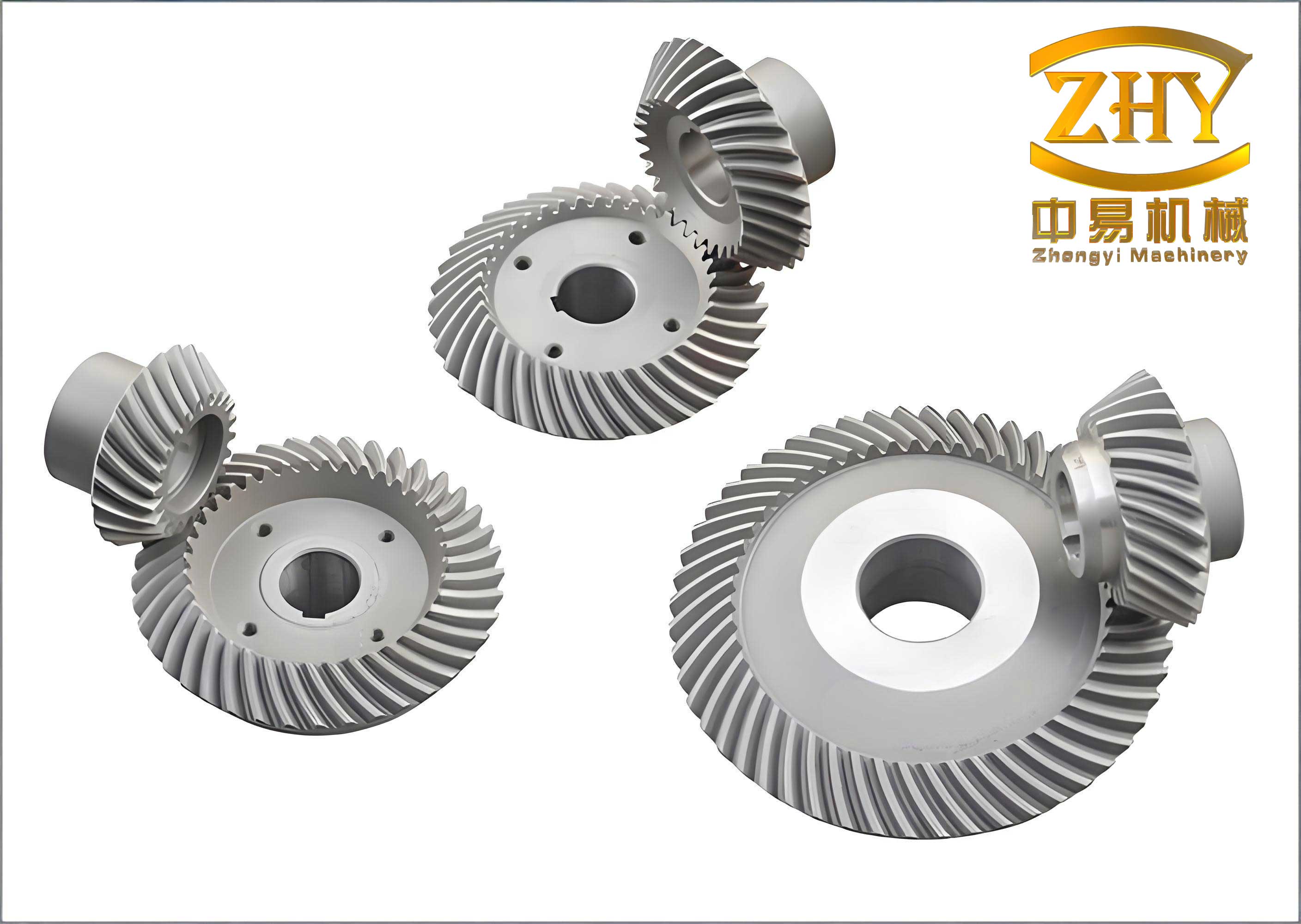
This visualization is indispensable for understanding the meshing conditions and for performing subsequent verification calculations across various cross-sections. The primary design sequence involves selecting a foundational set of parameters, which then serve as inputs for solving a system of equations to determine all remaining unknown dimensions and machine settings for cutting the hyperbolic gear teeth.
Fundamental Design Methodology for Hyperbolic Gears
The design of a hyperbolic gear set begins with the specification of several key parameters. These choices are not arbitrary; they are constrained by functional requirements, manufacturing capabilities, and performance targets such as load capacity, efficiency, noise, and durability.
1. Determination of Gear Ratio and Diametral Pitch
The gear ratio \( i \) is a primary driver of the overall drivetrain configuration. It is defined as the ratio of the number of teeth on the gear \( N_g \) to the number of teeth on the pinion \( N_p \):
$$ i = \frac{N_g}{N_p} $$
Closely related is the diametral pitch \( P_d \), which influences tooth size, bending strength, and sensitivity to scoring. An inappropriate choice of tooth numbers can lead to manufacturing waste or functional failure. The diametral pitch is linked to the pitch diameter \( d \) and number of teeth \( N \):
$$ P_d = \frac{N}{d} $$
For hyperbolic gears, the effective diametral pitch must be considered on the pitch cone. A balanced design aims for a diametral pitch that provides sufficient tooth strength without excessively reducing the tooth depth, which could compromise overlap and smoothness.
2. Selection of Spiral Angles
The spiral angle \( \beta \) is a critical parameter affecting the smoothness of operation, axial thrust loads, and overall gear strength. In a hyperbolic gear pair, the pinion and gear have different spiral angles due to the axis offset. The pinion spiral angle \( \beta_p \) is typically larger than the gear spiral angle \( \beta_g \). A common and effective configuration in automotive axles is to set the pinion spiral angle around 50° and the gear spiral angle around 25°. This yields an “offset angle” \( \Sigma \) approximately equal to the difference:
$$ \Sigma \approx \beta_p – \beta_g $$
For many designs, \( \Sigma \) is around 25°. Increasing the gear’s spiral angle improves the overlap ratio and smoothness but simultaneously increases axial thrust, necessitating larger bearings. The direction of the spiral is chosen so that under forward driving torque, the axial thrust on the pinion tends to move it away from the gear, reducing load on the thrust bearing. Conversely, reverse torque pulls the pinion into mesh, increasing bearing clearance and tooth stress. The choice is thus a compromise, and for specialized applications, the spiral angles must be tailored specifically.
3. Determination of the Offset Distance
The offset distance \( E \), also known as the hypoid offset, is the perpendicular distance between the axes of the pinion and the gear. This is the defining feature of a hyperbolic gear. The offset significantly influences gear design, assembly flexibility, and performance characteristics. A larger offset allows for a larger pinion diameter, enhancing its strength and bending resistance. However, it also increases the sliding velocity between tooth surfaces, which can exacerbate wear and scuffing. The offset is intrinsically linked to the spiral angles and the pitch diameters. Its value is often derived from the design goal to position the offset towards the convex side of the gear tooth, leveraging the advantages of a “large” pinion design and favorable bearing reactions. The relationship can be approximated through geometric considerations on the pitch hyperboloids. The offset influences the generated sliding velocity \( V_s \), which for a point on the tooth surface can be expressed as a function of the offset \( E \), pitch line velocity \( V \), and the spiral angles:
$$ V_s \propto E \cdot V \cdot \sin(\beta_p – \beta_g) $$
Thus, optimizing the offset is a central challenge in hyperbolic gear design.
4. Determination of Other Parameters via Computational Systems
Once the primary parameters (ratio, spiral angles, offset, gear face width \( F \), and cutter blade radius \( R_c \)) are tentatively chosen, the remaining unknown dimensions are determined by solving a system of nonlinear equations derived from the geometry of meshing hyperboloids. These equations govern the relationships between pitch diameters, cone angles, tooth depth, and machine setup parameters for gear generation (e.g., using a face-mill or face-hob process). Key equations often involve the pitch cone angles \( \gamma_p \) and \( \gamma_g \), which are not complementary as in bevel gears due to the offset. They can be found using relations such as:
$$ \tan \gamma_g = \frac{\sin \Sigma}{i + \cos \Sigma} $$
and
$$ \tan \gamma_p = \frac{i \sin \Sigma}{1 + i \cos \Sigma} $$
where \( \Sigma \) is the shaft angle (usually 90° in automotive axles). However, with an offset \( E \), the effective operating pitch cone angles deviate from these nominal values. The exact calculation requires iterative computational procedures. Modern design relies heavily on specialized software that solves these equations while ensuring constraints on tooth contact pattern, tooth tip sharpness, root fillet stress, and manufacturing feasibility are met. The output includes all gear blank dimensions, tooth geometry data, and the detailed machine settings for cutting and lapping the hyperbolic gear pair.
| Parameter | Symbol | Typical Range/Value | Primary Influence |
|---|---|---|---|
| Gear Ratio | \( i \) | 3:1 to 6:1 (Axle) | Torque multiplication, pinion size |
| Pinion Spiral Angle | \( \beta_p \) | 45° to 55° | Axial thrust, smoothness, overlap |
| Gear Spiral Angle | \( \beta_g \) | 20° to 30° | Axial thrust, effective offset angle |
| Offset Distance | \( E \) | 10% to 30% of Gear Pitch Diameter | Pinion strength, sliding velocity, bearing loads |
| Gear Face Width | \( F \) | ~30% of Gear Pitch Diameter | Bending strength, contact pattern length |
| Cutter Blade Radius (Blade Circle Diameter) | \( R_c \) | Design-dependent | Tooth longitudinal curvature, tooth taper, production cost |
Characteristics and Inherent Challenges of Hyperbolic Gear Operation
The hyperbolic gear design offers compelling advantages but also introduces specific challenges that must be meticulously managed. Understanding these characteristics is paramount for a successful application.
The most celebrated advantage is the superior smoothness and quietness of operation compared to spiral bevel gears. This stems from a higher contact ratio and the gradual engagement of teeth due to the curved tooth lines and offset geometry. Furthermore, the ability to use a larger pinion for a given ratio and center distance increases the pinion’s root thickness and bending strength, often by 30% or more. The offset also allows the driveline to be positioned lower in the vehicle, improving ground clearance and center of gravity, a crucial benefit in automotive design.
However, the same offset that confers these benefits is the source of the primary challenge: high sliding velocity at the tooth interface. While rolling is the dominant motion in gear teeth, a sliding component always exists. In hyperbolic gears, this sliding component is substantially magnified. The sliding velocity \( V_s \) at the pitch point can be approximated by:
$$ V_s = 2 \cdot E \cdot \omega_p \cdot \sin(\beta_m) $$
where \( \omega_p \) is the pinion angular velocity and \( \beta_m \) is the mean spiral angle. This high sliding velocity, combined with high contact pressures, creates an extreme pressure (EP) lubrication regime. The thin oil film is susceptible to breakdown under high load and temperature, leading to metal-to-metal contact. This can result in scuffing (adhesive wear), scoring, and ultimately, rapid tooth failure. Therefore, hyperbolic gears demand dedicated, high-performance extreme pressure (EP) lubricants containing additives like sulfur-phosphorus compounds that form protective surface layers under high stress.
Another significant characteristic is the sensitivity to assembly and alignment errors. The optimal contact pattern—a well-centered ellipse on the tooth flank—is crucial for distributing load evenly and minimizing stress concentrations. Misalignments in the form of incorrect pinion position (offset, mounting distance), gear backlash, or shaft deflections can shift the contact pattern towards the toe or heel, or even cause edge loading. This drastically reduces load capacity, increases noise, and accelerates wear. The adjustment process during assembly is therefore precise and critical.
The axial thrust forces generated are also larger and more complex than in bevel gears. The pinion experiences a substantial axial force that must be reacted by a robust bearing system. The magnitude of the pinion axial thrust \( F_{ax,p} \) can be estimated from the transmitted torque \( T_p \) and the pinion spiral angle:
$$ F_{ax,p} \approx \frac{2 T_p}{d_p} \tan \beta_p $$
where \( d_p \) is the pinion pitch diameter. This necessitates the use of larger, preloaded tapered roller bearings or similar arrangements, impacting the overall size and design of the differential carrier.
| Characteristic | Spiral Bevel Gear | Hyperbolic Gear |
|---|---|---|
| Meshing Smoothness & Noise | Good | Excellent (Higher overlap ratio) |
| Bending Strength (Pinion) | Baseline | ~30% higher (due to larger pinion diameter) |
| Resistance to Pitting | Baseline | ~20-30% higher (better load distribution) |
| Sensitivity to Scuffing/Scoring | Lower | Higher (due to increased sliding velocity) |
| Relative Sliding Velocity | Lower | Can be 200% higher or more |
| Mechanical Efficiency | Slightly higher (≈99%) | High, but slightly lower (≈97-98%) due to sliding friction |
| Lubricant Requirement | Regular Gear Oil (Mild EP) | Dedicated Hypoid/EP Gear Oil |
| Sensitivity to Misalignment | Moderate | High (Contact pattern is highly sensitive) |
| Manufacturing & Grindability | Standard, but smaller blade clearance can limit grinding | Larger blade clearance often allows easier grinding |
| Maximum Practical Ratio | Limited by pinion size | Higher ratios feasible due to larger pinion |
| Differential Package Size | Smaller (pinion closer to center) | Larger (offset creates more space around diff) |
| Pinion Bearing Reactions (Axial) | Smaller | Larger |
| Pinion Shaft Diameter | Smaller | Larger (to support larger pinion head) |
Directions for Improvement and Optimization in Hyperbolic Gear Design
Continuous improvement is vital to overcome the challenges and further exploit the benefits of hyperbolic gears. Based on analysis and field experience, several key directions for optimization stand out.
1. Strategic Increase of Offset Distance
As established, the offset \( E \) is a double-edged sword. The trend in advanced axle design is to cautiously increase the offset beyond historical norms. This “high-offset” hyperbolic gear design aims to maximize pinion diameter and strength. To mitigate the concomitant rise in sliding velocity and scuffing risk, complementary measures are essential. These include advanced surface treatments like phosphating or diamond-like carbon (DLC) coatings to reduce friction, and the development of next-generation lubricants with enhanced film strength and thermal stability. The optimization problem can be framed as maximizing a strength-to-sliding ratio. A simplified merit function \( M \) for initial assessment could be:
$$ M = \frac{k_s \cdot d_p^{3}}{k_v \cdot V_s} $$
where \( k_s \) and \( k_v \) are scaling constants related to bending strength and sliding wear susceptibility, respectively. Design exploration involves finding the offset that maximizes \( M \) within packaging and manufacturing constraints.
2. Optimization of Pressure Angle and Asymmetric Tooth Profiles
The pressure angle \( \phi \) profoundly affects tooth strength, overlap, and sensitivity to undercut. Increasing the pressure angle strengthens the tooth root against bending but can lead to a pointed tooth tip and reduced contact ratio. A significant innovation is the use of asymmetric pressure angles for the drive and coast sides of the tooth. The drive side (primary load direction) can employ a lower pressure angle (e.g., \( \phi_d = 16°-18° \)) to increase the transverse contact ratio \( \epsilon_{\alpha} \), improving smoothness and reducing contact stress. The coast side can use a higher pressure angle (e.g., \( \phi_c = 20°-22° \)) to maintain ample root thickness for occasional reverse torque loads. The contact ratio for the drive side is given by:
$$ \epsilon_{\alpha} = \frac{\sqrt{R_{a1}^2 – R_{b1}^2} + \sqrt{R_{a2}^2 – R_{b2}^2} – a \sin \phi_d}{\pi m_t \cos \phi_d} $$
where \( R_a \) is tip radius, \( R_b \) is base radius, \( a \) is center distance, and \( m_t \) is transverse module. This asymmetric approach allows designers to tailor performance specifically for the dominant loading condition, a flexibility highly beneficial for hyperbolic gears.
3. Rational Selection and Adjustment of Cutter Blade Radius (Blade Circle Diameter)
The cutter blade radius \( R_c \) (or the diameter of the cutting tool’s blade circle) is a master parameter in the gear generation process. It controls the longitudinal curvature of the tooth, influencing the effective spiral angle along the face width, the taper of the tooth, and the shape of the contact ellipse. A larger \( R_c \) produces a flatter tooth longitudinally, which can be beneficial for distributing load but may reduce the effective length of contact. A smaller \( R_c \) increases curvature, potentially concentrating stress. The choice also impacts manufacturing economy; a standard, readily available cutter size is preferable. The relationship between the cutter radius and the gear’s mean spiral angle \( \beta_m \) and pitch diameter \( d \) is governed by the machine kinematics. Optimizing \( R_c \) involves balancing gear strength (contact pattern shape) with production cost and tooling commonality across different gear sets.
4. Integrated Computational Design and Simulation
The future of hyperbolic gear design lies in fully integrated digital twins. This involves coupling advanced geometry generation algorithms (based on the theory of gearing for hypoid surfaces) with high-fidelity finite element analysis (FEA) for stress and deflection, elastohydrodynamic lubrication (EHL) analysis for film thickness prediction, and system-level multi-body dynamics (MBD) for noise and vibration simulation. The goal is to predict the loaded tooth contact pattern and transmission error (TE) under real-world conditions of misalignment, torque, and temperature before physical prototyping. The transmission error, a primary exciter of gear noise, can be minimized through micro-geometry modifications like tip and root relief, lead crowning, and bias modification (flank twist). These modifications are described by polynomial functions applied to the basic tooth surface coordinates. For instance, lead crowning modifies the tooth surface along its length to accommodate misalignment, defined by a parabolic function \( \delta(y) = C_y \cdot y^2 \), where \( y \) is the distance from the tooth center along the face width and \( C_y \) is the crowning coefficient.
| Optimization Area | Specific Parameter | Adjustment Direction | Primary Target Effect |
|---|---|---|---|
| Geometry | Offset Distance \( E \) | Increase (within limits) | Increase pinion bending strength, allow lower driveline |
| Tooth Profile | Pressure Angle \( \phi \) (Asymmetric) | Drive side: Lower; Coast side: Higher | Increase drive-side contact ratio & smoothness; maintain coast-side strength |
| Manufacturing | Cutter Blade Radius \( R_c \) | Select for optimal longitudinal curvature | Control contact ellipse size/shape, balance stress vs. manufacturability |
| Micro-geometry | Lead Crowning, Profile Relief, Bias | Apply based on loaded simulation | Stabilize contact pattern under load/misalignment, reduce Transmission Error (TE) |
| Material & Surface | Case Hardening Depth, Surface Coating | Optimize gradient, apply low-friction coatings | Increase surface durability, reduce scuffing risk, improve fatigue life |
Conclusion: The Path Forward for Hyperbolic Gear Technology
The development and application of hyperbolic gear design have profoundly transformed automotive axle engineering, providing solutions where traditional bevel gears fell short. The methodology, while complex due to the interdependence of parameters like offset, spiral angles, and cutter geometry, is now well-established and supported by sophisticated computational tools. The characteristic advantages—superior smoothness, higher strength potential, and packaging benefits—are clear. However, the challenges, particularly the high sliding velocities and associated sensitivity to lubrication and alignment, demand constant attention and innovation.
The future trajectory for hyperbolic gear design is one of deepened integration and smart optimization. We are moving towards generative design algorithms that can explore vast parameter spaces to meet multi-objective targets for efficiency, durability, noise, and cost. The use of asymmetric tooth profiles, optimized micro-geometry, and advanced materials will become standard. Furthermore, the rise of electric vehicles presents new challenges and opportunities; the instantaneous high torque of electric motors and different noise signatures will require re-evaluation of traditional hyperbolic gear design rules. Perhaps new ratios, offsets, or surface finishes will become optimal in this context.
Ultimately, the hyperbolic gear remains a cornerstone of power transmission in demanding applications. By continuing to refine its design through a combination of analytical rigor, empirical validation, and technological innovation, we can ensure that this versatile component meets the evolving demands of the automotive industry and beyond, solidifying its role in efficient and reliable drivetrain systems for years to come. The journey of mastering hyperbolic gear design is continuous, driven by the relentless pursuit of performance, durability, and perfection in mechanical power transmission.