
In the field of mechanical transmission, the design and analysis of crossed helical gears represent a critical area of study due to their unique ability to transmit motion between non-parallel and non-intersecting shafts. These gears, often referred to as spiral gears or skew gears, offer significant advantages in applications where space constraints, cost-effectiveness, and flexibility in shaft alignment are paramount. Throughout this paper, we explore a comprehensive methodology for designing crossed helical gears with arbitrary shaft angles and center distances, develop a parameterized modeling approach using advanced CAD software, and conduct detailed finite element analysis to evaluate modal characteristics and bending stresses. The integration of theoretical calculations, parametric modeling, and simulation ensures the reliability and optimization of helical gears in practical engineering scenarios.
The fundamental appeal of crossed helical gears lies in their versatility. Unlike parallel shaft helical gears, they can accommodate a wide range of shaft angles, typically from 0° to 90°, and beyond, making them ideal for complex machinery layouts. However, this flexibility comes with challenges: the point contact nature of meshing, high helical angles often approaching or exceeding 45°, and resultant three-dimensional stress states under load can lead to increased wear, deformation, and potential failure. Thus, a systematic approach encompassing design, modeling, and analysis is essential. We aim to bridge gaps in existing literature by providing an in-depth treatment of these aspects, focusing on practical implementation and robust validation through simulation.
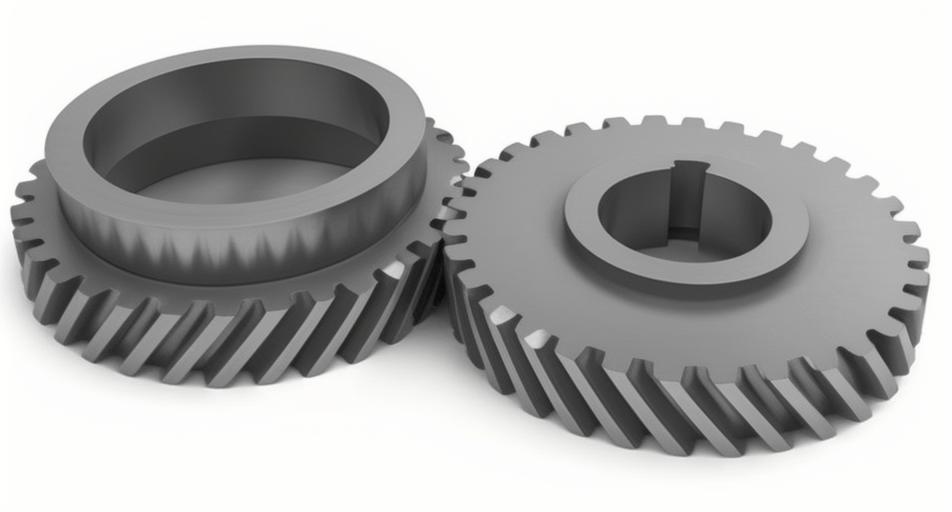
The initial phase involves the theoretical design of crossed helical gears. Each individual gear in the pair is essentially a helical gear, characterized by key parameters: normal module (m_n), normal pressure angle (α_n), helix angle (β), number of teeth (z), addendum coefficient (h_a^*), and dedendum coefficient (c^*). For gears requiring profile shifting, the modification coefficient (x) must also be determined. The normal module is standardized and selected based on center distance, helix angle, and tooth count, while typical values are α_n = 20°, h_a^* = 1, and c^* = 0.25. The correct meshing conditions for crossed helical gears dictate that the normal modules and pressure angles must be equal, and the shaft angle (Σ) equals the sum of the helix angles of the two gears. This relationship is foundational for designing helical gears with specific transmission requirements.
To elaborate, consider a pair of crossed helical gears with shaft angle Σ, transmission ratio i, and design center distance a′. The helix angles β1 and β2 (assuming right-hand orientation) are derived from Σ = β1 + β2. The pitch diameters are related to the normal module and helix angle via the transverse module. The basic equations governing the design are as follows:
The pitch diameter d is given by:
$$ d = \frac{m_n z}{\cos \beta} $$
where m_n is the normal module, z is the number of teeth, and β is the helix angle.
The transmission ratio i is:
$$ i = \frac{\omega_1}{\omega_2} = \frac{z_2}{z_1} = \frac{d_2 \cos \beta_2}{d_1 \cos \beta_1} $$
where ω represents angular velocity.
For a given design center distance a′, if the standard center distance a (without modification) does not match, angular modification (profile shifting) is applied. The calculation of modification coefficients involves several steps. First, the transverse pressure angle α_t is computed:
$$ \alpha_t = \arctan \left( \frac{\tan \alpha_n}{\cos \beta} \right) $$
Next, the working transverse pressure angle α_t′ is determined from the center distance relation:
$$ \alpha_t’ = \arccos \left( \frac{a}{a’} \cos \alpha_t \right) $$
where a is the standard center distance:
$$ a = \frac{m_n (z_1 + z_2)}{2 \cos \beta} $$
assuming equal helix angles for simplification in some cases, but generally, a is calculated per gear pair.
The total modification coefficient x_Σ is:
$$ x_\Sigma = (z_1 + z_2) \frac{\text{inv} \alpha_t’ – \text{inv} \alpha_t}{2 \tan \alpha_n} $$
where the involute function inv α = tan α – α (in radians).
The center distance modification coefficient y_n is:
$$ y_n = \frac{a’ – a}{m_n} $$
These formulas enable the design of helical gears with precise control over geometry and performance.
To illustrate, we present a practical example involving two pairs of crossed helical gears used in an industrial gearbox. The input power is P = 10 kW, speed n = 500 rpm, with shaft angles of 95° and 85°, transmission ratio i = 1, and center distance a′ = 48 mm. Selecting m_n = 2 mm, and assuming symmetric design for i = 1 (i.e., d1 = d2, β1 = β2), the helix angles are β = 47.5° and 42.5°, respectively. The calculated numbers of teeth without modification are approximately 16.214 and 17.695; opting for integer teeth (16 and 17) and positive modification, the modification coefficients are derived as 0.162060 and 0.507230. This example underscores the adaptability of helical gears to varying operational conditions.
A summary of key design parameters for helical gears in this context is provided in Table 1.
| Parameter | Symbol | Gear Pair 1 (Σ=95°) | Gear Pair 2 (Σ=85°) |
|---|---|---|---|
| Normal Module | m_n | 2 mm | 2 mm |
| Normal Pressure Angle | α_n | 20° | 20° |
| Helix Angle | β | 47.5° | 42.5° |
| Number of Teeth | z | 16 | 17 |
| Addendum Coefficient | h_a^* | 1 | 1 |
| Dedendum Coefficient | c^* | 0.25 | 0.25 |
| Modification Coefficient | x | 0.162060 | 0.507230 |
| Design Center Distance | a′ | 48 mm | 48 mm |
| Transmission Ratio | i | 1 | 1 |
The parameterized modeling of crossed helical gears is a crucial step for achieving accurate digital prototypes and facilitating rapid design iterations. Utilizing CAD software with programming capabilities, such as Pro/ENGINEER or similar parametric tools, we can automate the generation of gear geometry. The process involves defining parameters, creating curves for tooth profiles and helices, and constructing solid features. This approach ensures that changes in basic parameters—like module, teeth count, or helix angle—instantly update the entire model, enhancing design efficiency for helical gears.
In the parameterization module, key variables are established through relations. For instance, the standard center distance a, transverse pressure angle α_t, working transverse pressure angle α_t′, and modification coefficients are computed programmatically. A snippet of the code logic includes:
relations {

  a = m_n * z / cos(β);

  α_t = atan(tan(α_n) / cos(β));

  α_t′ = acos(a * cos(α_t) / a′);

  inv_α_t = tan(α_t) - α_t * π / 180;

  inv_α_t′ = tan(α_t′) - α_t′ * π / 180;

  x_Σ = z * (inv_α_t′ - inv_α_t) / (2 * tan(α_n));

  ...

}
The generation of the involute curve is fundamental for tooth profile accuracy. In a Cartesian coordinate system, the parametric equations for an involute are implemented as:
$$ x = r_b (\sin \theta – \theta \cos \theta) $$
$$ y = r_b (\cos \theta + \theta \sin \theta) $$
$$ z = 0 $$
where r_b is the base radius (r_b = d cos α_t / 2), and θ is the parameter ranging typically from 0 to an angle corresponding to the tooth tip. This curve defines the active flank of the helical gears.
For the helix, which governs the tooth orientation along the gear width, a cylindrical coordinate system is used. The helix equation incorporates control for hand orientation (right-hand or left-hand). The parametric form is:
$$ r = \frac{d}{2} $$
$$ \theta = t \cdot \delta_s – \frac{\delta_s}{2} + 90^\circ $$
$$ z = \frac{b}{2} – t \cdot b $$
where b is the face width, t is a parameter from 0 to 1, and δ_s is the angular increment per unit length, calculated as:
$$ \delta_s = \pm \frac{b \tan \beta}{(d/2)} \cdot \frac{180}{\pi} $$
with the sign depending on hand orientation. This ensures precise control over the spiral trajectory of helical gears.
A critical aspect of modeling helical gears is the tooth root fillet or transition curve. In theoretical gear design, if the root diameter is larger than the base diameter, the tooth profile consists entirely of the involute; otherwise, a non-involute curve must be added in the root region to avoid undercutting and stress concentration. For accurate finite element analysis, it is essential to model the actual tooth root geometry based on manufacturing processes, such as hobbling. We employ an extended involute method to generate the root curve, derived from the cutting tool geometry. The equations for the extended involute are:
$$ x = r \sin \phi – \left( \frac{a – x m_n}{\sin \alpha’} + r_\rho \right) \cos(\alpha’ – \phi) $$
$$ y = r \cos \phi – \left( \frac{a – x m_n}{\sin \alpha’} + r_\rho \right) \sin(\alpha’ – \phi) $$
$$ z = 0 $$
where r is the pitch radius, r_ρ is the tool tip radius (typically 0.38m_n), a and b are tool geometry parameters, α’ is the pressure angle variation, and φ is an angular parameter. This results in a smooth transition from the involute to the root circle, enhancing the realism of helical gears models for simulation.
Through feature-based operations in CAD, such as sweeps along helices, pattern generation for teeth, and boolean operations, the solid model of the crossed helical gears is constructed. The parameterized models for the two gear pairs are generated efficiently, demonstrating the adaptability of this approach. The ability to quickly regenerate gears with different specifications underscores the value of parametric modeling in the design of helical gears.
Finite element analysis (FEA) is employed to evaluate the dynamic and structural behavior of the designed helical gears. Modal analysis determines the natural frequencies and mode shapes, which are vital for avoiding resonance and ensuring low-noise operation. Static stress analysis assesses bending stresses under load, providing insights into gear strength and potential failure modes. We use integrated FEA modules within CAD software to perform these simulations, applying realistic boundary conditions and loads.
For modal analysis, we consider the free vibration of the gear without damping. The gear body is meshed with tetrahedral elements, and constraints are applied at the bore to simulate mounting. The first four natural frequencies and corresponding mode shapes are extracted. For the gear with β = 47.5° (Gear 1), the frequencies are:
– Mode 1: 33,351.98 Hz
– Mode 2: 41,531.88 Hz
– Mode 3: 41,787.38 Hz
– Mode 4: 44,813.90 Hz
For the gear with β = 42.5° (Gear 2), the frequencies are:
– Mode 1: 27,845.85 Hz
– Mode 2: 37,150.44 Hz
– Mode 3: 37,286.73 Hz
– Mode 4: 40,271.48 Hz
The meshing frequency f_z, which is the frequency at which teeth engage, is calculated as:
$$ f_z = \frac{z n}{60} $$
For Gear 1 (z=16, n=500 rpm), f_z = 133.3 Hz; for Gear 2 (z=17, n=500 rpm), f_z = 141.7 Hz. These values are significantly lower than the lowest natural frequencies, indicating that resonance is unlikely, and the helical gears should operate smoothly with minimal vibration. This aligns with practical observations where such gears exhibit low noise in service.
Table 2 summarizes the modal analysis results for both helical gears, highlighting the safety margins relative to operating frequencies.
| Gear Pair | Helix Angle β | Meshing Frequency f_z (Hz) | First Natural Frequency (Hz) | Frequency Ratio (f_n1 / f_z) |
|---|---|---|---|---|
| Pair 1 (Σ=95°) | 47.5° | 133.3 | 33,351.98 | 250.2 |
| Pair 2 (Σ=85°) | 42.5° | 141.7 | 27,845.85 | 196.5 |
Stress analysis focuses on bending stresses at the tooth root, which is a common failure point for helical gears under load. Although crossed helical gears theoretically contact at a point, in practice, due to elastic deformation and wear, the contact spreads into an elliptical area. We approximate this by applying distributed loads over a small region on the tooth flank, based on Hertzian contact theory. The forces on the gear tooth include tangential (F_t), radial (F_r), and axial (F_a) components, derived from the transmitted torque T:
The torque T is:
$$ T = 95.5 \times 10^5 \frac{P}{n} $$
For P = 10 kW and n = 500 rpm, T = 1.91 × 10^5 N·mm.
The tangential force is:
$$ F_t = \frac{2T}{d} $$
The radial force is:
$$ F_r = \frac{F_t \tan \alpha_n}{\cos \beta} $$
The axial force is:
$$ F_a = F_t \tan \beta $$
Using the pitch diameters calculated earlier, for Gear 1 (d ≈ 48 mm), F_t = 8065 N, F_r = 4345 N, F_a = 8801 N; for Gear 2 (d ≈ 48 mm), F_t = 8284 N, F_r = 4089 N, F_a = 7590 N.
In the FEA setup, the gear is fixed at the hub, and these forces are applied to the contact region on a single tooth. The static analysis yields von Mises stress contours. For Gear 1 (β=47.5°), the maximum stress is 913 MPa, concentrated at the tooth root and contact zone. For Gear 2 (β=42.5°), the maximum stress is 656 MPa. This indicates that helical gears with higher helix angles (and thus larger shaft angles) experience greater stresses under similar loading conditions. Therefore, in applications where feasible, selecting a smaller shaft angle can enhance gear life by reducing stress. This insight is valuable for optimizing the design of helical gears in terms of durability and performance.
The stress results are summarized in Table 3, emphasizing the impact of helix angle on gear strength.
| Gear Pair | Helix Angle β | Maximum von Mises Stress (MPa) | Primary Stress Location |
|---|---|---|---|
| Pair 1 (Σ=95°) | 47.5° | 913 | Tooth root and contact area |
| Pair 2 (Σ=85°) | 42.5° | 656 | Tooth root and contact area |
In conclusion, this work presents a holistic framework for the design, modeling, and analysis of crossed helical gears. Through theoretical derivations, we have established formulas for designing helical gears with arbitrary shaft angles and center distances, incorporating profile shifting to meet specific geometric constraints. The parameterized modeling approach, leveraging CAD software capabilities, enables rapid generation and modification of gear geometries, ensuring accuracy and efficiency. The finite element analysis provides critical insights into the dynamic and structural behavior of helical gears, confirming that natural frequencies are sufficiently high to avoid resonance and that bending stresses are manageable within material limits, though they increase with helix angle. These findings underscore the importance of integrated design and simulation in developing reliable helical gears for industrial applications. Future work may explore advanced materials, lubrication effects, and dynamic load simulations to further enhance the performance and longevity of helical gears in demanding environments.
The versatility of helical gears makes them indispensable in many mechanical systems, and the methodologies outlined here contribute to their optimized implementation. By continuously refining design calculations, parametric models, and analytical techniques, we can push the boundaries of gear technology, ensuring that helical gears meet evolving engineering challenges with robustness and precision.