
In the field of all-wheel-drive vehicles, the inter-axle limited slip differential plays a critical role in distributing torque between front and rear axles, ensuring optimal traction and stability under varying road conditions. Traditional limited slip differentials, such as those utilizing bevel gears, often face limitations in locking capability, structural complexity, and manufacturing challenges. This paper proposes a novel design for an inter-axle limited slip differential employing face gears, which offers superior performance compared to conventional bevel gears-based systems. The design leverages the unique advantages of face gears, including high load capacity, reduced vibration, and ease of maintenance, to address the shortcomings of existing differentials. Through theoretical analysis and dynamic simulation, we demonstrate the feasibility and effectiveness of this design, providing a foundation for future applications in high-mobility vehicles.
The evolution of limited slip differentials has seen various configurations, including forced lock types, viscous couplings, and bevel gears with friction plates. However, these designs often compromise on locking performance or cost-effectiveness. For instance, bevel gears-based differentials, while common, exhibit limited locking coefficients and require precise manufacturing. In contrast, face gears transmit only axial forces, enabling higher friction torque capacity in the clutch packs, thus enhancing the locking capability. This paper explores the principles, mathematical modeling, and simulation of a face gear differential, highlighting its advantages over traditional bevel gears systems.
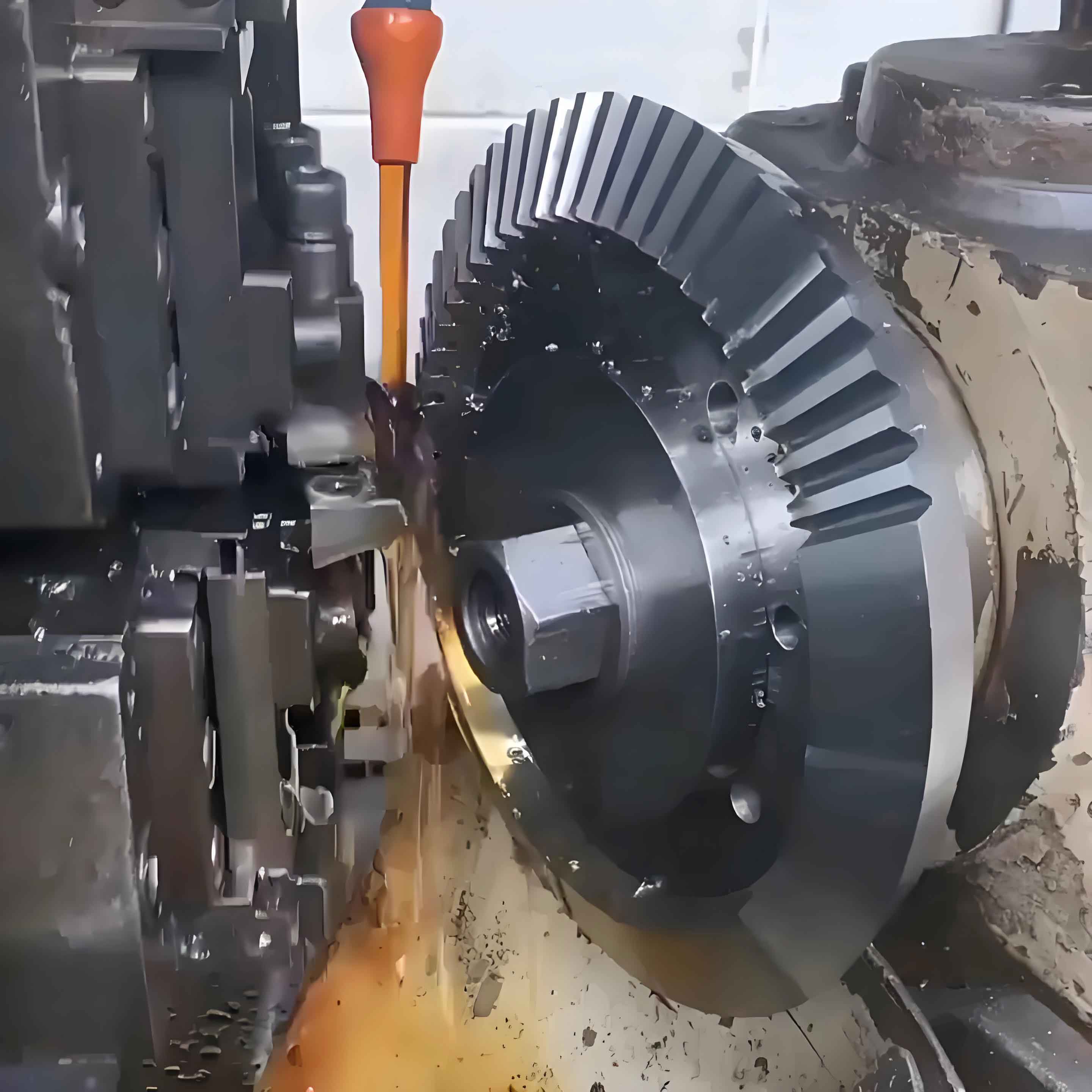
The core of the proposed differential consists of a planetary gear set with straight face gears, where four planetary gears engage with front and rear face gears. Unlike bevel gears, which impose radial and axial forces, face gears primarily handle axial loads, reducing stress on components and allowing for compact design. The asymmetric torque distribution ratio is set at 40:60 for front and rear axles, respectively, to optimize vehicle dynamics during acceleration and cornering. Friction clutch packs are integrated to provide locking action when wheel slip occurs, with multiple friction surfaces designed for enhanced torque transfer. This configuration ensures rapid response to traction loss, redistributing torque to the axle with better grip.
To understand the kinematic behavior, we analyze the angular velocity relationships within the differential. The overall planetary carrier rotation, denoted as ω₀, relates to the front and rear face gear rotations, ω₁ and ω₂, and the planetary gear spin, ω₃, through the following equations:
$$ ω₀ = i_{201} ω₁ + i_{102} ω₂ $$
$$ ω₁ = ω₀ + ω₃ \frac{z₃}{z₁} $$
$$ ω₂ = ω₀ – ω₃ \frac{z₃}{z₂} $$
Here, z₁, z₂, and z₃ represent the tooth numbers of the front face gear, rear face gear, and planetary gears, respectively. The transmission ratios i_{201} and i_{102} are derived from the fundamental gear kinematics, and for a tooth ratio of z₁/z₂ = 4/6, the angular velocity equation simplifies to:
$$ ω₀ = \frac{2}{5} ω₁ + \frac{3}{5} ω₂ $$
This equation illustrates the speed distribution under ideal conditions, where the planetary gears revolve without spinning, ensuring smooth torque transfer. In contrast, bevel gears-based differentials often exhibit more complex motion due to their conical geometry, leading to higher friction losses.
The torque characteristics are crucial for evaluating differential performance. The input torque T₀ is balanced between the front and rear output torques T₁ and T₂:
$$ T₀ = T₁ + T₂ $$
Under normal driving conditions, with no wheel slip, the friction clutches are inactive, and torque is distributed proportionally based on the face gear radii:
$$ T₁ = \frac{r₁}{r₁ + r₂} T₀ $$
$$ T₂ = \frac{r₂}{r₁ + r₂} T₀ $$
When slip occurs, such as the front axle spinning faster than the rear, the friction clutches engage, generating torques T_{f1} and T_{f2} that modify the output torques:
$$ T₁ = \frac{r₁}{r₁ + r₂} T₀ – T_{f1} $$
$$ T₂ = \frac{r₂}{r₁ + r₂} T₀ + T_{f2} $$
Similarly, for rear axle slip, the signs reverse, emphasizing the adaptive torque redistribution. This behavior surpasses that of bevel gears-based systems, where the locking effect is often weaker due to lower friction torque capacity.
To quantify the locking performance, we develop a mathematical model for the differential. The dynamic equations account for moments of inertia and friction losses. For the input shaft and planetary assembly, the equation is:
$$ J̄₀ \dot{ω}₀ = T₀ – T_L – n₃ r₁ F₁ – n₃ r₂ F₂ $$
where J̄₀ is the total inertia, T_L is the friction loss, n₃ is the number of planetary gears, and F₁, F₂ are the forces at gear meshes. The output axles follow:
$$ J₁ \dot{ω}₁ = n₃ r₁ F₁ – T₁ – T_{f1} $$
$$ J₂ \dot{ω}₂ = n₃ r₂ F₂ – T₂ + T_{f2} $$
$$ J₃ \dot{ω}₃ = -r₃ F₁ – r₃ F₂ $$
Solving these under steady-state conditions (with angular accelerations zero) yields the output torques, highlighting the role of friction clutches in torque modulation. The friction torque capacity is modeled based on clutch design:
$$ T_f = \frac{2}{3} n F_p μ \frac{R_o^3 – R_i^3}{R_o^2 – R_i^2} $$
where n is the number of friction surfaces, μ is the friction coefficient, R_o and R_i are outer and inner radii, and F_p is the axial pressure, comprising preload F_s and gear-induced force F_z:
$$ F_p = F_s + F_z $$
$$ F_z = \frac{T_c \cdot 2 \tan α}{z₃ m} $$
Here, T_c is the gear torque, α is the pressure angle, and m is the module. This model shows that face gears, by generating axial forces, enhance F_z compared to bevel gears, which also produce radial forces, thus increasing the effective friction torque.
The locking coefficient K, defined as the ratio of higher to lower output torque (K = T₁/T₂ for T₁ ≥ T₂), is a key metric. For front axle slip, K is derived as:
$$ K₁ = \frac{T_{c2} + T_{f2}}{T_{c1} – T_{f1}} $$
and for rear axle slip:
$$ K₂ = \frac{T_{c1} + T_{f1}}{T_{c2} – T_{f2}} $$
Substituting the friction torque expressions, we compute K values that reach up to 6.5 and 5 for front and rear axles, respectively, significantly higher than typical bevel gears-based differentials, which average K around 2-3. This demonstrates the superior locking capability of the face gear design.
For simulation, we establish a virtual prototype using Adams software. The face gear tooth profile is generated based on meshing theory with a pinion cutter. The position vector for the gear surface is given by:
$$ \mathbf{R}_w(u_w, θ_w) = \begin{bmatrix} r_{bw} [ \sin(θ_{ow} + θ_w) – θ_w \cos(θ_{ow} + θ_w) ] \\ -r_{bw} [ \cos(θ_{ow} + θ_w) + θ_w \sin(θ_{ow} + θ_w) ] \\ u_w \\ 1 \end{bmatrix} $$
where u_w and θ_w are surface parameters, and r_{bw} is the base radius. The transformation matrix from cutter to gear coordinates facilitates tooth generation, and the meshing equation ensures proper contact:
$$ f₁(u_s, θ_s, φ_s) = \mathbf{n} \cdot \mathbf{v}_{s2s} = r_{bs} (1 – m_{2s} \cos γ_n) – u_s m_{2s} \sin γ_n \cos(φ_s + θ_s + θ_{os}) = 0 $$
This approach enables accurate modeling of face gears, which are then assembled into a full differential model for dynamics analysis.
We simulate three driving scenarios: stable motion on high-adhesion roads, and straight-line driving on split-μ surfaces. The vehicle parameters are as follows:
| Parameter | Value |
|---|---|
| Vehicle Mass | 2000 kg |
| Wheel Radius | 0.3255 m |
| Axle Load Distribution | 45:55 (front:rear) |
| Final Drive Ratio | 2.5 |
The gear parameters for the differential are:
| Component | Teeth Number | Module (mm) | Pressure Angle (°) | Face Width (mm) |
|---|---|---|---|---|
| Planetary Gear | 18 | 3.4 | 20 | 25 |
| Front Face Gear | 48 | 3.4 | 20 | 15 |
| Rear Face Gear | 72 | 3.4 | 20 | 20 |
In the first scenario, stable driving at 20 km/h, the input speed is set to 2446.25 °/s, with front and rear loads of 878.50 N·m and 1073.72 N·m, respectively. The output speeds stabilize quickly, and torque distribution aligns with the design ratio, yielding approximately 41.5% front and 58.5% rear, close to the intended 40:60 split. This minor deviation arises from the non-ideal axle load distribution, a common issue in vehicle dynamics that also affects bevel gears-based systems but is more pronounced due to their sensitivity to load variations.
For split-μ conditions, we simulate front axle slip (low adhesion) and rear axle slip. During front slip, the front load reduces to 200.96 N·m, while the rear remains at 1073.72 N·m. The speeds show initial divergence, with the slipping axle accelerating, but the friction clutches engage, locking the axle and redistributing torque. The output torques stabilize at 340.65 N·m (front) and 1260.75 N·m (rear), giving a distribution ratio of 21.3:78.7. Similarly, for rear slip, the torques reach 1025.00 N·m (front) and 385.00 N·m (rear), ratio 72.7:27.3. These results confirm the differential’s ability to adapt torque allocation based on traction, outperforming bevel gears-based designs that often struggle to achieve such high redistribution ratios.
The friction torque during slip events exhibits periodic fluctuations due to gear meshing excitations, but overall, it increases during locking and stabilizes post-lock. The input-output torque balance validates the model, with the sum of output torques equating to input torque minus losses, consistent across scenarios. The table below summarizes the torque distribution results and comparisons with theoretical values:
| Scenario | Simulated Ratio (Front:Rear) | Theoretical Ratio | Difference |
|---|---|---|---|
| Stable 20 km/h | 41.5:58.5 | 40:60 | 1.5 |
| Front Slip | 21.3:78.7 | 16:84 | 5.3 |
| Rear Slip | 72.7:27.3 | 78:22 | 5.3 |
In conclusion, the face gear-based inter-axle limited slip differential demonstrates exceptional locking performance and adaptability, with locking coefficients up to 6.5, far exceeding those of bevel gears-based systems. The design benefits from the axial force characteristics of face gears, which amplify friction clutch capacity, enabling efficient torque redistribution under varying road conditions. Simulation results corroborate the theoretical models, showing close alignment with expected behavior and minimal errors. This design offers a viable alternative to traditional bevel gears differentials, promising enhanced vehicle dynamics and traction control for all-wheel-drive applications. Future work could focus on optimization for mass production and integration with electronic control systems to further improve performance.
The mathematical rigor and simulation approach adopted in this study provide a comprehensive framework for analyzing differential systems. By comparing with bevel gears, we highlight the advancements in locking capability and structural efficiency. The use of face gears not only reduces complexity but also enhances reliability, making it suitable for high-demand environments such as military and off-road vehicles. As automotive technology evolves, the integration of such innovative designs will be crucial for achieving superior traction and stability, underscoring the importance of moving beyond conventional bevel gears-based solutions.