
The ongoing transition towards automation in manufacturing underscores the critical need for high-performance, precision transmission components. Within robotic systems, the strain wave gear (also commonly referred to as a harmonic drive) is a core actuator, prized for its compactness, high reduction ratio, and zero-backlash characteristics. My focus here is on advancing the design of these essential components by moving beyond traditional tooth profiles.
Conventional strain wave gear designs frequently employ involute tooth profiles. However, a significant limitation exists: the flexible spline (or “flexspline”) and the circular spline (or “rigid spline”) are only approximately conjugate under the deformation induced by the wave generator. This often results in edge contact or point contact between mating teeth. Such imperfect engagement leads to non-uniform load distribution, accelerated wear, and a heightened risk of tooth interference under heavy loads. To overcome these challenges, my work explores the implementation of a double-circular-arc tooth profile. This geometry promotes a larger number of teeth in simultaneous contact, significantly improves motion accuracy, and enhances the fatigue strength of the flexible spline—a key life-limiting component in any strain wave gear system.
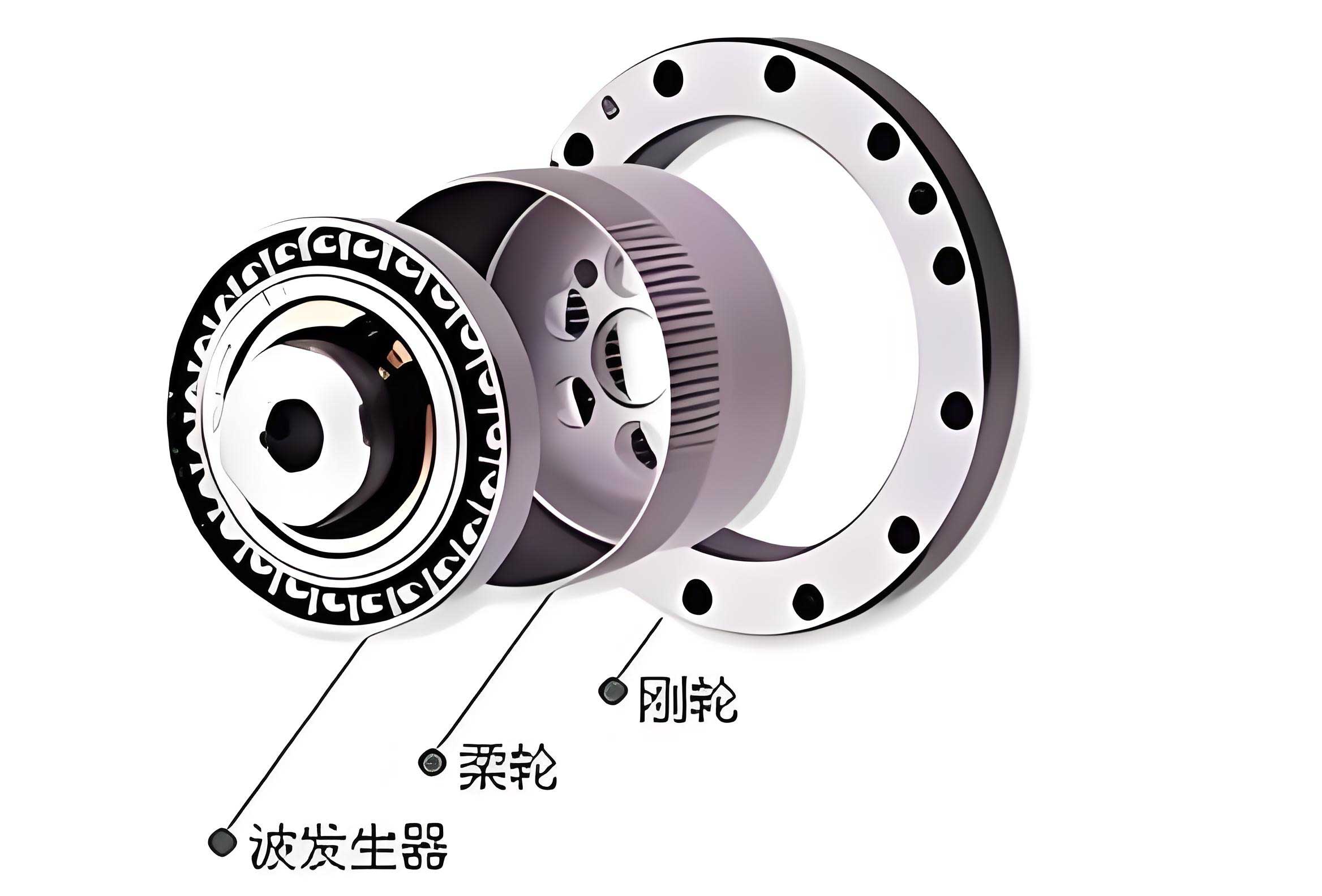
The fundamental operating principle of a strain wave gear revolves around the controlled elastic deformation of a flexible spline. The assembly typically consists of three primary elements: the wave generator (input), the flexible spline (output), and the circular spline (stationary). For this analysis, I consider a configuration with a cylindrical flexible spline connected via an outward-facing flanged coupling and driven by a standard elliptical cam wave generator. This type of wave generator is favored for its ability to produce stable, high-precision, and efficient meshing conditions. When the elliptical cam is inserted, it deforms the flexible spline from its original circular shape into an elliptical one. The major axis of this ellipse defines the region of maximum radial displacement where the teeth of the flexible spline fully engage with those of the circular spline. Conversely, at the minor axis, the teeth completely disengage. This cyclical engagement and disengagement as the wave generator rotates is what creates the high reduction ratio characteristic of a strain wave gear.
Tooth Profile Design and Mathematical Foundation
Flexible Spline Tooth Profile Definition
Leveraging experience from circular-arc gear design, initial parameters for the double-circular-arc profile in a strain wave gear are established. For a case-hardened and tempered flexible spline, the total tooth height \(h\) typically ranges from \(2m\) to \(2.25m\), where \(m\) is the module. To prevent interference, a tip clearance is necessary. Therefore, for the strain wave gear’s flexible spline, the reference tooth height \(h\) is initially set between \(1.8m\) and \(2.12m\). The addendum \(h_a\) can be \(0.7m\) to \(1.0m\), the dedendum \(h_f\) can be \(1.1m\) to \(1.5m\), and the tip clearance \(c\) is set between \(0.2m\) and \(0.35m\). A pressure angle of \(25^\circ\) is selected. The basic tooth profile for the flexible spline is symmetrical, composed of a convex arc (near the tip) and a concave arc (near the root) on each flank.
Mathematical Modeling of the Flexible Spline Tooth
To derive the precise tooth profile, I establish a coordinate system \(xoy\) where the y-axis coincides with the tooth’s symmetry line and the x-axis lies along the neutral curve of the flexible spline’s cylindrical body. Considering the right-side flank, the equations for the convex and concave arcs are developed.
For the convex arc (segment AB):
The center shift distance \(X_1\) is:
$$X_1 = R_1 \sin \beta_1 – s/2$$
where \(R_1\) is the convex arc radius, \(\beta_1\) is its pressure angle, and \(s\) is the tooth thickness at the reference circle.
The center offset \(L_1\) is:
$$L_1 = \sqrt{R_1^2 – X_1^2}$$
The coordinates of the convex arc center \(O_1\) are:
$$(X_{O1}, Y_{O1}) = (-L_1, \ h_f + t/2 – X_1)$$
where \(t\) is the wall thickness of the flexible spline.
The polar coordinate equation \((r_1, \theta_1)\) for the convex arc, defined relative to the tooth coordinate origin, is:
$$
r_1(\beta) = \sqrt{(X_{O1} + R_1 \sin \beta)^2 + (Y_{O1} – R_1 \cos \beta)^2}, \quad \theta_1(\beta) = \arctan\left(\frac{Y_{O1} – R_1 \cos \beta}{X_{O1} + R_1 \sin \beta}\right), \quad \text{for } \beta_A < \beta < \beta_B
$$
For the concave arc (segment CD):
The center shift distance \(X_2\) and offset \(L_2\) are defined similarly. The polar coordinate equation \((r_2, \theta_2)\) is:
$$
r_2(\beta) = \sqrt{(X_{O2} + R_2 \sin \beta)^2 + (Y_{O2} – R_2 \cos \beta)^2}, \quad \theta_2(\beta) = \arctan\left(\frac{Y_{O2} – R_2 \cos \beta}{X_{O2} + R_2 \sin \beta}\right), \quad \text{for } \beta_C < \beta < \beta_D
$$
where \(R_2\) is the concave arc radius and \(\beta_1’\) is its pressure angle.
Derivation of the Conjugate Circular Spline Profile Using the Envelope Method
Coordinate System Setup
To find the exact tooth profile of the circular spline that will conjugate with the deforming flexible spline tooth, I employ the envelope method. Three coordinate systems are defined:
1. A fixed coordinate system \(OXY\) attached to the wave generator, with the Y-axis aligned with its major axis.
2. A moving coordinate system \(O_1X_1Y_1\) attached to the flexible spline, with \(Y_1\) along the tooth symmetry line.
3. A moving coordinate system \(O_2X_2Y_2\) attached to the circular spline, with \(Y_2\) along the tooth space symmetry line.
The relationships between these systems are governed by the kinematics of the strain wave gear assembly and the waveform function.
Kinematic Relationships and the Meshing Equation
The radial deformation of the flexible spline’s neutral curve is described by a waveform function. For an elliptical wave generator, a common approximation is:
$$w(\theta) = w_0 \cos(2\theta)$$
where \(w_0\) is the maximum radial deformation (at the major axis) and \(\theta\) is the angular coordinate on the flexible spline.
The kinematic relationships between the rotation of the wave generator \(\phi\), the flexible spline’s deformation, and the relative motion between the flexible spline and circular spline are complex but essential. The key is the meshing condition, which states that the relative velocity at the contact point between the two tooth profiles must be orthogonal to the common normal vector. This condition leads to the general meshing equation for the strain wave gear:
$$\frac{\partial x_1}{\partial u} \cdot \frac{\partial y_1}{\partial \phi} – \frac{\partial y_1}{\partial u} \cdot \frac{\partial x_1}{\partial \phi} = 0$$
where \(x_1(u), y_1(u)\) define the flexible spline tooth profile in its own coordinate system, \(u\) is a profile parameter (like \(\beta\)), and \(\phi\) is the input angle of the wave generator.
Circular Spline Profile Equations
By substituting the parametric equations of the flexible spline’s convex arc \((r_1(\beta), \theta_1(\beta))\) into the coordinate transformation and the meshing equation, the conjugate profile for the circular spline’s corresponding concave segment is derived. A similar process is followed for the flexible spline’s concave arc to obtain the circular spline’s convex segment. The resulting system of equations for the circular spline coordinates \((x_2, y_2)\) is:
$$
\begin{aligned}
x_2 &= (x_1 + \rho_r(\theta)\cos\mu)\cos\Phi + (y_1 + \rho_r(\theta)\sin\mu)\sin\Phi \\
y_2 &= -(x_1 + \rho_r(\theta)\cos\mu)\sin\Phi + (y_1 + \rho_r(\theta)\sin\mu)\cos\Phi \\
&\text{subject to the meshing condition: } F(u, \phi) = 0
\end{aligned}
$$
Here, \(\rho_r(\theta) = r_m + w(\theta)\) is the radius of the deformed neutral curve, \(r_m\) is the initial radius, \(\mu\) is the angular position of the tooth, and \(\Phi\) is the relative rotation between the flexible and circular splines, related to the gear ratio.
Case Study: Design and Modeling of an 80:1 Strain Wave Gear
To demonstrate the design process, I developed a double-circular-arc strain wave gear with a reduction ratio of \(i = 80\). It utilizes a two-wave configuration (\(n=2\)). The key design parameters are summarized in the table below:
| Parameter | Symbol | Value | Unit |
|---|---|---|---|
| Gear Ratio | i | 80 | – |
| Number of Waves | n | 2 | – |
| Flexible Spline Teeth | Z_f | 160 | – |
| Circular Spline Teeth | Z_c | 162 | – |
| Module | m | 0.5 | mm |
| Deformation Coefficient | w_0^* | 0.9 | – |
| Tooth Wall Thickness | t_t | 1.0m = 0.5 | mm |
| Cylinder Wall Thickness | t_c | 0.8m = 0.4 | mm |
| Theoretical Wave Generator Height | d_g | 2w_0 = m*Z_f/n = 0.5*160/2 = 0.4 | mm |
| Convex Arc Radius | R_1 | 1.09m = 0.545 | mm |
| Convex Arc Center Shift (X1) | X_1 | 0.19m = 0.095 | mm |
| Convex Arc Center Offset (L1) | L_1 | 0.71m = 0.355 | mm |
| Concave Arc Radius | R_2 | 1.2m = 0.6 | mm |
| Concave Arc Center Shift (X2) | X_2 | 0.26m = 0.13 | mm |
| Concave Arc Center Offset (L2) | L_2 | 1.54m = 0.77 | mm |
| Flexible Spline Tip Diameter | D_{fa} | \(\approx \Phi 81\) | mm |
| Flexible Spline Root Diameter | D_{ff} | \(\approx \Phi 78.9\) | mm |
| Circular Spline Tip Diameter | D_{ca} | \(\approx \Phi 80\) | mm |
| Circular Spline Root Diameter | D_{cf} | \(\approx \Phi 82.1\) | mm |
Using these parameters, three-dimensional solid models of the flexible spline, circular spline, and elliptical cam wave generator were created. The assembly clearly shows the elliptical deformation of the flexible spline. At the major axis, the teeth of the flexible and circular splines engage fully with the designed tip clearance, effectively preventing interference. At the minor axis, the teeth are completely disengaged. A visual inspection of the meshing pattern confirms that the double-circular-arc profile facilitates a greater number of tooth pairs in simultaneous contact compared to a traditional involute profile for the same strain wave gear geometry, promising better load sharing.
Finite Element Analysis of the Flexible Spline
To validate the structural integrity of the design and predict stress concentrations, a Finite Element Analysis (FEA) was performed on the flexible spline under assembly load (i.e., with the wave generator inserted).
Model Setup and Meshing
The 3D model of the flexible spline was imported into the FEA software. The material was defined as alloy steel with a Young’s modulus \(E = 196\ \text{GPa}\) and a Poisson’s ratio \(\mu = 0.3\). Given the expected large deformations, the SOLID185 element was selected for its suitability in handling geometric nonlinearities. To ensure accuracy in the critical tooth engagement region, the model was partitioned to allow for a finer, controlled mesh in the tooth area and a coarser mesh in the rear flange. The final meshed model consisted of a high-quality hex-dominant grid.
Boundary Conditions and Contact Definition
The interaction between the wave generator and the flexible spline’s inner surface was modeled as a surface-to-surface contact pair. The wave generator cam surface was treated as a rigid target, while the inner surface of the flexible spline was the deformable contact surface. The bottom inner edge of the flexible spline’s flange, representing the bolted connection to the output, was constrained in all degrees of freedom (Fixed Support).
Analysis Results and Discussion
The FEA results provide critical insights into the performance of the double-circular-arc strain wave gear design.
Deformation: The radial displacement contour plot shows the maximum deformation is concentrated symmetrically at the major axis of the wave generator. The computed maximum radial displacement is approximately \(0.517\ \text{mm}\), which aligns closely with the theoretical wave generator height of \(0.5\ \text{mm}\) (based on \(m \cdot Z_f / n\)), confirming the deformation matches the design intent. The overall displacement plot reveals that the cylindrical body of the flexible spline also contracts at the minor axis, with deformation attenuating along the length away from the teeth.
Stress Distribution: The von Mises stress distribution is the most critical output. The highest stress concentrations are located in the region of the major axis, specifically at the transition zone between the tooth root and the smooth cylindrical body of the flexible spline. A detailed view of the tooth region shows that within the teeth themselves, the maximum stress occurs at the root fillet of the engaged teeth. This identifies the tooth root and the body transition as the primary candidate locations for fatigue crack initiation and propagation, which is a common failure mode for flexible splines in strain wave gear sets.
| FEA Result Metric | Value | Location | Design Implication |
|---|---|---|---|
| Max. Radial Displacement | ~0.517 mm | Major Axis (Tooth Tip) | Matches theoretical wave height (0.5mm), validating deformation kinematics. |
| Max. von Mises Stress | Peak Value (Material Dependent) | 1. Tooth root fillet. 2. Transition between teeth and cylinder at major axis. |
Identifies critical fatigue zones. Optimization should focus on root fillet radius and transition geometry. |
| Stress at Minor Axis | Significantly Lower | Cylinder body at minor axis. | Confirms low stress in disengagement zone, as expected. |
| Engagement Pattern | Multi-tooth contact observed | Major axis region | Corroborates design advantage of double-circular-arc profile for improved load sharing. |
Conclusion
The design and analysis process for a double-circular-arc strain wave gear has been detailed, from initial tooth profile parameter selection and conjugate geometry derivation to 3D modeling and advanced structural simulation. The kinematic modeling confirms the ability to achieve proper meshing engagement and disengagement. The 3D assembly model visually verifies the multi-tooth contact characteristic of the double-circular-arc profile, a key advantage over traditional involute profiles for strain wave gear applications.
The finite element analysis provides a rigorous validation of the flexible spline’s elastic behavior under load. The close agreement between the simulated maximum radial displacement and the theoretical value confirms the accuracy of the deformation model. More importantly, the FEA clearly identifies the high-stress concentration zones at the tooth root and the tooth-body transition near the wave generator’s major axis. This predictive insight is invaluable; it not only pinpoints the likely failure origins for this specific strain wave gear design but also provides a direct quantitative basis for future design optimization. Such optimization could focus on refining the tooth root fillet profile, adjusting the wall thickness transition, or employing material treatments to enhance fatigue life precisely where it is needed most. This comprehensive approach—combining theoretical gearing principles with modern simulation tools—establishes a robust framework for developing high-performance, reliable strain wave gear drives.