
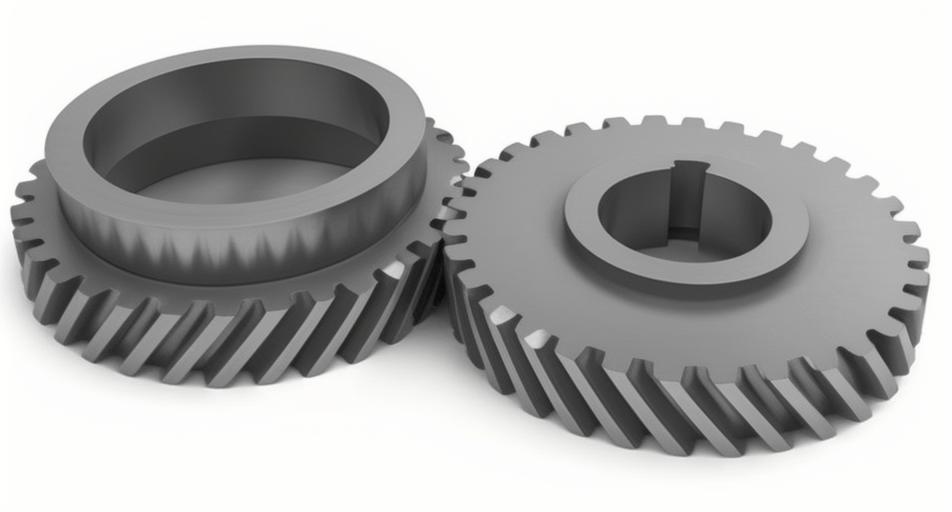
The pursuit of superior meshing performance, characterized by low noise and vibration, is a paramount objective in the design and manufacturing of high-precision power transmission systems. Among gear types, the helical gear is widely favored for its smooth engagement and high load capacity due to the gradual line contact of its teeth. A critical indicator of meshing quality is the Transmission Error (TE), defined as the deviation of the output gear’s actual rotational position from its theoretical position for a given input rotation. Traditional design often aims for a parabolic, or second-order, geometric TE to mitigate engagement and disengagement shocks. However, recent advancements have demonstrated the superior performance of helical gear pairs engineered with specifically designed higher-order TE functions. This article presents a comprehensive methodology for the design, optimization, and precise manufacturing of topologically modified helical gears to achieve a controlled higher-order TE and optimal contact pattern, ultimately minimizing loaded transmission error and grinding inaccuracies.
1. Introduction and Problem Statement
The dynamic excitation caused by transmission error is a primary source of gear whine and vibration. The loaded transmission error (LTE), which accounts for tooth deflections under operating loads, is the direct excitatory source. Therefore, the goal of gear micro-geometry modification, or “tooth flank correction,” is to design a geometric TE curve that, under load, results in a minimized and smooth LTE. A second-order (parabolic) TE is a common target, providing relief at the points of tooth engagement and recess. For helical gears and other complex gear types like spiral bevel gears, higher-order TE polynomials offer an additional degree of freedom. By carefully designing a fourth or sixth-order TE curve, it is possible to not only manage entry/exit shocks but also to create a “softer” mesh by introducing a slight concavity in the middle of the meshing cycle. This flattens the LTE curve under load, further reducing vibration.
The challenge is twofold: first, to determine the optimal parameters of the higher-order TE curve and the associated contact path that minimizes the LTE amplitude across the intended load range; second, to translate this optimal design into a physically realizable tooth surface topography and manufacture it with high precision. Modern multi-axis Computer Numerical Control (CNC) grinding machines, equipped with either dish-shaped (continuous generating) or profile (form) grinding wheels, provide the necessary flexibility. This work details an integrated process: designing a fourth-order TE, optimizing its parameters via Loaded Tooth Contact Analysis (LTCA), deriving the corresponding pinion modification surface, and finally, developing a corrective model for its accurate manufacture on a 5-axis CNC profile grinding machine.
2. Methodology for Higher-Order TE Design and Surface Derivation
2.1. Design of Higher-Order Transmission Error and Contact Path
The design philosophy for the modified helical gear pair involves presetting both the geometric transmission error function and the contact path on the tooth flank. The gear pair consists of a theoretical, unmodified gear (driven) and a topologically modified pinion (driver). The following principles guide the design:
- Controlled Contact Path: To avoid edge loading and reduce flash temperature at the tooth tips and roots, the contact path should be centered along the face width. A parabolic deviation at the entry and exit regions guides the contact away from the edges smoothly. The function can be defined piecewise:
$$
F(y) =
\begin{cases}
c_0 (y – b_1)^4, & y \leq b_1, \\
c_1 (y – b_2)^4, & y \geq b_2, \\
b_0, & b_1 < y < b_2
\end{cases}
$$
where \(y\) is the coordinate along the face width on the transverse plane, \(b_0, b_1, b_2, b_3\) are constants defining the linear and parabolic transition zones, and \(c_0, c_1\) are coefficients determined by boundary conditions for smoothness.
- Profile Relief: Additional tip and root relief is applied to prevent interference and further reduce engagement shock. This can be modeled as a fourth-order modification applied to the basic rack tool profile:
$$
y_a(u_1) =
\begin{cases}
e_0 (u_1 – d_1)^4, & u_1 \leq d_1, \\
e_1 (u_1 – d_2)^4, & u_1 \geq d_2, \\
0, & d_1 < u_1 < d_2
\end{cases}
$$
where \(u_1\) is the profile direction parameter on the rack, \(d_1, d_2\) define the start of relief regions, and \(e_0, e_1\) are coefficients.
- Higher-Order Transmission Error: A fourth-order polynomial is chosen for the geometric TE function \(\psi(\phi_1)\), where \(\phi_1\) is the pinion rotation angle.
$$
\psi(\phi_1) = a_0 + a_1 \phi_1 + a_2 \phi_1^2 + a_3 \phi_1^3 + a_4 \phi_1^4
$$
The coefficients \(a_0\) to \(a_4\) are determined by setting boundary conditions at key meshing points (p0 to p4): a reference point (p0) near the middle, points (p1, p2) defining a central concave segment, and points (p3, p4) at the engagement and recess regions providing sufficient parabolic relief. The parameters \(\sigma\) (central concavity depth) and \(\epsilon\) (end relief magnitude) are the primary design variables, alongside profile relief parameters \(q_1\) and \(q_2\).
| Design Parameter | Symbol | Role |
|---|---|---|
| Central Concavity | \(\sigma\) | Creates a “soft” middle region to flatten LTE. |
| End Relief Magnitude | \(\epsilon\) | Controls shock absorption at engagement/recess. |
| Tip Relief Parameter | \(q_1\) | Defines amount of profile relief near the tip. |
| Root Relief Parameter | \(q_2\) | Defines amount of profile relief near the root. |
2.2. Parameter Optimization via Loaded Tooth Contact Analysis (LTCA)
The unknown parameters \(\sigma, \epsilon, q_1, q_2\) are determined through an optimization process that minimizes the amplitude of the Loaded Transmission Error (LTE). The process involves iterative LTCA simulations. For a given set of parameters, the pinion tooth surface is derived (as described in Section 2.3). The LTCA model, which incorporates tooth compliance (bending, shear, and contact deformation), is then solved to obtain the normal approach \(Z\) of the gear teeth under load across one mesh cycle. This is converted to LTE amplitude \(G\) (in arc-seconds):
$$
G = \frac{3600 (Z_{max} – Z_{min})}{R_{b2} \cos \beta}
$$
where \(R_{b2}\) is the base circle radius of the gear and \(\beta\) is the helix angle. The optimization problem is formulated as:
$$
\begin{aligned}
&\text{Minimize: } f(y_i) = G/G_0 \\
&\text{Subject to: } Q_{min} \leq y_i \leq Q_{max}, \quad i=1,…,4
\end{aligned}
$$
where \(y_i\) represents the design variables \([\sigma, \epsilon, q_1, q_2]\), \(G_0\) is the LTE amplitude of the unmodified gear pair, and \(G\) is the LTE amplitude of the modified pair. Particle Swarm Optimization (PSO) is an effective algorithm for solving this nonlinear problem with multiple local minima.
2.3. Derivation of the Pinion Topological Modification Surface
Given the optimized TE function \(\psi(\phi_1)\) and contact path \(F(y)\), the corresponding pinion tooth surface must be calculated. The principle is based on the fact that a helical gear tooth surface can be generated by the motion of a basic rack cutter. For the modified pinion, this motion is no longer the standard one but is adjusted.
The governing equations combine the Gear Tooth Contact Analysis (TCA) condition for the modified pair with the generation condition of the pinion by the rack. The standard TCA equations for a pair of mating helical gear surfaces \(\mathbf{R}_1\) (pinion) and \(\mathbf{R}_2\) (gear) are:
$$
\begin{aligned}
&\mathbf{M}_{f1}(\phi_1) \mathbf{R}_{1r}(u_1, l_1) – \mathbf{M}_{f2}(\phi_2) \mathbf{M}_{e2} \mathbf{R}_2(u_2, l_2) = 0 \\
&\mathbf{L}_{f1}(\phi_1) \mathbf{N}_{1r}(u_1, l_1) – \mathbf{L}_{f2}(\phi_2) \mathbf{L}_{e2} \mathbf{n}_2(u_2, l_2) = 0
\end{aligned}
$$
where \(u, l\) are surface parameters, \(\mathbf{M}\) and \(\mathbf{L}\) are coordinate transformation matrices and their sub-matrices for normal vectors, and \(\mathbf{M}_{e2}\) accounts for assembly errors. The prescribed TE links the angles: \(\phi_2 = \psi(\phi_1) + (N_1/N_2)(\phi_1 – \phi_1^0) + \phi_2^0\). The prescribed contact path provides an additional scalar equation: \(F(y(\mathbf{R}_1)) = x(\mathbf{R}_1)\).
The pinion surface \(\mathbf{R}_{1r}\) is defined by the rack generation process with two added degrees of freedom: a variation in the effective helix angle \(\Delta\beta\) and an additional rack travel \(\Delta\theta_1\) (equivalent to a profile modification). Thus:
$$
\begin{aligned}
&\mathbf{R}_{1r}(u_1, l_1, \Delta\beta, \Delta\theta_1, \theta_1) = \mathbf{M}_{1c}(\theta_1, \Delta\beta, \Delta\theta_1) \mathbf{r}_c(u_1, l_1) \\
&f(u_1, l_1, \Delta\beta, \Delta\theta_1, \theta_1) = \mathbf{N}_{1r} \cdot \mathbf{v}_{c1} = 0
\end{aligned}
$$
where \(\mathbf{r}_c\) is the rack surface, \(\mathbf{v}_{c1}\) is the relative velocity, and \(\theta_1\) is the basic generating rotation. For a given input pinion angle \(\phi_1\), the system of equations from TCA and generation can be solved for the six unknowns: \(u_1, l_1, u_2, l_2, \Delta\beta, \Delta\theta_1\). By solving for a discrete set of \(\phi_1\) values across the mesh cycle, the functions \(\Delta\beta(\theta_1)\) and \(\Delta\theta_1(\theta_1)\) are obtained. These are typically fitted with 6th-order polynomials:
$$
\begin{aligned}
\Delta\beta &= g_0 + g_1\theta_1 + g_2\theta_1^2 + g_3\theta_1^3 + g_4\theta_1^4 + g_5\theta_1^5 + g_6\theta_1^6 \\
\Delta\theta_1 &= h_0 + h_1\theta_1 + h_2\theta_1^2 + h_3\theta_1^3 + h_4\theta_1^4 + h_5\theta_1^5 + h_6\theta_1^6
\end{aligned}
$$
Finally, the normal topological modification surface \(\delta\) for the pinion is calculated as the normal deviation between the modified surface \(\mathbf{R}_{1r}\) and the theoretical involute helical gear surface \(\mathbf{R}_{1}\):
$$
\delta(u_1, l_1) = (\mathbf{R}_{1r}(u_1, l_1, \Delta\beta, \Delta\theta_1) – \mathbf{R}_{1}(u_1, l_1)) \cdot \mathbf{n}_1(u_1, l_1)
$$
3. CNC Profile Grinding Model and Error Correction
3.1. Kinematic Model of a 5-Axis CNC Profile Grinding Machine
Manufacturing the complex modification surface requires a free-form CNC grinding machine. A 5-axis vertical machine layout is considered, with the following axes: three linear axes (\(X, Y, Z\)), a workpiece rotary axis (\(A\)), and a swivel axis (\(C\)) to set the helix angle. The relationship between the grinding wheel and the workpiece is defined by a series of coordinate transformations.
The theoretical (unmodified) helical gear tooth surface is generated when the machine axes follow a specific set of motions, \(C_k^0\) (where \(k = x, y, z, a, b\)), which are functions of the workpiece rotation parameter \(\varphi_1\):
$$
\begin{aligned}
C_x^0 &= \frac{0.5 \varphi_1 d_1}{\tan \varphi_1} + K_1 \tan \beta – \frac{K_2}{\cos \beta} \\
C_y^0 &= 0.5(d_f + d_w) \\
C_z^0 &= \frac{K_1}{\cos \beta} – K_2 \tan \beta \\
C_a^0 &= -\beta \\
C_b^0 &= -\varphi_1
\end{aligned}
$$
Here, \(d_1\) is the pinion pitch diameter, \(d_f\) is the root diameter, \(d_w\) is the grinding wheel diameter, and \(K_1, K_2\) are machine constants.
3.2. Modeling the Grinding of the Modified Surface
To grind the modified pinion surface, deviations \(\Delta C_k(\varphi_1)\) are superimposed on the theoretical axis movements, and the axial profile of the form grinding wheel may also require a slight correction \(\sigma_w(x_w)\) in its normal direction. These corrections are parameterized as polynomial functions of the workpiece rotation \(\varphi_1\) (or the wheel profile parameter \(x_w\)):
$$
\begin{aligned}
C_k(\varphi_1) &= a_{0k} + a_{1k}\varphi_1 + a_{2k}\varphi_1^2 + a_{3k}\varphi_1^3 + a_{4k}\varphi_1^4 + a_{5k}\varphi_1^5 + a_{6k}\varphi_1^6 \quad (k=x,y,z,a,b)\\
\sigma_w(x_w) &= w_0 + w_1 x_w + w_2 x_w^2 + w_3 x_w^3 + w_4 x_w^4
\end{aligned}
$$
The total modification \(\delta\) to be achieved at a grid point \(i\) on the tooth flank can be linearly approximated (sensitivity model) as a function of the correction parameters \(\zeta_j\), which include all polynomial coefficients \(a_{jk}\) and \(w_j\):
$$
\delta_i \approx \mathbf{S}_i \boldsymbol{\zeta}
$$
where \(\mathbf{S}_i\) is the sensitivity row vector at point \(i\), and \(\boldsymbol{\zeta}\) is the column vector of all correction parameters. The actual modification ground by the CNC machine, \(\delta_i^C\), is a nonlinear function of \(\boldsymbol{\zeta}\). The grinding error at each point is \(\Delta \delta_i = \delta_i^C(\boldsymbol{\zeta}) – \delta_i\).
3.3. Optimization of Machine Parameters for Minimum Grinding Error
The objective is to find the set of correction parameters \(\boldsymbol{\zeta}\) that minimizes the overall grinding error. A key physical constraint is that the grinding process is subtractive; the wheel can only remove material where it contacts the surface. Therefore, if the sensitivity model predicts an addition of material (\(S_i \zeta > 0\)) at a point, the wheel cannot reach it, resulting in an uncut error. This leads to a constrained optimization problem:
$$
\begin{aligned}
&\text{Minimize: } F(\boldsymbol{\zeta}) = \sum_{i=1}^{p} f_i(\boldsymbol{\zeta})^2 \\
&\text{where } f_i(\boldsymbol{\zeta}) = \begin{cases}
\mathbf{S}_i \boldsymbol{\zeta} – \delta_i, & \text{if } \mathbf{S}_i \boldsymbol{\zeta} < 0 \quad \text{(wheel contacts)}\\
-\delta_i, & \text{if } \mathbf{S}_i \boldsymbol{\zeta} \geq 0 \quad \text{(wheel cannot contact)}
\end{cases} \\
&\text{Subject to: } \zeta_{j}^{0} – 0.8 \leq \zeta_j \leq \zeta_{j}^{0} + 0.8
\end{aligned}
$$
Here, \(p\) is the number of grid points, and \(\zeta_{j}^{0}\) are the nominal parameters for grinding the theoretical surface (for \(a_{0b}, a_{1b}\) etc., \(\zeta_{j}^{0}\) corresponds to the coefficients from \(C_k^0\), others are zero). The Particle Swarm Optimization (PSO) algorithm is again employed to solve this non-linear, non-smooth optimization problem effectively.
4. Results and Analysis
A case study was performed on a helical gear pair with the parameters listed below. The driven gear was kept theoretical, while the pinion was modified. The nominal torque was 2500 Nm.
| Parameter | Pinion | Gear |
|---|---|---|
| Number of Teeth | 19 | 47 |
| Normal Module (mm) | 6 | |
| Normal Pressure Angle (°) | 20 | |
| Helix Angle (°) | 9.91 | |
| Face Width (mm) | 75 | |
The PSO optimization of the TE parameters yielded the following values:
| Optimized Parameter | Symbol | Value |
|---|---|---|
| Central Concavity | \(\sigma\) | -3.0 arc-sec |
| End Relief Magnitude | \(\epsilon\) | -25 arc-sec |
| Tip Relief | \(q_1\) | 20 μm |
| Root Relief | \(q_2\) | 20 μm |
4.1. Meshing Performance Analysis
The designed higher-order TE curve is smooth and tangent-connected at the mesh cycle transition points, avoiding discontinuity-induced vibrations. The TCA results show a controlled contact path centered on the tooth flank with parabolic excursions at the ends. The derived normal modification surface \(\delta\) for the pinion exhibits a characteristic “diagonal” pattern: significant material removal near the root at the engagement region and near the tip at the recess region.
The effect of the central concavity (\(\sigma\)) on LTE amplitude was investigated under various loads. The results are summarized below:
| Load (Nm) | LTE Amp. for \(\sigma = 0\) (parabolic) | LTE Amp. for \(\sigma = -3″\) (concave) | Reduction |
|---|---|---|---|
| 1000 | 2.15″ | 0.56″ | 74% |
| 2000 | 4.30″ | 1.85″ | 57% |
| 2500 | 5.40″ | 2.62″ | 51% |
This confirms that a slightly concave TE curve creates a “softer” mesh, allowing the teeth to conform better under load, thereby flattening the LTE curve and reducing its amplitude significantly. The optimal value of concavity \(\sigma\) is load-dependent; generally, a larger magnitude of concavity is beneficial for higher operating loads.
4.2. CNC Grinding Error Assessment
The PSO algorithm successfully converged to a solution for the 39 correction parameters. The optimized axis motion corrections \(\Delta C_k\) were smooth and practically implementable. The primary corrections were in the \(Z\)-axis (constant offset for tooth thickness), the \(C\)-axis (mirroring the \(\Delta\beta\) helix angle variation), and the \(B\)-axis (for lead correction).
The theoretical grinding error \(\Delta \delta\) after applying the optimized corrections was evaluated over the tooth flank grid. The maximum error in the central, fully contacted region was below 2 μm. Larger localized errors (up to 8 μm) were predicted only in the extreme diagonal corners (engagement-root and recess-tip), which correspond to regions where the wheel is predicted to lose contact due to the significant undercut. These minor corner discrepancies can be effectively eliminated in a subsequent, light finishing pass using a diagonal grinding method with a flat dish wheel. Therefore, the proposed method based on a form wheel for primary correction and a flat wheel for final diagonal finishing is capable of achieving the complex topological modification on the helical gear with a total error well under 2 μm.
5. Conclusion
This article has presented an integrated methodology for the design and precision manufacturing of high-performance helical gears with a higher-order transmission error. The key contributions and findings are:
- Design and Optimization: A fourth-order geometric transmission error function, combined with a controlled contact path and profile relief, was designed. Its parameters were optimally determined by minimizing the amplitude of the loaded transmission error (LTE) through LTCA simulations and PSO optimization. The resulting TE curve is smooth, with a characteristic slight concavity in its middle segment that effectively “softens” the mesh and flattens the LTE under load.
- Surface Derivation: The corresponding pinion topological modification surface was precisely derived using the inverse solution of the rack-generating process. This surface typically exhibits a diagonal modification pattern with significant material removal at the root-engagement and tip-recess regions.
- Precision Manufacturing Model: A comprehensive mathematical model for grinding this complex surface on a 5-axis CNC profile grinding machine was developed. The model incorporates a sensitivity analysis linking axis motions and wheel profile corrections to the achieved modification. An optimization problem accounting for the subtractive nature of grinding was solved using PSO to determine the optimal machine parameters.
- Performance and Accuracy: The optimized higher-order TE significantly reduces LTE amplitude across a range of loads compared to a traditional parabolic TE. The proposed grinding strategy, involving primary correction with a profiled form wheel followed by a light diagonal finishing pass, is capable of realizing the designed topological surface with a theoretical grinding error of less than 2 μm. This methodology provides a systematic and effective approach for manufacturing advanced, low-vibration helical gear drives for demanding applications.