
In the realm of precision motion control and transmission systems, harmonic drive gears have emerged as a pivotal technology due to their exceptional characteristics, including high reduction ratios, compactness, and zero-backlash performance. As an engineer deeply immersed in fluid power and mechanical transmission systems, I have long been fascinated by the potential of harmonizing fluidic actuation with harmonic drive principles. This article presents a comprehensive exploration of a novel pneumatic wave generator designed specifically for harmonic drive gear systems. The motivation stems from the inherent limitations of traditional rigid wave generators, such as fixed major axis dimensions and the inability to adjust during continuous operation. By leveraging the flexibility and controllability of fluid power, we aim to develop an elastic wave generator that enhances the adaptability and performance of harmonic drive gears. Throughout this discussion, the term “harmonic drive gear” will be emphasized repeatedly to underscore its central role in this innovation, and mathematical formulations, tables, and analytical insights will be provided to enrich the technical depth.
The harmonic drive gear mechanism operates on the principle of controlled elastic deformation in a flexible spline, typically referred to as the flexspline, which engages with a rigid circular spline through a wave generator. This interaction produces a moving wave of deformation that enables high-ratio speed reduction or amplification. Historically, wave generators have been predominantly rigid components, such as elliptical cams or roller-based assemblies, which constrain the dynamic adjustment of the mesh between the flexspline and circular spline. In contrast, our research focuses on a fluid-based approach, where pneumatic cylinders are orchestrated to generate the requisite elliptical motion profile dynamically. This not only introduces elasticity into the wave generation process but also opens avenues for real-time tuning and improved durability in demanding applications like robotics, aerospace, and precision manufacturing. The integration of fluidics into harmonic drive gear systems represents a paradigm shift, potentially reducing manufacturing complexities and costs while maintaining high accuracy.
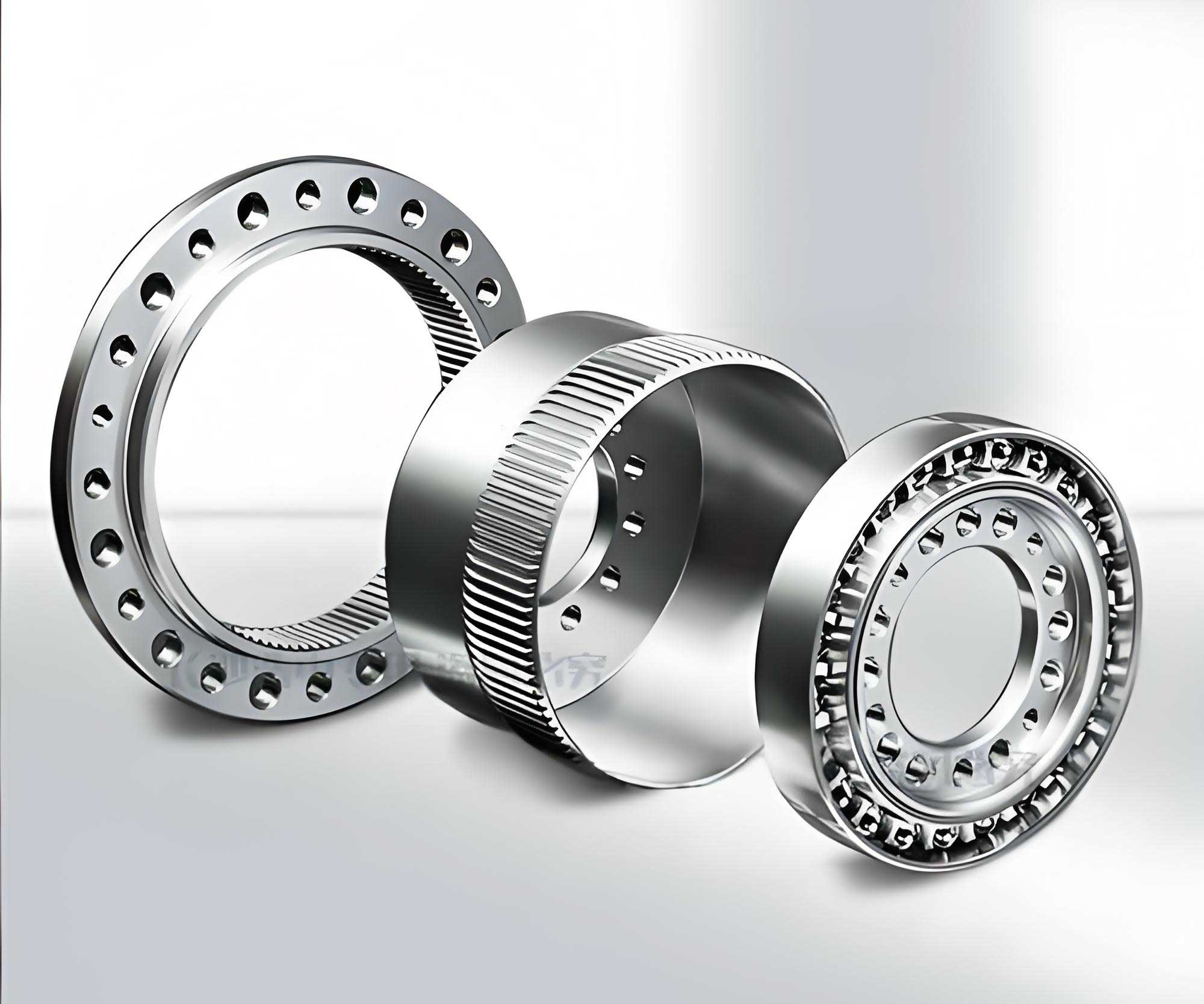
To lay the groundwork, let us delve into the fundamental principles of harmonic drive gears. A standard harmonic drive gear comprises three primary components: the wave generator, the flexspline (or柔轮 in some contexts), and the circular spline (or刚轮). The wave generator, often an elliptical cam, is inserted into the flexspline, causing it to deform into an elliptical shape. This deformation forces the teeth of the flexspline to engage with those of the circular spline at two diametrically opposite points along the major axis. As the wave generator rotates, the engagement zones propagate, resulting in relative motion between the flexspline and circular spline. The kinematic relationship governing harmonic drive gears can be expressed mathematically. The gear reduction ratio, denoted as \( i \), is given by:
$$ i = \frac{N_c}{N_c – N_f} $$
where \( N_c \) is the number of teeth on the circular spline and \( N_f \) is the number of teeth on the flexspline. Typically, the difference \( N_c – N_f \) is equal to the wave number (e.g., 2 for a double-wave generator), which defines the number of lobes in the deformation wave. For instance, in a common configuration with \( N_c = 100 \) and \( N_f = 98 \), the reduction ratio becomes:
$$ i = \frac{100}{100 – 98} = 50 $$
This high reduction ratio is achieved in a compact package, making harmonic drive gears ideal for space-constrained applications. The motion transmission relies on the elastic deflection of the flexspline, which can be modeled using thin-shell theory. The radial displacement \( w(\theta, t) \) of the flexspline as a function of angular position \( \theta \) and time \( t \) often approximates a harmonic wave, hence the name “harmonic drive.” A simplified representation is:
$$ w(\theta, t) = A \cos(2\theta – \omega t) $$
where \( A \) is the amplitude of deformation (half the major axis difference), \( \omega \) is the angular velocity of the wave generator, and the factor 2 accounts for a double-wave pattern. This equation highlights the continuous wave nature that our pneumatic system aims to replicate through discrete fluidic actuation.
Building on these principles, the design of the pneumatic wave generator centers on replicating the elliptical deformation profile using an array of pneumatic cylinders. Instead of a solid cam, we propose a configuration of four groups of single-acting cylinders arranged radially on a circular base plate. Each group consists of two cylinders positioned at 45-degree intervals, resulting in eight cylinders overall, all oriented with their piston rods pointing toward the center. This layout ensures that the endpoints of the piston rods can trace an elliptical path when actuated in a sequential manner. The core idea is to use the extension and retraction of these cylinders to mimic the moving wave, thereby creating an “elastic” wave generator that can adapt during operation. The following table summarizes the key design parameters for the pneumatic wave generator:
| Parameter | Symbol | Value/Range | Description |
|---|---|---|---|
| Number of Cylinder Groups | N | 4 | Groups labeled A, B, C, D |
| Cylinders per Group | m | 2 | Arranged at 45° apart |
| Total Cylinders | M | 8 | Radial distribution |
| Cylinder Type | — | Pre-retracted Single-Acting | NFPA standard, large bore, short stroke |
| Actuation Pressure | P | 0.4–0.7 MPa | Typical pneumatic supply range |
| Stroke Length | L | 5–10 mm | Sufficient for elliptical deformation |
| Wave Number | n | 2 | Double-wave harmonic drive gear |
The operation sequence for generating a standard elliptical wave involves cyclic actuation of the cylinder groups. Let us denote extension as “+” and retraction as “-“. For counterclockwise rotation of the wave generator, the sequence is: A+, A-, B+, B-, C+, C-, D+, D-. This sequence repeats continuously, with each group’s cylinders extending to push against the flexspline’s inner surface and then retracting to allow the wave to propagate. The trajectory of the piston rod endpoints can be derived geometrically. Assuming the base circle radius is \( R_0 \) and the elliptical major axis has a radius \( R_0 + \Delta R \), where \( \Delta R \) is the radial displacement amplitude, the coordinates of each cylinder’s endpoint during actuation can be expressed parametrically. For cylinder group A at angle \( \theta_A = 0^\circ \), its radial position \( r_A(t) \) as a function of time step \( t \) in the cycle is:
$$ r_A(t) = R_0 + \Delta R \cdot f(t) $$
where \( f(t) \) is a periodic function representing the actuation profile. By coordinating all groups, the combined envelope forms an ellipse that rotates. The elliptical equation in polar coordinates, with eccentricity \( e \), is:
$$ r(\theta) = \frac{R_0 (1 – e^2)}{1 – e \cos(2(\theta – \phi))} $$
where \( \phi \) is the phase angle corresponding to the wave generator’s rotation. Our pneumatic system approximates this continuous curve through discrete steps, with the accuracy dependent on the number of cylinders and control timing. To quantify the performance, we can analyze the wave fidelity using Fourier series decomposition. The ideal radial displacement wave for a harmonic drive gear is a pure cosine wave, but our discrete actuation introduces harmonics. However, with sufficient cylinders and precise control, the deviation can be minimized, ensuring smooth engagement in the harmonic drive gear system.
The pneumatic control system is pivotal to achieving the precise sequencing required for the wave generator. We have developed a pure pneumatic circuit without electrical components, making it suitable for hazardous environments where sparks must be avoided. The circuit utilizes two-position three-way directional control valves, pilot-operated via pneumatic signals from limit valves or sequence valves. Each cylinder group is controlled by a dedicated valve assembly that responds to the state of the previous group, creating a cascaded sequence. The displacement-step diagram, which maps the actuator states against control steps, serves as the blueprint for the circuit design. For the counterclockwise motion, the diagram shows eight distinct steps corresponding to the extensions and retractions. Based on this, we derive a motion flowchart that translates into a pneumatic ladder logic equivalent. The core components include pre-retracted single-acting cylinders, two-position three-way dual-pressure control valves, shuttle valves for OR logic, and manual override valves for initiation and emergency stop. The supply system consists of a standard pneumatic FRL (filter, regulator, lubricator) unit connected to a compressed air source. The following table outlines the key components in the control circuit:
| Component | Quantity | Function |
|---|---|---|
| Pre-retracted Single-Acting Cylinder | 8 | Generate radial displacement |
| Two-Position Three-Way Dual-Control Valve | 4 | Control cylinder groups A–D |
| Two-Position Three-Way Manual Valve (Start) | 1 | Initiate sequence (labeled 1S1) |
| Shuttle Valve | 4 | Combine signals for valve piloting |
| Limit Valve (Travel Valve) | 4 | Detect cylinder extension position |
| Pneumatic FRL Unit | 1 | Condition air supply |
The operational logic ensures that when the start valve is pressed, a pilot signal activates the valve for group A cylinders, causing them to extend. Upon full extension, a limit valve is triggered, sending a signal to retract group A and simultaneously initiate extension of group B. This cascade continues through groups C and D, after which the cycle repeats as long as the start valve is engaged. Releasing the start valve halts the sequence, with all cylinders retracting to the initial circular state. This design exemplifies the elegance of fluidic logic, enabling reliable and safe operation without electronics. Moreover, the system’s flexibility allows easy reversal of rotation direction by modifying the sequence order—for clockwise motion, the order becomes D+, D-, C+, C-, B+, B-, A+, A-. Such adaptability is crucial for harmonic drive gear applications requiring bidirectional control, such as in robotic joints or positioning tables.
To further substantiate the design, we conducted a dynamic analysis of the pneumatic wave generator’s interaction with the harmonic drive gear components. The forces involved in deforming the flexspline are critical for sizing the cylinders and selecting operating pressures. The radial force \( F_r \) required to achieve a deformation \( \Delta R \) can be estimated using the flexspline’s stiffness \( k_f \), derived from its material and geometry. For a thin-walled cylindrical flexspline, the stiffness per unit angle is approximately:
$$ k_f = \frac{E t^3}{12 R_0^3 (1 – \nu^2)} $$
where \( E \) is Young’s modulus, \( t \) is the wall thickness, \( R_0 \) is the nominal radius, and \( \nu \) is Poisson’s ratio. The total force at the major axis points is then:
$$ F_r = k_f \cdot \Delta \theta \cdot \Delta R $$
with \( \Delta \theta \) representing the angular span of engagement. Given that our pneumatic cylinders act at discrete points, the peak force per cylinder must exceed \( F_r \) divided by the number of active cylinders. For instance, with two cylinders active per group, each cylinder needs to provide a force \( F_c \) calculated as:
$$ F_c = \frac{F_r}{2} = \frac{k_f \cdot \Delta \theta \cdot \Delta R}{2} $$
This force dictates the cylinder bore size based on the supply pressure \( P \), using the relation \( F_c = P \cdot A_c \), where \( A_c \) is the cylinder’s effective area. Typical values for a harmonic drive gear with \( R_0 = 50 \, \text{mm} \), \( t = 1 \, \text{mm} \), and \( \Delta R = 0.5 \, \text{mm} \) yield \( F_r \approx 100 \, \text{N} \), so each cylinder requires about 50 N force. With a pressure of 0.6 MPa, the bore diameter \( d \) can be found from:
$$ d = 2 \sqrt{\frac{F_c}{\pi P}} $$
resulting in \( d \approx 10 \, \text{mm} \). Such calculations ensure that the pneumatic wave generator is adequately powered to maintain proper mesh in the harmonic drive gear without overstressing the flexspline.
Another aspect worth exploring is the kinematic accuracy of the pneumatic wave generator compared to ideal elliptical motion. Due to the stepwise actuation, the generated wave is piecewise linear rather than smooth. We can model the radial displacement error \( \epsilon(\theta) \) as the difference between the ideal ellipse and the polygonal approximation formed by cylinder endpoints. For eight cylinders equally spaced at 45°, the maximum error occurs at the midpoints between actuation angles. Using geometry, the error \( \epsilon_{\text{max}} \) is given by:
$$ \epsilon_{\text{max}} = \Delta R \left(1 – \cos\left(\frac{\pi}{8}\right)\right) $$
For \( \Delta R = 0.5 \, \text{mm} \), this yields \( \epsilon_{\text{max}} \approx 0.038 \, \text{mm} \), which is acceptable for many harmonic drive gear applications. To improve accuracy, one could increase the number of cylinder groups, but this adds complexity. Alternatively, incorporating proportional pneumatic valves with closed-loop control based on feedback from displacement sensors could enable continuous modulation of cylinder positions, approximating the ellipse more closely. However, our current design prioritizes simplicity and reliability using on/off valves, which suffices for most industrial settings where harmonic drive gears are deployed.
The potential applications of this pneumatic wave generator extend across various sectors where harmonic drive gears are already prevalent. In robotics, for instance, the elastic nature of the wave generator could reduce shock loads on gear teeth, enhancing longevity in dynamic tasks like assembly or handling. In aerospace, the pneumatic system’s insensitivity to electromagnetic interference makes it suitable for avionics or satellite mechanisms. Moreover, the ability to adjust the wave profile on-the-fly by varying cylinder actuation timing or pressure could enable adaptive gearing ratios, a feature not possible with rigid wave generators. This aligns with the trend towards smart transmissions in modern machinery. Below is a table summarizing comparative advantages of the pneumatic wave generator over traditional types in harmonic drive gear systems:
| Aspect | Traditional Rigid Wave Generator | Pneumatic Wave Generator |
|---|---|---|
| Elasticity | Rigid, no compliance | Elastic, absorbs shocks |
| Adjustability During Operation | Not possible | Real-time via pressure/sequence control |
| Manufacturing Complexity | High (precision cam machining) | Moderate (standard cylinders) |
| Suitability for Hazardous Areas | Depends on material | Excellent (no electrical parts) |
| Maintenance | Requires disassembly | Modular, easy cylinder replacement |
| Cost | High | Lower due to off-the-shelf components |
From a research perspective, this work opens several avenues for further investigation. One could explore hydraulic versions of the wave generator for higher force densities, suitable for heavy-duty harmonic drive gear applications like wind turbine pitch controls or industrial presses. The dynamics of the fluid-structure interaction between the cylinders and flexspline warrant detailed simulation using finite element analysis (FEA) to optimize the cylinder placement and stroke profiles. Additionally, integrating sensors for feedback control could lead to a “smart” harmonic drive gear that self-adjusts to load variations, further pushing the boundaries of transmission technology.
In conclusion, the development of a pneumatic wave generator for harmonic drive gears represents a significant step forward in merging fluid power with precision gearing. Our design, based on four groups of single-acting cylinders, successfully generates an elliptical wave through a purely pneumatic control system, offering elasticity, adjustability, and safety in hazardous environments. The harmonic drive gear, with its unique advantages, benefits from this innovation through reduced manufacturing costs and enhanced operational flexibility. As we continue to refine the concept, future iterations may incorporate advanced materials and digital control, paving the way for next-generation transmission systems. Ultimately, the synergy between fluidics and harmonic drive gears holds promise for broader adoption in industries demanding high performance and reliability, underscoring the timeless relevance of harmonic drive gear technology in engineering progress.
Throughout this article, we have emphasized the harmonic drive gear as the cornerstone of the discussion, reinforcing its importance in motion transmission. The mathematical models, design tables, and comparative analyses provided herein aim to offer a thorough resource for engineers and researchers alike. By embracing fluidic actuation, we not only address existing limitations but also inspire new possibilities for harmonic drive gear applications, from micro-robotics to large-scale industrial machinery. The journey of innovation continues, and I am optimistic that such cross-disciplinary approaches will yield even more groundbreaking solutions in the years to come.