
In the field of hydraulic systems, gear pumps are widely used due to their simplicity, reliability, and cost-effectiveness. However, traditional spur gear pumps often suffer from issues such as oil trapping, pulsation, and noise, which limit their performance in high-precision applications. As an engineer involved in hydraulic product development, I have focused on addressing these challenges through the design of a novel spiral gear pump. This article details our approach to designing a spiral gear pump with a conjugate tooth profile curve, aiming to ensure continuous meshing, eliminate oil trapping, reduce pulsation, and lower noise levels. Our work leverages mathematical modeling, simulation, and experimental validation to achieve a robust design. Throughout this discussion, the term ‘spiral gear’ will be emphasized repeatedly, as it is central to our innovation in enhancing gear pump efficiency.
The core problem with conventional spur gear pumps lies in their discontinuous meshing action. In a typical setup, two spur gears with involute profiles rotate within a pump housing, creating sealed chambers that transport fluid. The meshing trajectory between these gears is a short, intermittent line, leading to sudden changes in fluid volume and pressure. This discontinuity causes pulsation in the hydraulic output, resulting in noise and vibration. Additionally, during meshing, small sealed pockets form between the tooth flanks, tips, and roots, trapping oil and generating pressure spikes that further contribute to noise and wear. To overcome these drawbacks, we propose a spiral gear pump design where the gears feature a conjugate tooth profile combined with a helix angle, ensuring continuous contact and smooth fluid delivery. The spiral gear concept not only improves meshing continuity but also enhances volumetric efficiency by providing a more uniform flow.
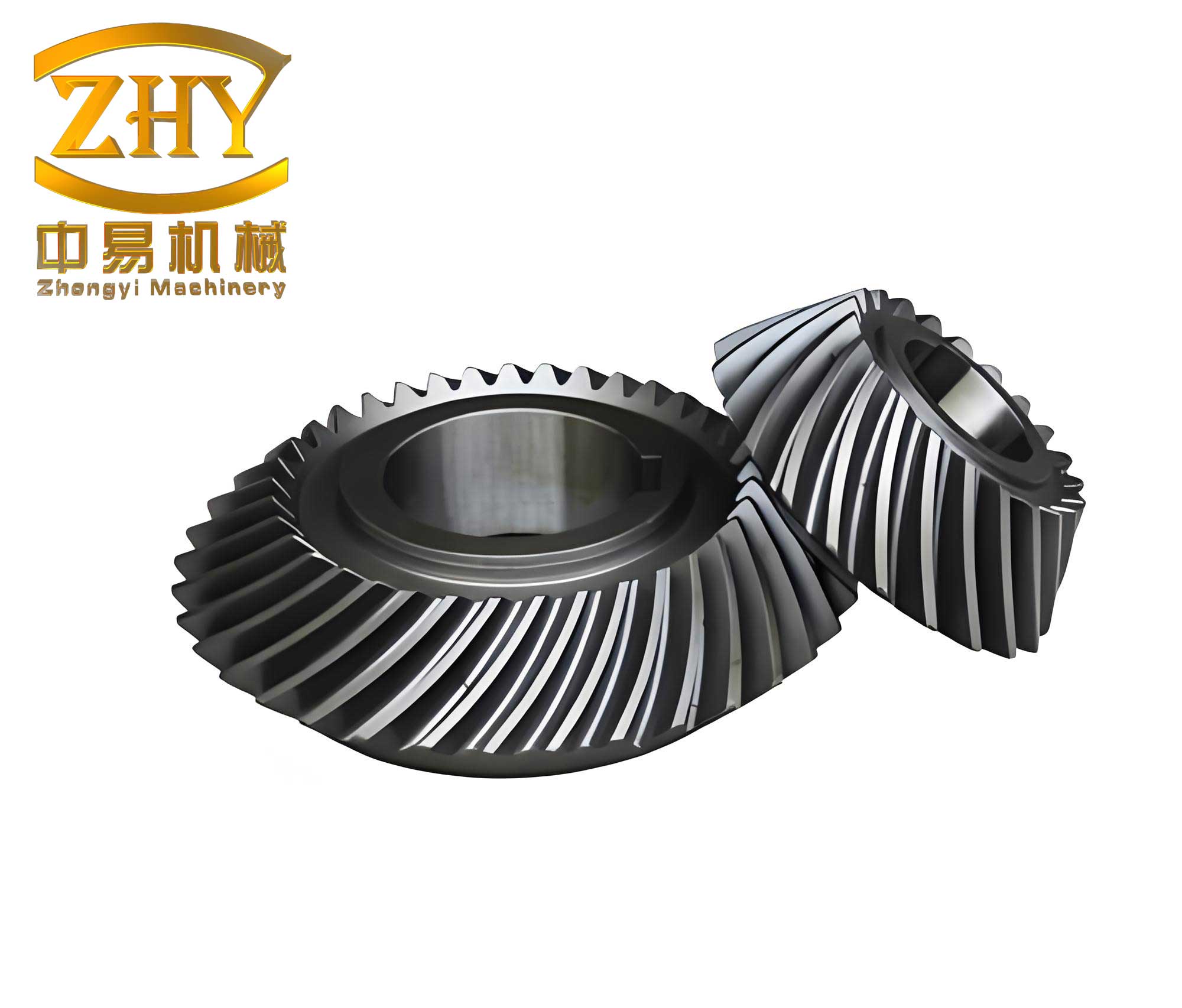
Our design process begins with the mathematical derivation of a conjugate tooth profile curve for the spiral gear. Instead of using standard involute curves alone, we combine arcs and involute segments to form a continuous curve that allows for full meshing without gaps. This curve consists of an arc at the tooth root, an involute segment along the flank, and an arc at the tooth tip, all seamlessly connected to ensure conjugate action. For a gear with symmetric teeth, we analyze one-fourteenth of the tooth profile, from the lowest point P of the tooth valley to the highest point Q of the adjacent tooth peak, enclosed by an angle of $\pi/7$. The curve segment PBCQ includes the involute BC and arcs PB and CQ, which are tangent to the involute at points B and C, respectively. By establishing a coordinate system with the origin at the gear center O and the x-axis along the line from O to the base point A, we can express the involute equation for any point P on the curve. Let $\alpha$ be the angle $\angle POA$, and let $r$ be the base circle radius. The parametric equations for the involute are:
$$ x_p = r(\cos(\alpha) + \alpha \sin(\alpha)) $$
$$ y_p = r(\sin(\alpha) – \alpha \cos(\alpha)) $$
Using these equations, we determine the coordinates of points B and C, denoted as $(X_B, Y_B)$ and $(X_C, Y_C)$. The lines BB’ and CC’ are tangents to the base circle at points B’ and C’, respectively. The equations for these lines, along with the lines OQ and OP, allow us to solve for key parameters such as the root arc radius $r_0$, tip arc radius $r_1$, and the angles $\alpha_0$ and $\alpha_1$ corresponding to points B and C. Specifically, we derive:
$$ r_0 = r \cdot \tan\left(\alpha_0 – \left(T – \frac{\pi}{7}\right)\right) – r\alpha_0 $$
$$ r_1 = r\alpha_1 – r \cdot \tan(\alpha_1 – T) $$
where $T$ is the angle $\angle QOA$. The small circle radius $\rho$ (related to the root) and large circle radius $\Phi$ (related to the tip) are given by:
$$ \frac{\rho}{r} = \sec\left(\alpha_0 – \left(T – \frac{\pi}{7}\right)\right) – \tan\left(\alpha_0 – \left(T – \frac{\pi}{7}\right)\right) + \alpha_0 $$
$$ \frac{\Phi}{r} = \sec(\alpha_1 – T) – \tan(\alpha_1 – T) + \alpha_1 $$
To ensure continuous meshing between two identical spiral gears, we consider two meshing states. In state 1, point P of the left gear contacts point Q of the right gear. After both gears rotate by an angle $\gamma$, they reach state 2 where point B of the left gear contacts point C of the right gear. From geometric consistency, we establish the relationship:
$$ \gamma = \alpha_0 – \left(T – \frac{\pi}{7}\right) – \theta = \theta – (\alpha_1 – T) $$
where $\theta$ is the angle $\angle B’O_1O_r$ in state 2. Solving these equations yields:
$$ T = \frac{\alpha_0 + \alpha_1 + \frac{\pi}{7}}{2} – \arctan\left(\frac{\alpha_0 + \alpha_1}{2}\right) $$
This formulation ensures that the tooth profiles are conjugate, meaning they remain in contact throughout the rotation, thereby eliminating oil trapping and providing smooth transmission. The spiral gear design incorporates a helix angle $\beta$ to further enhance meshing continuity and reduce axial forces.
Next, we define the key parameters for the spiral gear pump. These parameters are essential for manufacturing and performance evaluation. The following table summarizes the fundamental gear parameters and their formulas:
| Parameter | Symbol | Formula |
|---|---|---|
| Center Distance | $a$ | $a = \frac{z m_n}{\cos \beta}$ |
| Normal Module | $m_n$ | Design input |
| Pressure Angle (Normal) | $\alpha_n$ | Design input |
| Helix Angle | $\beta$ | Design input |
| Number of Teeth | $z$ | Design input |
| Transverse Pressure Angle | $\alpha_t$ | $\tan \alpha_t = \frac{\tan \alpha_n}{\cos \beta}$ |
| Pitch Diameter | $d_t$ | $d_t = m_n \frac{z}{\cos \beta}$ |
| Base Circle Diameter | $d_b$ | $d_b = d_t \cos \alpha_t$ |
| Actual Center Distance | $a’$ | $a’ = m_n \frac{z}{\cos \beta} + y_t m_t$ |
| Transverse Module | $m_t$ | $m_t = \frac{m_n}{\cos \beta}$ |
| Center Distance Change Coefficient | $y_t$ | $y_t = \frac{a’ – a}{m_t}$ |
| Working Pressure Angle (Transverse) | $\alpha_t’$ | $\cos \alpha_t’ = \frac{a}{a’} \cos \alpha_t$ |
| Number of Teeth for Measurement | $z_v$ | $z_v = \frac{z}{\cos^3 \beta}$ |
| Span Number of Teeth | $K$ | $K = \frac{z_v}{180} \arccos\left(\frac{z_v \cos \alpha_n}{z_v + 2 x_n}\right) + 0.5$ |
| Normal Profile Shift Coefficient | $x_n$ | Design input |
| Base Tangent Length | $W_k$ | $W_k = (W_k^* + \Delta W^*) m_n$ |
| Reference Base Tangent Length | $W_k^*$ | $W_k^* = \cos \alpha_n [\pi (K – 0.5) + z’ \text{inv} \alpha_n]$ |
| Increment due to Profile Shift | $\Delta W^*$ | $\Delta W^* = 2 x_n \sin \alpha_n$ |
| Equivalent Number of Teeth | $z’$ | $z’ = z \cdot \frac{\text{inv} \alpha_t}{\text{inv} \alpha_n}$ |
In our spiral gear design, the tooth profile is generated using the envelope method based on a spline curve. The spline curve is constructed from the derived conjugate segments and then revolved to form the complete tooth profile. The curve length $s$ for one tooth space is given by $s = 2\pi a’ / z$. After obtaining the O to A segment curve using the equations above, we rotate it by 180° around point A to get the O to B segment, then mirror it across the y-axis to produce a full rack curve. This rack curve is used to generate the gear tooth profile via simulation. The resulting spiral gear exhibits an ‘8’-shaped meshing trajectory, indicating continuous contact and no gaps, which is crucial for minimizing pulsation. The inclusion of a helix angle in the spiral gear further spreads the meshing action over a larger area, reducing noise and wear.
To validate our design, we conducted simulations using three-dimensional software. Initially, we selected parameters such as base radius $r = 27.498/2$, root radius $\rho = 25.4/2$, and tip radius $\Phi = 38.2/2$. Plugging these into the equations, we computed $\alpha_0 = 0.3312$, $\alpha_1 = 0.8300$, $r_0 = 2.9760$, and $r_1 = 2.97627$. Using these values in the involute equations, we generated coordinates for 28 starting points on the gear profile, as shown in the table below. This table provides a subset of key coordinates for points B and C and their symmetric counterparts, essential for defining the tooth geometry.
| Point Type | X Coordinate | Y Coordinate |
|---|---|---|
| B Point | 14.4827 | 0.1647 |
| C Point | 17.6996 | 2.4441 |
| B Point Symmetric | 12.3736 | 7.5279 |
| C Point Symmetric | 16.3095 | 5.5942 |
| Additional B Point | 8.9010 | 11.4257 |
| Additional C Point | 9.1247 | 15.3620 |
| Additional B Symmetric | -3.3833 | 14.0829 |
| Additional C Symmetric | -6.3214 | 16.7120 |
The simulation revealed minor oil trapping regions near the tooth tips and roots, indicating the need for curve refinement. We adjusted the parameters $\alpha_0$, $\alpha_1$, $r_0$, and $r_1$ iteratively to optimize the profile. After several iterations, we achieved a conjugate curve that eliminated oil trapping entirely. The final simulation showed smooth, continuous meshing with no sealed pockets, confirming the effectiveness of our spiral gear design. The helix angle $\beta$ was then incorporated, and the gears were manufactured using hobbing and grinding processes, resulting in precise spiral gears ready for testing.
We fabricated a prototype spiral gear pump with a displacement of 30 mL/rev, rated pressure of 20 MPa, maximum pressure of 25 MPa, and rated speed of 2000 rpm. The pump underwent comprehensive performance testing, and the results are summarized in the table below. All tests were conducted according to industry standards, and the spiral gear pump demonstrated exceptional performance across multiple criteria.
| Test Item | Technical Requirement | Test Result | Judgment |
|---|---|---|---|
| Displacement Verification (mL/rev) | 28.5 – 33 | 30.2 | Meets Requirement |
| Volumetric Efficiency at Rated Speed (%) | ≥ 91 | 94.7 | Meets Requirement |
| Overall Efficiency (%) | ≥ 81 | 87.3 | Meets Requirement |
| Sealing Performance | No leakage at static seals; no dripping at dynamic seals | No leakage or dripping observed | Meets Requirement |
| Overspeed Performance (2300 rpm for 15 min) | No abnormalities | No abnormalities | Meets Requirement |
| Overload Performance (25 MPa for 1 hour) | No abnormalities | No abnormalities | Meets Requirement |
| Low-Speed Performance (800 rpm at 20 MPa) | Stable output pressure | Stable pressure maintained | Meets Requirement |
| Low-Speed Volumetric Efficiency (%) | ≥ 65 | 70 | Meets Requirement |
| High-Temperature Performance (90–100°C for 1 hour) | Normal operation | Operated normally | Meets Requirement |
| High-Temperature Volumetric Efficiency (%) | ≥ 91 | 95.3 | Meets Requirement |
| Noise Level at 1500 rpm (dB) | ≤ 80 | 62 | Meets Requirement |
The test results highlight the superiority of the spiral gear pump. The volumetric efficiency of 94.7% at rated speed exceeds the requirement of 91%, indicating minimal internal leakage. The overall efficiency of 87.3% is significantly higher than the 81% threshold, showcasing improved energy conversion. Notably, the noise level of 62 dB is far below the 80 dB limit, underscoring the quiet operation enabled by the continuous meshing of the spiral gears. After testing, the pump was disassembled for inspection, and all friction pairs showed normal wear, confirming the durability of the design. The spiral gear pump effectively solves the oil trapping problem, reduces pulsation, and lowers noise, making it ideal for hydraulic systems where noise reduction is critical.
In conclusion, our research demonstrates that a spiral gear pump with a conjugate tooth profile curve can significantly enhance hydraulic pump performance. The mathematical design involving arcs and involute segments, combined with a helix angle, ensures continuous meshing and eliminates oil trapping. Through simulation and iterative refinement, we optimized the profile to achieve smooth operation. Experimental validation confirms that the spiral gear pump meets and exceeds industry standards for efficiency, sealing, and noise. This design not only addresses the limitations of traditional spur gear pumps but also offers a viable solution for modern hydraulic systems demanding low noise and high reliability. Future work could explore further optimizations in helix angle and material selection to expand the application range of spiral gear pumps. The success of this project underscores the importance of innovative gear design in advancing hydraulic technology, with the spiral gear playing a pivotal role in achieving these improvements.