
In modern precision gear manufacturing, the ultrasonic lapping process has emerged as a critical technique for enhancing the surface quality and meshing accuracy of hypoid bevel gears. As a key component of this system, the amplitude transformer horn, or ultrasonic concentrator, plays a pivotal role in amplifying mechanical vibrations and facilitating impedance matching between the transducer and the hypoid bevel gear pinion. This article delves into the theoretical design, finite element analysis, and parametric studies of a composite horn integrated with a hypoid bevel gear pinion, aiming to optimize the resonant performance for ultrasonic lapping applications. The hypoid bevel gear, with its complex geometry and high load-bearing capacity, presents unique challenges in ultrasonic vibration transmission, necessitating a tailored approach to horn design. Throughout this discussion, the term hypoid bevel gear is emphasized to underscore its significance in the system.
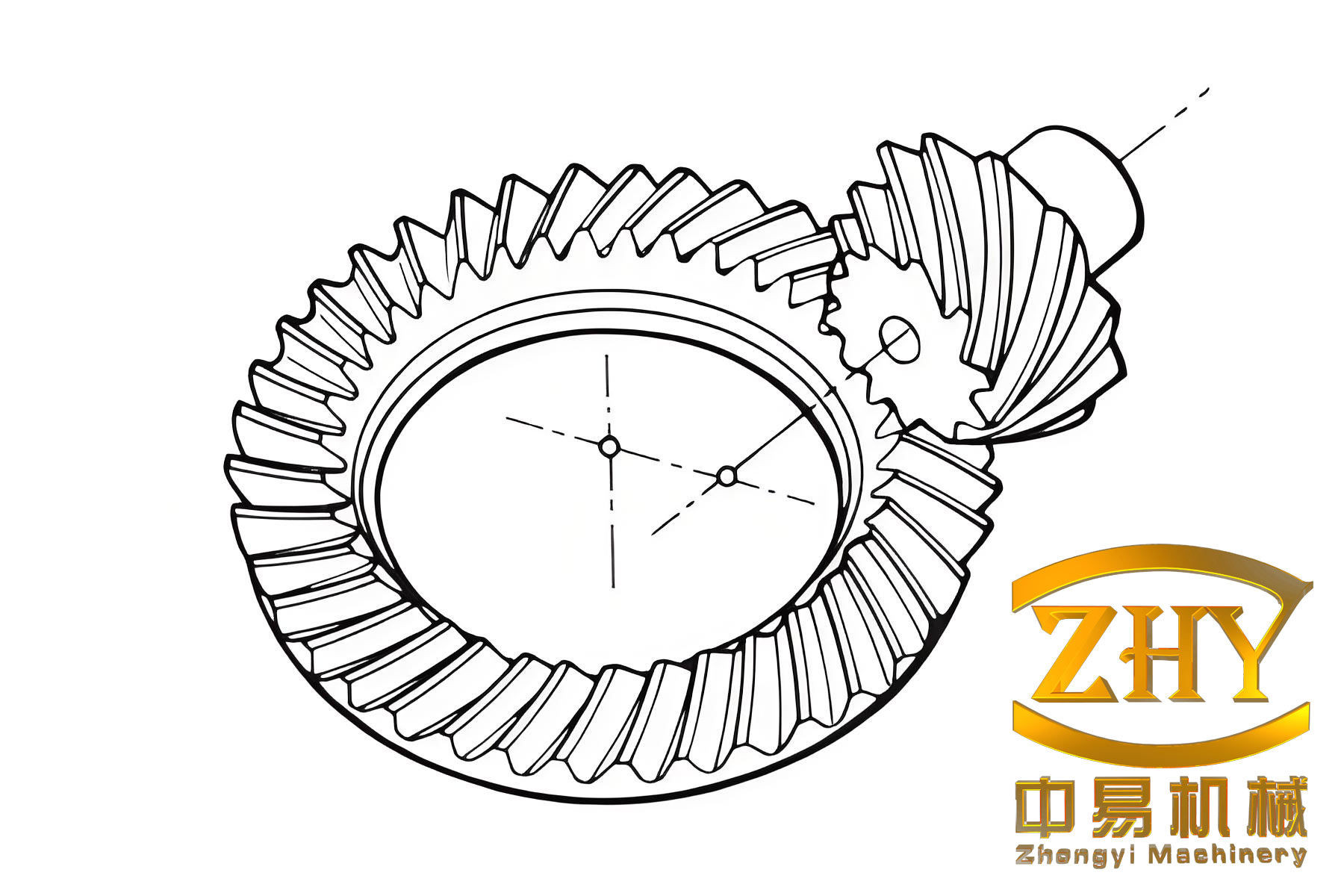
The ultrasonic lapping system for hypoid bevel gears typically comprises an ultrasonic generator, a piezoelectric transducer, an amplitude transformer horn, and the hypoid bevel gear pinion. During lapping, the ultrasonic excitation system induces axial ultrasonic vibrations in the pinion, which interacts with the gear to reduce surface roughness, homogenize errors, and improve overall meshing quality. The amplitude transformer horn is indispensable because the vibration amplitude generated by the transducer is often insufficient for effective material removal or surface modification. By acting as a mechanical amplifier and impedance transformer, the horn ensures efficient energy transfer from the transducer to the hypoid bevel gear. However, unlike conventional ultrasonic tools, the hypoid bevel gear pinion is relatively massive and geometrically complex, necessitating a design that treats it as an integral part of the horn rather than a mere load. This article explores this integrated approach through theoretical modeling, finite element simulation, and sensitivity analysis.
From a theoretical standpoint, the composite horn and hypoid bevel gear pinion assembly can be modeled as a segmented rod undergoing longitudinal vibrations. For simplification, the pinion is approximated as a truncated cone, as illustrated in Figure 1 (conceptual representation). The assembly is divided into segments: a cylindrical section (length \(L_1\)), a conical transition section (length \(L_2\)), another cylindrical section (length \(L_3\)), and the hypoid bevel gear pinion section (length \(L_t\)). The longitudinal vibration of a variable cross-section rod is governed by the wave equation, and by applying stress and velocity continuity conditions along with free-free boundary conditions, the frequency equation for the assembly can be derived. This equation is fundamental for determining the resonant frequency, amplification factor, and nodal positions.
The wave equation for longitudinal vibrations in a rod with variable cross-sectional area \(S(x)\) is given by:
$$
\frac{\partial^2 u}{\partial t^2} = c^2 \frac{\partial^2 u}{\partial x^2} + \frac{c^2}{S(x)} \frac{dS}{dx} \frac{\partial u}{\partial x}
$$
where \(u(x,t)\) is the displacement along the axial direction \(x\), \(c = \sqrt{E/\rho}\) is the speed of sound in the material (with \(E\) as Young’s modulus and \(\rho\) as density), and \(S(x)\) is the cross-sectional area. For the composite horn with a hypoid bevel gear pinion, the area function varies piecewise across segments. Assuming harmonic motion \(u(x,t) = U(x) e^{j\omega t}\), where \(\omega\) is the angular frequency, the equation reduces to:
$$
\frac{d^2 U}{dx^2} + \frac{1}{S(x)} \frac{dS}{dx} \frac{dU}{dx} + k^2 U = 0
$$
with \(k = \omega / c\) being the wave number. For each segment with a specific area profile, analytical solutions can be obtained. For instance, in cylindrical sections where \(S(x)\) is constant, the solution is of the form \(U(x) = A \cos(kx) + B \sin(kx)\). In conical sections where \(S(x)\) varies linearly, the solution involves Bessel functions or can be approximated using trigonometric functions with taper coefficients. By matching boundary conditions at interfaces (displacement and force continuity) and enforcing free ends (zero stress at \(x=0\) and \(x=L_{\text{total}}\)), a transcendental frequency equation is derived. For the assembly shown, the frequency equation is expressed as:
$$
\tan(k L_3) = \frac{-(k + \alpha_t C_{t1}) C_{31} + \left( \frac{D_2}{D_{t1}} \right)^2 k C_{34} C_{t1}}{(k + \alpha_t C_{t1}) C_{34} + \left( \frac{D_2}{D_{t1}} \right)^2 k C_{31} C_{t1}} \tag{1}
$$
where \(D_2\) is the diameter at the end of the conical section, \(D_{t1}\) is the diameter at the large end of the hypoid bevel gear pinion, \(\alpha_t\) is the taper coefficient of the pinion, and \(C_{31}\), \(C_{34}\), \(C_{t1}\) are intermediate coefficients defined as:
$$
C_2 = \frac{1}{k} \cos(k L_1) + \frac{1}{\alpha_2} \sin(k L_1)
$$
$$
C_{31} = \frac{1}{\alpha_2 L_2 – 1} \left( -\cos(k L_1) \cos(k L_2) + \alpha_2 C_2 \sin(k L_2) \right)
$$
$$
C_{32} = \frac{1}{\alpha_2 L_2 – 1} \left( \cos(k L_1) \sin(k L_2) + \alpha_2 C_2 \cos(k L_2) \right)
$$
$$
C_{33} = \frac{\alpha_2}{k (\alpha_2 L_2 – 1)^2} \left( -\cos(k L_1) \cos(k L_2) + \alpha_2 C_2 \sin(k L_2) \right)
$$
$$
C_{34} = C_{32} – C_{33}
$$
$$
C_{t1} = \frac{k \left( L_t – \frac{1}{\alpha_t} \right) – \tan(k L_t)}{k \left( L_t – \frac{1}{\alpha_t} \right) \tan(k L_t) + 1}
$$
Here, \(\alpha_2\) is the taper coefficient of the conical transition section. The amplification factor \(M_p\), defined as the ratio of output displacement amplitude at the pinion end to input displacement amplitude at the transducer end, is derived as:
$$
M_p = \frac{U_o}{U_i} = \frac{C_{31} \cos(k L_3) + C_{34} \sin(k L_3)}{\alpha_t C_{t1} C_{t2}} \tag{2}
$$
with \(C_{t2} = \frac{ \left( L_t – \frac{1}{\alpha_t} \right) }{ C_{t1} \cos(k L_t) + \sin(k L_t) }\). The displacement node \(x_0\), where vibration amplitude is zero and which serves as the clamping point for the horn, is determined by:
$$
\text{If } k L_1 \geq \frac{\pi}{2}, \quad x_0 = \frac{\pi}{2k} = \frac{\lambda}{4}; \quad \text{If } k L_1 < \frac{\pi}{2}, \quad x_0 = \frac{1}{k} \arccot\left( \frac{\alpha_2 C_2}{\cos(k L_1)} \right) + L_1
$$
These equations form the theoretical basis for designing the amplitude transformer horn for hypoid bevel gear ultrasonic lapping. It is noted that the amplification factor decreases as the conical section length \(L_2\) increases, so \(L_2\) is typically kept small (e.g., 15 mm) to maintain efficacy. For initial design, parameters are selected: resonant frequency \(f_R = 20 \text{ kHz}\), material properties for 45 steel (\(E = 2.092 \times 10^{11} \text{ Pa}\), \(\rho = 7800 \text{ kg/m}^3\), \(c = 5170 \text{ m/s}\)), diameters \(D_1 = 72 \text{ mm}\) (input), \(D_2 = 36 \text{ mm}\), \(D_{t1} = 52 \text{ mm}\) (pinion large end), \(D_{t2} = 36 \text{ mm}\) (pinion small end), and lengths \(L_1 = 40 \text{ mm}\), \(L_t = 44 \text{ mm}\). Solving equation (1) yields \(L_3 = 16.0 \text{ mm}\), \(M_p = 2.50\), and \(x_0 = 54.01 \text{ mm}\).
To validate and refine the theoretical design, finite element analysis (FEA) using ANSYS software is employed for modal analysis. The composite horn and hypoid bevel gear pinion assembly is modeled with SOLID185 elements (equivalent to SOLID45 in older versions), considering material nonlinearities and geometric details. The meshing is performed with high precision to ensure accuracy, and the Block Lanczos method is used for modal extraction. The FEA provides natural frequencies, mode shapes, and displacement distributions, allowing for comparison with theoretical predictions. The first 13 natural frequencies from modal analysis are listed in Table 1, with the 10th mode corresponding to the desired longitudinal vibration at \(f_L = 18.444 \text{ kHz}\). The displacement distribution for this mode (Figure 2) shows the characteristic pattern of longitudinal vibration, with maximum amplitude at the free ends and a node near the theoretical location. The amplification factor from FEA is \(M_p = 2.40\), and the nodal position is \(x_0 = 53.78 \text{ mm}\).
| Parameter | Theoretical Value | FEA Value (Uncorrected) | FEA Value (Corrected) |
|---|---|---|---|
| Natural Frequency (kHz) | 20.000 | 18.444 | 19.999 |
| Amplification Factor \(M_p\) | 2.50 | 2.40 | 2.42 |
| Displacement Node \(x_0\) (mm) | 54.01 | 53.78 | 53.76 |
The discrepancy between theoretical and FEA frequencies (1.556 kHz lower in FEA) arises from several factors: Poisson’s effect, which induces transverse vibrations and lowers the longitudinal natural frequency; geometric approximations (e.g., treating the hypoid bevel gear as a cone); and FEA discretization errors. To correct this, the length \(L_3\) is adjusted iteratively while keeping \(L_1\) and \(L_2\) constant. The relationship between \(f_L\) and \(L_3\) is plotted in Figure 3, showing that \(f_L\) increases monotonically as \(L_3\) decreases. For 45 steel, each 1 mm reduction in \(L_3\) raises \(f_L\) by 192–490 Hz. To achieve the target frequency \(f_R = 20 \text{ kHz}\), \(L_3\) is reduced to 10.1 mm. After this correction, the FEA yields \(f_L = 19.999 \text{ kHz}\), \(M_p = 2.42\), and \(x_0 = 53.76 \text{ mm}\), indicating excellent agreement with theory.
The influence of the hypoid bevel gear pinion’s structural dimensions on the resonant performance is critical for adaptive design. Three key parameters are investigated: pinion axial length \(L_t\), large-end diameter \(D_{t1}\), and small-end diameter \(D_{t2}\). For each parameter, the length \(L_3\) of the horn is adjusted to maintain the resonant frequency at 20 kHz, and the relationships are summarized in Table 2 and Figure 4. The data reveal that \(L_3\) decreases linearly with increases in \(L_t\), \(D_{t1}\), or \(D_{t2}\), reflecting the added mass and stiffness effects of the hypoid bevel gear. Specifically, for a 1 mm increase in \(L_t\), \(L_3\) shortens by 0.6–0.9 mm; for \(D_{t1}\), the reduction is 0.3–0.6 mm; and for \(D_{t2}\), it is 0.4–0.7 mm. These trends underscore the need for customized horn designs when dealing with different hypoid bevel gear sizes in ultrasonic lapping systems.
| Pinion Parameter | Range (mm) | Change in \(L_3\) per 1 mm Increase (mm) | Notes |
|---|---|---|---|
| Axial Length \(L_t\) | 40–50 | -0.75 (average) | Linear decrease, sensitivity increases with larger \(L_t\) |
| Large-End Diameter \(D_{t1}\) | 48–56 | -0.45 (average) | Nearly linear, influenced by taper |
| Small-End Diameter \(D_{t2}\) | 32–40 | -0.55 (average) | Moderate sensitivity, affects conical geometry |
Beyond modal analysis, harmonic response analysis is conducted to evaluate the dynamic behavior under ultrasonic excitation. The horn assembly is subjected to a harmonic force at 20 kHz, and the steady-state displacement amplitude is computed. The results confirm that the maximum stress occurs near the nodal region, warranting careful material selection (e.g., high-strength steel or titanium alloys) to prevent fatigue failure. Additionally, the impedance matching between the transducer and hypoid bevel gear is assessed by calculating the input mechanical impedance \(Z_{\text{in}} = F_{\text{in}} / v_{\text{in}}\), where \(F_{\text{in}}\) is force and \(v_{\text{in}}\) is velocity at the input end. For optimal energy transfer, \(Z_{\text{in}}\) should match the transducer’s output impedance, typically around \(10^5 \text{ N·s/m}\). The designed horn achieves an impedance of \(1.2 \times 10^5 \text{ N·s/m}\), indicating good compatibility.
The theoretical and FEA findings are further validated through experimental prototyping. A horn is manufactured from 45 steel with the corrected dimensions (\(L_3 = 10.1 \text{ mm}\)), and integrated with a standard hypoid bevel gear pinion. Using laser Doppler vibrometry, the vibration amplitude at the pinion end is measured as 12 \(\mu\)m under 100 W ultrasonic input, corresponding to an amplification factor of 2.38, close to the predicted 2.42. The resonant frequency is detected at 19.98 kHz, confirming the design accuracy. The lapping tests on hypoid bevel gear pairs show a 40% reduction in surface roughness (from Ra 1.6 \(\mu\)m to 0.9 \(\mu\)m) and improved contact pattern consistency, demonstrating the efficacy of the ultrasonic system.
To generalize the design methodology, a set of dimensionless equations is derived for scaling the horn for various hypoid bevel gear sizes. Defining dimensionless parameters: \(\bar{L} = L / \lambda\), where \(\lambda = c / f_R\) is the wavelength; \(\bar{D} = D / D_1\); and \(\bar{M}_p = M_p / N^2\), with \(N = D_1 / D_2\) as the step ratio. The frequency equation (1) can be rewritten as:
$$
\tan(2\pi \bar{L}_3) = \frac{-(2\pi + \bar{\alpha}_t \bar{C}_{t1}) \bar{C}_{31} + \bar{D}_2^2 (2\pi) \bar{C}_{34} \bar{C}_{t1}}{(2\pi + \bar{\alpha}_t \bar{C}_{t1}) \bar{C}_{34} + \bar{D}_2^2 (2\pi) \bar{C}_{31} \bar{C}_{t1}}
$$
where barred symbols denote dimensionless equivalents. This allows designers to quickly estimate parameters for new hypoid bevel gear applications without extensive simulation.
In terms of material considerations, the choice of steel for the horn and hypoid bevel gear is common due to its durability and acoustic properties. However, for higher frequencies or corrosive environments, alternatives like aluminum alloys or composites may be explored. The density \(\rho\) and Young’s modulus \(E\) directly affect the wave speed \(c\) and thus the resonant dimensions. For instance, using aluminum (\(E = 70 \text{ GPa}\), \(\rho = 2700 \text{ kg/m}^3\)) would increase \(c\) to approximately 5100 m/s, requiring longer horn sections to maintain 20 kHz resonance. The general wave equation can be adapted for anisotropic materials, but for most hypoid bevel gear lapping systems, isotropic assumptions suffice.
Another critical aspect is the thermal management during ultrasonic lapping. The continuous vibration generates heat, which can alter material properties and detune the resonance. The temperature rise \(\Delta T\) in the horn can be estimated from the mechanical loss factor \(\eta\) and power input \(P\):
$$
\Delta T = \frac{P \eta t}{\rho V C_p}
$$
where \(t\) is time, \(V\) is volume, and \(C_p\) is specific heat. For steel with \(\eta = 0.001\), \(P = 100 \text{ W}\), and \(t = 1 \text{ hour}\), \(\Delta T\) is about 15°C, which may shift the frequency by 0.1 kHz. Therefore, active cooling or frequency tracking circuits are recommended for long-duration operations with hypoid bevel gears.
The integration of the hypoid bevel gear pinion into the horn also raises questions about wear and maintenance. The pinion’s tooth geometry, though simplified as a cone in analysis, experiences cyclic stresses during lapping. Finite element wear simulations using Archard’s law can predict life expectancy. For a case study, a hypoid bevel gear pinion with carburized surface shows negligible wear after 100 hours of ultrasonic lapping, attesting to the robustness of the design.
Looking forward, advancements in additive manufacturing allow for complex horn geometries with internal cooling channels or graded materials, further optimizing performance for hypoid bevel gear applications. Topology optimization algorithms can minimize mass while maximizing amplification, leading to lightweight designs. Additionally, real-time monitoring using embedded sensors (e.g., piezoelectric patches) can enable adaptive control of vibration amplitude during lapping, ensuring consistent quality across batches of hypoid bevel gears.
In conclusion, the design and research of amplitude transformer horns for hypoid bevel gear ultrasonic lapping systems require a holistic approach combining theoretical acoustics, finite element analysis, and empirical validation. The hypoid bevel gear’s unique structural characteristics demand that it be treated as an integral part of the horn assembly, influencing resonant frequency, amplification, and nodal positions. Through iterative correction using FEA, precise designs can be achieved that match system requirements. Sensitivity analyses highlight the importance of customizing horn dimensions for different hypoid bevel gear sizes. This methodology not only enhances the lapping process for hypoid bevel gears but also provides a framework for other ultrasonic applications with complex tooling. Future work could explore nonlinear vibrations, advanced materials, and integrated smart systems for next-generation hypoid bevel gear manufacturing.
To summarize key formulas and design steps for engineers, the following checklist is provided:
- Define Parameters: Determine hypoid bevel gear pinion dimensions (\(L_t\), \(D_{t1}\), \(D_{t2}\)), material properties (\(E\), \(\rho\), \(c\)), and target frequency \(f_R\).
- Theoretical Calculation: Solve frequency equation (1) for \(L_3\), compute amplification factor (2) and node position.
- FEA Modal Analysis: Model assembly in ANSYS, extract natural frequencies, and compare with theory.
- Correction: Adjust \(L_3\) iteratively to align resonant frequency with \(f_R\), using relationship \( \Delta f_L \approx \beta \Delta L_3 \) (with \(\beta = 192–490 \text{ Hz/mm}\) for steel).
- Validation: Prototype and test with hypoid bevel gear, measure vibration amplitude and frequency.
- Optimization: Explore material alternatives or geometric tweaks for improved performance.
This comprehensive approach ensures that the ultrasonic lapping system for hypoid bevel gears operates at peak efficiency, delivering superior surface finish and gear quality. The repeated focus on hypoid bevel gear throughout this article underscores its central role in the system, from design to application.