
In the field of gear manufacturing, the production of helical gears is critical due to their superior load-bearing capacity and smooth operation compared to spur gears. As a researcher focused on digital design and manufacturing, I have developed a simulation system for helical gear hobbing using NX secondary development. This system aims to bridge the gap between geometric simulation and physical modeling of the hobbing process, enabling precise geometric modeling of helical gears and extraction of undeformed chip geometries for further analysis of cutting forces and tool wear. The helical gear, with its angled teeth, presents unique challenges in machining, and virtual simulation provides a cost-effective way to optimize process parameters and validate tool designs.
The importance of accurate helical gear manufacturing cannot be overstated, as these gears are widely used in automotive, aerospace, and industrial machinery. Traditional methods rely on physical prototyping, which is time-consuming and expensive. Therefore, virtual machining simulations have gained traction, allowing for the creation of digital twins that replicate real-world processes. My work leverages NX, a powerful CAD/CAM software, to simulate the hobbing process for helical gears, incorporating kinematics, geometry, and material removal dynamics. The simulation system not only generates precise 3D models of helical gears but also outputs undeformed chip geometries, which are essential for physical simulations such as finite element analysis (FEA) of cutting forces.
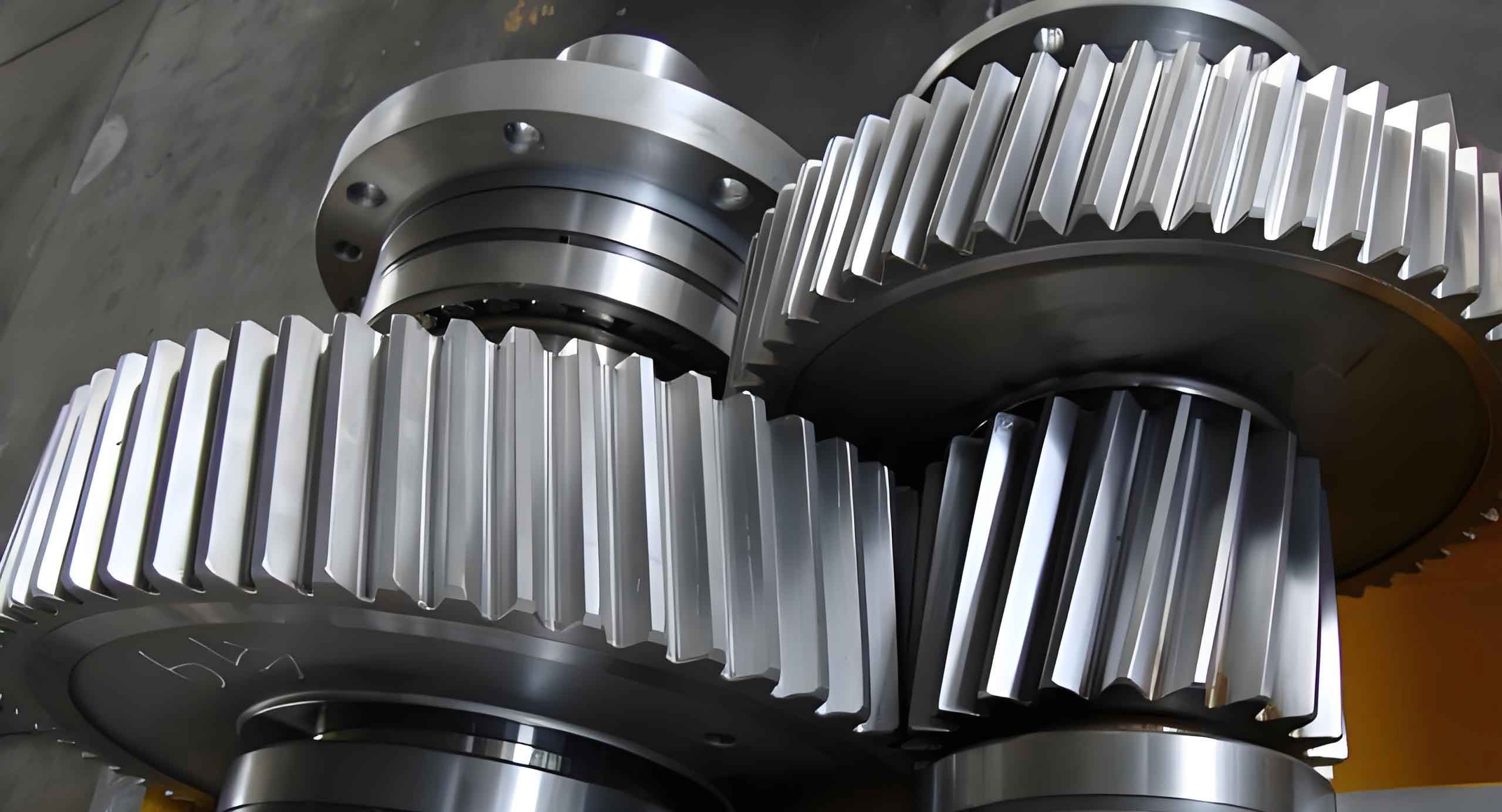
To provide a visual reference for helical gears, consider the following image that illustrates their typical structure and tooth geometry. This representation helps in understanding the complex shape that must be accurately replicated in simulation.
The simulation system is built on a Windows platform using Visual Studio 2008 for programming, MATLAB for numerical computations, and NX for geometric modeling and secondary development. The overall architecture consists of several interconnected modules that handle parameter input, geometric entity creation, kinematic calculations, and simulation output. Below is a table summarizing the key components of the system and their functions, which ensures a structured approach to simulating helical gear hobbing.
| Module | Function | Tools Used |
|---|---|---|
| Parameter Input | Accepts gear and process parameters (e.g., helical gear tooth count, modulus, helix angle) | User interface in NX |
| Workpiece Creation | Generates initial cylindrical blank for the helical gear | NX secondary development functions |
| Hob Modeling | Constructs 3D model of hob teeth with precise geometry | MATLAB for calculations, NX for modeling |
| Kinematics Solver | Computes relative motions between hob and helical gear workpiece | MATLAB and custom code |
| Chip Extraction | Outputs undeformed chip geometries for each cutting tooth | NX Boolean operations |
| Simulation Output | Produces final helical gear model and error analysis data | NX and MATLAB for post-processing |
The kinematic model is fundamental to accurately simulating the hobbing process for helical gears. I assume the workpiece remains stationary, while the hob rotates about its own axis and performs a helical motion around the workpiece. For a helical gear with helix angle $\beta$, the relationship between the hob rotation angle $\theta_1$, workpiece rotation angle $\theta_2$, and axial feed $f$ is derived as follows. This accounts for the helical motion required to generate the angled teeth of the helical gear.
The key equations governing the motion are:
$$ \theta_2 = K_1 \theta_1, \quad K_1 = \frac{1}{Z_p} \div \left(1 – \frac{f_t \sin \beta}{\pi m_n Z_p}\right) $$
$$ f = K_2 \theta_2, \quad K_2 = \frac{f_t}{2\pi} $$
Here, $Z_p$ is the number of teeth on the helical gear, $m_n$ is the normal modulus, $f_t$ is the feed per revolution, and $\beta$ is the helix angle of the helical gear. These equations ensure that the simulation replicates the synchronized rotations and feeds inherent in hobbing helical gears.
To formalize the coordinate systems, I define a workpiece coordinate system $S_g(X_g, Y_g, Z_g)$ fixed to the top surface of the helical gear blank, with $Z_g$ along the gear axis. The hob coordinate system $S_h(X_h, Y_h, Z_h)$ is attached to the hob, and for each hob tooth, a local coordinate system $S_n(X_n, Y_n, Z_n)$ is established. The transformation between these systems incorporates the hob installation angle $\Gamma = \beta – \gamma$, where $\gamma$ is the hob lead angle. For a hob tooth indexed $n$, its axial offset $x_n$ and phase angle $\phi_n$ are given by:
$$ x_n = \frac{\pi m_n}{G_n \cos \gamma} n $$
$$ \phi_n = \frac{2\pi}{G_n} n $$
where $G_n$ is the number of gashes on the hob. Using homogeneous transformation matrices, the coordinates of a point on the $n$-th hob tooth in the workpiece system are computed as:
$$ \begin{bmatrix} X_g \\ Y_g \\ Z_g \\ 1 \end{bmatrix} = A^{-1} \begin{bmatrix} X_n \\ Y_n \\ Z_n \\ 1 \end{bmatrix} $$
with the transformation matrix $A$ defined as:
$$ A = \begin{bmatrix} 1 & 0 & 0 & -x_n \\ 0 & \cos \phi_n & -\sin \phi_n & 0 \\ 0 & \sin \phi_n & \cos \phi_n & 0 \\ 0 & 0 & 0 & 1 \end{bmatrix} \begin{bmatrix} 1 & 0 & 0 & 0 \\ 0 & \cos \theta_1 & -\sin \theta_1 & 0 \\ 0 & \sin \theta_1 & \cos \theta_1 & 0 \\ 0 & 0 & 0 & 1 \end{bmatrix} \begin{bmatrix} \cos \Gamma & 0 & \sin \Gamma & 0 \\ 0 & 1 & 0 & 0 \\ -\sin \Gamma & 0 & \cos \Gamma & 0 \\ 0 & 0 & 0 & 1 \end{bmatrix} \begin{bmatrix} \cos \theta_2 & -\sin \theta_2 & 0 & 0 \\ -\sin \theta_2 & -\cos \theta_2 & 0 & L_1 \\ 0 & 0 & 1 & f – L \\ 0 & 0 & 0 & 1 \end{bmatrix} $$
This kinematic framework ensures accurate positioning of each hob tooth during the simulation of helical gear hobbing, which is crucial for generating correct tooth profiles.
The geometric modeling phase involves creating entities for the workpiece, hob tooth swept volumes, and undeformed chips. For the helical gear blank, I use a cylindrical solid generated via NX secondary development functions like UF_MODL_create_cyl1, based on parameters such as pitch diameter and face width of the helical gear. The hob tooth swept volume is constructed by sweeping the hob tooth face along its trajectory curve, which is derived from the kinematic model. The trajectory curve represents the path of the cutting edge relative to the helical gear workpiece, and it is modeled using NX curve functions. The swept volume is created with UF_MODL_create_sweep, and it intersects with the instantaneous gear slot to form undeformed chips and update the slot geometry.
The process of material removal is simulated through Boolean operations between the hob tooth swept volume and the current gear slot. Each cutting tooth removes material corresponding to the overlap, producing an undeformed chip entity and a new slot shape. This iterative process continues until all teeth have been simulated, resulting in the final helical gear geometry. The undeformed chip geometries are stored for subsequent analysis, such as predicting cutting forces in helical gear hobbing. Below is a table summarizing the key geometric entities and their creation methods, highlighting the focus on helical gear features.
| Geometric Entity | Description | Creation Method |
|---|---|---|
| Helical Gear Blank | Cylindrical workpiece representing the gear before cutting | NX function for cylinder creation |
| Hob Tooth Face | 3D surface of the hob tooth based on tool geometry | MATLAB calculations and NX surface modeling |
| Tooth Trajectory Curve | Path of hob tooth relative to helical gear workpiece | Kinematic equations and NX curve functions |
| Swept Volume | Volume generated by sweeping tooth face along trajectory | NX sweeping functions |
| Undeformed Chip | Material removed by each hob tooth during helical gear hobbing | Boolean intersection in NX |
| Final Helical Gear | Complete 3D model of the machined helical gear | Accumulative Boolean operations |
To validate the simulation system, I conducted an example using a standard helical gear with parameters: normal modulus $m_n = 3$ mm, tooth count $Z_p = 36$, pressure angle $\alpha = 20^\circ$, helix angle $\beta = 15^\circ$, and full depth cutting. The hob was a single-start, right-hand standard gear hob with parameters per GB/T 6084-2001. The simulation produced a precise 3D model of the helical gear, and I extracted the normal tooth profile for analysis. By fitting data points from the simulation in MATLAB and comparing with a theoretical involute profile, I evaluated the accuracy. The error distribution between the simulated profile and theoretical involute was found to be within 0.7 to 0.9 micrometers, demonstrating the high fidelity of the simulation for helical gear manufacturing.
The error analysis is crucial for assessing the simulation’s performance in replicating helical gear geometry. The small errors indicate that the kinematic and geometric models effectively capture the complexities of helical gear hobbing. Additionally, the undeformed chip geometries extracted during simulation provide insights into the cutting process. For instance, the chip shapes vary depending on the hob tooth position, as shown in the simulation outputs. These chips can be used in physical models to predict dynamic cutting forces and optimize hob design for helical gears.
In terms of implementation, the simulation system leverages NX’s robust API for secondary development, allowing for automated creation and manipulation of geometric entities. The use of MATLAB for numerical computations ensures efficient solving of kinematic equations and error analysis. The integration of these tools facilitates a comprehensive simulation environment that can handle various helical gear configurations and hobbing parameters. For example, by adjusting the helix angle $\beta$ or hob lead angle $\gamma$, the system can simulate different types of helical gears, including those with high helix angles used in specialized applications.
The benefits of this simulation approach extend beyond geometric accuracy. By outputting undeformed chip geometries, the system enables researchers to study chip formation mechanisms in helical gear hobbing, which is essential for improving tool life and surface finish. Moreover, the simulation can be used to test the validity of hob designs before physical manufacturing, reducing costs and time. In industrial settings, this can lead to more efficient production of helical gears, which are critical components in many mechanical systems.
Future work will focus on enhancing the physical simulation aspects. For instance, integrating the undeformed chip geometries into finite element models to predict cutting temperatures and tool stresses during helical gear hobbing. Additionally, the simulation system could be expanded to include multi-axis hobbing machines or to model wear progression on hob teeth. Another direction is to incorporate real-time adjustments based on sensor data, moving towards a digital twin framework for helical gear manufacturing.
In conclusion, the development of this helical gear hobbing simulation system based on NX secondary development represents a significant advancement in virtual manufacturing. It provides a reliable method for generating precise helical gear models and extracting undeformed chip data, bridging the gap between geometric and physical simulations. The accuracy demonstrated in the example validates the approach, and the system’s flexibility allows for applications in tool design, process optimization, and research. As helical gears continue to be vital in engineering, such simulation tools will play an increasingly important role in ensuring high-quality and efficient production.