
In the realm of mechanical power transmission, the screw gear reducer plays a pivotal role as a critical intermediary between prime movers and working machinery, facilitating efficient speed reduction and torque amplification. Its indispensability in mechanized manufacturing stems from its ability to ensure smooth operation, durability, and precision in diverse industrial applications. As technology advances, the integration of Computer-Aided Design (CAD) and associated technologies has revolutionized the design process, enabling accelerated development cycles, enhanced design quality, and improved reliability. This, in turn, yields substantial economic and social benefits by reducing time-to-market and minimizing errors. In this article, I will delve into the practical application of three-dimensional CAD technology and its secondary development within the screw gear reducer manufacturing industry. Focusing on the SolidWorks environment, I have developed a specialized CAD system tailored for screw gear reducers, leveraging tools like Visual Basic for customization. The journey encompasses 3D modeling of key components, virtual simulation assembly, and motion analysis, all aimed at optimizing design efficiency and performance.
The foundation of any CAD system lies in its software environment, which dictates the capabilities and flexibility of the design process. For this project, I selected SolidWorks, a prominent mechanical design software developed by Dassault Systèmes SolidWorks Corp., which operates seamlessly on Windows platforms. SolidWorks excels in parametric solid modeling through intuitive features such as extrusion, revolution, sweep, and loft, allowing for precise geometric creation and modification. Its user-friendly interface and robust API (Application Programming Interface) make it ideal for secondary development, enabling customization to meet specific industry needs. To enhance functionality, I employed Visual Basic 6.0 (VB6.0), a component of Microsoft Visual Studio, for programming the CAD system. VB6.0 offers a flexible user interface, strong error-handling mechanisms, and seamless integration with SolidWorks, facilitating the automation of repetitive tasks and the creation of tailored design workflows. This combination empowers engineers to streamline the screw gear reducer design process, from initial concept to final validation.
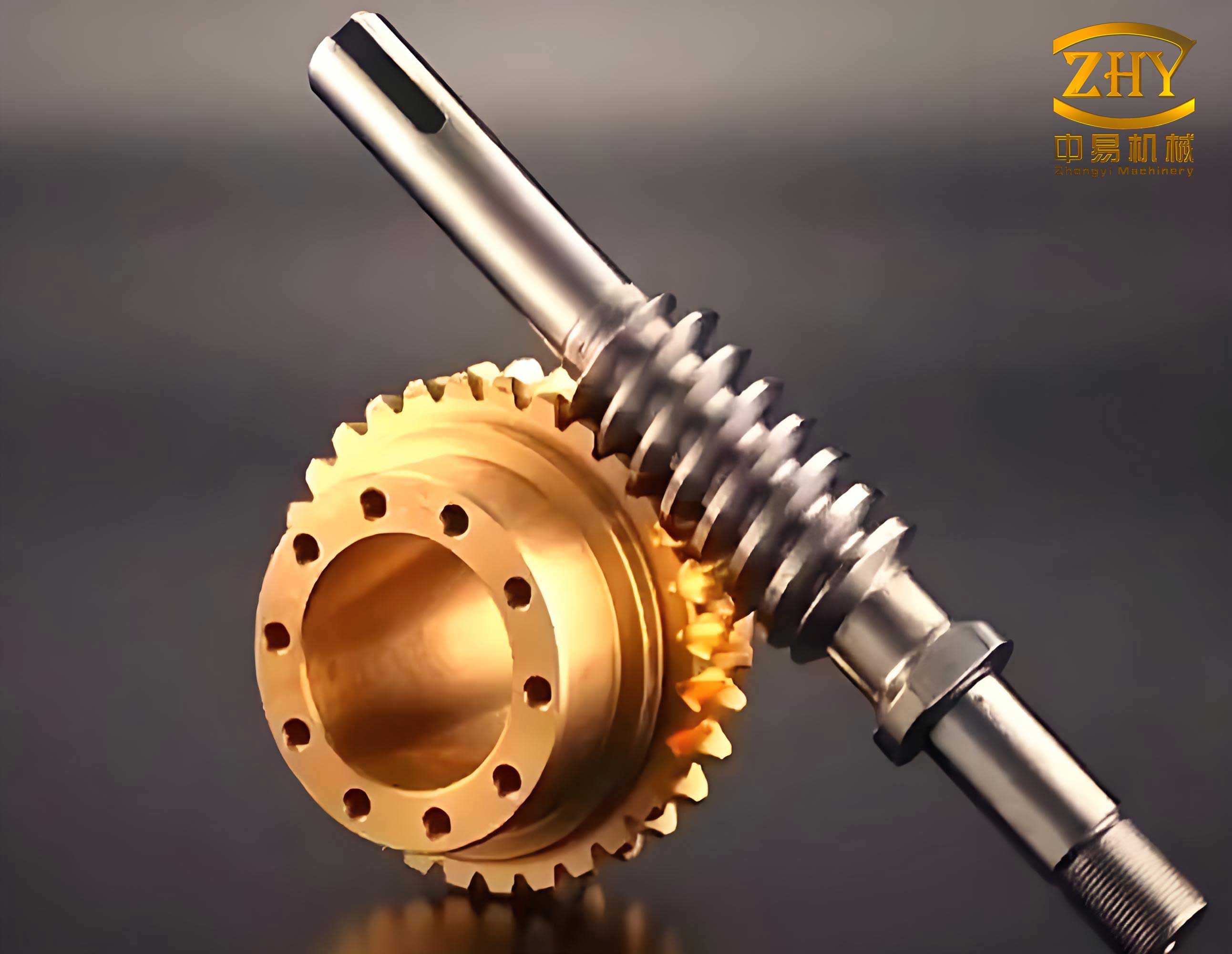
Central to the screw gear reducer is the screw gear itself, which typically consists of a worm (screw) and a worm wheel (gear). The 3D modeling of these components begins with defining design parameters, which I have summarized in the table below to provide a clear overview of key variables influencing performance.
| Parameter | Symbol | Typical Value Range | Description |
|---|---|---|---|
| Module | m | 2-10 mm | Determines tooth size and gear ratio |
| Number of Worm Threads | z1 | 1-4 | Affects reduction ratio and efficiency |
| Number of Worm Wheel Teeth | z2 | 20-60 | Influences torque transmission |
| Center Distance | a | 50-200 mm | Distance between worm and wheel axes |
| Pressure Angle | α | 20° | Tooth profile angle for load distribution |
| Lead Angle | γ | 5°-30° | Angle of worm thread relative to axis |
Using these parameters, I initiated the 3D modeling in SolidWorks. For the worm wheel, I started by sketching the overall profile, incorporating geometric constraints to ensure accuracy. The sketch was then revolved around a central axis to generate the wheel’s blank entity. To create the intricate tooth profile, I employed a point-and-spline approximation method to simulate the involute curve, which is mathematically represented by the equation for an involute of a circle: $$ x = r_b (\cos \theta + \theta \sin \theta) $$ $$ y = r_b (\sin \theta – \theta \cos \theta) $$ where \( r_b \) is the base radius and \( \theta \) is the involute angle. This curve was used in a sweep-cut operation to remove material, forming the tooth spaces. Through mirroring and circular patterning, the complete worm wheel model was achieved, showcasing a precise screw gear configuration. Similarly, for the worm, I drafted the tooth profile sketch based on the lead angle and module, then extruded or swept it along a helical path to produce the threaded shaft. The worm’s geometry can be described by the helix equation: $$ z = \frac{p}{2\pi} \phi $$ where \( p \) is the pitch and \( \phi \) is the rotation angle. These steps highlight the importance of accurate modeling for screw gear components, ensuring optimal meshing and performance.
The housing or gearbox is another critical element of the screw gear reducer, serving as the foundation that supports and aligns all internal components. It must exhibit sufficient strength and stiffness to withstand operational loads and prevent deformation. In SolidWorks, I constructed the housing using a series of features: extrusion for basic shapes, fillets and chamfers for stress reduction, and cutouts for mounting points and lubrication access. The design process involved creating a base sketch, adding ribs for reinforcement, and incorporating bolt holes for assembly. A key aspect was ensuring proper clearance for the screw gear set, which I verified through interference detection tools. The housing’s dimensions were derived from the center distance and component sizes, with wall thickness calculated based on load analysis. For instance, the minimum thickness \( t \) can be estimated using the formula: $$ t = \frac{P \cdot a}{2 \sigma_{allow}} $$ where \( P \) is the transmitted power, \( a \) is the center distance, and \( \sigma_{allow} \) is the allowable stress of the housing material. This systematic approach resulted in a robust housing model that facilitates easy assembly and maintenance.
Virtual simulation assembly represents a transformative advancement in product development, allowing engineers to validate component interactions and assemblability during the design phase. By leveraging SolidWorks’ assembly capabilities, I performed a step-by-step virtual assembly of the screw gear reducer, which helps identify potential issues early, reduce physical prototyping costs, and optimize performance. The process began with sub-assemblies, such as the worm shaft assembly. I created a new assembly document and inserted the worm shaft as a fixed component. Subsequently, I added keys, bearings, spacers, and locknuts, applying mate constraints like concentricity, parallelism, and coincident surfaces to ensure precise alignment. For example, the key was mated to the shaft keyway using concentric and parallel relations, mathematically expressed as: $$ \vec{r}_{key} = \vec{r}_{shaft} + \Delta \vec{r} $$ where \( \vec{r} \) denotes position vectors and \( \Delta \vec{r} \) is the offset. This sub-assembly, when complete, formed the core transmission unit of the screw gear reducer.
Next, I proceeded to the overall assembly, integrating the worm wheel, housing, covers, and fasteners. The sequence followed a bottom-up approach, starting with the housing as the base and progressively adding components. SolidWorks’ collision detection and motion simulation tools enabled me to verify that all parts moved smoothly without interference. The screw gear meshing was particularly scrutinized, as proper contact between the worm and worm wheel is essential for efficient power transmission. The contact ratio \( \epsilon \) for a screw gear pair can be calculated using: $$ \epsilon = \frac{\sqrt{r_{a2}^2 – r_{b2}^2} + \sqrt{r_{a1}^2 – r_{b1}^2} – a \sin \alpha}{p_b} $$ where \( r_a \) and \( r_b \) are addendum and base radii, \( a \) is center distance, \( \alpha \) is pressure angle, and \( p_b \) is base pitch. This ensured the virtual model replicated real-world behavior accurately. The final assembly demonstrated a fully functional screw gear reducer, ready for further analysis such as finite element analysis (FEA) or computational fluid dynamics (CFD) for lubrication studies.
To encapsulate the design parameters and performance metrics, I have compiled a comprehensive table below, which summarizes key aspects of the screw gear reducer system. This table serves as a quick reference for engineers, highlighting the interplay between geometric and operational factors.
| Aspect | Formula/Value | Implication |
|---|---|---|
| Reduction Ratio | \( i = \frac{z2}{z1} \) | Determines speed reduction and torque multiplication |
| Efficiency | \( \eta = \frac{\tan \gamma}{\tan (\gamma + \rho)} \) | Accounts for friction losses, where \( \rho \) is friction angle |
| Torque Capacity | \( T = \frac{P \cdot 9550}{n} \) Nm | Based on power \( P \) (kW) and speed \( n \) (rpm) |
| Center Distance Adjustment | \( a = \frac{m (z1 + z2)}{2} \) | Ensures proper meshing and backlash control |
| Thermal Rating | \( Q = k A \Delta T \) | Heat dissipation capacity, critical for screw gear longevity |
The integration of motion simulation further enhances the virtual prototype, allowing for dynamic analysis of the screw gear reducer under various loads. In SolidWorks, I applied rotational motors to the worm input and resistive torques to the worm wheel output, then ran simulations to observe velocity, acceleration, and force distributions. The equations of motion governing the system can be expressed as: $$ I_1 \ddot{\theta}_1 + c_1 \dot{\theta}_1 + k_1 \theta_1 = \tau_{in} – \tau_{mesh} $$ $$ I_2 \ddot{\theta}_2 + c_2 \dot{\theta}_2 + k_2 \theta_2 = \tau_{mesh} – \tau_{out} $$ where \( I \) denotes inertia, \( c \) damping, \( k \) stiffness, \( \theta \) angular displacement, and \( \tau \) torque. The mesh torque \( \tau_{mesh} \) is derived from the screw gear contact forces, which depend on the tooth geometry and material properties. These simulations revealed potential vibration modes and stress concentrations, guiding design refinements such as adding balancing weights or optimizing tooth profiles. For instance, I adjusted the lead angle to improve efficiency, as a higher lead angle reduces sliding friction in the screw gear interface. This iterative process, supported by virtual tools, ensures that the final design meets performance criteria before manufacturing.
Material selection and heat treatment are also vital for screw gear reducers, as components endure significant wear and fatigue. Common materials include hardened steels for worms and bronze alloys for worm wheels, chosen for their compatibility and durability. The heat treatment process, such as carburizing or induction hardening, enhances surface hardness and core toughness. A typical hardness gradient can be modeled using: $$ H(x) = H_0 + (H_s – H_0) e^{-kx} $$ where \( H_0 \) is core hardness, \( H_s \) is surface hardness, \( x \) is depth, and \( k \) is a decay constant. I incorporated these considerations into the CAD system by assigning material properties in SolidWorks, enabling accurate mass properties and stress analysis. This holistic approach ensures that the screw gear reducer not only fits geometrically but also performs reliably under operational conditions.
In conclusion, the development of a specialized CAD system for screw gear reducers based on SolidWorks and VB6.0 represents a significant stride toward manufacturing informatization. By embracing 3D modeling, virtual assembly, and motion simulation, engineers can achieve a more intuitive and efficient design process, reducing development cycles and enhancing product quality. The screw gear, as a fundamental component, benefits immensely from these technologies, with precise modeling ensuring optimal meshing and longevity. Future work may involve integrating artificial intelligence for automated parameter optimization or expanding the system to include other gear types. Ultimately, this methodology fosters innovation in power transmission systems, contributing to broader industrial advancements. The journey from concept to virtual prototype underscores the transformative power of CAD in modern engineering, with the screw gear reducer standing as a testament to technological progress.
Throughout this article, I have emphasized the repeated application of screw gear principles, from design parameters to simulation outcomes. The tables and formulas provided summarize critical aspects, offering a resource for practitioners. As industries continue to evolve, the role of screw gear reducers will remain pivotal, and tools like SolidWorks will be indispensable in pushing the boundaries of design excellence. By leveraging virtual environments, we can anticipate and resolve challenges proactively, ensuring that screw gear systems deliver peak performance in diverse applications, from automotive to aerospace. This endeavor not only accelerates innovation but also paves the way for sustainable and efficient manufacturing practices worldwide.