
In the realm of precision motion control and power transmission, the harmonic drive gear stands out as a pivotal technology. Its unique operating principle, relying on the elastic deformation of a flexible spline (the ‘Flexspline’) by an elliptical wave generator to achieve meshing with a rigid circular spline (the ‘Circular Spline’), endows it with exceptional characteristics. These include a high single-stage reduction ratio, compact size and light weight, high positional accuracy with minimal backlash, and the ability to transmit motion through sealed walls. Consequently, harmonic drive gear systems have become indispensable in demanding applications such as aerospace actuators, robotic joints, precision machine tools, and satellite tracking systems. As these applications push towards higher speeds, greater precision, and increased reliability, a deep understanding of the dynamic behavior of harmonic drive gear transmissions has become paramount. Their performance is no longer evaluated solely on static torque capacity or kinematic accuracy but critically on their dynamic response under operational loads.
The dynamic performance of a harmonic drive gear is inherently nonlinear. This nonlinearity stems from several physical phenomena intrinsic to its design and operation. The kinematic transmission is not ideal; manufacturing imperfections, assembly errors, and elastic deformations under load introduce a time-varying discrepancy between the theoretical and actual output position, known as transmission error. This error is a primary source of vibration excitation. Furthermore, the torsional stiffness of the system—the relationship between applied torque and angular deflection—is not constant. It varies significantly with the number of teeth in simultaneous contact, the load distribution across the tooth flank, and the nonlinear material properties of the Flexspline. This results in a nonlinear stiffness characteristic. Additionally, despite being marketed as zero-backlash devices, practical harmonic drive gear assemblies possess small, yet non-negligible, clearance in the meshing zones and bearings. This dead-zone or backlash introduces a discontinuous nonlinearity that can lead to impacts, chatter, and limit cycles. Finally, damping within the system, arising from material hysteresis, friction in the meshing teeth, and lubricant squeeze, is complex and often amplitude-dependent.
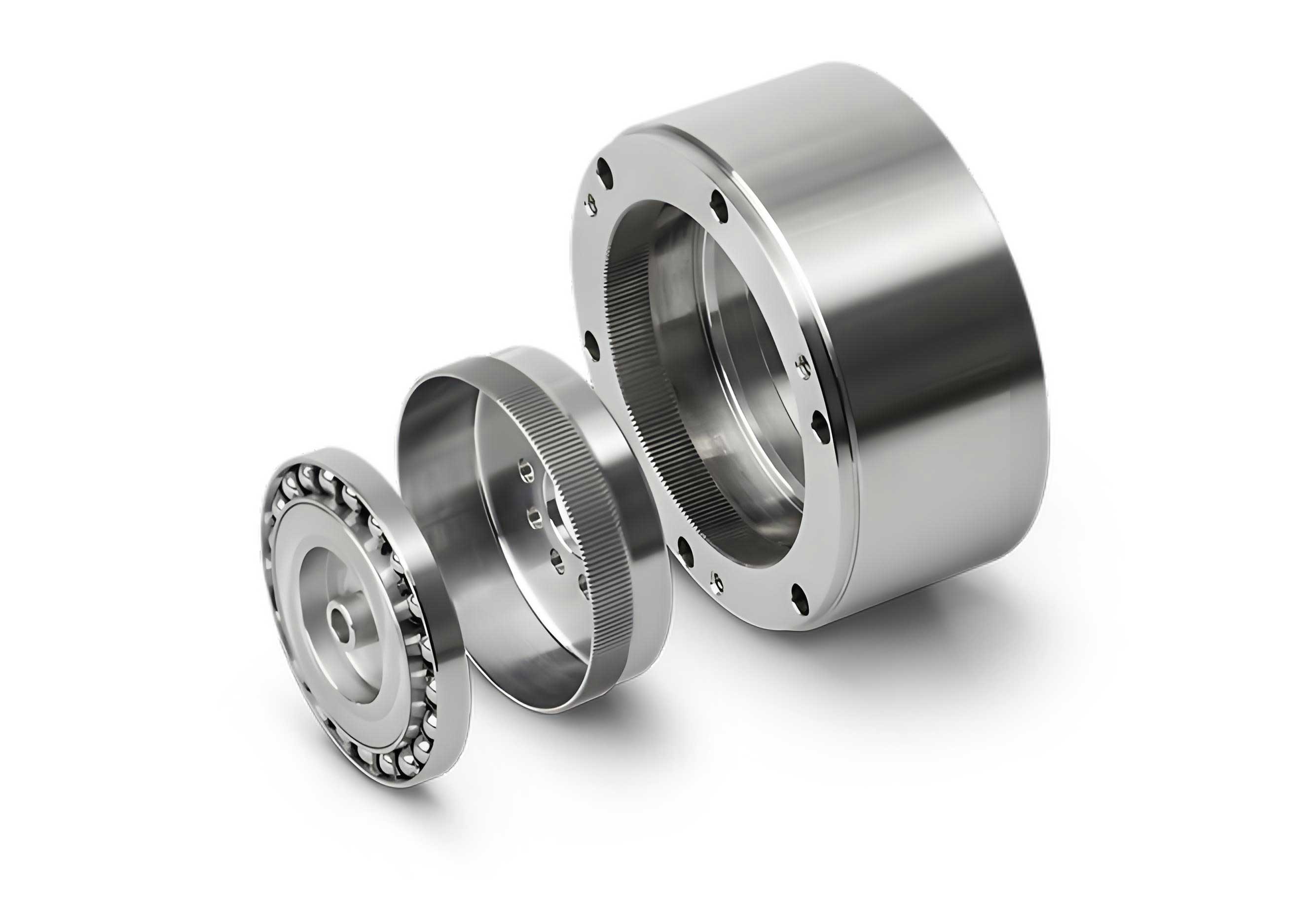
Analyzing such a system requires moving beyond linear vibration theory. The governing equations of motion are nonlinear differential equations. For the vast majority of these equations, closed-form analytical solutions do not exist. The dynamic response—including phenomena like subharmonic and superharmonic resonances, jump phenomena, and chaotic motion—must be investigated through numerical simulation. However, performing these simulations from scratch for every design iteration or parameter study is impractical and requires specialized expertise in numerical methods and programming. This gap between theoretical nonlinear models and practical engineering design necessitates dedicated software tools. This article presents the comprehensive design, development, and experimental validation of a specialized simulation software package created explicitly for modeling the nonlinear torsional vibration of harmonic drive gear systems. The software integrates fundamental principles of harmonic drive gear mechanics, advanced nonlinear dynamics theory, robust numerical algorithms, and modern computer technology into a cohesive, user-friendly platform.
Architecture of the Simulation Software System
The developed simulation software is conceived as a modular analysis system. Its primary objective is to provide researchers and designers with a streamlined workflow: from inputting the physical parameters and nonlinear characteristics of a specific harmonic drive gear, through the automated formulation and numerical solution of its nonlinear equations of motion, to the visualization and analysis of the dynamic response. The overall architecture is hierarchical and modular, ensuring maintainability, extensibility, and clear data flow.
The system is built around a main control module that orchestrates all activities. This master module manages the user interface, handles menu commands, and coordinates the execution and data exchange between four core functional sub-modules. The selection of the development platform was critical. Microsoft Visual C++ was chosen as the primary development environment due to its high execution efficiency, powerful object-oriented capabilities for structuring complex software, excellent support for graphical user interface (GUI) design, and low-level system control. For the demanding tasks of advanced numerical computation, signal processing (like Fast Fourier Transforms), and high-quality graphical plotting, the software leverages the extensive mathematical libraries of MATLAB. Communication between the VC++ core and MATLAB is achieved seamlessly using Component Object Model (COM) and Automation technology. The high-level system structure is illustrated in the functional diagram below and summarized in the table.
| Module Name | Primary Function | Key Technologies Used |
|---|---|---|
| Main Control Module | Manages GUI, menus, dialog boxes, and controls the execution flow and data routing between all sub-modules. | Visual C++ MFC (Microsoft Foundation Classes), Document/View architecture. |
| File Management Module | Handles creation, opening, saving, and closing of project files. Serializes all input parameters and computed results for later retrieval. | VC++ serialization, file I/O streams. |
| Parameter Input Module | Presents interactive dialog boxes for user input of all system parameters. Dynamically plots graphs of nonlinear functions (stiffness, error, etc.) based on input. | VC++ dialog resources, custom control drawing, GDI/GDI+. |
| Differential Equation Solver Module | Assembles the nonlinear equations of motion from user parameters. Solves them numerically using a high-precision adaptive algorithm. | Numerical integration algorithms (Runge-Kutta), VC++ mathematical libraries. |
| MATLAB Interface Module | Transfers time-domain solution data to MATLAB. Executes MATLAB commands for FFT and graph generation remotely from within the VC++ application. | MATLAB Engine API, COM Automation, ActiveX. |
The workflow is intuitive. A user starts a new project via the File menu. They then input all necessary parameters through dedicated dialogs in the Parameter Input menu. The software provides immediate visual feedback, plotting the described nonlinear stiffness curve or transmission error waveform. With parameters set, the user invokes the solver from the Data Processing menu. The solver module computes the time-domain response. Finally, through commands in the Plot menu (which trigger the MATLAB Interface Module), the user can generate and view professional-quality time-history plots, phase portraits, Poincaré sections, and frequency spectrum plots directly within the application’s interface.
Mathematical Modeling of Nonlinear Dynamics in Harmonic Drive Gear
The core of the simulation software is a refined, lumped-parameter nonlinear torsional vibration model for a single-stage harmonic drive gear reducer connected to inertial loads. The model considers three primary degrees of freedom: the rotation of the input/wave generator ($ heta_1$), the rotation of the Flexspline ($ heta_2$), and the rotation of the output load/Circular Spline ($ heta_3$). The dynamics are governed by a set of coupled, second-order nonlinear differential equations. The general form for a two-inertia model (simplifying the Flexspline and output inertia) can be expressed as:
$$ J_{eq} ddot{ heta} + C(dot{ heta}, heta) + T_{K}( heta, t) + T_{B}( heta, dot{ heta}) = T_{in}(t) $$
Where $J_{eq}$ is the equivalent inertia reflected to the output shaft, $ heta$ is the output angular displacement, $C$ represents the nonlinear damping torque, $T_K$ is the nonlinear restoring torque from stiffness and transmission error, $T_B$ is the torque discontinuity due to backlash, and $T_{in}$ is the input driving torque. We will now decompose these nonlinear terms based on the specific physics of the harmonic drive gear.
1. Modeling of Transmission Error (TE)
Transmission error is defined as the difference between the actual output position and the theoretically ideal output position, given a perfect input. It is the primary kinematic excitation in a harmonic drive gear. Our model synthesizes TE from multiple geometric and assembly error sources, each contributing specific frequency components. The total transmission error, $delta_e(t)$, is modeled as a superposition of harmonic components related to the wave generator rotation frequency ($f_H$) and the tooth meshing frequency ($2z_2 f_H$):
$$ delta_e(t) = sum_{i} A_i sin(2 pi f_i t + phi_i) $$
The key frequencies and their physical origins are crucial for understanding the dynamic response. The following table categorizes the major components implemented in the software model.
| Frequency Component ($f_i$) | Typical Origin in Harmonic Drive Gear | Amplitude Factor ($A_i$) |
|---|---|---|
| $f_H$ (Input shaft frequency) | Eccentricity of wave generator bearing, assembly misalignment of input shaft. | Related to radial runout tolerances. |
| $2f_H$ | Ellipticity of the wave generator or deformation pattern of the Flexspline. | Often a significant component. |
| $2(1 pm 1/i)f_H$ (where $i$ is gear ratio) |
Manufacturing errors in tooth spacing (pitch error) on the Flexspline and Circular Spline. This is a “sideband” frequency around $2f_H$. | Directly related to the tangential composite error ($Delta F_i’$) of the Flexspline and Circular Spline. This is often the dominant excitation. |
| $2z_2 f_H$ (Tooth Meshing Frequency) |
Individual tooth profile errors, deviations in the tooth flank geometry. | Generally smaller amplitude but very high frequency. |
The software’s parameter input dialog allows users to specify the amplitude ($A_i$) and phase ($phi_i$) for each of these pre-defined frequency components, or to define a custom periodic error function.
2. Modeling of Nonlinear Torsional Stiffness
The torsional stiffness ($K_T$) of a harmonic drive gear is not linear. It is relatively low at very low torques, increases sharply as more teeth come into full contact, and may saturate or even soften at very high loads due to material yielding or severe deformation of the Flexspline. This nonlinear relationship $K_T( heta)$ is critical for accurately predicting resonant frequencies, which are amplitude-dependent. The software models this using a piecewise or polynomial function derived from experimental static torque-deflection tests. A common representation is a cubic spring model:
$$ T_K( heta) = k_1 cdot Delta heta + k_3 cdot (Delta heta)^3 $$
Where $Delta heta = heta – delta_e(t)$ is the net elastic deflection across the gear, accounting for transmission error. The linear coefficient $k_1$ represents the small-angle stiffness, while the cubic coefficient $k_3$ captures the stiffening (if $k_3 > 0$) or softening (if $k_3 < 0$) behavior. The parameter input module includes a dedicated dialog where users can input the coefficients of a polynomial fit ($k_1, k_3, …$) or define a lookup table of torque vs. deflection data.
3. Modeling of Backlash and Discontinuous Nonlinearity
While minimal, backlash ($2varphi_j$) exists in real harmonic drive gear systems. It creates a dead zone where a change in input direction does not immediately produce output motion. This introduces a severe nonlinearity that can cause chatter, impacting, and periodic separation. The model implements a classic dead-zone function for the torque transmission through the backlash zone. Let $ heta_d = heta_{in}/i – heta_{out}$ be the relative displacement between input and output sides, where $i$ is the gear ratio. The transmitted torque $T_B$ due to elastic engagement is then:
$$
T_B( heta_d) =
egin{cases}
K_T( heta_d) cdot ( heta_d – varphi_j), & ext{if } heta_d > varphi_j \\
0, & ext{if } -varphi_j leq heta_d leq varphi_j \\
K_T( heta_d) cdot ( heta_d + varphi_j), & ext{if } heta_d < -varphi_j
\end{cases}
$$
This piecewise function is a significant source of numerical stiffness in the differential equations, requiring a robust solver.
4. The Complete Model and Numerical Solution
Combining all elements, the equations of motion for a simplified two-inertia system (ignoring Flexspline inertia as part of the elastic element) become:
$$
\begin{aligned}
J_{in} ddot{ heta}_{in} + c_{in} dot{ heta}_{in} + rac{1}{i} T_Bleft( rac{ heta_{in}}{i} – heta_{out} – delta_e(t) ight) &= T_{motor}(t) \\
J_{out} ddot{ heta}_{out} + c_{out} dot{ heta}_{out} – T_Bleft( rac{ heta_{in}}{i} – heta_{out} – delta_e(t) ight) &= -T_{load}(t)
\end{aligned}
$$
Here, $T_B(cdot)$ encapsulates both the nonlinear stiffness $K_T(cdot)$ and the backlash logic described above. The term $delta_e(t)$ is the prescribed transmission error. $c_{in}$ and $c_{out}$ are viscous damping coefficients. The software assembles these equations dynamically based on user parameters. To solve this coupled, nonlinear, and potentially discontinuous system, a high-order, adaptive step-size numerical integration routine is essential. The software employs a 4th/5th order Runge-Kutta-Fehlberg (RKF45) method. This algorithm controls local truncation error by adjusting the integration step size, ensuring stability and accuracy through the rapid variations caused by backlash impacts and high-frequency excitation from the harmonic drive gear transmission error.
Software Implementation, Interface, and Core Functionality
The software presents a standard Windows-style graphical user interface (GUI), designed for ease of use without sacrificing analytical depth. The main window features a menu bar, toolbar, status bar, and a multi-document area for displaying graphical results. The menu system is logically organized to guide the user through the simulation workflow.
| Main Menu | Key Functions and Sub-items |
|---|---|
| File | New Project, Open Project, Save Project, Save Results, Print Graphs, Exit. |
| View | Toolbar and Status Bar toggle. |
| Parameter Input |
|
| Data Processing |
|
| Plot |
|
| Window & Help | Standard window arrangement and help documentation. |
The Parameter Input dialogs are designed with validation checks to prevent non-physical inputs (e.g., negative inertia, excessive backlash). The Data Processing module provides real-time feedback in the status bar, indicating the progress of the numerical integration. The integration time for a typical 2-second simulation at a high tolerance is on the order of a few minutes on a standard PC, which is acceptable for design analysis. The seamless MATLAB Interface is a cornerstone of the software’s power. Once data is transferred, all of MATLAB’s visualization and advanced signal processing toolboxes become available, allowing users to create publication-quality graphs and conduct detailed spectral analysis without leaving the application environment.
Simulation and Experimental Validation Case Study
To validate the software’s predictive capability, a detailed case study was performed on a commercial harmonic drive gear reducer, model XB-80-134H. The objective was to compare the simulated torsional vibration spectrum with experimentally measured data and identify the dominant error sources.
System Parameters:
The key parameters for the simulation were obtained from design drawings, direct measurement, and standard formulas:
- Gear Ratio, $i = 134$
- Flexspline Teeth, $z_1 = 268$
- Circular Spline Teeth, $z_2 = 270$
- Input Inertia, $J_{in} = 2.2 imes 10^{-4} ext{ kg·m}^2$
- Output Inertia, $J_{out} = 0.2839 ext{ kg·m}^2$
- Input Speed, $f_H = 2680/60 = 44.667 ext{ Hz}$
- Transmission Error Amplitudes: Derived from tolerances for $Delta F_i’$, radial runout ($Delta S_{fa1}, Delta S_{obh1}$), etc.
- Nonlinear Stiffness Coefficients: $k_1$, $k_3$ from experimental torque-windup tests.
- Total Backlash: $2varphi_j = 8’$ (arc-minutes).
- Damping Ratio: $zeta = 0.06$.
Critical Frequency Analysis:
The model’s transmission error excitation contains components at specific frequencies. Their contribution to the output response was analyzed both in simulation and experiment.
- Component at $f_H = 44.667 ext{ Hz}$: This low-frequency component, caused by input shaft eccentricity, is greatly attenuated by the high gear ratio ($i=134$) when reflected to the output. Both simulated and experimental spectra showed no significant peak in this region, confirming its minor role in output vibration.
- Component at $2f_H = 89.33 ext{ Hz}$: This component, related to wave generator ellipticity, has a larger inherent amplitude. Distinct peaks were observed near 89 Hz in both the simulated and measured frequency spectra.
- Components at $2(1 ± 1/i)f_H ≈ 90 ext{ Hz}$: These sideband frequencies, originating from the tangential composite errors ($Delta F_i’$) of the Flexspline and Circular Spline, are the most significant. The simulation predicted a very large amplitude peak at approximately 90 Hz. The experimental spectrum confirmed this, showing the largest peak magnitude in the low-frequency range (0-1000 Hz), precisely at 90 Hz. This identifies tooth spacing/pitch error as the paramount factor governing the dynamic torsional response of this harmonic drive gear.
- Component at $2z_2 f_H = 24120 ext{ Hz}$: This very high-frequency component, related to individual tooth profile errors, appeared as a small, isolated peak in both the simulated and experimental high-frequency spectra. While measurable, its energy is low and thus its contribution to overall vibration severity is minimal.
The remarkable agreement between the simulated and experimental spectral peaks, both in frequency location and relative amplitude, validates the fidelity of the nonlinear mathematical model and the robustness of the numerical solver within the software.
| Frequency (Hz) | Source in Harmonic Drive Gear | Relative Amplitude (Simulation & Experiment) | Design/Manufacturing Control Recommendation |
|---|---|---|---|
| ~44.7 | Input shaft/wave generator assembly runout. | Very Low | Standard bearing and shaft tolerances sufficient. |
| ~89.3 | Wave generator ellipticity/ Flexspline deformation pattern. | Medium | Control cam profile accuracy and bearing preload. |
| ~90.0 | Tangential composite error (pitch error) of Flexspline ($Delta F_{i1}’$) and Circular Spline ($Delta F_{i2}’$). | Very High (Dominant) | Primary control focus: Tighten gear hobbing/machining tolerances for pitch accuracy. Improve spline quality. |
| ~24120 | Individual tooth profile deviations. | Low | Standard tooth grinding/profile tolerances are adequate. |
Conclusion
The development of this specialized nonlinear torsional vibration simulation software represents a significant tool for advancing the design and analysis of harmonic drive gear systems. By integrating a comprehensive nonlinear dynamics model—incorporating detailed transmission error spectra, amplitude-dependent torsional stiffness, and clearance nonlinearities—into an accessible Windows-based application, the software bridges the gap between complex theoretical analysis and practical engineering workflow. The use of Visual C++ for core application logic and GUI, coupled with the computational and graphical power of MATLAB via an automated interface, provides an optimal balance of performance, control, and analytical depth.
The experimental validation case on the XB-80-134H reducer conclusively demonstrated the software’s effectiveness. The accurate prediction of key spectral peaks and the correct identification of the dominant excitation source (the 90 Hz component from pitch errors) provide engineers with actionable insights. This allows for a targeted approach to improving dynamic performance: rather than applying uniformly tight tolerances, resources can be focused on controlling the specific manufacturing and assembly parameters that most influence the dominant error frequencies. This leads to more cost-effective and higher-performance harmonic drive gear designs.
In summary, this simulation software serves as a virtual test bench for harmonic drive gear dynamics. It enables rapid prototyping and “what-if” analysis during the design phase, reducing reliance on physical prototypes and costly experimental iterations. By providing clear visualizations of time-domain responses, phase-space behavior, and frequency spectra, it empowers engineers to understand, predict, and ultimately optimize the dynamic performance of these critical precision transmission components.