
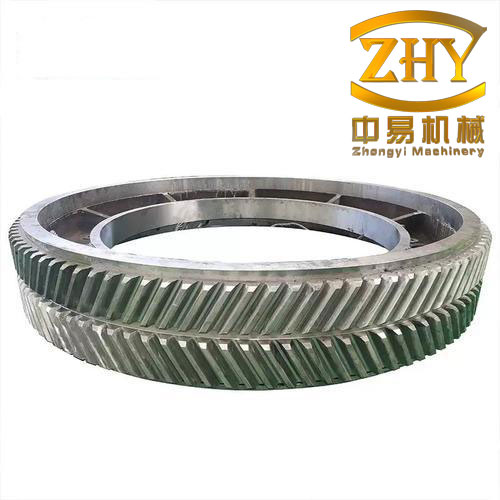
In the design and manufacturing of herringbone gears, the relief groove—commonly referred to as the “empty sipe” or “space for cutter exit”—plays a critical role in ensuring that the hobbing tool can complete the tooth cutting process without interference. Determining the optimal width of this groove requires a precise mathematical model that accounts for gear parameters, hob parameters, and machine tool constraints. In this work, I present a systematic approach based on geometric modeling and analytical solving to compute the minimum relief groove width for herringbone gears under both maximum and actual interference conditions. The methodology is validated through numerical examples and can be directly applied in production planning.
The geometric model is established by considering the pitch line of the hob and the pitch cylinder of the herringbone gear. At the moment when the tangent point between the hob’s pitch line and the gear’s pitch cylinder reaches the end face of the relief groove, the hob has not yet completed cutting the teeth on that side. An additional axial move e (overrun) is required to finish the cut. To avoid interference during tool withdrawal, the end face of the relief groove must lie outside the maximum theoretical interference region formed by the hob cylinder and the gear cylinder. The boundary of this region is the curve of intersection of two cylinders with non‑parallel axes. By solving the spatial curve equation, we can determine the minimum required groove width.
Let us define two coordinate systems: o-xyz fixed on the gear axis with origin at the center of the relief groove end face, and o’-x’y’z’ attached to the hob axis with origin at the tangent point p. The axes are oriented as described in the established model. The transformation between the two systems involves a rotation by the hob setting angle λ and a translation along the center distance a.
Geometric Modeling and Parameter Definitions
The following table summarizes the key parameters used throughout the derivation.
| Symbol | Description | Unit |
|---|---|---|
| rr | Gear tip circle radius | mm |
| rg | Hob tip circle radius | mm |
| r | Gear pitch circle radius | mm |
| h | Tooth height (full depth) | mm |
| β | Gear helix angle at pitch circle | deg |
| γ | Hob helix angle (lead angle) | deg |
| λ | Hob setting angle (λ = β ± γ) | deg |
| αn | Normal pressure angle of hob | deg |
| a | Hobbing center distance (a = rr + rg – h) | mm |
| e | Minimum overrun for complete cutting | mm |
| Bmin | Minimum relief groove width | mm |
Calculation of Minimum Overrun e
The overrun e ensures that the hob disengages completely from the gear after the last tooth is cut. In the normal plane of the hob, the gear appears as an ellipse, and the hob acts as a rack. The minimum length of hob engagement in the normal plane, denoted ln, is determined by the intersection of the hob tip line with the gear tooth profile lines.
The gear ellipse equation in the normal plane is:
$$
\frac{x^2}{r_r^2} + \frac{y^2}{\left(r_r / \cos\beta\right)^2} = 1
$$
The line of action is given by:
$$
y = r – x \tan\alpha_n
$$
and the hob tip line is:
$$
y = r_r – h
$$
Solving the intersection points yields the maximum half‑length of the active cutting zone on the hob:
$$
l_n = \max\left( |x_{m’}|, |x_{n’}| \right)
$$
where
$$
x_{m’} = \frac{-\tan\alpha_n \cdot r + \sqrt{(\tan\alpha_n \cdot r)^2 – 4\left( \frac{\cos^2\beta}{r_r^2} + \frac{\tan^2\alpha_n}{r_r^2/\cos^2\beta} \right)\left(r^2 – r_r^2\right)}}{2\left( \frac{\cos^2\beta}{r_r^2} + \frac{\tan^2\alpha_n}{r_r^2/\cos^2\beta} \right)}
$$
$$
x_{n’} = (r + h – r_r)\tan\alpha_n
$$
The minimum overrun is then projected onto the hob axis direction:
$$
e_{\min} = l_n \sin\lambda
$$
For a left‑hand hob cutting a left‑hand herringbone gear, the setting angle is λ = β – γ (same hand) or λ = β + γ (opposite hand).
Minimum Relief Groove Width Under Maximum Interference
The maximum interference occurs when the hob is long enough so that the entire intersection curve between the hob cylinder and the gear cylinder is developed. In the o-xyz system, the hob tip cylinder equation becomes:
$$
(x – a)^2 + (y\sin\gamma – z\cos\gamma)^2 = r_g^2
$$
and the gear tip cylinder equation is:
$$
x^2 + y^2 = r_r^2
$$
The intersection curve projected onto the yoz plane yields the function z = f(y):
$$
z = \frac{-\sqrt{r_g^2 – (x – a)^2} + y\sin\gamma}{\cos\gamma}
$$
Substituting x = √(r_r² – y²) (positive root for the quadrant of interest) gives:
$$
z = \frac{-\sqrt{r_g^2 – \left(\sqrt{r_r^2 – y^2} – a\right)^2} + y\sin\gamma}{\cos\gamma}
$$
The minimum point of this curve (i.e., the deepest point into the groove side) corresponds to the derivative f'(y)=0. Setting the derivative to zero leads to a quartic equation in an auxiliary variable t:
$$
t = \sqrt{r_r^2 – y^2}
$$
The equation becomes:
$$
t^4 + 2t^3 \cos^2\gamma + t^2\left( \cos^2\gamma – 2a\cos^2\gamma \right) – 2a r_g t \sin^2\gamma + a^2 r_g^2 = 0
$$
Solving for t (using MATLAB or similar numerical tool) and back‑substituting yields the coordinates (yc, zc) of the tangent point c. The minimum relief groove width is then:
$$
B_{\min} = z_c + e_{\min}
$$
where zc is negative (below the gear axis) and emin is the overrun computed earlier.
| Parameter | Value |
|---|---|
| rr | 125 mm |
| rg | 75 mm |
| r | 100 mm |
| h | 20 mm |
| β | 30° |
| γ | 5° |
| λ | 25° (β – γ) |
| αn | 20° |
| a | 180 mm |
| ln | 44.3 mm |
| emin | 18.7 mm |
| yc | –82.5 mm |
| zc | –12.4 mm |
| Bmin (max interference) | 31.1 mm |
Minimum Relief Groove Width Under Actual (Finite) Hob Length
If the hob is not long enough to generate the entire intersection curve, the actual interference region is bounded by the end face of the hob. In that case, the deepest point of the projected curve is not the minimum of f(y) but rather the intersection of the hob end‑face line with the curve z = f(y). The hob end‑face line in the yoz plane is:
$$
z = (y \cos\gamma + L) \cot\gamma \quad \text{(simplified form)}
$$
where L is the axial distance from the node to the hob end face. Solving the system:
$$
\begin{cases}
z = (y \cos\gamma + L) \cot\gamma \\
z = \frac{-\sqrt{r_g^2 – \left(\sqrt{r_r^2 – y^2} – a\right)^2} + y\sin\gamma}{\cos\gamma}
\end{cases}
$$
yields a nonlinear equation in y. The solution gives zc’, and the minimum groove width is:
$$
B_{\min} = z_{c’} + e_{\min}
$$
This case often yields a smaller Bmin than the maximum interference case.
Interference Condition Discernment
To decide which case applies, we compare the actual hob end‑face position with the critical tangent point from the maximum interference case. The critical line passing through point c is given by:
$$
z_c = (y_c \cos\gamma + L_{crit}) \cot\gamma
$$
If the actual L (distance from hob end face to node) satisfies:
$$
z_c > (y_c \cos\gamma + L) \cot\gamma
$$
then the actual hob end face lies above the tangent line, meaning the maximum interference condition is valid. Otherwise, the finite‑length condition applies.
The decision process is summarized in the following table.
| Condition | Interference Type | Formula for Bmin |
|---|---|---|
| zc > (yc cosγ + L) cotγ | Maximum interference | Bmin = zc + emin |
| zc ≤ (yc cosγ + L) cotγ | Finite hob length | Bmin = zc’ + emin |
Application Example
Consider a herringbone gear with the following specifications: module mn = 8 mm, number of teeth z = 25, helix angle β = 28°, normal pressure angle αn = 20°, tooth height coefficient ha* = 1.0, clearance coefficient c* = 0.25. Using a hob with tip radius rg = 70 mm and lead angle γ = 4°, the calculations proceed as follows.
First, the gear tip radius is rr = (mn z)/(2 cosβ) + mn = … (102.4 mm). The center distance a = rr + rg – h, where h = 2.25 mn = 18 mm, so a = 102.4 + 70 – 18 = 154.4 mm.
The overrun emin is computed via the normal‑plane elipse method. The resulting values are tabulated below.
| Parameter | Symbol | Value |
|---|---|---|
| Gear pitch radius | r | 113.1 mm |
| Gear tip radius | rr | 121.1 mm |
| Tooth height | h | 18 mm |
| Hob tip radius | rg | 70 mm |
| Setting angle λ = β – γ | λ | 24° |
| Normal pressure angle | αn | 20° |
| Overrun half‑length ln | ln | 38.5 mm |
| Minimum overrun emin | emin | 15.6 mm |
Next, solving the quartic equation for maximum interference gives yc = –95.3 mm, zc = –10.8 mm. Therefore Bmin = 10.8 + 15.6 = 26.4 mm under maximum interference. The actual hob length is 100 mm, giving L = 50 mm from the node. The critical line test yields: (yc cosγ + L) cotγ = (–95.3×0.9976 + 50) × 2.050 ≈ –97.1 mm, and zc = –10.8 mm. Since –10.8 > –97.1, the maximum interference condition holds, and the computed width of 26.4 mm is valid.
Conclusion
I have developed a precise mathematical approach for determining the minimum relief groove width for herringbone gears in hobbing operations. The method accounts for both the maximum theoretical interference (infinite hob length) and the actual finite hob length. By solving the spatial intersection curve of the hob and gear cylinders and incorporating the necessary overrun for complete cutting, the designer can obtain an optimal groove width that avoids interference while minimizing material removal. The derived equations are readily implemented in numerical computing environments such as MATLAB or Python, providing a reliable tool for process engineers. The tables and formulas presented here serve as a complete reference for practical herringbone gear groove design.