
In the realm of modern mechanical transmission systems, the helical gear stands out due to its superior performance characteristics. Compared to spur gears, the helical gear offers smoother operation, higher load capacity, and reduced noise and vibration because multiple teeth are in contact at any given time during meshing. This is attributed to its teeth being cut at an angle, the helix angle, to the gear axis. When these advantages are combined with the manufacturability, corrosion resistance, and self-lubricating properties of engineering plastics, plastic helical gears become ideal components for precision applications in office equipment, instruments, and household appliances.
However, the very feature that grants the helical gear its benefits—the helix angle—poses a significant challenge in injection molding. The inclined tooth flank prevents a simple linear ejection from the mold. A direct pull would damage the teeth. Therefore, a controlled rotational unscrewing motion must be integrated into the mold’s ejection system to successfully release the helical gear portion of the part. This case study delves into the comprehensive design of an injection mold for a complex helical gear shaft component, focusing on the innovative use of a two-stage ejection system to facilitate this rotational demolding.
Part Analysis and Material Selection
The component in question is an integrated shaft featuring a helical gear on one end. The primary functional element is the helical gear itself, which is an imperial (DP) gear with 24 teeth, a diametral pitch of 32, and a right-hand helix angle of 12°. The shaft section includes an external thread and a series of circumferential torque-transmission slots. Key dimensions include a major outside diameter and a nominal wall thickness of approximately 1.50 mm.
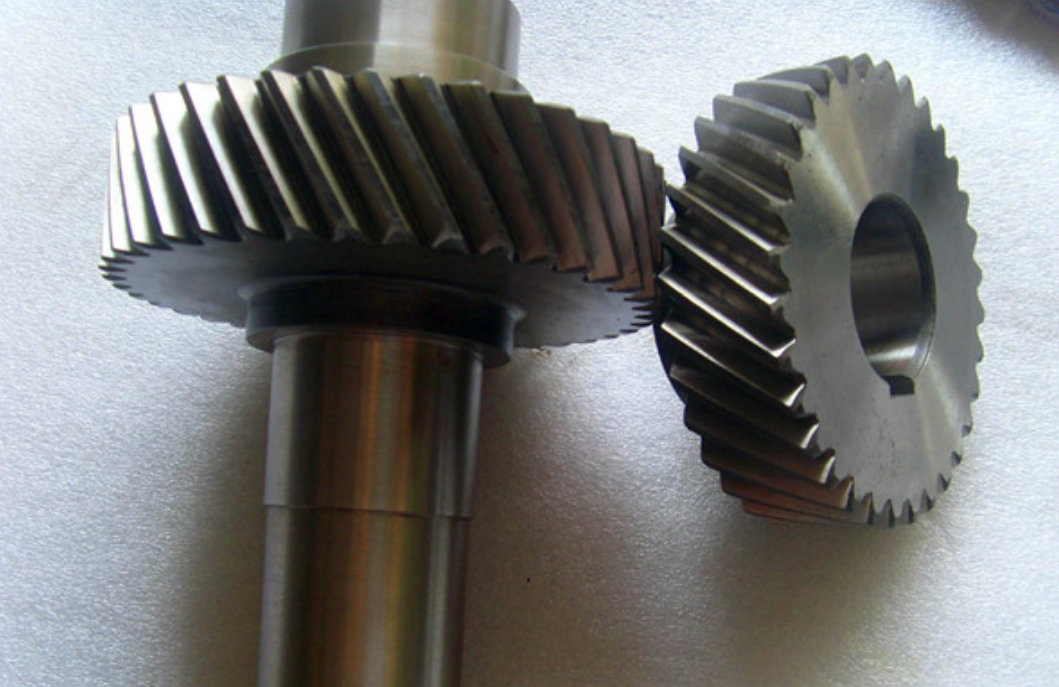
The material specified is Polyoxymethylene (POM). This choice is critical for the performance of a helical gear. POM exhibits exceptional mechanical properties, often considered the closest thermoplastic to metal. Its high tensile and fatigue strength, excellent dimensional stability, low friction coefficient, and good wear resistance make it perfectly suited for dynamic, load-bearing components like gears. The low moisture absorption of POM ensures consistent dimensional accuracy, which is paramount for precise gear meshing. A shrinkage rate of 2.0% must be accurately accounted for in all mold cavity dimensions.
| Parameter | Specification / Value |
|---|---|
| Type | Helical Gear with Integrated Shaft |
| Material | Polyoxymethylene (POM) |
| Shrinkage Rate | 2.0% |
| Number of Teeth (z) | 24 |
| Diametral Pitch (DP) | 32 in-1 |
| Helix Angle (β) | 12° (Right Hand) |
| Key Feature | External Thread, Internal Torque Slots |
Core Challenge: Demolding the Helical Gear
The central dilemma in molding a helical gear is demolding. The geometry dictates that for the gear to be released from a stationary core, it must rotate along the path defined by its own helix. The required rotational travel distance, S_rot, to fully disengage the gear from the core is a function of the face width of the gear (B) and the helix angle (β). It can be conceptually derived from the lead of the helix.
For a helical gear, the lead (L) is the axial distance for one complete revolution of the helix. It is related to the helix angle and the base geometry:
$$ L = \pi \cdot d \cdot \cot(\beta) $$
where d is the reference diameter. The required axial travel S_ax to achieve a full rotation is the lead L. However, for demolding, we only need to rotate the gear enough to disengage the teeth from the cavities in the mold—typically a fraction of a tooth’s angular pitch. The required axial ejection stroke S_eject_gear to achieve a rotation of one tooth pitch (360°/z) is approximately:
$$ S_{eject\_gear} \approx \frac{L}{z} = \frac{\pi \cdot d \cdot \cot(\beta)}{z} $$
This calculation highlights the need for a synchronized axial push and rotation during ejection.
Mold Design Strategy and Layout
Given high production volumes, a multi-cavity approach is essential. A 1×12 cavity layout was selected. The presence of an external thread requiring a side-action (split core/half) mechanism constrains the cavity layout to a linear arrangement to simplify the slider mechanism. Consequently, the 12 cavities are arranged in two straight rows of six. The feeding system is designed as a double “Y” type runner to approximate a balanced fill across all cavities, which is crucial for consistent part quality in a high-cavitation mold for a precision component like a helical gear.
The parting line is strategically placed at the top face of the gear flange. A more critical decision is the allocation of components between the moving and fixed halves. Placing the threaded shaft in the fixed half and the helical gear core in the moving half simplifies the overall mechanism. This arrangement localizes the complex ejection (rotation) on the moving side and uses a simpler spring-activated side action on the fixed side for the thread.
| Design Aspect | Decision | Rationale |
|---|---|---|
| Cavity Number | 12 | High production volume requirement. |
| Layout | 2 linear rows of 6 | Accommodates linear slider movement for external thread. |
| Parting Line | At gear flange top face | Simple, clean separation. |
| Thread Location | Fixed (A) Half | Simplifies slider design; parts drop free after ejection. |
| Helical Gear Location | Moving (B) Half | Centralizes complex rotational ejection system. |
| Gating | Submarine gate at shaft shoulder | Automatic degating during ejection, good fill pattern. |
Detailed Mold System Design
1. Feed System and Gating
Plastic enters through the main sprue, flows along the double-Y distributor on the parting surface, and is directed between adjacent cavities into the slider areas. Each cavity is fed by a submarine (tunnel) gate located at the shoulder of the shaft. This gate design is sheared off automatically as the part is ejected, eliminating the need for a secondary trimming operation and leaving a minimal gate vestige.
2. Side-Action for External Thread
The external thread is formed by two split cores (halves). These are housed in angled sliding blocks on the fixed half. The actuation force is provided by compression springs. Upon mold opening, the springs push the sliding blocks outward, retracting the split cores and freeing the threaded section. This “fixed-half side action” design is advantageous because the molded part remains on the moving half core. After ejection, both parts and runners fall freely, avoiding potential sticking in the thread sliders. For durability and maintenance, wear plates are installed on sliding surfaces, and the slider inserts are designed with interlocking features for precise alignment.
3. The Two-Stage Ejection System for the Helical Gear
This is the heart of the mold. A standard ejection system would fail to release the helical gear without damage. The solution is a two-stage ejection system with two distinct ejection plates.
- Stage 1: Combined Linear Movement. The mold opens, and the injection machine’s ejector rod advances the primary (lower) ejection plate assembly. This plate carries the sprue puller pin, runner ejectors, and ejector sleeves for the shaft. A set of compression springs (return springs) connects this primary plate to the secondary (upper) ejection plate. The secondary plate carries the specialized helical gear cavity inserts. Initially, the spring force causes both plates to move forward together. The helical gear insert pushes against the molded helical gear, but the gear cannot rotate yet because it is still seated on the stationary core pin in the mold base. This first stage provides a purely axial stroke, denoted as \( S_1 \).
- Stage 2: Rotational Unscrewing. After a predetermined travel \( S_1 \) (e.g., 6.35mm), the helical gear part has completely cleared the stationary core pin. At this point, the forward travel of the secondary plate is physically halted by a positive stop (e.g., shoulder bolts). The primary plate continues its forward stroke, now compressing the springs that connect the two plates. The continued axial force from the primary plate, transmitted through the now-compressing springs, pushes the part forward. However, with the secondary plate (holding the helical gear insert) stopped, the only way for the part to move forward is to rotate within the helical gear insert. The inclined flanks of the helical gear act as a screw thread against the stationary insert, converting linear force into rotational motion. This continues until the part is completely free of the insert. The stroke for this stage is \( S_2 \), which is precisely calculated to provide the required rotational travel for full disengagement.
The total ejection stroke is \( S_{total} = S_1 + S_2 \). The force required during the second stage must overcome the frictional torque of the helical gear unscrewing. This torque \( T \) is related to the axial ejection force \( F_{eject} \), the mean radius of the gear \( r_m \), and the effective friction angle \( \phi \):
$$ T = F_{eject} \cdot r_m \cdot \tan(\beta \pm \phi) $$
The sign depends on the direction of rotation relative to the helix hand. This force consideration is vital for selecting appropriate springs and verifying ejector plate strength.
Return of the ejection system utilizes a standard DME early-return mechanism (ER-101). During mold closing, this mechanism ensures the primary plate retracts first, pulling the secondary plate back via the connecting limit bolts, safely resetting the entire complex system before the mold halves meet.
| Stage | Driving Plate | Action | Key Component State | Purpose |
|---|---|---|---|---|
| Stage 1 | Primary (Lower) Plate | Moves forward, carrying Secondary Plate via springs. | Helical gear insert moves axially. Part is still on stationary core. | Lift part off stationary core pin. |
| Transition | – | Secondary Plate hits positive stop. | Helical gear insert movement halts. | Initiate rotational unscrewing. |
| Stage 2 | Primary (Lower) Plate | Continues forward, compressing springs. | Axial force on part causes it to rotate within the now-stationary insert. | Unscrew and fully eject the helical gear. |
4. Cooling System Design
Effective cooling is non-negotiable for achieving a short cycle time and controlling warpage in a crystalline material like POM. Cooling channels are incorporated into the fixed mold half, moving mold half, and the slider bodies. A particularly critical area is the core pin forming the inner diameter of the shaft. To address this, a baffle or “bubbler” cooling pin is inserted into the deep core. This allows cooling water to flow to the tip of the core, extracting heat efficiently from the center of the part. The cooling time \( t_c \) can be estimated using the standard formula for thermoplastic injection molding:
$$ t_c = \frac{s^2}{\pi \cdot \alpha} \ln\left[\frac{4}{\pi} \left(\frac{T_m – T_w}{T_e – T_w}\right)\right] $$
where \( s \) is the wall thickness, \( \alpha \) is the thermal diffusivity of POM, \( T_m \) is the melt temperature, \( T_w \) is the coolant temperature, and \( T_e \) is the desired ejection temperature.
| Component | Cooling Method | Objective |
|---|---|---|
| Fixed & Moving Halves | Conventional drilled cooling channels | Extract heat from cavity walls and base. |
| Sliders | Drilled cooling channels | Cool the thread-forming inserts. |
| Deep Core Pin (Shaft) | Bubbler / Cooling Pin insert | Active cooling at the core’s center to reduce cycle time. |
5. Venting
Proper venting is essential to prevent air traps, burns, and short shots, especially in a high-cavity mold. Venting slots, typically 0.02-0.03 mm deep, are machined at the end of fill areas along the parting line and at the extremities of the runner system. This ensures air can escape freely as the melt front advances.
Conclusion
The successful injection molding of components with integral helical gears demands innovative mold design that addresses the fundamental demolding challenge. The two-stage ejection system presented here provides an elegant and mechanically robust solution. By first lifting the part off its stationary core and then forcing a rotational unscrewing motion against a halted helical gear cavity insert, the mold reliably releases the part without damage.
This design philosophy, which cleverly uses the part’s own geometry to guide the demolding process, simplifies what would otherwise require a more complex active rotational mechanism (like a motorized unscrewing device). The integration of a fixed-half side action for secondary features like threads further streamlines the ejection process. When combined with a balanced multi-cavity layout, a robust cooling system, and careful material selection (POM for the helical gear), this mold design meets the stringent requirements for high-volume production of precision plastic components. The principles demonstrated—particularly the mechanical synchronization of linear and rotational motion during ejection—are widely applicable to the molding of any plastic part featuring a helical undercut, such as threads, knurls, or, most critically, functional helical gears.