
In modern manufacturing, the assembly of gear shafts is a critical process due to their widespread use in power transmission systems across various industries. Gear shafts are essential components that integrate gears and shafts into a single unit, often requiring high precision and reliability. Traditional manual assembly methods for gear shafts are labor-intensive, prone to human error, and inefficient, leading to inconsistent product quality and increased production costs. To address these challenges, I have developed an automated assembly system specifically designed for gear shafts. This system leverages advanced mechanization and control technologies to streamline the assembly process, enhance accuracy, and boost productivity. In this article, I will delve into the comprehensive design of this automated assembly system, focusing on its overall layout, key components, and critical workstations, all while emphasizing the importance of gear shafts in the context of industrial automation.
The gear shaft assembly typically consists of four main parts: an output shaft, a gear, and two friction plates (upper and lower). The friction plates feature a square-shaped slot that must be precisely aligned during assembly, making automation challenging. In traditional manual workflows, workers sequentially assemble these components, apply lubricant, perform riveting, and conduct running-in tests, which is time-consuming and subject to variability. My automated system aims to replace these manual steps with a seamless, high-speed process that ensures consistent quality. The core of the system is a rotary index table with 12 stations, each equipped with custom fixtures to hold the gear shafts securely during assembly. This configuration allows for simultaneous operations across multiple stations, significantly reducing cycle times and minimizing human intervention. By integrating various automated mechanisms, such as vibratory feeders, robotic handlers, and precision positioning devices, the system achieves a fully automated assembly line for gear shafts, capable of handling small-sized components with tight tolerances.
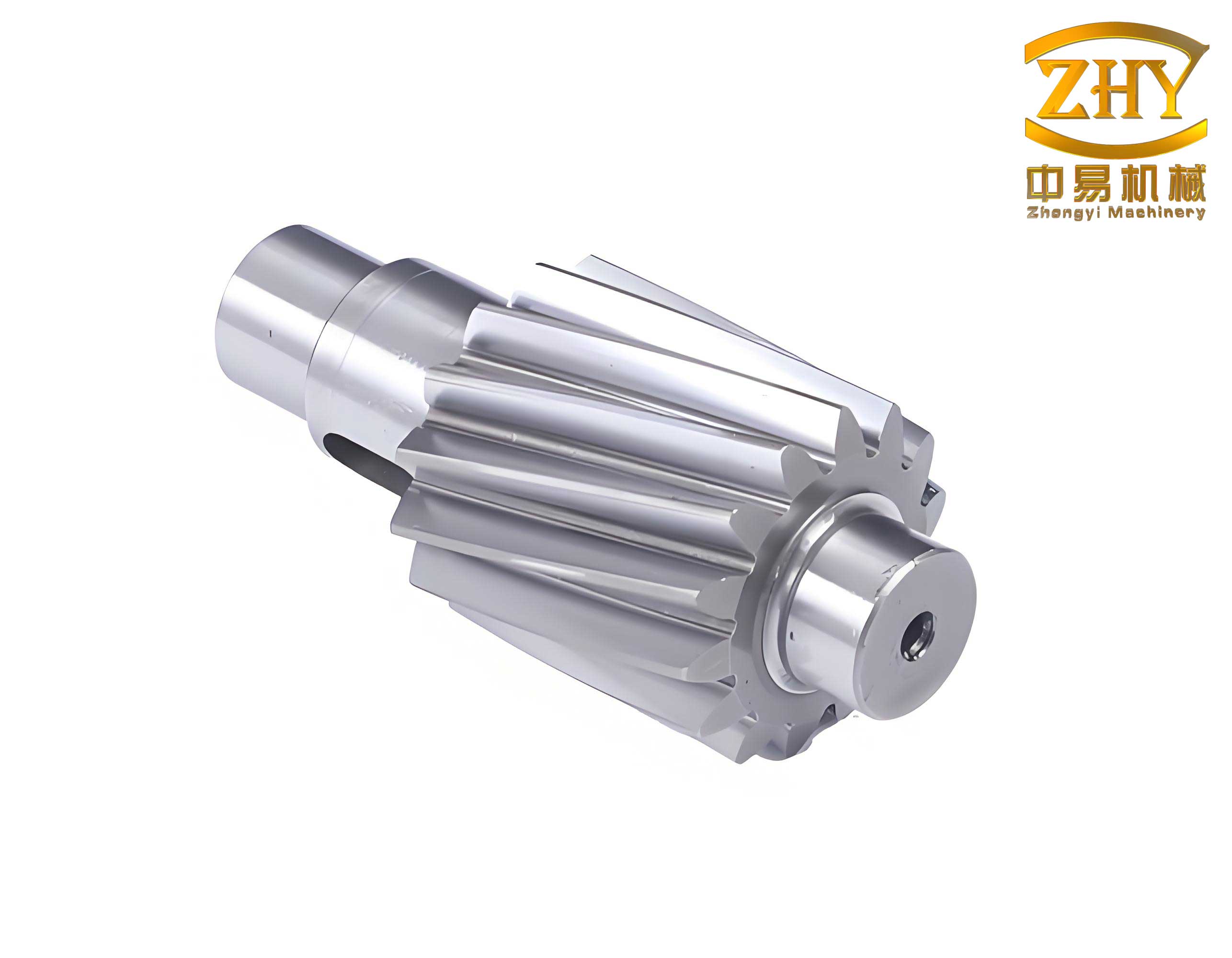
The overall layout of the automated assembly system for gear shafts is based on a circular indexing mechanism combined with linear transfer units. The system comprises 12 workstations evenly distributed around a rotary table with a diameter of 400 mm, mounted on a sturdy frame constructed from 50 mm × 50 mm square tubes. Each workstation is dedicated to a specific assembly task, such as part feeding, lubrication, inspection, or riveting. The indexing motion is driven by a cam divider, which ensures high-precision angular positioning and smooth rotation, critical for maintaining alignment during the assembly of gear shafts. The sequence of operations begins with the loading of the output shaft, followed by the assembly of the lower friction plate, gear, and upper friction plate, along with intermediate steps like grease application and quality checks. A key feature is the use of palletized fixtures that travel with the gear shafts, providing consistent localization and reducing reorientation errors. This design not only enhances accuracy but also facilitates quick changeovers for different gear shaft variants. Below is a table summarizing the main technical parameters of the system:
| Parameter Name | Parameter Value |
|---|---|
| Cycle Time per Gear Shaft | 20 seconds |
| Rotary Table Diameter | 400 mm |
| Table Height | 900 mm |
| System Dimensions (L × W × H) | 1700 mm × 1600 mm × 1800 mm |
| Operation Mode | Continuous Automatic |
| Control System | PLC with HMI Interface |
| Additional Requirements | Easy Maintenance, Quick Disassembly |
To achieve the desired precision in assembling gear shafts, the design of key components is paramount. One of the most critical elements is the traveling fixture, which holds the gear shaft in place throughout the assembly process. These fixtures are made from Cr12 steel, known for its durability and dimensional stability, and are surface-treated to prevent wear. The design incorporates a spring-loaded clamping mechanism that securely grips the output shaft without causing surface damage, ensuring accurate positioning within a tolerance of ±0.02 mm. This is essential for the subsequent assembly steps, especially when dealing with the small dimensions of gear shafts. The fixture base is mounted on the rotary table using locating pins and screws, allowing for easy replacement and alignment. The mathematical model for the clamping force can be expressed as:
$$F_c = k \cdot \Delta x$$
where \(F_c\) is the clamping force, \(k\) is the spring constant, and \(\Delta x\) is the deflection. This ensures that the gear shaft remains stable during high-speed indexing and assembly operations.
Another vital component is the cam divider, which drives the rotary indexing motion. For gear shaft assembly, the divider must provide precise angular increments to position each workstation accurately. I selected a Ferguson-type cam divider model 4DF12-120-SGN-1R ±15, paired with a 5IK90RGU-CF-5GU3-180 stepper motor. The divider offers high positioning accuracy and smooth motion, minimizing vibrations that could affect the assembly of delicate gear shafts. The indexing angle for 12 stations is calculated as:
$$\theta = \frac{360^\circ}{n}$$
where \(\theta\) is the indexing angle and \(n = 12\) is the number of stations. Thus, \(\theta = 30^\circ\) per station. The cam divider’s torque capacity and speed are matched to the system’s inertial loads, which include the mass of the fixtures and gear shafts. The total inertia \(J\) can be estimated using:
$$J = \sum m_i r_i^2$$
where \(m_i\) is the mass of each component and \(r_i\) is the distance from the axis of rotation. This ensures reliable operation under continuous production conditions for gear shafts.
Moving to the critical workstations, the friction plate feeding station poses significant challenges due to the plate’s small size (0.4 mm thickness) and the need for rotational alignment. My design employs a vibratory bowl feeder that orients the friction plates horizontally and delivers them to a linear track. A separating mechanism isolates individual plates, which are then picked by a robotic gripper and transferred to a rotary positioning unit. This unit uses a servo motor to rotate the friction plate until the square slot aligns with the output shaft’s keyway, a process enhanced by machine vision or tactile sensors. The gripper fingers are precision-machined from Cr12 steel to grip the plate’s outer diameter without deformation, critical for maintaining the integrity of gear shafts. The alignment accuracy is governed by:
$$\alpha = \tan^{-1}\left(\frac{\delta}{d}\right)$$
where \(\alpha\) is the angular error, \(\delta\) is the positional deviation, and \(d\) is the plate diameter. This ensures that the friction plate seats correctly on the gear shaft.
The gear feeding station addresses the issue of distinguishing between the top and bottom sides of the gear, which have subtle height differences. A vibratory feeder delivers gears to a staging area, where a pneumatic cylinder with a probing sensor measures the gear’s height to determine its orientation. If the gear is upside down, a flipping mechanism engages, rotating it 180° via a rack-and-pinion system. The rotation is controlled by:
$$\phi = \frac{s}{r_p}$$
where \(\phi\) is the rotation angle, \(s\) is the rack stroke, and \(r_p\) is the pinion radius. This ensures proper orientation before the gear is assembled onto the gear shaft. The station also includes a compliance mechanism to accommodate minor misalignments during insertion, reducing the risk of jamming.
Throughout the system, quality control is integrated at multiple points. For instance, after each assembly step, sensors verify the presence and position of components. A contact probe checks if the friction plate is fully seated on the gear shaft, while a through-beam fiber optic sensor detects any gaps. The lubrication stations apply a consistent grease film using a positive displacement pump, with the volume dispensed given by:
$$V = A \cdot v \cdot t$$
where \(V\) is the volume, \(A\) is the nozzle area, \(v\) is the flow velocity, and \(t\) is the time. This ensures optimal lubrication for the gear shafts without excess waste.
The system’s control architecture is built around a programmable logic controller (PLC) that coordinates all actuators, sensors, and the cam divider. A human-machine interface (HMI) allows operators to monitor parameters such as production rates and error logs for gear shafts. The PLC program implements error recovery routines, such as retrying a missed pick or diverting defective gear shafts to a rejection bin. The communication between modules uses industrial protocols to ensure real-time synchronization, crucial for maintaining the high throughput required in gear shaft manufacturing.
In terms of performance, the automated assembly system for gear shafts achieves a significant improvement over manual methods. The cycle time of 20 seconds per gear shaft translates to a production rate of 180 units per hour, compared to approximately 30 units per hour with manual assembly. The rejection rate due to assembly errors is reduced from around 5% to under 0.5%, thanks to the precision of the fixtures and sensors. Additionally, the system reduces labor costs and minimizes physical strain on workers, as they only need to oversee operations and handle exceptions. The table below summarizes the key benefits:
| Aspect | Manual Assembly | Automated System |
|---|---|---|
| Production Rate (units/hour) | 30 | 180 |
| Rejection Rate | 5% | 0.5% |
| Labor Requirements | High | Low |
| Consistency | Variable | High |
| Cost per Gear Shaft | Higher | Lower |
From a design perspective, the development of this automated system for gear shafts involved several iterations to optimize reliability. For example, the friction plate gripper was tested under various loads to ensure it could handle thousands of cycles without wear affecting the gear shafts. Finite element analysis (FEA) was used to simulate stresses on the fixture components, with the von Mises stress criterion:
$$\sigma_v = \sqrt{\frac{(\sigma_1 – \sigma_2)^2 + (\sigma_2 – \sigma_3)^2 + (\sigma_3 – \sigma_1)^2}{2}}$$
where \(\sigma_v\) is the equivalent stress and \(\sigma_1, \sigma_2, \sigma_3\) are principal stresses. This ensured that all parts remained within yield limits during operation. Similarly, the cam divider’s dynamic performance was validated using motion simulation software to prevent any jerks that could misalign the gear shafts.
Looking ahead, the system is designed with scalability in mind. Additional workstations can be incorporated for secondary operations, such as laser marking or final testing of gear shafts. The modular frame allows for easy expansion, and the PLC program can be updated to accommodate new gear shaft variants with different dimensions or assembly sequences. This flexibility is crucial in an industry where product designs evolve rapidly, and manufacturers must adapt quickly to remain competitive.
In conclusion, the automated assembly system I have designed for gear shafts represents a significant advancement in manufacturing technology. By integrating precise fixtures, a high-accuracy cam divider, and specialized workstations for challenging components like friction plates and gears, the system achieves high efficiency and reliability. The use of robust materials and advanced control systems ensures durability and ease of maintenance, making it suitable for continuous production environments. As the demand for gear shafts continues to grow in applications such as automotive transmissions and industrial machinery, such automated solutions will play a pivotal role in meeting quality and productivity targets. Future enhancements could include artificial intelligence for predictive maintenance or adaptive control to handle variations in component tolerances, further optimizing the assembly process for gear shafts.