
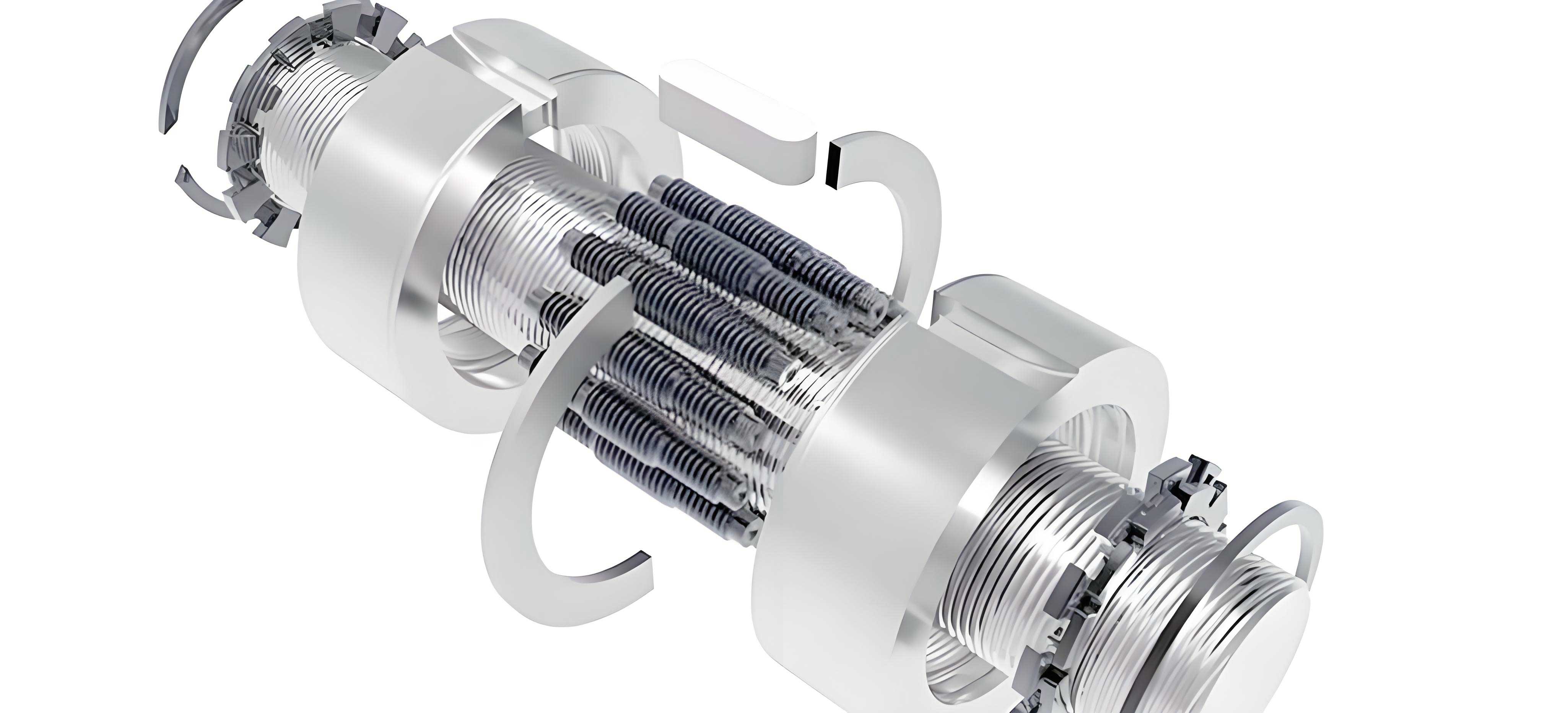
In recent years, the application of planetary roller screw assemblies in aerospace and maritime fields has achieved remarkable successes. However, the accurate assessment of the performance of planetary roller screw assemblies remains a critical bottleneck limiting their widespread adoption. The comprehensive performance of a planetary roller screw assembly plays a foundational role in ensuring the safety of the equipment it serves. Therefore, conducting safe and effective detection of the comprehensive performance of planetary roller screw assemblies is of paramount importance. To address this, I have designed an upper computer system for a comprehensive performance test platform for planetary roller screw assemblies. This system, developed using LABVIEW, encompasses interface design, logic design, and communication interface design. It integrates measurement, control, data saving, data querying, and communication functions. These functions are mutually independent yet complementary. Communication forms the basis for data acquisition and control, while the correct execution of data acquisition and control is reflected through communication. Data saving is a prerequisite and necessary condition for data querying, and data querying can verify the success of data saving. This article details my design process, implementation, and testing of this system.
The overall design of the comprehensive performance test system for planetary roller screw assemblies involves connecting the upper computer PC to external devices primarily through three methods. Firstly, sensors with serial communication capabilities, such as tension-compression force sensors and sound level meters, directly communicate with LABVIEW via RS232. Secondly, sensors like rotary encoders and platinum resistance temperature detectors, along with their subsequent circuits, interface with NI-PCI boards; the upper computer LABVIEW then communicates with these boards using the built-in DAQ assistant. Thirdly, the PLC communicates directly with the upper computer LABVIEW via TCP/IP using an RJ45 interface. This setup establishes a control loop from PC-PLC-servo system-actuator and a measurement loop from sensors-PC. The integration of these elements forms a robust framework for evaluating the planetary roller screw assembly. The overall framework of the planetary roller screw assembly comprehensive performance test platform is conceptualized to ensure seamless interaction between hardware and software components.
The upper computer system I designed is built around a structured framework to manage the testing of planetary roller screw assemblies. After studying signals such as acceleration, velocity, displacement, thermal displacement, tension-compression force, and noise during the comprehensive performance testing of planetary roller screw assemblies, I determined that the system must possess measurement, control, data saving, data querying, and communication functionalities. The block diagram of the upper computer system for the planetary roller screw assembly comprehensive performance test is organized to reflect these core functions. To ensure ease of use and logical completeness, I designed a system startup main interface, two test interfaces, and several interactive sub-interfaces. The main interface allows navigation to high-speed test, accuracy test, historical data query, system parameter settings, and login interfaces. This modular approach facilitates efficient operation and management of tests for the planetary roller screw assembly.
| Function | Description | Key Components |
|---|---|---|
| Measurement | Real-time acquisition of performance parameters like acceleration, velocity, displacement, temperature, noise, and force. | Sensors (accelerometers, encoders, RTDs, sound level meters), DAQ boards. |
| Control | Parameter setting and command issuance to the servo system driving the planetary roller screw assembly. | TCP/IP communication with PLC, servo drives, soft limit handling. |
| Data Saving | Automatic storage of test data to local files for future reference. | Local buffer, file I/O functions, timestamping. |
| Data Querying | Retrieval and display of historical test data based on multiple search criteria. | Database or file system search, filtering by screw ID, date, etc. |
| Communication | Interface with various hardware components using serial, PCI, and TCP protocols. | RS232, NI-PCI boards, Ethernet TCP/IP. |
The measurement function is critical for monitoring the planetary roller screw assembly during testing to prevent irreversible damage from excessive loads and ensure the safety of personnel and the test platform. In the high-speed test interface, I implemented real-time waveform displays for velocity, acceleration, noise, and vibration. For the accuracy test interface, I included a displacement-time relationship graph. The design leverages LABVIEW’s event structure within a While loop to scan for events; when an event like a “Start” button press is captured, the corresponding program executes to begin sensor data acquisition and real-time display. The signals acquired often require conversion. For instance, the voltage or current from an accelerometer is converted to acceleration using a sensitivity factor. This can be represented as:
$$ a = k_v \cdot V $$
where \( a \) is acceleration, \( k_v \) is the sensor’s voltage-to-acceleration coefficient, and \( V \) is the measured voltage. Similarly, for a rotary encoder measuring displacement of the planetary roller screw assembly, the count \( N \) is converted to linear displacement \( x \):
$$ x = \frac{N \cdot p}{R} $$
Here, \( p \) is the lead of the planetary roller screw assembly, and \( R \) is the encoder resolution (counts per revolution). For noise measurement, sound pressure level \( L_p \) in decibels is calculated from the acquired voltage, considering a reference pressure \( p_0 = 20 \mu Pa \):
$$ L_p = 20 \log_{10}\left(\frac{p}{p_0}\right) $$
where \( p \) is the measured sound pressure derived from the sensor output. These conversions are implemented in the measurement modules to provide meaningful physical values for the planetary roller screw assembly performance.
| Parameter | Sensor Type | Typical Signal | Conversion Formula |
|---|---|---|---|
| Acceleration | Piezoelectric accelerometer | Voltage (V) | \( a = S_a \cdot V \), \( S_a \) is sensitivity (m/s²/V) |
| Velocity | Tachometer or derived from displacement | Frequency (Hz) or Counts | \( v = \frac{dx}{dt} \) or \( v = f \cdot k \) |
| Displacement | Rotary encoder | Digital pulses | \( x = N \cdot \frac{p}{C} \), \( C \) is counts per revolution |
| Temperature | Platinum Resistance Thermometer (PRT) | Resistance (Ω) | Callendar-Van Dusen equation: \( R(T) = R_0[1 + A T + B T^2 + C (T-100) T^3] \) |
| Tension/Compression Force | Strain gauge load cell | Voltage (mV/V) | \( F = k_f \cdot V_{out} \), \( k_f \) is calibration factor (N/V) |
| Noise | Microphone/Sound level meter | Voltage (V) | \( L_p = 20 \log_{10}(V / V_0) + K \), \( K \) includes sensitivity and ref. |
The control function allows the upper computer to command the servo system driving the planetary roller screw assembly. I designed the front panel to accept control parameters such as speed, acceleration, operation mode, and lubrication settings. These parameters are sent to the PLC via TCP communication. To ensure safety, I implemented soft limits; the motion position is constrained between left and right limits. If a commanded position exceeds these limits, the system sends a stop command, preventing the servo control system from starting. The control logic involves sending parameter values from LABVIEW property nodes to a communication module. The relationship between commanded velocity \( v_c \) and the actual motor speed \( \omega_m \) can be expressed as:
$$ \omega_m = \frac{v_c \cdot G}{p} $$
where \( G \) is the gear ratio of the transmission system and \( p \) is the lead of the planetary roller screw assembly. For acceleration control, the commanded acceleration \( a_c \) translates to a motor torque command \( \tau_c \) through the system dynamics:
$$ \tau_c = J_{eq} \cdot \alpha_m + F_{fric} + F_{load} $$
Here, \( J_{eq} \) is the equivalent inertia reflected to the motor shaft, \( \alpha_m \) is the angular acceleration, \( F_{fric} \) represents frictional forces, and \( F_{load} \) is the external load from the planetary roller screw assembly. These calculations are handled by the PLC and servo drive, but the upper computer sets the reference points.
Data saving is essential for traceability and post-test analysis of the planetary roller screw assembly performance. During operation, data is continuously acquired and stored in a local buffer. Upon test completion, the operator can choose to save the data permanently. Clicking a “Save” button writes the time-stamped data to a local spreadsheet file. If not saved, the buffer is cleared at the start of the next test. The saving process uses LABVIEW’s file I/O functions. For a dataset consisting of time \( t_i \) and corresponding measurement values \( y_i \) (e.g., displacement), the saved file typically contains columns for each parameter. The data integrity can be verified by checking that the number of records \( N \) matches the sampling rate \( f_s \) and test duration \( T \):
$$ N = f_s \cdot T $$
This ensures that all data points from the planetary roller screw assembly test are captured.
The data query function provides a means to efficiently retrieve historical test data for the planetary roller screw assembly. I developed a query system that allows searching based on multiple fields: screw assembly ID, test date, testing unit, and operator. These fields are combined with an AND logical relationship, enabling precise queries using one or more criteria. Upon selecting an entry from the search results, the corresponding test data and waveforms are displayed immediately. This functionality relies on organized data storage, where each test record is indexed by the search fields. The query can be modeled as a database operation:
$$ Q = \sigma_{condition}(R) $$
where \( Q \) is the query result, \( \sigma \) denotes selection, \( condition \) is a logical expression combining search fields (e.g., \( \text{ID} = \text{‘PRS-001’} \land \text{Date} > \text{‘2023-01-01’} \)), and \( R \) is the relation storing test records. This system enhances the usability and accountability of the planetary roller screw assembly test platform.
Communication is the backbone enabling data acquisition and control for the planetary roller screw assembly test system. I implemented three primary communication methods. Firstly, serial communication (RS232/RS485) is used for sensors like the tension-compression force sensor. The protocol typically involves sending a command message and reading a response. The LABVIEW VISA functions configure the serial port, write the command, read the data, and close the port. The received data string is parsed to extract the numerical value. For instance, if the sensor returns a string “F=+123.4 N”, the force \( F \) is extracted using string manipulation functions.
Secondly, communication via NI-PCI boards handles sensors outputting TTL pulses or analog signals. After installing NI-DAQmx drivers, the DAQ assistant in LABVIEW is configured for the specific board model and channel. The acquired raw values are scaled to engineering units. For an analog input channel measuring voltage \( V_{raw} \), the physical value \( P \) is obtained as:
$$ P = G \cdot V_{raw} + O $$
where \( G \) is the gain (units per volt) and \( O \) is the offset. For digital pulse counting from an encoder, the count \( C \) is accumulated over a sample period \( \Delta t \) to compute velocity or displacement for the planetary roller screw assembly.
Thirdly, TCP/IP communication is established between LABVIEW and the PLC. The PLC IP address is set, and remote PUT/GET access is enabled. In LABVIEW, the TCP functions open a connection, write data packets containing control parameters, and read status information. The data packet structure for controlling the planetary roller screw assembly might include fields for command type, speed setpoint, acceleration, and position limits. A simple checksum \( \chi \) for error detection can be added:
$$ \chi = \sum_{i=1}^{n} d_i \mod 256 $$
where \( d_i \) are the bytes in the packet. This ensures reliable data transmission for controlling the planetary roller screw assembly.
| Device/Interface | Communication Type | LABVIEW Functions Used | Typical Data Format |
|---|---|---|---|
| Tension-Compression Sensor | RS232 Serial | VISA Configure, Write, Read, Close | ASCII string, e.g., “F=+100.5” |
| Rotary Encoder | Digital Pulse via NI-PCI Board | DAQmx Create Channel (Counter Input), Read | Integer counts |
| Platinum RTD (Temperature) | Analog Voltage via NI-PCI Board | DAQmx Create Channel (Analog Input), Read | Voltage (V), converted to resistance then temperature |
| PLC (Siemens S7-1200/1500) | TCP/IP Ethernet | TCP Open Connection, Write, Read, Close | Binary packets following S7 protocol or custom format |
| Sound Level Meter | RS485 Serial (Modbus RTU) | VISA functions with Modbus library | Binary registers holding sound level values |
After developing the upper computer system, I conducted comprehensive testing to validate its functionality for the planetary roller screw assembly. The system demonstrated robust performance in measurement, control, data saving, querying, and communication. For high-speed testing, I set control parameters via the upper computer, including speed, acceleration, and travel distance. The system successfully acquired and displayed real-time waveforms for velocity, acceleration, noise, and vibration. The data was saved upon completion, and the query system allowed quick retrieval. Similarly, for accuracy testing, parameters such as start coordinate, end coordinate, speed, and target points were set. The system controlled the motion and measured displacement with high precision. The accuracy \( A \) of the planetary roller screw assembly can be evaluated from the displacement error \( e_i \) at multiple target positions \( i \):
$$ A = \max | e_i | \quad \text{where} \quad e_i = x_{i,\text{measured}} – x_{i,\text{commanded}} $$
The system computed and displayed these errors, confirming the capability to assess the positioning accuracy of the planetary roller screw assembly.
The integration of all functions results in a cohesive upper computer system that significantly enhances the testing of planetary roller screw assemblies. The use of LABVIEW provides a flexible graphical programming environment, facilitating rapid development and modification. The event-driven architecture ensures responsive user interaction. The modular design allows for easy expansion, such as adding new sensor types or control algorithms. For future improvements, advanced signal processing techniques could be incorporated, like Fourier analysis for vibration data from the planetary roller screw assembly. The power spectral density \( S_{xx}(f) \) of acceleration signals could be computed to identify characteristic frequencies:
$$ S_{xx}(f) = \lim_{T \to \infty} \frac{1}{T} \left| \int_{-T/2}^{T/2} x(t) e^{-j 2 \pi f t} dt \right|^2 $$
This would provide deeper insights into the dynamic behavior of the planetary roller screw assembly under test.
In conclusion, the upper computer system I designed based on LABVIEW effectively addresses the need for comprehensive performance testing of planetary roller screw assemblies. It enables precise control of the test platform, real-time acquisition of multiple performance parameters, reliable data storage and retrieval, and robust communication with various hardware components. The system has been validated through experiments, demonstrating its ability to measure acceleration, velocity, displacement, thermal displacement, tension-compression force, and noise. The successful implementation of this system offers substantial value for research, quality control, and development in fields utilizing planetary roller screw assemblies, such as aerospace, robotics, and heavy machinery. Its modular and scalable nature suggests high potential for adaptation and promotion in industrial and academic settings, ultimately contributing to safer and more reliable applications of planetary roller screw assemblies.