
In the field of precision mechanical transmission, the harmonic drive gear stands out as a revolutionary technology that offers exceptional performance in terms of high reduction ratios, compactness, and minimal backlash. My focus here is to delve into the methodologies for achieving truly backlash-free operation in harmonic drive gears, specifically through the application of profile shift modification. This approach is critical for applications demanding high positional accuracy, such as in aerospace, robotics, and精密 instrumentation. The harmonic drive gear’s unique working principle, which involves the elastic deformation of a flexspline, presents both challenges and opportunities for eliminating齿侧间隙. I will explore the theoretical foundations, detailed design calculations, and practical implementation steps, employing numerous formulas and tables to encapsulate the key parameters and relationships.
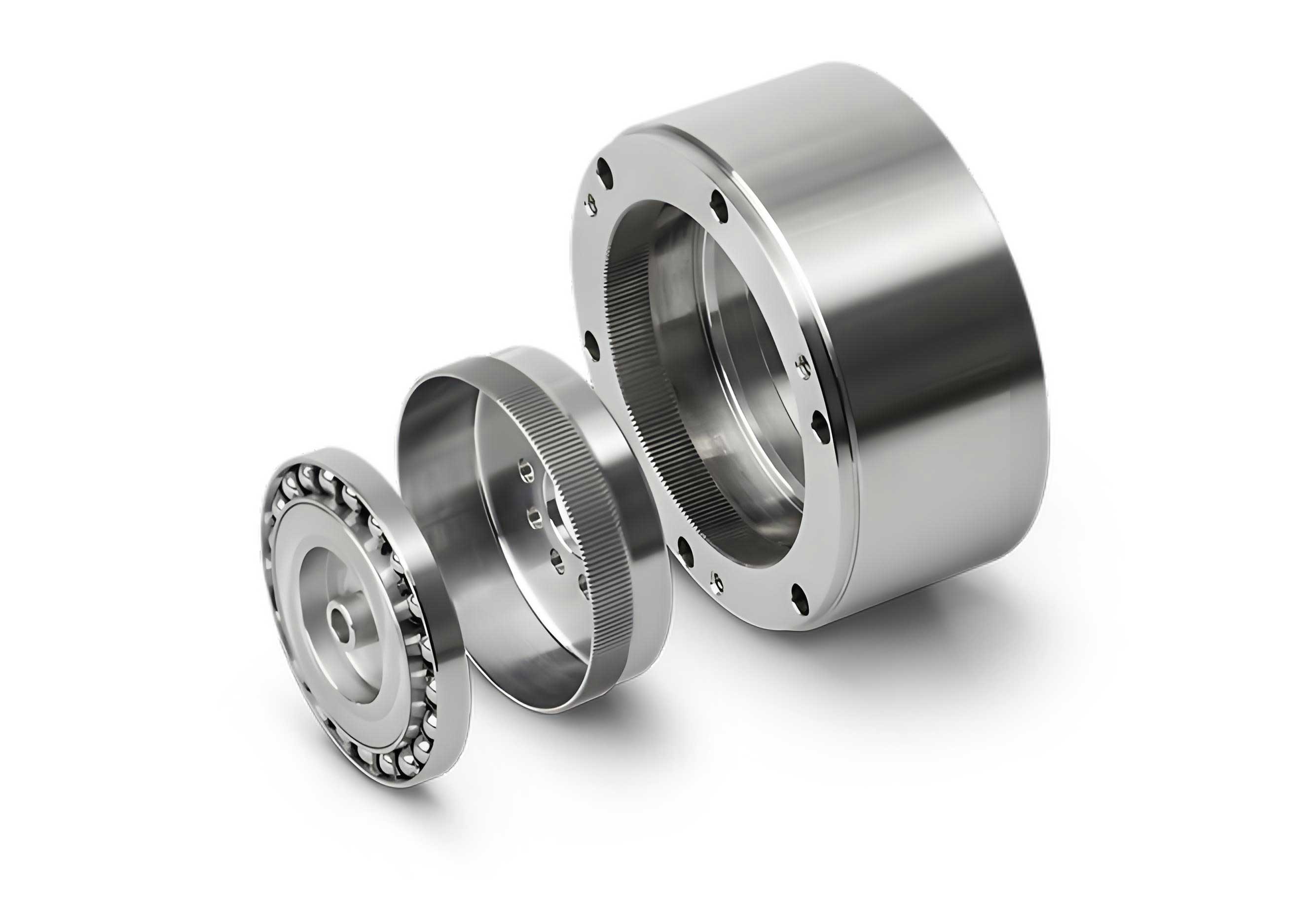
The core components of a harmonic drive gear system are the wave generator, the flexspline (or柔轮), and the circular spline (or刚轮). The wave generator, typically an elliptical or cam-based component, is inserted into the flexspline, causing it to deform elastically into a non-circular shape. This deformation enables meshing between the flexspline teeth and the internal teeth of the circular spline at two diametrically opposite regions (for a double-wave configuration). As the wave generator rotates, the zones of meshing propagate, resulting in a high reduction ratio determined by the difference in tooth counts between the flexspline and circular spline. The fundamental kinematic relationship is given by the transmission ratio. When the circular spline is fixed, the wave generator is the input, and the flexspline is the output, the ratio is expressed as:
$$i = \frac{Z_f}{Z_f – Z_c}$$
where \(Z_f\) is the number of teeth on the flexspline and \(Z_c\) is the number of teeth on the circular spline. For a standard double-wave harmonic drive gear, \(Z_c – Z_f = 2\). This inherent design offers advantages like high torque capacity, smooth motion, and the potential for zero-backlash operation. However, achieving and maintaining zero backlash requires meticulous design of the tooth profiles and their engagement conditions.
The pursuit of a backlash-free harmonic drive gear necessitates a design that ensures continuous tooth contact without any clearance between the mating flanks. This is not merely a matter of manufacturing tolerance but a systematic approach to tooth profile geometry. In standard gear design, backlash is intentionally provided to prevent jamming due to thermal expansion or lubrication needs. However, for precision harmonic drive gears, this clearance becomes a source of error and must be eliminated. The primary method I employ involves the strategic use of profile shift (or变位) for both the flexspline and circular spline, followed by a refinement process to correct the theoretical tooth side间隙.
To begin the design process for a backlash-free harmonic drive gear, we must first establish the basic gear parameters. These include the module (m), pressure angle (α), and the tooth numbers. For high-precision, small-module applications, common values are m = 0.3 mm and α = 20°. The selection of tooth numbers is guided by the desired reduction ratio and the wave number. For a double-wave design with a high ratio, we might choose \(Z_f = 170\) and \(Z_c = 172\), yielding a theoretical reduction ratio \(i = -85\) (negative indicating direction reversal).
The cornerstone of our backlash elimination strategy is the controlled application of profile shift coefficients. The profile shift coefficient (ξ) moves the tool reference line during gear cutting, effectively modifying the tooth thickness and the operating pitch circle. For an internal gear pair like the harmonic drive gear, we apply positive profile shift to both gears to avoid radial interference and to tailor the contact pattern. The initial values of the profile shift coefficients for the flexspline (ξ_f) and circular spline (ξ_c) are determined through empirical formulas derived from extensive analysis of harmonic drive gear meshing behavior. The initial flexspline coefficient is calculated as:
$$\xi_{f0} = K_a K_i \sqrt[3]{2i}$$
where \(K_a\) is a coefficient dependent on the standard pressure angle α, and \(K_i\) is a coefficient dependent on the transmission ratio i. The values for these coefficients are summarized in the following tables based on established design practice.
| Pressure Angle α | Coefficient \(K_a\) |
|---|---|
| 20° | 1.00 |
| 25° | 0.50 |
| 30° | 0.00 |
| Transmission Ratio i | Coefficient \(K_i\) |
|---|---|
| 45 to 100 | 0.59 |
| >100 to 150 | 0.66 |
| >150 to 250 | 0.68 |
For our example with i=85 and α=20°, we have \(K_a=1\) and \(K_i=0.59\). Therefore, the initial profile shift coefficient for the flexspline is:
$$\xi_{f0} = 1 \times 0.59 \times \sqrt[3]{2 \times 85} = 0.59 \times \sqrt[3]{170} \approx 3.2684$$
The initial profile shift for the circular spline is then set slightly larger than that of the flexspline to promote a specific meshing condition favorable for minimizing backlash. The relationship is:
$$\xi_{c0} = \xi_{f0} + k \cdot m$$
where \(k\) is a factor typically in the range of 0.2 to 0.25 for精密谐波齿轮传动 designs to further guard against interference. Choosing \(k = 0.22\) and m=0.3 mm gives:
$$\xi_{c0} = 3.2684 + 0.22 \times 0.3 = 3.3350$$
These initial values ensure that the fundamental gear geometry avoids gross干涉. However, achieving true zero backlash requires a more precise adjustment. This is where the modification of the profile shift coefficients comes into play. We must analyze the tooth side clearance across the entire arc of engagement.
The tooth side clearance, or间隙, at any point during meshing can be modeled mathematically. We define a coordinate system fixed to the circular spline. The coordinates of the flexspline tooth tip \((x_{f}^c, y_{f}^c)\) and the corresponding point on the circular spline tooth flank \((x_{cf}, y_{cf})\) found along the common normal are used to calculate the instantaneous clearance \(H_{fc}\). The governing equation is:
$$H_{fc} = \pm \sqrt{ (x_{f}^c – x_{cf})^2 + (y_{f}^c – y_{cf})^2 }$$
The sign indicates whether the牙齿 are in contact (negative or zero clearance) or separated (positive clearance). A comprehensive numerical analysis evaluates \(H_{fc}\) at numerous discrete positions (e.g., 210 points) across the engagement角. The goal is to have a significant portion of these points exhibit zero or slightly negative clearance (interference), while the rest show a small positive clearance. Controlled elastic deformation of the flexspline accommodates slight干涉 without causing jamming. The target is to have approximately 30-40% of the engagement positions with a controlled interference of 0 to -0.005 mm.
To achieve this optimal clearance distribution, we apply a correction \(\Delta \xi_f\) to the initial flexspline profile shift coefficient. The final coefficient becomes:
$$\xi_f = \xi_{f0} + \Delta \xi_f$$
The circular spline coefficient typically remains at its initial value \(\xi_c = \xi_{c0}\). The determination of \(\Delta \xi_f\) is an iterative process. We start with the clearance values calculated using the initial coefficients. Suppose the minimum clearance \(H_{fc_{min}}\) from this analysis is a positive value, say 0.0054 mm. To introduce controlled interference, we need to increase \(\xi_f\), which effectively thickens the flexspline teeth. The optimal \(\Delta \xi_f\) is found using numerical optimization techniques (like the golden-section search) to shift the clearance curve until about 35% of points are within the desired轻微干涉 range. For our example design, after several iterations, a correction of \(\Delta \xi_f = 0.1066\) was found to be optimal. This yields final coefficients:
$$\xi_f = 3.2684 + 0.1066 = 3.3750$$
$$\xi_c = 3.3350$$
With these final coefficients, a重新计算 of the tooth side clearance across all engagement points shows that roughly 76 out of 210 positions exhibit negative clearance, with a minimum value of about -0.00563 mm. The remaining positions show positive clearance, with a maximum of about 0.01172 mm. This configuration ensures that multiple tooth pairs are always in contact or in轻微干涉, effectively eliminating functional backlash in the harmonic drive gear assembly.
Another critical aspect of the harmonic drive gear design for backlash prevention is the selection of addendum coefficients. The standard addendum height may lead to tip interference in the tightly meshing internal pair. Therefore, we often use a shortened tooth for the flexspline and a standard or slightly modified tooth for the circular spline. The choice of addendum coefficient (\(h_a^*\)) and dedendum or clearance coefficient (\(c^*\)) significantly influences the clearance calculation and the risk of干涉. Based on经验 and analysis, the following values are recommended for a backlash-optimized harmonic drive gear with α=20°.
| Component | Addendum Coefficient \(h_a^*\) | Clearance Coefficient \(c^*\) | Tooth Type |
|---|---|---|---|
| Flexspline | 0.408 | 0.842 | Shortened Tooth |
| Circular Spline | 0.8 | 0.3 | Modified Standard |
The reduced addendum on the flexspline minimizes the risk of tip接触 with the circular spline root during the complex deformation cycle, while the specified clearance ensures proper lubrication and thermal expansion space without introducing operational backlash.
The entire design process hinges on precise mathematical modeling of the harmonic drive gear meshing. The deformation of the flexspline under the wave generator is not perfectly elliptical; it follows a specific curve defined by the wave generator’s profile (e.g., two-roller, cam). For a two-roller (dual eccentric) wave generator, the radial deformation \(\rho(\phi)\) of the flexspline neutral line as a function of the wave generator angle \(\phi\) can be approximated by:
$$\rho(\phi) = R_0 + e \cos(2\phi)$$
where \(R_0\) is the nominal radius of the undeformed flexspline, and \(e\) is the eccentricity of the wave generator rollers. This deformation profile directly affects the instantaneous center distance between the flexspline and circular spline, which in turn influences the meshing phase and the calculated tooth side clearance \(H_{fc}\). Therefore, the clearance equation \(H_{fc}\) is implicitly a function of \(\phi\), \(\xi_f\), \(\xi_c\), and the basic gear geometry parameters.
To facilitate the design of a backlash-free harmonic drive gear, we can consolidate the key calculation steps into a systematic procedure:
1. Define requirements: Determine the reduction ratio \(i\), output torque, and precision (backlash tolerance).
2. Select basic parameters: Choose module \(m\), pressure angle \(\alpha\), wave number (usually 2), and tooth numbers \(Z_f\) and \(Z_c\) such that \(Z_c – Z_f = \text{wave number}\).
3. Determine initial profile shifts: Calculate \(\xi_{f0}\) using $$ \xi_{f0} = K_a K_i \sqrt[3]{2i} $$ and \(\xi_{c0}\) using $$ \xi_{c0} = \xi_{f0} + (0.2 \text{ to } 0.25)m $$.
4. Select addendum coefficients: Choose \(h_{af}^*\) and \(h_{ac}^*\) from standard或 modified tables to prevent interference.
5. Model meshing and clearance: Develop or use software to compute the tooth side clearance \(H_{fc}(\phi)\) for the entire engagement cycle using the initial parameters.
6. Apply profile shift correction: Iteratively adjust \(\xi_f\) by \(\Delta \xi_f\) until the clearance distribution meets the target (e.g., ~35% points with -0.005 to 0 mm clearance).
7. Finalize design: Confirm all geometric parameters, including tip diameters, root diameters, and中心距 modified by the wave generator action.
The effectiveness of this profile shift modification method can be further validated by examining the contact stress and transmission error. While the primary goal is backlash elimination, a good design must also ensure sufficient load capacity and smooth motion. The modified profile shifts generally lead to a larger effective contact ratio, which distributes load across more teeth and reduces transmission error. The contact ratio \(\epsilon\) for the harmonic drive gear can be estimated using modified formulas for internal gears with profile shift, considering the varying effective center distance due to flexspline deformation.
In practical manufacturing, achieving the calculated geometry requires high-precision gear cutting equipment. The recommended accuracy grade for both the flexspline and circular spline in a backlash-free harmonic drive gear is AGMA or ISO Class 6 or better. This ensures that the theoretical zero-backlash condition is not compromised by random manufacturing variations. Furthermore, the wave generator’s profile must be manufactured to tight tolerances to maintain the predicted deformation pattern.
The application of this design methodology extends beyond standard harmonic drive gears. It can be adapted for strain wave gears, also known as “harmonic drive” gears, used in robotic joints, satellite天线 positioning systems, and medical devices where any backlash is unacceptable. The principle of using calculated profile shift modifications to engineer a predefined tooth flank clearance distribution is a powerful tool for the precision engineer.
To summarize the key formulas and relationships in one place, here is a consolidated set of equations essential for the backlash-free harmonic drive gear design via profile shift modification:
1. Transmission Ratio (Circular Spline Fixed):
$$i = \frac{Z_f}{Z_f – Z_c}$$
2. Initial Flexspline Profile Shift Coefficient:
$$\xi_{f0} = K_a(\alpha) \cdot K_i(i) \cdot \sqrt[3]{2i}$$
3. Initial Circular Spline Profile Shift Coefficient:
$$\xi_{c0} = \xi_{f0} + k \cdot m \quad \text{with } k \in [0.2, 0.25]$$
4. Tooth Side Clearance at Meshing Point j:
$$H_{fc}(j) = \sqrt{ \left( x_f^c(\phi_j, \xi_f, \xi_c) – x_{cf}(\phi_j, \xi_f, \xi_c) \right)^2 + \left( y_f^c(\phi_j, \xi_f, \xi_c) – y_{cf}(\phi_j, \xi_f, \xi_c) \right)^2 }$$
5. Final Flexspline Profile Shift after Correction:
$$\xi_f = \xi_{f0} + \Delta \xi_f$$
6. Addendum Diameters:
$$d_{af} = m \cdot Z_f + 2m(h_{af}^* + \xi_f)$$
$$d_{ac} = m \cdot Z_c – 2m(h_{ac}^* – \xi_c)$$
In conclusion, the pursuit of a truly backlash-free harmonic drive gear is a meticulous engineering endeavor that combines theoretical gear geometry, elastic mechanics, and precision manufacturing. The method of profile shift modification, starting from empirically derived initial coefficients and refining them through precise clearance analysis, provides a systematic and effective path to eliminate齿侧间隙. This approach ensures that the harmonic drive gear operates with the high positional accuracy and stiffness required by advanced technological systems. The repeated focus on the harmonic drive gear’s unique characteristics throughout this design process underscores its importance as a cornerstone of modern precision motion control. Future work may involve integrating thermal and load deformation models into the clearance analysis for even more robust designs under operational conditions. The harmonic drive gear, through techniques like these, continues to evolve as an indispensable component in the world of high-performance mechanical transmissions.