
In the development of modern mining equipment, the roadheader-anchor integrated machine represents a significant advancement, combining tunneling, support, transportation, and crawler walking into a single system. As a key component, the cutting reducer must meet stringent requirements for compact size, high power transmission, and exceptional reliability. This paper focuses on the design and analysis of a double excitation bevel gear pair transmission system, which enables power confluence and directional change at the high-speed stage using two motors. The double excitation bevel gear pair is critical for handling impact and heavy-load conditions in underground mining environments. Here, I delve into the principles, parameter selection, design calculations, and practical applications of this system, emphasizing the role of bevel gear technology in enhancing performance.
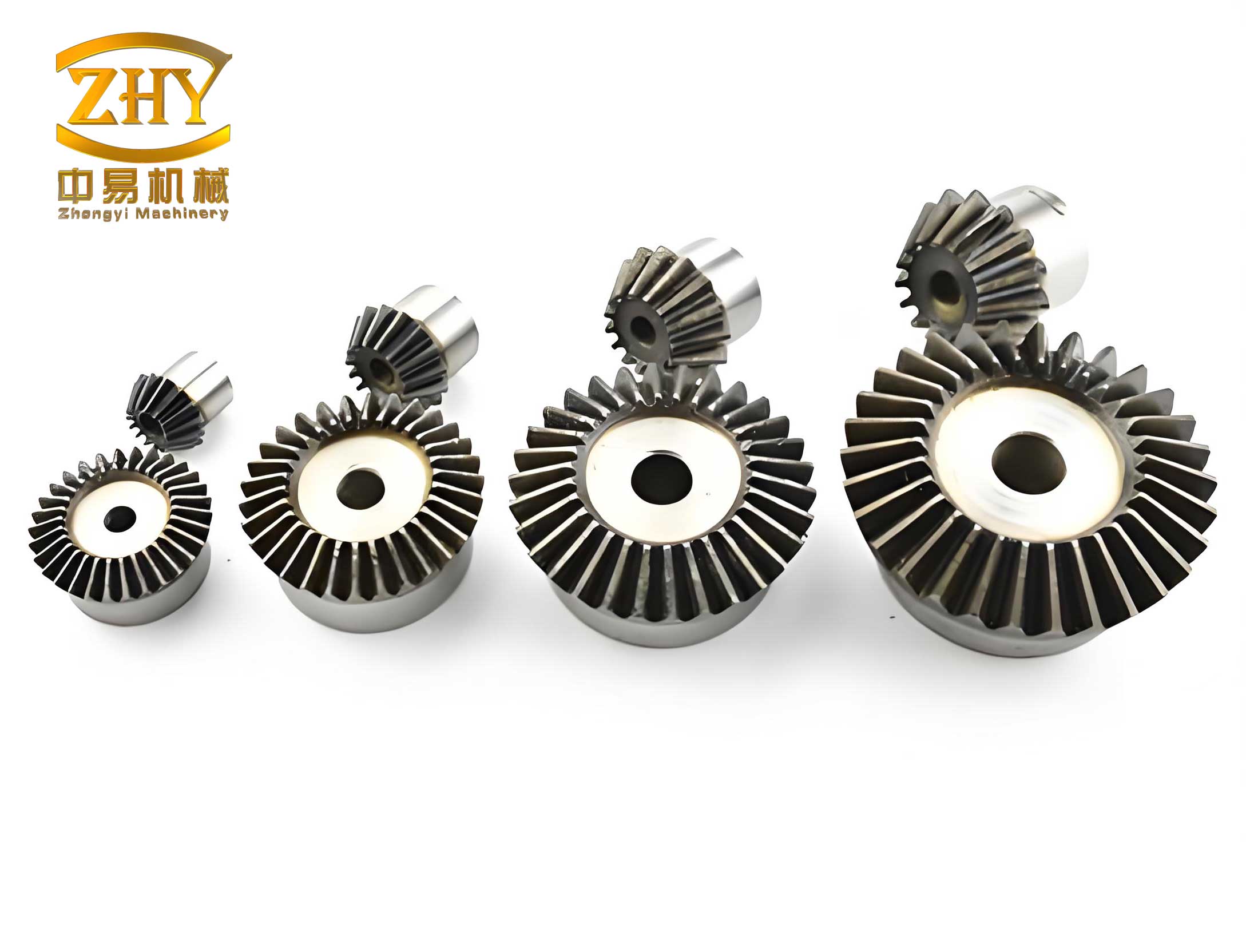
The double excitation bevel gear pair consists of two driving bevel gears and one driven bevel gear, forming a configuration that efficiently merges power from two sources. This setup is particularly advantageous in applications where space constraints and high torque demands coexist. In this design, the bevel gear arrangement allows for synchronous power input from two AC motors, leveraging their self-balancing characteristics to avoid power loss and ensure smooth operation. The bevel gear system is chosen for its ability to transmit power at right angles while maintaining high efficiency and durability. Throughout this discussion, the term “bevel gear” will be frequently referenced to underscore its centrality in the transmission design.
To understand the double excitation bevel gear pair, it’s essential to grasp its structural features. The system includes two active bevel gears arranged in a cantilevered manner with back-to-back bearing supports, and one driven bevel gear with straddle mounting using face-to-face bearings. This configuration minimizes axial loads and enhances stability under dynamic conditions. The bevel gear geometry, such as the spiral angle and tooth profile, plays a pivotal role in optimizing force distribution. For instance, the bevel gear’s spiral angle is carefully selected to balance axial and radial forces, as derived from fundamental equations. The force analysis for a bevel gear can be expressed using the following formulas for tangential, radial, and axial forces:
$$ F_t = \frac{2000 T}{d_m} $$
$$ F_r = \frac{F_t}{\cos \beta_m} (\tan \alpha \cos \delta – \sin \beta_m \sin \delta) $$
$$ F_a = \frac{F_t}{\cos \beta_m} (\tan \alpha \sin \delta + \sin \beta_m \cos \delta) $$
where \( F_t \) is the tangential force, \( T \) is the torque, \( d_m \) is the mean pitch diameter, \( \beta_m \) is the mean spiral angle, \( \alpha \) is the pressure angle, and \( \delta \) is the pitch cone angle. These equations highlight how the bevel gear parameters influence load handling, which is crucial for designing a reliable double excitation system. By adjusting the bevel gear spiral angle, we can mitigate excessive axial forces on the driven bevel gear, thereby reducing bearing requirements and extending component life.
Selecting the appropriate bevel gear type and material is vital for performance. Common bevel gear variants include straight, helical, and spiral bevel gears, each with distinct advantages. Spiral bevel gears, such as those following the Klingelnberg or Gleason systems, are preferred for high-power applications due to their smooth engagement, high load capacity, and noise reduction. For this double excitation bevel gear pair, a hard-faced spiral bevel gear with a Klingelnberg tooth system is chosen, processed through carburizing and quenching to achieve a surface hardness that resists wear while maintaining core toughness. The material selection involves high-performance alloys like 17CrNiMo6, which offers excellent mechanical properties under stress. Below is a table summarizing key bevel gear parameters for the design:
| Parameter | Value | Description |
|---|---|---|
| Number of Teeth (z) | 24 | For both driving and driven bevel gears |
| Module (m) | 8 mm | Standardized for high torque |
| Mean Spiral Angle (\(\beta_m\)) | 20° | Optimized to reduce axial forces |
| Pitch Cone Angle (\(\delta\)) | 45° | For 1:1 ratio bevel gear pair |
| Face Width (B) | 40 mm | To ensure sufficient contact area |
| Material | 17CrNiMo6 | High-strength alloy for bevel gears |
| Heat Treatment | Carburizing & Grinding | For hard surface and precision |
The design calculations for the double excitation bevel gear pair involve verifying gear strength, shaft dimensions, bearing life, and thermal balance. Starting with gear strength, the preliminary dimensions are derived from bending and contact stress formulas. For a bevel gear, the bending stress \(\sigma_F\) and contact stress \(\sigma_H\) can be estimated using:
$$ \sigma_F = \frac{F_t}{b m_n} Y_F Y_\beta Y_K $$
$$ \sigma_H = Z_E Z_H Z_\epsilon \sqrt{\frac{F_t}{d_1 b} \cdot \frac{u+1}{u}} $$
where \( b \) is the face width, \( m_n \) is the normal module, \( Y_F \) is the form factor, \( Y_\beta \) is the spiral angle factor, \( Y_K \) is the stress correction factor, \( Z_E \) is the elasticity coefficient, \( Z_H \) is the zone factor, \( Z_\epsilon \) is the contact ratio factor, and \( u \) is the gear ratio. For the double excitation bevel gear pair with a 1:1 ratio, the driven bevel gear shares the load from two inputs, necessitating a safety factor above 1.5. Using specialized software, the calculated safety factors for bending and contact stress are 2.1 and 2.3, respectively, confirming the bevel gear’s adequacy for heavy-duty operation.
Shaft design for the bevel gear system requires careful consideration of torque and bending moments. The shaft diameter is initially estimated from torsion theory:
$$ d’ = \sqrt[3]{\frac{5T}{\tau (1-\nu^4)}} $$
where \( \tau \) is the allowable shear stress (50 MPa), and \( \nu \) is the ratio of inner to outer diameter (0.8 for hollow shafts). For an input torque of 1108 N·m per motor, the minimum shaft diameter is approximately 65 mm, but we increase it to 70 mm for added safety. The bevel gear shafts are integrated with the gear teeth to enhance rigidity, a common practice in high-speed bevel gear applications. Bearing selection involves calculating dynamic loads and life expectancy. For the double excitation bevel gear pair, tapered roller bearings are used due to their ability to handle combined radial and axial loads. The equivalent dynamic load \( P_r \) for a bearing is given by:
$$ P_r = X F_r + Y F_a $$
where \( F_r \) and \( F_a \) are radial and axial loads, and \( X \) and \( Y \) are factors depending on the bearing type. The bearing life \( L_{10} \) in hours is calculated as:
$$ L_{10} = \frac{10^6}{60 n} \left( \frac{C}{P_r} \right)^3 $$
with \( C \) being the basic dynamic load rating and \( n \) the rotational speed. For the active bevel gear bearings, with \( C = 150 \, \text{kN} \) and \( P_r = 12 \, \text{kN} \), the life exceeds 10,000 hours, well above the 5,000-hour requirement. The following table summarizes key shaft and bearing parameters:
| Component | Parameter | Value | Note |
|---|---|---|---|
| Shaft | Minimum Diameter | 70 mm | For bevel gear integration |
| Material | 42CrMo | High-strength alloy steel | |
| Safety Factor | 2.5 | Against yielding | |
| Bearing | Type | Tapered Roller | For bevel gear loads |
| Dynamic Load Rating (C) | 150 kN | For active bevel gear support | |
| Equivalent Load (P_r) | 12 kN | Calculated for double excitation | |
| Life (L_{10}) | >10,000 h | Ensuring longevity for bevel gear system |
Thermal management is crucial for the double excitation bevel gear pair, as high power transmission generates heat that can degrade lubrication and material properties. The heat generated \( Q_1 \) during continuous operation is:
$$ Q_1 = 1000 (1 – \eta) P_1 $$
where \( \eta \) is the transmission efficiency (0.99 for precision bevel gears) and \( P_1 \) is the input power (340 kW total for two motors). This yields \( Q_1 = 3400 \, \text{W} \). The maximum heat dissipation \( Q_{2,\text{max}} \) through the housing is:
$$ Q_{2,\text{max}} = K S (\theta_{\text{ymax}} – \theta_0) $$
with \( K \) as the heat transfer coefficient (12 W/m²·°C), \( S \) as the surface area, \( \theta_{\text{ymax}} \) as the maximum allowable temperature (90°C), and \( \theta_0 \) as the ambient temperature (20°C). For natural convection, the required surface area is approximately 5.4 m², which is impractical given space constraints. Therefore, an auxiliary water cooling system is integrated, circulating oil through a heat exchanger to maintain optimal operating temperatures for the bevel gear set. This ensures that the double excitation bevel gear pair remains within thermal limits, preventing premature failure.
The practical application of this double excitation bevel gear pair in the EJM340/4-2 roadheader-anchor integrated machine demonstrated its effectiveness. Over several months of operation in a coal mine, the system handled intense cutting loads with minimal vibration and noise. The bevel gear transmission achieved synchronous power confluence without significant wear, and temperature readings stayed below 80°C, thanks to the cooling design. This success underscores the robustness of the bevel gear design in real-world mining conditions. The double excitation approach, centered on bevel gear technology, enabled the machine to complete over 5,000 meters of tunneling, highlighting its reliability and efficiency.
In conclusion, the design of a double excitation bevel gear pair for cutting reducers involves meticulous parameter selection, rigorous strength calculations, and innovative thermal solutions. The bevel gear system, with its optimized spiral angle and material choice, proves capable of withstanding shock and heavy loads while maintaining compact dimensions. Key formulas for bevel gear forces, stress analysis, and heat balance provide a foundation for future designs. As mining equipment evolves, the double excitation bevel gear pair will continue to play a vital role in enhancing power transmission and durability. Further research could explore advanced coatings for bevel gears or digital monitoring systems to predict maintenance needs, ensuring even greater performance in harsh environments.