
In the context of deep space exploration, the Mars probe serves as a critical vehicle for investigating the Martian environment. One of the primary challenges in designing such probes is the stringent mass constraints imposed by launch capabilities, coupled with the need for high precision in optical systems. The optical load turret, which directs solar panels, optical detectors, and communication devices, requires a transmission system that offers high reduction ratios, minimal backlash, and lightweight construction. Traditional solutions, such as direct drive stepper motors or multi-stage gear systems, often lead to excessive mass or complexity. In this work, we present a novel design of dual-segment backlash elimination worm gears to address these requirements. This system ensures zero-backlash operation, high transmission efficiency, and adaptability to the extreme thermal conditions on Mars. The design process encompasses structural optimization, material selection, parameter calculation, and rigorous testing to validate performance under simulated Martian environments.
The core of the optical load turret’s drive system is the worm gears, which provide a high reduction ratio in a single stage, thereby minimizing mass and complexity. The dual-segment backlash elimination mechanism involves a split worm design with adjustable shims and preload springs. This configuration allows for continuous adjustment of the meshing condition between the worm and worm wheel, ensuring that the tooth surfaces remain in contact during bidirectional rotation. As a result, positional accuracy is maintained without the need for additional motors or complex control systems, which would otherwise increase mass and energy consumption. The following sections detail the design principles, material choices, parameter calculations, simulation results, and experimental validation of this innovative worm gears system.
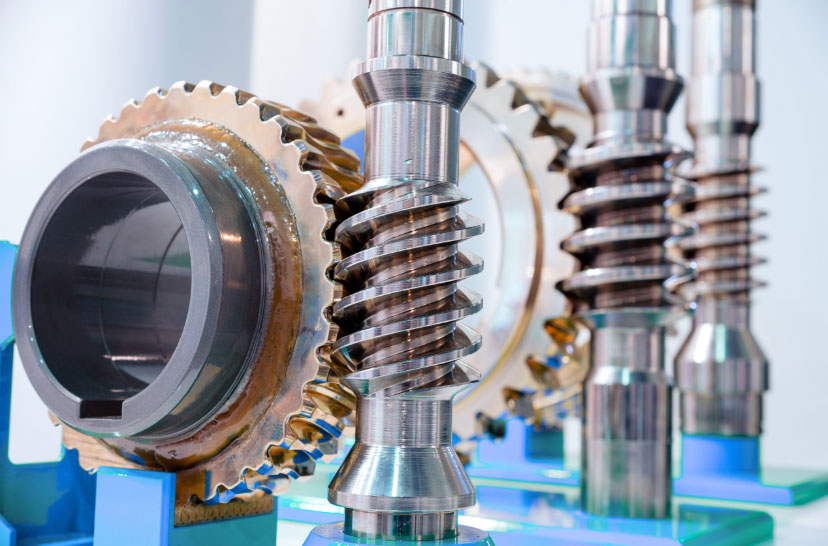
Principle of Dual-Segment Backlash Elimination Worm Gears
The dual-segment backlash elimination system for worm gears consists of a split worm shaft, adjustment shims, preload springs, and a nut mechanism. The worm is divided into two segments: a fixed worm and a movable worm, connected via a tension sleeve that ensures synchronous rotation while allowing axial displacement. Preload springs at both ends of the worm assembly apply a constant force, pushing the worm segments apart. The central adjustment shims control the axial position of the movable worm, enabling fine-tuning of the meshing gap between the worm and worm wheel. By adjusting the shim thickness, the worm segments can be displaced axially to eliminate any clearance between the tooth surfaces, thus achieving zero backlash. This mechanism is crucial for high-precision applications, as it compensates for manufacturing tolerances, assembly errors, and thermal expansions that could otherwise introduce positional inaccuracies.
The transmission system operates with a reduction ratio of 80:1, driven by a motor connected to one end of the worm shaft. A rotary encoder on the opposite end provides feedback for closed-loop control, ensuring precise angular positioning of the turret. The worm wheel is fixed to the rotating platform, which is supported by combined radial-thrust bearings. The dual-segment design of the worm gears allows for continuous adjustment during operation, maintaining optimal contact under varying loads and temperatures. The fundamental equation for the transmission ratio is given by:
$$i = \frac{z_2}{z_1}$$
where \(z_2\) is the number of teeth on the worm wheel (80) and \(z_1\) is the number of starts on the worm (1). This results in a high reduction ratio, enabling fine control of the output motion. The lead angle of the worm, which affects the efficiency and self-locking properties, is calculated as:
$$\gamma = \arctan\left(\frac{m \cdot z_1}{d_1}\right)$$
where \(m\) is the module (1.6 mm) and \(d_1\) is the pitch diameter of the worm (18 mm). For our design, \(\gamma \approx 5^\circ 4’47”\), which balances efficiency and compactness. The axial force generated by the preload springs must exceed the operational forces to prevent displacement. The required spring force \(F_s\) is derived from the tangential force \(F_t\) on the worm wheel:
$$F_t = \frac{T}{r}$$
where \(T\) is the output torque (0.5 N·m) and \(r\) is the pitch radius of the worm wheel (64 mm). Thus, \(F_t \approx 7.8\, \text{N}\). The axial force on the worm is equal to \(F_t\) due to the geometry of worm gears, so the spring preload must satisfy \(F_s > 7.8\, \text{N}\). In our design, springs with a preload of 10 N are used, ensuring reliable contact under all conditions.
Design of Worm Gears
Material Selection
The selection of materials for the worm gears is critical to achieving lightweight construction and reliable performance in the harsh Martian environment. Common aerospace materials, such as carbon composites, ceramic matrix composites, titanium alloys, and engineering plastics, were evaluated based on their specific strength, thermal properties, and self-lubricating capabilities. After thorough analysis, polyimide was chosen for the worm wheel due to its low density, high strength-to-weight ratio, and excellent self-lubricating properties. Titanium alloy TC4 was selected for the worm shaft because of its high strength, low thermal expansion, and compatibility with the polyimide worm wheel. The combination of these materials minimizes mass while providing adequate wear resistance and thermal stability. Key material properties are summarized in Table 1.
| Property | Polyimide YS20 | Titanium TC4 | Beryllium | Aluminum LY12CZ | Magnesium MB5 |
|---|---|---|---|---|---|
| Density (g/cm³) | 1.44–1.53 | 4.51 | 1.85 | 2.8 | 1.8 |
| Elastic Modulus (GPa) | 200 | 110 | 303 | 68–72 | 45 |
| Tensile Strength (MPa) | 130 | ≥895 | 243 | 390–441 | 255 |
| Thermal Conductivity (W/m·K) | 0.1–0.35 | 7.955 | 216 | 159 | 134 |
| Coefficient of Thermal Expansion (10⁻⁶/K) | 3 | 8.6 | 11.3 | 21.6 | 23 |
To enhance the self-lubricating properties of the worm gears, carbon fibers are incorporated into the polyimide matrix, reducing the coefficient of friction between the worm and worm wheel. This modification is essential for maintaining efficiency in the absence of external lubrication, as conventional lubricants would fail at the low temperatures encountered on Mars. The friction coefficient between polyimide and titanium TC4 is estimated to be between 0.1 and 0.12, leading to a frictional force of approximately 1.2 N under operational conditions. The resulting frictional torque \(T_f\) is calculated as:
$$T_f = F_f \cdot r_w$$
where \(F_f\) is the frictional force and \(r_w\) is the radius of the worm (8.85 mm). Thus, \(T_f \approx 10.62\, \text{mN·m}\), which is below the required starting torque of 15 mN·m, ensuring reliable operation.
Parameter Design
The design of the worm gears parameters focuses on achieving the desired transmission ratio, strength, and minimal backlash. The center distance, module, number of teeth, and other geometric parameters are determined through iterative calculations based on contact stress, bending stress, and deflection criteria. The primary design parameters are listed in Table 2.
| Parameter | Worm Wheel | Worm | Parameter | Worm Wheel | Worm |
|---|---|---|---|---|---|
| Center Distance (mm) | 73 | 73 | Lead Angle | 5°4′47″ | 5°4′47″ |
| Module (mm) | 1.6 | 1.6 | Worm Lead (mm) | — | 5.024 |
| Number of Teeth | 80 | 1 | Pitch Diameter (mm) | 128 | 18 |
| Tip Diameter (mm) | 130.56 | 20.56 | Root Height (mm) | 1.6 | 1.6 |
| Addendum (mm) | 1.28 | 1.28 | Face Width (mm) | 35 | 15 |
| Root Arc Radius (mm) | 10.6 | — | Tip Arc Radius (mm) | 7.72 | — |
| Pitch Arc Radius (mm) | 9 | — | Outer Diameter (mm) | 133.76 | — |
The weight of the worm wheel is 68.56 g, and the worm shaft weighs 60.5 g, resulting in a total mass of approximately 129 g for the worm gears assembly. This lightweight design is crucial for the overall mass budget of the probe. Strength verification using software such as KissSoft indicates a bending safety factor of 15.6 and a wear safety factor of 9.7, which are well above the required thresholds. The transmission efficiency is calculated to be 33.8%, considering the friction losses in the worm gears. The efficiency \(\eta\) can be estimated using the formula:
$$\eta = \frac{\tan \gamma}{\tan(\gamma + \phi)}$$
where \(\phi\) is the friction angle, approximately \(\arctan(0.12) \approx 6.84^\circ\). Substituting the values, \(\eta \approx 0.338\), confirming the calculated efficiency.
Adjustment Shims and Spring Design
The adjustment shims and preload springs are vital components for maintaining zero backlash in the worm gears system. The nominal backlash at room temperature is 0.3 mm, but this value changes with temperature due to differential thermal expansion of the materials. The adjustment shims, with an initial thickness of 0.5 mm, are used to compensate for these variations. The thermal expansion of the worm gears components is calculated based on the coefficient of thermal expansion (\(\alpha\)) and the temperature change (\(\Delta T\)). The change in tooth thickness \(\Delta s\) for a component of length \(L\) is given by:
$$\Delta s = \alpha \cdot L \cdot \Delta T$$
For the polyimide worm wheel, \(\alpha = 3 \times 10^{-6}\, \text{K}^{-1}\), and for the titanium worm, \(\alpha = 8.6 \times 10^{-6}\, \text{K}^{-1}\). The housing, made of aluminum silicon carbide, has \(\alpha = 21.6 \times 10^{-6}\, \text{K}^{-1}\). Considering a temperature range from room temperature (25°C) to the minimum operating temperature (-95°C), the total change in backlash is calculated to be 3.491 μm. To compensate for this, the adjustment shims are ground down by 3.491 μm during assembly, ensuring zero backlash at all temperatures.
The preload springs are designed to provide a force greater than the axial force generated during operation. Using springs with a wire diameter of 0.8 mm, free length of 15 mm, and compressed length of 10 mm, the preload force is measured to be 10 N, which exceeds the required 7.8 N. This ensures that the worm segments remain in contact with the worm wheel under all load conditions. The spring rate \(k\) can be expressed as:
$$k = \frac{G d^4}{8 D^3 N}$$
where \(G\) is the shear modulus, \(d\) is the wire diameter, \(D\) is the mean coil diameter, and \(N\) is the number of active coils. For our springs, \(k \approx 2\, \text{N/mm}\), providing sufficient compliance for thermal adjustments.
Simulation Verification
Finite element analysis (FEA) was conducted to verify the thermal and structural performance of the worm gears system. The simulations focused on temperature distribution and thermal deformation under Martian environmental conditions, as mechanical loads are relatively low. The worm gears assembly was modeled with polyimide for the worm wheel and titanium TC4 for the worm shaft. Natural convection heat transfer with a coefficient of 20 W/(m²·K) was assumed, and the ambient temperature was varied from 25°C to 65°C, then to -60°C, and back to 65°C over a 5400-second cycle.
The simulation results show that the temperature of the worm gears components closely follows the environmental temperature changes, with no excessive thermal gradients. The maximum deformation due to thermal expansion is within acceptable limits, ensuring that the meshing condition remains stable. The temperature distribution at key time points (e.g., T=900 s, T=2700 s, T=5400 s) indicates uniform heating and cooling, which validates the material selection and design approach. The thermal stress \(\sigma_{\text{thermal}}\) in a component can be estimated as:
$$\sigma_{\text{thermal}} = E \cdot \alpha \cdot \Delta T$$
where \(E\) is the elastic modulus. For the polyimide worm wheel, \(\sigma_{\text{thermal}} \approx 200 \times 10^9 \times 3 \times 10^{-6} \times 100 = 60\, \text{MPa}\), which is below the material’s yield strength. Similarly, for the titanium worm, \(\sigma_{\text{thermal}} \approx 110 \times 10^9 \times 8.6 \times 10^{-6} \times 100 = 94.6\, \text{MPa}\), also within safe limits. These results confirm that the worm gears system can withstand the thermal cycles without failure.
Validation Tests
Running-in Test
Running-in tests were performed to optimize the contact pattern between the worm and worm wheel and to achieve zero backlash. The process involves cyclic operation under load to wear in the surfaces and improve meshing accuracy. The test procedure includes initial assembly, adjustment of shims, and measurement of starting torque. The flowchart for the running-in test is as follows: assemble the worm gears, apply preload, run the system under load for several cycles, measure backlash and starting torque, adjust shims if necessary, and repeat until zero backlash is achieved. The starting torque is verified to be below 15 mN·m, ensuring that the system can initiate motion reliably.
Thermal Environment Test
Thermal environment tests simulate the extreme temperature conditions on Mars, ranging from -95°C to 70°C. These tests include thermal cycling, thermal vacuum, and storage tests to validate the worm gears’ performance. The test conditions are summarized in Table 3.
| Test Type | Low Temperature | High Temperature | Pressure | Cycles | Dwell Time | Temperature Rate | Operation |
|---|---|---|---|---|---|---|---|
| Thermal Cycling | -75°C | +70°C | Atmospheric | 6 | ≥4 hours | 3–5°C/min | Bidirectional rotation |
| Thermal Vacuum | -75°C | +70°C | 600 Pa | 6.5 | ≥4 hours | ≥1°C/min | Bidirectional rotation |
| Storage | -145°C | +85°C | 600 Pa | 4 | ≥4 hours | 3–5°C/min | Static |
During these tests, the worm gears system is operated at speeds up to 100 rpm under a load of 0.5 N·m. The system functions normally without any signs of wear or failure, confirming its suitability for Martian conditions.
Mechanical Environment Test
Mechanical environment tests assess the worm gears’ ability to withstand random vibrations and sinusoidal loads模拟火星表面的复杂地形。使用V8-440型振动台进行测试,首先施加正弦振动,条件如表4所示,然后进行随机振动测试。正弦振动测试频率范围为5-100 Hz,加速度为2 g,而随机振动测试功率谱密度如图6所示。测试后拆解检查表明,蜗轮蜗杆完好无损,性能符合要求。
| Frequency Range (Hz) | Acceleration (g) | Duration (min) | Axis |
|---|---|---|---|
| 5–100 | 2 | 10 | X, Y, Z |
The random vibration test profile includes a power spectral density (PSD) of 0.04 g²/Hz in the frequency range of 20–2000 Hz, with an overall level of 7.7 g RMS. The worm gears system survives these tests without damage, demonstrating robust mechanical integrity.
Conclusion
The design of dual-segment backlash elimination worm gears for the Mars probe optical load turret successfully meets the requirements of lightweight construction, high precision, and reliability in extreme environments. Through careful material selection, parameter optimization, and rigorous testing, the worm gears system achieves zero backlash, efficient operation, and resistance to thermal and mechanical stresses. The use of polyimide and titanium alloy minimizes mass while maintaining strength, and the adjustable shim mechanism ensures continuous tooth contact under varying temperatures. Simulation and experimental results validate the design, confirming that the worm gears are ready for deployment in Martian exploration missions. This work highlights the importance of innovative mechanical design in advancing deep space technology.