
In the field of high-precision power transmission, herringbone gears are widely utilized due to their ability to handle large loads and eliminate axial forces. These gears are critical in applications such as marine propulsion and aerospace systems. However, the symmetry between the left and right helical teeth of a herringbone gear is a crucial factor influencing operational smoothness, vibration, and noise. Any asymmetry can lead to increased wear and reduced efficiency. Traditional methods for assessing symmetry in herringbone gears often involve manual measurements or indirect techniques, which are prone to errors and inefficiencies. To address this, I have developed a specialized software solution based on Microsoft Foundation Classes (MFC) for automated symmetry measurement using a Computer Numerical Control (CNC) gear measuring center. This article details the definition of symmetry, measurement principles, software design, experimental validation, and conclusions, with an emphasis on mathematical formulations and tabular data to enhance clarity. Throughout this work, the term “herringbone gears” will be frequently referenced to underscore their significance in this context.
The symmetry of herringbone gears refers to the ideal condition where the left and right helical teeth are mirror images about the central cross-section. In practice, manufacturing imperfections cause deviations, known as symmetry error. This error can be defined as the distance between the actual intersection point of contact lines from the left and right teeth and the theoretical central plane. Formally, let the central plane be defined as the plane perpendicular to the gear axis and equidistant from the two end faces. For a given pair of contact lines on opposite sides of a herringbone gear, their theoretical intersection should lie on this central plane. The symmetry error \(\Delta Th\) is the perpendicular distance from the actual intersection point to the central plane. If all such errors across the gear are within a tolerance \(t/2\), the herringbone gear meets symmetry requirements. Mathematically, for contact lines represented as lines in 3D space, the error can be computed using vector geometry. Consider two lines \(L_L\) and \(L_R\) from the left and right teeth, respectively. Their equations can be expressed in parametric form:
$$ L_L: \mathbf{r}_L = \mathbf{p}_L + \lambda_L \mathbf{d}_L $$
$$ L_R: \mathbf{r}_R = \mathbf{p}_R + \lambda_R \mathbf{d}_R $$
where \(\mathbf{p}_L\) and \(\mathbf{p}_R\) are points on the lines, \(\mathbf{d}_L\) and \(\mathbf{d}_R\) are direction vectors, and \(\lambda_L, \lambda_R\) are parameters. The intersection point \(\mathbf{O}\) satisfies \(\mathbf{r}_L = \mathbf{r}_R\). Solving for \(\lambda_L\) and \(\lambda_R\) yields the coordinates of \(\mathbf{O}\). The distance \(\Delta Th\) from \(\mathbf{O}\) to the central plane (e.g., defined by equation \(z = 0\) if the gear axis is along the z-axis) is then:
$$ \Delta Th = |z_O| $$
where \(z_O\) is the z-coordinate of \(\mathbf{O}\). This formulation provides a basis for automated measurement. The challenge lies in accurately measuring the contact lines on herringbone gears, which requires precise instrumentation and software control.
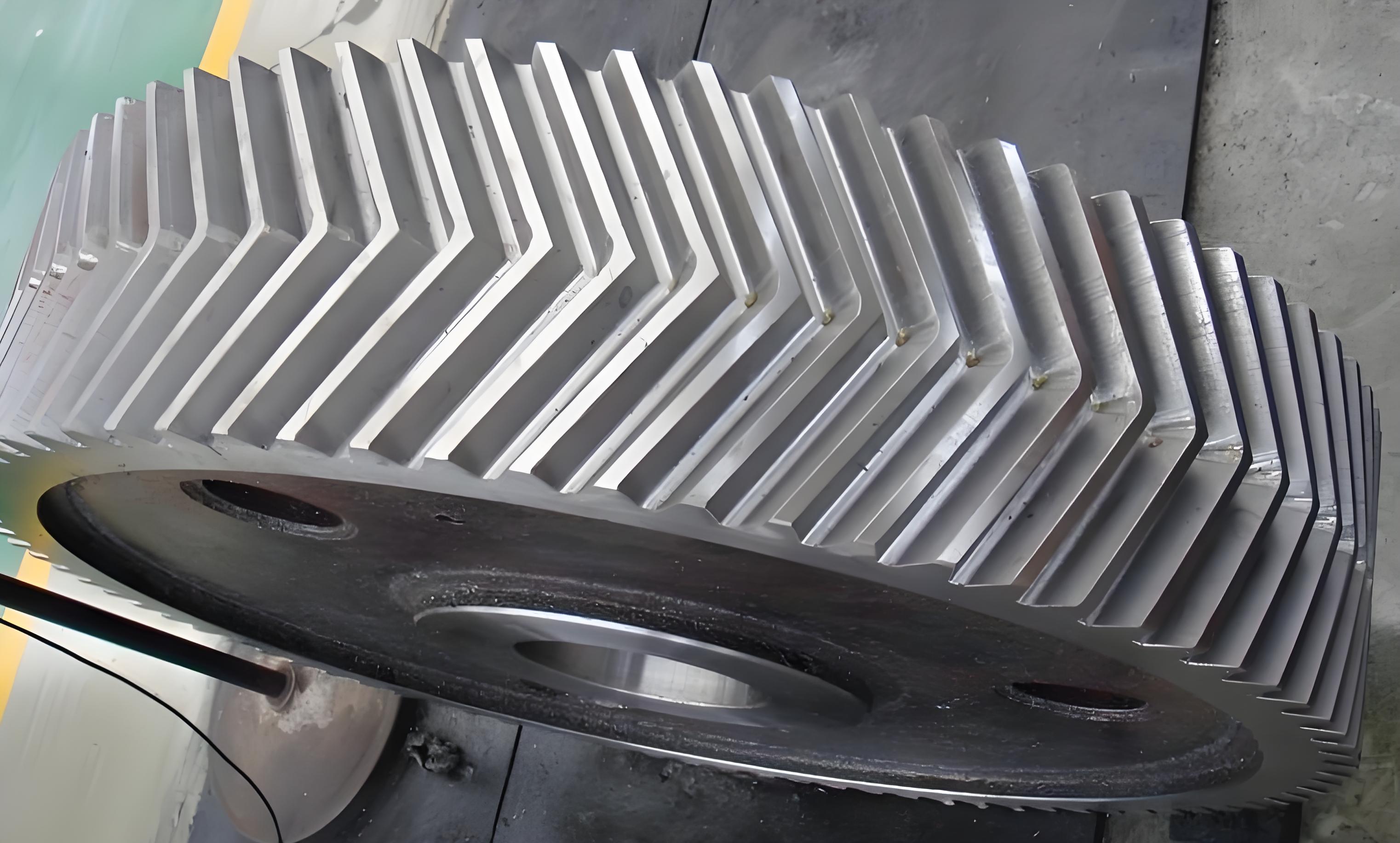
To measure the contact lines on herringbone gears, I employed a CNC gear measuring center, which offers multi-axis control and high precision. The measurement principle is based on the direct method, where a probe traces the contact line on the tooth surface. A contact line is defined as the path of instantaneous contact between mating gear teeth, lying in the tangent plane to the base cylinder and oriented at the base helix angle \(\beta_b\). For a herringbone gear, the left and right teeth have opposite helix angles, but their contact lines should symmetrically intersect. The probe movement is programmed to follow this line, collecting coordinate points. The setup involves fixing the herringbone gear on a rotary table, with the probe aligned to move along the theoretical contact line direction. The base helix angle \(\beta_b\) is derived from the gear parameters:
$$ \beta_b = \arctan(\tan \beta \cdot \cos \alpha_n) $$
where \(\beta\) is the helix angle and \(\alpha_n\) is the normal pressure angle. The probe path is controlled by synchronizing linear axes (X, Y, Z) and the rotary axis (\(\theta\)) to maintain the correct orientation. This ensures that the probe contacts the tooth surface along the contact line, minimizing errors. The data acquisition system records the coordinates of each point, which are later used to fit lines and compute symmetry errors. The accuracy of this method depends on the precision of the CNC system and the probe calibration, which is addressed through software algorithms.
The software for symmetry measurement of herringbone gears was developed using MFC in the Visual C++ environment. MFC provides a robust framework for creating Windows applications with graphical user interfaces (GUIs), database integration, and hardware control. The design focuses on automation, precision, and user-friendliness. The software architecture comprises several key modules: gear parameter input, measurement motion control, data acquisition, and data analysis/export. Each module is implemented as a set of classes and functions, ensuring modularity and maintainability. Below is a table summarizing the software modules and their functions:
| Module | Function | Description |
|---|---|---|
| Parameter Input | Read gear specifications | Accepts parameters such as module, number of teeth, helix angle, etc., from user or database. |
| Motion Control | Control CNC axes | Orchestrates probe movement along contact lines, including homing, positioning, and safety checks. |
| Data Acquisition | Capture coordinate points | Records probe contact points at specified sampling density, with anti-interference filtering. |
| Analysis & Export | Compute errors and generate reports | Fits lines to data, calculates symmetry errors, and exports results to files or displays graphs. |
The user interface features a main window with a menu bar, toolbar, and status bar. The menu bar allows access to functions like parameter setting, measurement selection, and report printing. The toolbar provides quick buttons for common operations, while the status bar displays real-time probe coordinates. For symmetry measurement of herringbone gears, a dedicated “Contact Line Measurement” option was added. Upon selection, users input gear parameters via a dialog box. The software then automates the entire measurement process. The core of the software is the measurement motion control program, which follows a detailed flowchart to ensure accurate and safe operation. The algorithm includes steps for probe approach, contact detection, point sampling, and error calculation. A simplified version of the control logic is represented in the following pseudo-code:
1. Initialize system: set motors to auto mode, clear data.
2. Move probe to start position based on gear parameters.
3. For each tooth in herringbone gear:
   a. Measure left tooth contact line: sample points along line.
   b. Retract probe to safe position.
   c. Rotate table to right tooth position.
   d. Measure right tooth contact line: sample points.
   e. Move to next tooth.
4. For each pair of contact lines:
   a. Fit left line to points using least squares: get equation.
   b. Fit right line similarly.
   c. Compute intersection point of the two lines.
   d. Calculate distance from intersection to central plane.
5. Aggregate results: compute maximum error, average error, etc.
6. Output results: display graphs, save data.
To handle real-world variations, the software incorporates error compensation algorithms. For instance, probe deflection and machine geometric errors are modeled and corrected in the coordinate data. The fitting of contact lines uses a linear regression model. Given a set of \(n\) points \((x_i, y_i, z_i)\) for a contact line, the line equation in 3D can be expressed as:
$$ \frac{x – x_0}{a} = \frac{y – y_0}{b} = \frac{z – z_0}{c} $$
where \((x_0, y_0, z_0)\) is a point on the line and \((a, b, c)\) is the direction vector. The least squares method minimizes the sum of squared distances from points to the line. The symmetry error \(\Delta Th\) for each tooth is then computed as described earlier. The software also includes functionality for exporting data to formats like CSV for further analysis, enhancing its versatility in industrial settings.
To validate the software, I conducted an experiment using a CNC gear measuring center and a sample herringbone gear. The gear parameters are listed in the table below:
| Parameter | Value | Unit |
|---|---|---|
| Normal module, \(m_n\) | 2.5 | mm |
| Number of teeth, \(z\) | 27 | – |
| Normal pressure angle, \(\alpha_n\) | 22 | ° |
| Helix angle, \(\beta\) | 30 | ° |
| Single tooth width, \(B\) | 30 | mm |
| Groove width, \(W\) | 20 | mm |
The measurement procedure followed these steps: First, the herringbone gear was mounted on the rotary table, and the system was calibrated using a standard sphere to define the coordinate zero. Second, in the software, I selected the contact line measurement option and entered the gear parameters. Third, the probe was manually positioned near the mid-width of the teeth, and automatic measurement commenced. The software controlled the probe to trace contact lines on all teeth, alternating between left and right sides. For each tooth, points were sampled at a density of 10 points per millimeter along the contact line. The total measurement time for the entire gear was approximately 15 minutes, demonstrating efficiency. The collected data comprised coordinates for each point, which were processed offline within the software to compute symmetry errors. The results for all teeth are summarized in the table below:
| Tooth Number | Symmetry Error \(\Delta Th\) (mm) | Tooth Number | Symmetry Error \(\Delta Th\) (mm) |
|---|---|---|---|
| 1 | -0.0013 | 15 | -0.0251 |
| 2 | -0.0124 | 16 | -0.0302 |
| 3 | -0.0187 | 17 | -0.0345 |
| 4 | -0.0220 | 18 | -0.0370 |
| 5 | -0.0256 | 19 | -0.0358 |
| 6 | -0.0289 | 20 | -0.0321 |
| 7 | -0.0315 | 21 | -0.0284 |
| 8 | -0.0332 | 22 | -0.0247 |
| 9 | -0.0340 | 23 | -0.0209 |
| 10 | -0.0338 | 24 | -0.0172 |
| 11 | -0.0327 | 25 | -0.0135 |
| 12 | -0.0308 | 26 | -0.0098 |
| 13 | -0.0283 | 27 | -0.0061 |
| 14 | -0.0255 |
The symmetry errors range from -0.0370 mm to -0.0013 mm, with an arithmetic mean absolute value of 0.0260 mm. This indicates that the herringbone gear meets typical symmetry tolerance requirements (e.g., \(t = 0.05\) mm would allow \(\Delta Th \leq 0.025\) mm). The negative signs denote the direction of deviation from the central plane, which is consistent across the gear. The software also generated a graphical plot of errors versus tooth number, showing a periodic pattern that could be linked to manufacturing issues such as machine tool errors. Further analysis using Fourier transform could identify dominant error frequencies, but that is beyond the current scope. The experiment confirms that the MFC-based software effectively automates symmetry measurement for herringbone gears, with high precision and repeatability. Compared to manual methods, this approach reduces human error and increases throughput, making it suitable for quality control in production environments.
In conclusion, the development of MFC-based software for symmetry measurement of herringbone gears represents a significant advancement in gear metrology. By leveraging a CNC gear measuring center and direct contact line measurement, the software achieves automated, high-precision assessment of symmetry errors. The key contributions include a novel mathematical formulation for symmetry error based on contact line intersections, a robust software architecture with modules for parameter input, motion control, data acquisition, and analysis, and experimental validation on a real herringbone gear. The results demonstrate that the software can detect symmetry deviations as small as a few micrometers, fulfilling accuracy requirements for high-performance applications. Future work could extend the software to include real-time error compensation during gear manufacturing, integration with CAD systems for design verification, and adaptation to other gear types like double helical gears. Additionally, machine learning algorithms could be incorporated to predict symmetry errors from process parameters, further enhancing the intelligence of the system. Overall, this research provides a practical tool for improving the quality and reliability of herringbone gears in critical industries, underscoring the importance of precise measurement in advanced manufacturing.