
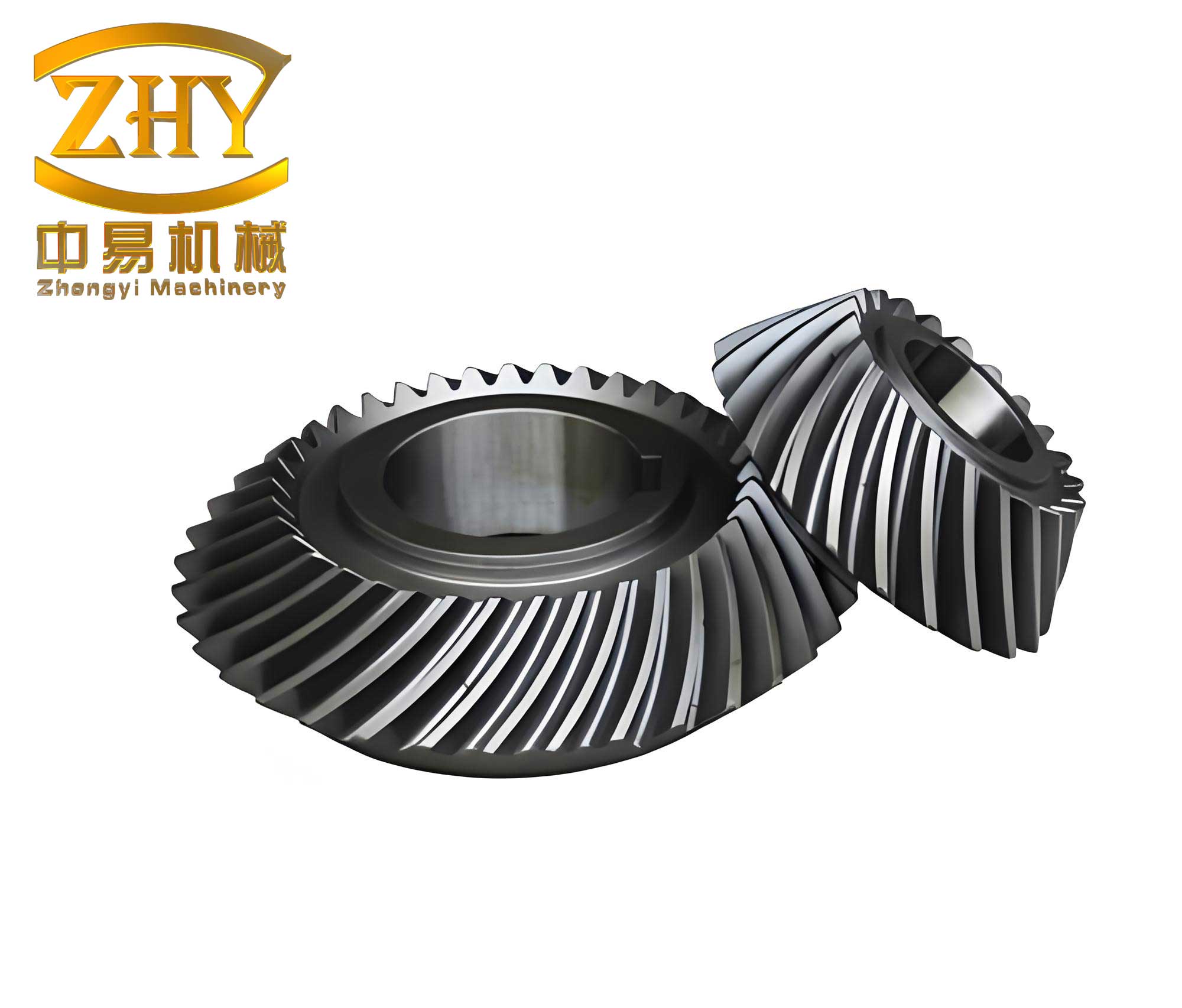
In my extensive work with power transmission systems, the design and manufacturing of spiral bevel gears present a fascinating and complex challenge. Their ability to transmit power between intersecting shafts, typically at a 90-degree angle, with high efficiency and smooth operation makes them indispensable in automotive differentials, industrial gearboxes, and aerospace applications. The unique curved tooth geometry of spiral gears offers significant advantages over straight bevel gears, including higher contact ratios, smoother engagement, and greater load-carrying capacity. However, this complexity demands a meticulous approach to geometry definition, strength calculation, and manufacturing process selection.
The core of reliable gear design lies in accurate stress analysis. For spiral bevel gears, calculating the actual stress at the root fillet is critical for predicting bending fatigue life. Often, nominal or comparative stress formulas are used for simplicity, but they may not capture local stress concentrations. I have explored methods to derive formulas for the actual stress in the root transition curve. In some approaches, if the form factor Y is easily determined from a diagram and the bending fatigue strength limit \(\sigma_{lim}\) of the gear material is known, the basic allowable tangential load \(F_{t-basic}\) can be estimated from a foundational formula. This leads to an actual stress calculation that mirrors the form of the nominal stress equation:
$$ \sigma_{actual} = f(\sigma_{basic}, Y) $$
While this formulation simplifies practical application, its widespread use requires further validation and study. Concurrently, independent theoretical derivations for root stress in spiral gears have been attempted elsewhere, but were often abandoned due to extreme computational complexity. Alternative specialized methods have proven useful for calculating residual stresses in root fillets, particularly for gears with shrink-fitted rims.
The standardization of spiral bevel gear systems provides a essential foundation for designers. A prominent standard system, revised from an earlier foundation, establishes parameters for general industrial use. Key modifications in such a standard include adopting a basic pressure angle of 20°, providing design data for non-perpendicular axis pairs, revising tooth thickness for better load balance between pinion and gear, and updating addendum data using consistent formulas. This system is intended for generated spiral bevel gears with perpendicular axes and a specific range of diametral pitches. It recommends gear proportions and blank dimensions to achieve a balance between surface durability (pitting resistance) and bending strength. A fundamental characteristic is the use of unequal addenda and unequal tooth thicknesses for all ratios except 1:1. The pinion typically has a longer addendum to avoid undercut and enhance strength.
| Parameter | Specification / Formula |
|---|---|
| Working Depth (hk) | $$ h_k = \frac{2.000}{P_d} $$ |
| Clearance (c) | $$ c = \frac{0.188}{P_d} $$ |
| Whole Depth (ht) | $$ h_t = h_k + c $$ |
| Standard Pressure Angle (φ) | 20° |
| Mean Spiral Angle (βm) | 35° |
| Face Width (F) | $$ F = 0.3 \, A_0 $$ or $$ \frac{10}{P_d} $$, whichever is smaller |
| Pitch Diameter (d) | $$ d = \frac{N}{P_d} $$ |
| Pitch Angle (γ) | For 90° shaft angle: $$ \gamma_p = \arctan\left(\frac{N_p}{N_g}\right), \quad \gamma_g = 90° – \gamma_p $$ |
| Outer Cone Distance (Ao) | $$ A_o = \frac{d}{2 \sin \gamma} $$ |
| Circular Pitch (p) | $$ p = \frac{\pi}{P_d} $$ |
Tooth thickness is tailored so that when a left-hand spiral pinion drives clockwise or a right-hand pinion drives counterclockwise (viewed from the back), the stress condition in both members is approximately equal, aiming for balanced life under loads below the endurance limit. The face cone of the blank is set parallel to the root cone of the mating gear to ensure constant clearance along the tooth line. The following table summarizes the step-by-step geometric calculation process for a standard set of spiral bevel gears.
| Step | Parameter | Pinion Formula | Gear Formula |
|---|---|---|---|
| 1 | Addendum (a) | $$ a_p = \frac{0.540}{P_d} + \frac{0.460}{P_d \cdot m_G^2} $$ | $$ a_g = h_k – a_p $$ |
| 2 | Dedendum (b) | $$ b_p = h_t – a_p $$ | $$ b_g = h_t – a_g $$ |
| 3 | Dedendum Angle (δ) | $$ \delta_p = \arctan\left(\frac{b_p}{A_o}\right) $$ | $$ \delta_g = \arctan\left(\frac{b_g}{A_o}\right) $$ |
| 4 | Face Angle (γO) | $$ \gamma_{Op} = \gamma_p + \delta_g $$ | $$ \gamma_{Og} = \gamma_g + \delta_p $$ |
| 5 | Root Angle (γR) | $$ \gamma_{Rp} = \gamma_p – \delta_p $$ | $$ \gamma_{Rg} = \gamma_g – \delta_g $$ |
| 6 | Outside Diameter (dO) | $$ d_{Op} = d_p + 2 a_p \cos \gamma_p $$ | $$ d_{Og} = d_g + 2 a_g \cos \gamma_g $$ |
| 7 | Pitch Apex to Crown (X) | $$ X_p = \frac{d_g}{2} – a_p \sin \gamma_p $$ | $$ X_g = \frac{d_p}{2} – a_g \sin \gamma_g $$ |
Designing for non-perpendicular axes, where the shaft angle Σ is not 90°, requires a modified approach. The pitch angles are calculated differently. If Σ < 90°, the formulas are: $$ \gamma_p = \arctan\left(\frac{\sin \Sigma}{m_G + \cos \Sigma}\right), \quad \gamma_g = \Sigma – \gamma_p $$. If Σ > 90°, they become: $$ \gamma_p = \arctan\left(\frac{\sin(180° – \Sigma)}{m_G – \cos(180° – \Sigma)}\right), \quad \gamma_g = \Sigma – \gamma_p $$. An equivalent gear ratio \( m_G’ \) and an equivalent pinion tooth number \( N_p’ \) are then used with the standard size tables: $$ m_G’ = \frac{m_G \cos \gamma_p}{\cos \gamma_g}, \quad N_p’ = \frac{N_p}{\cos \gamma_p} $$.
Selecting the correct pressure angle is vital. For the standard 20° system, a minimum number of pinion teeth is required to avoid undercut at various gear ratios. The same applies if a lower pressure angle, such as 16° or 14.5°, is desired for specific applications like increased tooth overlap or reduced axial thrust.
| Gear Ratio Range | Minimum Pinion Teeth for 20° PA | Minimum Pinion Teeth for 16° PA |
|---|---|---|
| 1.00 to 1.75 | 13 | 16 |
| 1.75 to 2.50 | 12 | 15 |
| 2.50 to 3.50 | 11 | 14 |
| 3.50 to 5.00 | 10 | 13 |
| 5.00 and higher | 9 | 12 |
For applications demanding very high ratios with pinions having fewer than 13 teeth, special tooth proportions are necessary to maintain strength and avoid excessive undercut. In such cases, the working depth is often reduced, and the whole depth adjusted accordingly, which departs from the standard system. A dedicated table is used for these designs, ensuring the total number of teeth in the pair is not less than 40.
Backlash is a crucial assembly parameter. The recommended operational backlash varies with diametral pitch to accommodate manufacturing tolerances, thermal expansion, and lubrication needs. Typically, all necessary backlash is provided by reducing the tooth thickness of the pinion, as the gear is often cut using a two-sided finishing process.
| Diametral Pitch (Pd) | Recommended Backlash (inches) |
|---|---|
| 1.00 – 1.50 | 0.025 – 0.040 |
| 1.51 – 2.00 | 0.020 – 0.030 |
| 2.01 – 3.00 | 0.014 – 0.022 |
| 3.01 – 4.00 | 0.010 – 0.016 |
| 4.01 – 6.00 | 0.008 – 0.012 |
| 6.01 – 8.00 | 0.006 – 0.010 |
| 8.01 – 10.00 | 0.005 – 0.008 |
| 10.01 – 12.00 | 0.004 – 0.006 |
Strength calculation for spiral bevel gears involves two primary failure modes: bending fatigue at the tooth root and surface pitting (contact fatigue) on the flank. The bending stress calculation must account for the complex three-dimensional shape of the tooth. Lewis’s formula provides a starting point, but for spiral gears, it is heavily modified with multiple factors (K-factors) from standards like AGMA or ISO. The fundamental bending stress equation can be expressed as:
$$ \sigma_F = \frac{F_t}{b m_n} \cdot Y_F \cdot Y_S \cdot Y_\beta \cdot K_A \cdot K_V \cdot K_{F\beta} \cdot K_{F\alpha} $$
Where:
\(F_t\) is the nominal tangential load at the reference circle,
\(b\) is the face width,
\(m_n\) is the normal module,
\(Y_F\) is the tooth form factor (stress correction factor),
\(Y_S\) is the notch sensitivity factor,
\(Y_\beta\) is the helix angle factor,
\(K_A\) is the application factor,
\(K_V\) is the dynamic factor,
\(K_{F\beta}\) is the face load factor for bending,
\(K_{F\alpha}\) is the transverse load factor for bending.
The allowable bending stress \(\sigma_{FP}\) is derived from the material’s bending fatigue limit, modified by factors for life, temperature, and reliability:
$$ \sigma_{FP} = \frac{\sigma_{Flim} \cdot Y_{NT} \cdot Y_{\delta relT}}{S_{Fmin} \cdot Y_X} $$
The safety factor for bending \(S_F\) is then:
$$ S_F = \frac{\sigma_{FP}}{\sigma_F} \geq S_{Fmin} $$
For surface durability (pitting), the contact stress (Hertzian stress) \(\sigma_H\) is calculated. The fundamental formula is based on the contact of two cylinders, adapted for gear geometry:
$$ \sigma_H = Z_{E} \cdot Z_{H} \cdot Z_{\varepsilon} \cdot Z_{\beta} \cdot \sqrt{ \frac{F_t}{b d_{p1}} \cdot \frac{u + 1}{u} \cdot K_A \cdot K_V \cdot K_{H\beta} \cdot K_{H\alpha} } $$
Where:
\(Z_E\) is the elasticity factor,
\(Z_H\) is the zone factor,
\(Z_{\varepsilon}\) is the contact ratio factor,
\(Z_{\beta}\) is the helix angle factor for contact stress,
\(d_{p1}\) is the pinion pitch diameter,
\(u\) is the gear ratio,
\(K_{H\beta}\) and \(K_{H\alpha}\) are the face and transverse load factors for contact stress.
The allowable contact stress \(\sigma_{HP}\) is:
$$ \sigma_{HP} = \frac{\sigma_{Hlim} \cdot Z_{NT}}{S_{Hmin}} \cdot Z_L \cdot Z_V \cdot Z_R \cdot Z_W \cdot Z_X $$
Here, \(\sigma_{Hlim}\) is the material’s contact fatigue limit, \(Z_{NT}\) is the life factor, and the other Z-factors account for lubrication, roughness, speed, and size. The safety factor against pitting is:
$$ S_H = \frac{\sigma_{HP}}{\sigma_H} \geq S_{Hmin} $$
I find that a comparative analysis of different calculation methods is instructive. The table below contrasts the traditional nominal stress method with a more advanced actual stress calculation approach for the bending strength of spiral gears.
| Aspect | Nominal/Comparative Stress Method | Proposed Actual Stress Method |
|---|---|---|
| Basis | Simplified beam theory with empirical corrections. | Theoretical derivation for stress in the root transition curve. |
| Form Factor (Y) | Determined from standardized diagrams based on virtual spur gear teeth. | Could be derived from the specific geometry of the generated spiral bevel tooth. |
| Stress Formula | $$ \sigma_{nom} = \frac{F_t}{b m_n} \cdot Y \cdot K_o \cdot K_s \cdot … $$ | $$ \sigma_{actual} = \sigma_{basic} \cdot Y’ $$ where \(\sigma_{basic}\) relates to material’s \(\sigma_{lim}\). |
| Accuracy | Good for initial sizing and comparison. May not capture local root stresses accurately. | Potentially more accurate for high-precision life prediction, but requires more detailed input and validation. |
| Application | Widely used in industry standards (AGMA, ISO). | Seen as a research topic; practical application needs further development and simplification. |
| Complexity | Moderate, well-documented in standards. | High, can become computationally prohibitive without simplification. |
The manufacturing of spiral bevel gears is a discipline in itself. Beyond traditional face hobbing and face milling processes, innovative methods continue to emerge. One notable development is the “Tangential Cutter Method” or “Tanger Process” for cylindrical helical gears, which offers insights into high-efficiency machining. This process uses two cutter heads equipped with dual-tip carbide blades. The cutting motion is essentially linear relative to the tooth space, with feed in the direction tangential to the workpiece’s base circle. It can produce both involute and non-involute profiles, add chamfers, and even generate crowned teeth. The benefits include very high tool life and exceptional productivity, making it suitable for high-volume production of specific automotive transmission helical gears. While not directly applicable to spiral bevel gears, the principle of optimizing the cutting path and tooling for a specific tooth geometry is a common theme in advancing the manufacturing of all types of spiral gears.
Material selection and heat treatment are equally critical. For high-performance spiral bevel gears, case-hardening steels such as AISI 8620, 9310, or their equivalents are predominant. The process involves carburizing to create a hard, wear-resistant surface (typically 58-63 HRC) while maintaining a tough, ductile core to withstand bending loads. The control of core strength, case depth, and residual stresses post-heat treatment is vital for achieving the calculated strength and durability. Grinding after heat treatment is often necessary to correct distortion and achieve the final precision for noise and load distribution.
In conclusion, the engineering of spiral bevel gears is a multifaceted endeavor requiring a deep synthesis of geometric theory, strength of materials, manufacturing capability, and metallurgical science. The standardized systems provide a robust starting point, but true optimization for any application—whether in a heavy truck differential or a high-speed helicopter transmission—requires careful analysis and often, tailored adjustments. The ongoing research into more accurate stress calculation methods and the evolution of high-precision, efficient manufacturing processes like advanced face milling and grinding ensure that spiral gears will continue to be a key, high-performance solution in mechanical power transmission. As I refine my designs, I constantly balance the theoretical elegance of the formulas with the practical realities of manufacturing and material behavior to create reliable and efficient spiral bevel gear sets.