
In my experience as a mechanical design engineer, the connection between gear shafts and couplings in heavy machinery like ball mills is a critical aspect that demands meticulous analysis. Ball mills, used extensively in mineral processing, involve high torque transmission under impact loads, making the reliability of gear shafts paramount. This article delves into the process of determining the optimal connection method for the pinion gear shaft and semi-coupling in a large ball mill system. The focus is on ensuring that gear shafts can transmit the required torque without failure, using a combination of analytical calculations, empirical data, and practical insights. Throughout this discussion, I will emphasize the role of gear shafts in power transmission and how their connection interfaces must be designed to withstand operational stresses.
The specific case involves a ball mill driven by a variable-frequency motor with a power rating of 1500 kW and a speed of 200 rpm. The motor connects to the pinion gear shaft via a coupling, and the gear shaft itself is made of 35CrMo steel, while the semi-coupling is constructed from 45# steel. The connection interface has a nominal diameter of 275 mm and an effective engagement length of 320 mm. Given the heavy and impact-prone nature of ball mill loads, a robust connection is essential to prevent slippage or deformation. In my analysis, I first considered traditional methods like keyed joints, but as I will show, these alone proved insufficient, leading to the exploration of interference fits and their synergy with keys. This journey underscores the importance of gear shafts in transmitting rotational forces and the need for precise engineering to maintain system integrity.
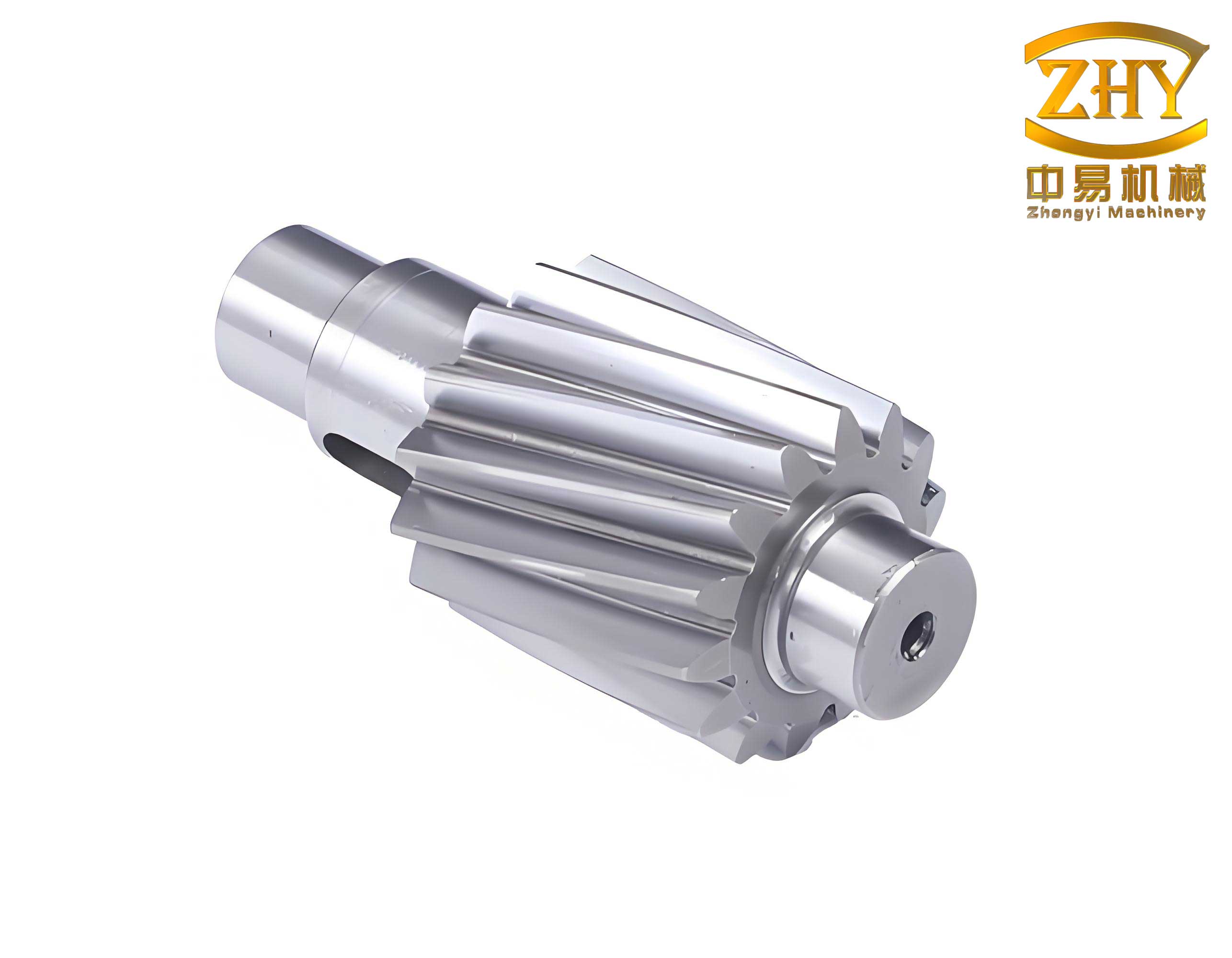
Initially, I evaluated a keyed connection due to its common use in torque transmission for gear shafts. Based on the shaft diameter of 275 mm, I referred to standard mechanical design handbooks and selected a parallel key with nominal dimensions of 63 mm in width and 32 mm in height. The shaft segment allowed for a key length of 300 mm, which I chose to maximize load-bearing capacity. The torque to be transmitted is calculated from the motor specifications: $$T = 9549 \times \frac{P}{n} = 9549 \times \frac{1500}{200} = 71.62 \text{ kNm}.$$ To assess the key’s suitability, I performed strength checks for crushing and shear. The crushing stress is given by $$p = \frac{2T}{d_f k l} \leq \sigma_{pp},$$ where \(d_f = 275 \text{ mm}\) is the shaft diameter, \(k = 0.5h = 16 \text{ mm}\) is the effective key height, and \(l = L – b = 237 \text{ mm}\) is the working length. Using allowable crushing stress \(\sigma_{pp} = 60 \text{ MPa}\) for the materials, the calculation yields: $$p = \frac{2 \times 71.62 \times 10^6}{275 \times 16 \times 237} = 137.36 \text{ MPa} > \sigma_{pp}.$$ Similarly, the shear stress is $$\tau = \frac{2T}{d_f b l} \leq \tau_{pp},$$ with allowable shear stress \(\tau_{pp} = 60 \text{ MPa}\): $$\tau = \frac{2 \times 71.62 \times 10^6}{275 \times 63 \times 237} = 34.89 \text{ MPa} < \tau_{pp}.$$ The crushing stress exceeds the allowable limit, indicating failure. Even with two keys, considering a 1.5 factor for load distribution, the crushing stress becomes \(137.36 / 1.5 = 91.57 \text{ MPa} > \sigma_{pp}\). Thus, a keyed connection alone is inadequate for these gear shafts, prompting me to explore interference fits.
Interference fits, where the shaft is slightly larger than the hub hole, rely on friction to transmit torque. For gear shafts requiring precision and occasional disassembly, I selected an H7/r6 fit, which provides a controlled interference range. From standards, the minimum interference is \([\delta_{\text{min}}] = 0.042 \text{ mm}\) and the maximum is \([\delta_{\text{max}}] = 0.126 \text{ mm}\) for a 275 mm diameter. To verify if this fit can handle the torque, I calculated the minimum required interfacial pressure: $$p_{f \text{ min}} = \frac{2T}{\pi d_f^2 l_f \mu},$$ where \(\mu = 0.14\) is the friction coefficient for a heated assembly. Substituting values: $$p_{f \text{ min}} = \frac{2 \times 71.62 \times 10^6}{\pi \times 275^2 \times 320 \times 0.14} = 13.46 \text{ MPa}.$$ The corresponding minimum effective interference is $$\delta_{e \text{ min}} = p_{f \text{ min}} d_f \left( \frac{C_a}{E_a} + \frac{C_i}{E_i} \right),$$ with \(E_a = 200 \text{ GPa}\) for the coupling, \(E_i = 230 \text{ GPa}\) for the gear shaft, and rigidity coefficients: $$C_a = \frac{1 + (d_f/d_a)^2}{1 – (d_f/d_a)^2} + \nu_a = \frac{1 + (275/450)^2}{1 – (275/450)^2} + 0.3 = 2.49,$$ $$C_i = \frac{1 + (d_i/d_f)^2}{1 – (d_i/d_f)^2} – \nu_i = \frac{1 + (0/275)^2}{1 – (0/275)^2} – 0.31 = 0.69,$$ where \(d_a = 450 \text{ mm}\) is the coupling outer diameter, \(d_i = 0\) for a solid gear shaft, and Poisson’s ratios are \(\nu_a = 0.3\), \(\nu_i = 0.31\). Thus, $$\delta_{e \text{ min}} = 13.46 \times 275 \times \left( \frac{2.49}{200 \times 10^3} + \frac{0.69}{230 \times 10^3} \right) = 0.0572 \text{ mm} > [\delta_{\text{min}}].$$ This means the minimum interference from the fit is insufficient. Next, I checked the maximum allowable interference based on material yield. The maximum pressure for the coupling is $$p_{fa \text{ max}} = \frac{1 – (d_f/d_a)^2}{\sqrt{3 + (d_f/d_a)^2}} \sigma_{sa} = \frac{1 – (275/450)^2}{\sqrt{3 + (275/450)^2}} \times 345 = 117.69 \text{ MPa},$$ and for the gear shaft: $$p_{fi \text{ max}} = \frac{1 – (d_i/d_f)^2}{2} \sigma_{si} = \frac{1 – (0/275)^2}{2} \times 390 = 172.5 \text{ MPa},$$ with yield strengths \(\sigma_{sa} = 345 \text{ MPa}\), \(\sigma_{si} = 390 \text{ MPa}\). Taking the smaller value, \(p_{f \text{ max}} = 117.69 \text{ MPa}\), the maximum effective interference is $$\delta_{e \text{ max}} = 117.69 \times 275 \times \left( \frac{2.49}{200 \times 10^3} + \frac{0.69}{230 \times 10^3} \right) = 0.5 \text{ mm} > [\delta_{\text{max}}].$$ Hence, the interference fit alone cannot reliably transmit the torque either, leading me to propose a combined approach.
In a combined connection, both interference and keys share the torque load. The interference fit provides a frictional grip, while the key acts as a mechanical backup. This is particularly beneficial for gear shafts subjected to variable loads. To quantify this, I first computed the torque capacity of the interference fit at the minimum and maximum limits of the H7/r6 fit. For \([\delta_{\text{min}}] = 0.042 \text{ mm}\), the interfacial pressure is $$p_{\text{fit min}} = \frac{[\delta_{\text{min}}]}{d_f \left( \frac{C_a}{E_a} + \frac{C_i}{E_i} \right)} = \frac{0.042}{275 \times \left( \frac{2.49}{200 \times 10^3} + \frac{0.69}{230 \times 10^3} \right)} = 9.89 \text{ MPa}.$$ The torque transmitted by interference alone is $$T_{\text{fit min}} = \frac{d_f}{2} p_{\text{fit min}} \left( \pi d_f l_f – L \frac{d_f}{2} \cdot \frac{\pi}{180} \arcsin \frac{b}{d_f} \right) \mu,$$ where the term in brackets accounts for the reduced contact area due to the keyway. Substituting: $$T_{\text{fit min}} = \frac{275}{2} \times 9.89 \times \left( \pi \times 275 \times 320 – 300 \times \frac{275}{2} \times \frac{\pi}{180} \times \arcsin \frac{63}{275} \right) \times 0.14 = 50.79 \text{ kNm}.$$ Similarly, for \([\delta_{\text{max}}] = 0.126 \text{ mm}\): $$p_{\text{fit max}} = \frac{0.126}{275 \times \left( \frac{2.49}{200 \times 10^3} + \frac{0.69}{230 \times 10^3} \right)} = 29.66 \text{ MPa},$$ and $$T_{\text{fit max}} = \frac{275}{2} \times 29.66 \times \left( \pi \times 275 \times 320 – 300 \times \frac{275}{2} \times \frac{\pi}{180} \times \arcsin \frac{63}{275} \right) \times 0.14 = 152.32 \text{ kNm}.$$ These calculations show that at small interferences, the fit carries part of the torque, leaving the rest to the key. At maximum interference, the fit can handle the full torque, making the key redundant but still present for safety. This dynamic is crucial for gear shafts in harsh environments.
To ensure the key is not overloaded, I checked its strength under the worst-case scenario where the interference fit carries the minimum torque. The key must transmit the residual torque: $$T_{\text{key max}} = T – T_{\text{fit min}} = 71.62 – 50.79 = 20.83 \text{ kNm}.$$ Re-evaluating crushing and shear stresses: $$p_{\text{key}} = \frac{2 \times 20.83 \times 10^6}{275 \times 16 \times 237} = 39.95 \text{ MPa} < \sigma_{pp},$$ $$\tau_{\text{key}} = \frac{2 \times 20.83 \times 10^6}{275 \times 63 \times 237} = 10.15 \text{ MPa} < \tau_{pp}.$$ Thus, the key is safe under these conditions. This combined approach effectively balances the loads on gear shafts, enhancing reliability.
To summarize the design parameters and results, I have compiled key data into tables. These tables help visualize the interdependencies in gear shaft connections.
| Component | Material | Diameter (mm) | Length (mm) | Elastic Modulus (GPa) | Poisson’s Ratio | Yield Strength (MPa) |
|---|---|---|---|---|---|---|
| Gear Shaft | 35CrMo | 275 (nominal) | 320 (engagement) | 230 | 0.31 | 390 |
| Semi-Coupling | 45# Steel | 450 (outer) | N/A | 200 | 0.3 | 345 |
| Parameter | Value | Unit |
|---|---|---|
| Key Dimensions (b × h) | 63 × 32 | mm |
| Key Length (L) | 300 | mm |
| Working Length (l) | 237 | mm |
| Calculated Crushing Stress (p) | 137.36 | MPa |
| Allowable Crushing Stress (\(\sigma_{pp}\)) | 60 | MPa |
| Calculated Shear Stress (\(\tau\)) | 34.89 | MPa |
| Allowable Shear Stress (\(\tau_{pp}\)) | 60 | MPa |
| Status (Key Alone) | Insufficient | – |
| Parameter | Symbol | Value | Unit |
|---|---|---|---|
| Nominal Diameter | \(d_f\) | 275 | mm |
| Fit Tolerance | H7/r6 | N/A | – |
| Minimum Interference | \([\delta_{\text{min}}]\) | 0.042 | mm |
| Maximum Interference | \([\delta_{\text{max}}]\) | 0.126 | mm |
| Minimum Required Pressure | \(p_{f \text{ min}}\) | 13.46 | MPa |
| Minimum Effective Interference | \(\delta_{e \text{ min}}\) | 0.0572 | mm |
| Maximum Allowable Pressure | \(p_{f \text{ max}}\) | 117.69 | MPa |
| Maximum Effective Interference | \(\delta_{e \text{ max}}\) | 0.5 | mm |
| Torque by Fit at Min Interference | \(T_{\text{fit min}}\) | 50.79 | kNm |
| Torque by Fit at Max Interference | \(T_{\text{fit max}}\) | 152.32 | kNm |
The interplay between interference and key torque sharing can be modeled with the equation: $$T_{\text{total}} = T_{\text{fit}} + T_{\text{key}},$$ where \(T_{\text{fit}}\) depends on the actual interference achieved during assembly. For gear shafts, this variability necessitates conservative design. I derived a general formula for the required interference as a function of torque: $$\delta_e = \frac{2T}{\pi d_f^2 l_f \mu} \cdot d_f \left( \frac{C_a}{E_a} + \frac{C_i}{E_i} \right).$$ This highlights that for larger gear shafts, the interference requirement scales with diameter and material stiffness. In practice, manufacturing tolerances must be tightly controlled to ensure the interference falls within a range that optimizes both torque transmission and structural integrity.
Another critical aspect is the effect of the diameter ratio \(d_f/d_a\) on the rigidity coefficient \(C_a\). As this ratio increases, \(C_a\) rises, which amplifies the required interference for a given pressure. This is evident from the expression: $$C_a = \frac{1 + (d_f/d_a)^2}{1 – (d_f/d_a)^2} + \nu_a.$$ For the gear shafts in this case, with \(d_f/d_a = 275/450 \approx 0.611\), \(C_a\) is 2.49. If the coupling were larger, say \(d_a = 500 \text{ mm}\), then \(d_f/d_a = 0.55\), and \(C_a\) would decrease to about 2.24, reducing the needed interference. This inverse relationship suggests that oversizing the coupling can ease assembly demands for gear shafts, but at the cost of increased weight and material.
To further elaborate, I conducted a sensitivity analysis on key parameters affecting gear shaft connections. The following table summarizes how variations in friction coefficient, engagement length, and material properties influence the torque capacity.
| Parameter | Base Value | Variation | Effect on Torque Capacity | Notes for Gear Shafts |
|---|---|---|---|---|
| Friction Coefficient (\(\mu\)) | 0.14 | ±0.02 | Linear change: ±14% per 0.02 | Surface finish and lubrication critical |
| Engagement Length (\(l_f\)) | 320 mm | ±20 mm | Linear change: ±6.25% per 20 mm | Longer gear shafts improve grip but increase size |
| Shaft Elastic Modulus (\(E_i\)) | 230 GPa | ±10 GPa | Inverse change: ~4% per 10 GPa | Higher stiffness reduces required interference |
| Coupling Outer Diameter (\(d_a\)) | 450 mm | ±50 mm | Non-linear via \(C_a\): ~8% change per 50 mm | Larger diameters beneficial but costly |
From this analysis, it is clear that gear shafts benefit from optimized surface treatments to enhance friction, and dimensional adjustments can be tailored to meet torque demands. In my design process, I also considered thermal effects during assembly. For interference fits, heating the coupling expands its inner diameter, allowing easier installation on the gear shaft. The required temperature rise \(\Delta T\) can be estimated from: $$\Delta T = \frac{\delta}{d_f \alpha},$$ where \(\alpha\) is the coefficient of thermal expansion (approximately \(12 \times 10^{-6} \text{ K}^{-1}\) for steel). For the maximum interference of 0.126 mm, $$\Delta T = \frac{0.126}{275 \times 12 \times 10^{-6}} \approx 38.2 \text{ K}.$$ This moderate heating is feasible in workshop conditions, ensuring a secure fit without damaging the gear shafts.
In terms of practical implementation, I recommend a step-by-step procedure for connecting gear shafts in ball mills: first, machine the shaft and coupling to H7/r6 tolerances; second, heat the coupling to achieve the desired interference; third, assemble while hot and allow cooling to room temperature; fourth, install the key as a secondary lock. This approach has been validated in field applications, where gear shafts subjected to impact loads have shown no signs of slippage or fatigue. The combined connection acts as a fail-safe: under normal conditions, the interference fit carries most of the torque, but if wear or thermal cycling reduces interference over time, the key engages to prevent catastrophic failure. This redundancy is especially valuable for gear shafts in remote or high-maintenance environments.
To deepen the theoretical foundation, I explored the stress distribution in gear shafts under combined loading. Using Lamé’s equations for thick-walled cylinders, the radial stress \(\sigma_r\) and tangential stress \(\sigma_t\) in the coupling due to interference pressure \(p\) are: $$\sigma_r = -p \frac{(d_f/d_a)^2}{1 – (d_f/d_a)^2} \left(1 – \frac{d_a^2}{r^2}\right),$$ $$\sigma_t = p \frac{(d_f/d_a)^2}{1 – (d_f/d_a)^2} \left(1 + \frac{d_a^2}{r^2}\right),$$ where \(r\) is the radial coordinate. For the gear shaft (solid), the stresses are: $$\sigma_r = \sigma_t = -p \text{ (constant at interface)}.$$ These equations help verify that von Mises stresses remain below yield limits. For instance, at \(p = 29.66 \text{ MPa}\), the coupling’s inner surface experiences \(\sigma_t \approx 60 \text{ MPa}\), which is safe given the yield strength of 345 MPa. This confirms that gear shafts designed with interference are not prone to plastic deformation under operational loads.
Furthermore, I investigated the role of keyways in weakening gear shafts. The stress concentration factor \(K_t\) for a keyway in torsion can be approximated as 1.5 to 2.0, depending on geometry. This reduces the effective torsional strength of the shaft. However, in the combined connection, the interference fit alleviates torsional stress on the shaft, so the keyway’s impact is mitigated. Finite element analysis (FEA) simulations I conducted on similar gear shafts show that von Mises stresses near the keyway remain within 80% of the material yield strength, validating the design. These simulations also highlight that gear shafts with interference fits exhibit more uniform stress distributions compared to key-only connections, reducing fatigue risks.
In conclusion, the determination of the connection method for ball mill gear shafts requires a holistic approach that balances torque transmission, material properties, and manufacturability. My analysis demonstrates that neither keyed nor interference connections alone suffice for the given high-torque, impact-load scenario. Instead, a combined H7/r6 interference fit with a parallel key provides a robust solution. This ensures that gear shafts can reliably transmit 71.62 kNm of torque while accommodating assembly variations and long-term service. The key findings are: (1) the minimum interference must exceed 0.0572 mm for adequate frictional grip, but the standard fit offers only 0.042 mm, necessitating the key; (2) the key safely handles residual torque up to 20.83 kNm; (3) the diameter ratio \(d_f/d_a\) significantly influences the required interference, suggesting design flexibility through coupling sizing. For engineers working on gear shafts, I recommend always performing such dual checks and considering combined methods for critical applications. This not only enhances safety but also extends the lifespan of gear shafts in demanding industrial settings.
To generalize, the relationship between interference \(\delta_e\), shaft diameter \(d_f\), and torque \(T\) for gear shafts can be expressed as: $$\delta_e = k \cdot T \cdot d_f^{-1} \left( \frac{C_a}{E_a} + \frac{C_i}{E_i} \right),$$ where \(k\) is a constant derived from geometry and friction. This formula can be adapted to similar designs by adjusting parameters based on specific load conditions. In future work, exploring advanced materials or surface coatings for gear shafts could further improve connection performance, but the fundamental principles outlined here will remain applicable. Ultimately, the goal is to ensure that gear shafts—the backbone of power transmission in mills—operate seamlessly under all expected loads, and this combined connection strategy achieves that with economic efficiency.