
In the design and development of vehicle drive axles, the accurate determination of loads acting on critical components, particularly the bevel gears in the main reducer, is paramount for achieving optimal reliability, performance, and weight efficiency. As an engineer specializing in transmission systems, I have encountered numerous challenges in predicting the complex loading conditions that bevel gears endure during vehicle operation. Traditional methods often rely on simplified equivalent loads, which can lead to either over-design, increasing cost and mass, or under-design, risking premature failure. This article, based on extensive research and testing, presents a comprehensive approach to deriving precise load spectra for drive axle bevel gears using field data and statistical analysis. The core of this method involves fitting empirical load data to a three-parameter Weibull distribution, thereby enabling a more realistic and nuanced design calculation. Throughout this discussion, the term ‘bevel gears’ will be emphasized repeatedly, as these components are the heart of the main reducer, responsible for torque multiplication and power transfer to the wheels. The integration of load spectra into the design process not only enhances predictive accuracy but also paves the way for lightweight and durable axle systems. I will detail the methodologies, from data acquisition to probabilistic modeling, and validate the approach through comparative calculations and rigorous bench testing.
The drive axle, serving as the final link in the vehicle’s powertrain, has the fundamental function of increasing torque received from the transmission and distributing it to the driving wheels while accommodating differential action for turning. In disconnected drive axles, which are the focus here, the primary load is the power-flow torque, without the additional stress of supporting vehicle weight. The bevel gears within the main reducer are subjected to highly variable loads depending on road conditions, driving maneuvers, and vehicle dynamics. Historically, design loads for these bevel gears have been determined using two primary equivalent load calculations: one based on engine maximum torque and another based on road adhesion limits. The lesser of these two values is typically chosen as the peak static load. The average torque for fatigue analysis is often derived from vehicle weight, rolling resistance, and gradient coefficients. These formulas are as follows:
For peak torque from the engine:
$$T_{je} = \frac{T_{emax} \cdot i_{TL} \cdot K_0 \cdot \eta_T}{n}$$
where \(T_{je}\) is the torque at the driven bevel gear from the engine, \(T_{emax}\) is the engine’s maximum torque, \(i_{TL}\) is the lowest gear ratio from engine to the gear, \(K_0\) is an overload factor, \(\eta_T\) is the transmission efficiency (often 0.9), and \(n\) is the number of drive axles.
For peak torque from road adhesion:
$$T_{j\phi} = \frac{G_2 \cdot \phi \cdot r_r}{\eta_{LB} \cdot i_{LB}}$$
where \(T_{j\phi}\) is the torque from road conditions, \(G_2\) is the maximum load on one drive axle, \(\phi\) is the tire-road adhesion coefficient, \(r_r\) is the wheel rolling radius, \(\eta_{LB}\) is the efficiency from the driven bevel gear to the wheel, and \(i_{LB}\) is the ratio from the gear to the wheel.
The average torque for fatigue assessment is given by:
$$T_{jm} = \frac{(G_a + G_T) \cdot r_r}{i_{LB} \cdot \eta_{LB} \cdot n} (f_R + f_H + f_P)$$
where \(T_{jm}\) is the average calculation torque, \(G_a\) is the gross vehicle weight, \(G_T\) is the trailer weight, \(f_R\) is the rolling resistance coefficient, \(f_H\) is the average gradeability coefficient, and \(f_P\) is a vehicle performance coefficient.
While these equations provide a baseline, the selection of coefficients such as \(f_R\), \(f_H\), and \(\phi\) is often subjective and based on conservative estimates. This can result in designs that are not optimized for the actual duty cycle. For instance, if the coefficients are chosen too low, the bevel gears may experience stresses beyond their endurance limit, leading to failure. Conversely, overly high coefficients lead to bulky, heavy bevel gears and associated components, reducing vehicle efficiency. Therefore, in my pursuit of precision engineering, I have advocated for the use of实测 load spectra derived from vehicle testing under representative conditions.
To obtain真实 load data for the bevel gears, a wireless telemetry system was employed on a prototype vehicle. Strain gauges were attached to rotating shafts, such as the wheel-side output齿轮, to measure torque indirectly via stress. The transmitted signals were captured by a data acquisition system, yielding raw stress-time and rotational speed-time histories. Through careful calibration and conversion, these were transformed into torque-time profiles for the drive axle input, specifically at the location of the main reducer bevel gears. Subsequent rainflow counting and statistical analysis produced a load spectrum—a relationship between torque magnitude and the number of occurrence cycles. A typical spectrum for the bevel gears, derived from such testing, is shown in the following conceptual representation; the actual data exhibits a characteristic spread that hints at an underlying probabilistic distribution.
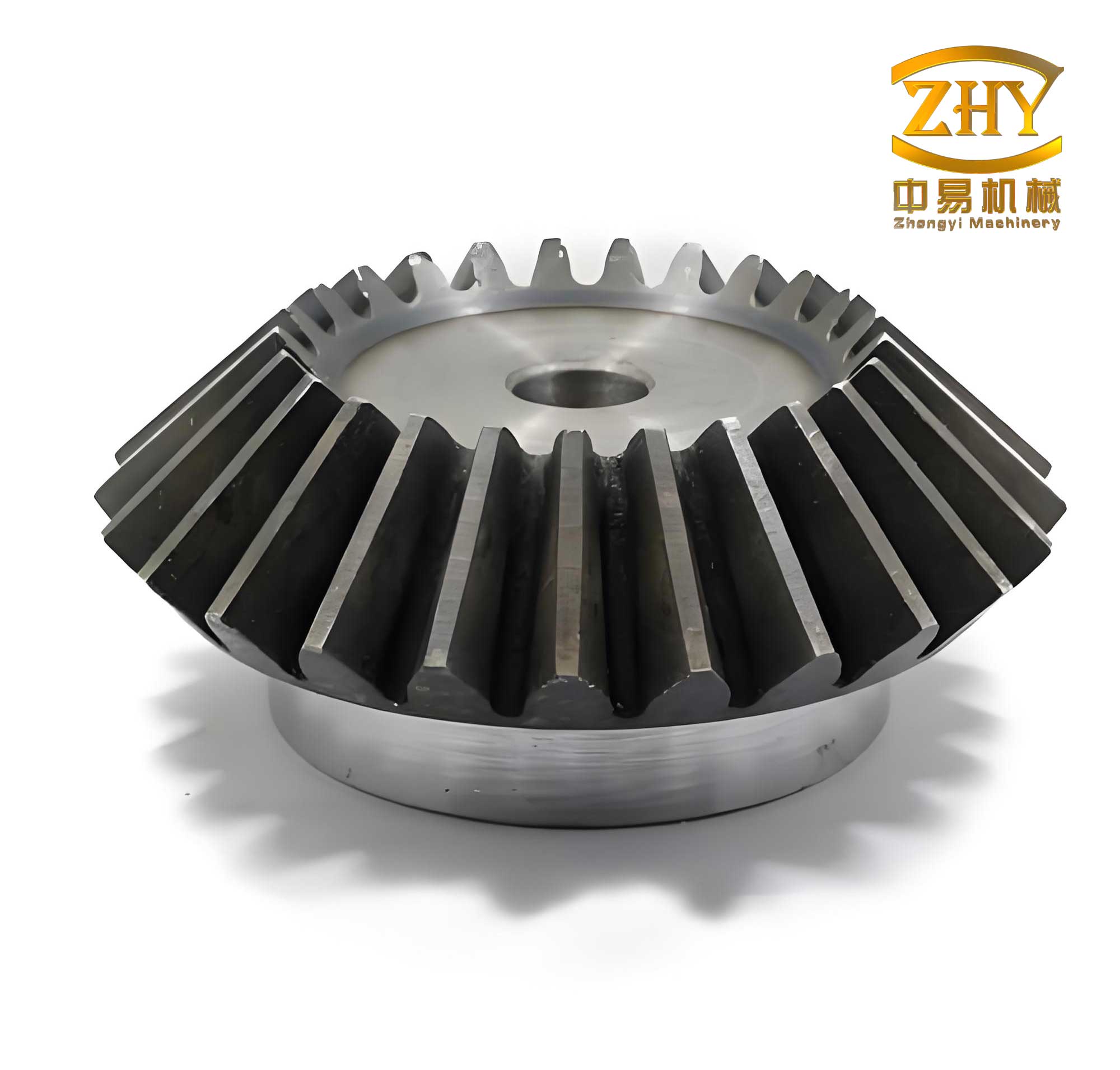
Analysis of multiple datasets revealed that the load spectra for drive axle bevel gears consistently follow a three-parameter Weibull distribution. This distribution is exceptionally suitable for modeling life data and fatigue loads because it can accommodate a wide variety of shapes based on its parameters. The probability density function (PDF) for the Weibull distribution is expressed as:
$$f(t) = \frac{\beta}{\eta} \left( \frac{t – \gamma}{\eta} \right)^{\beta-1} \exp\left[ -\left( \frac{t – \gamma}{\eta} \right)^\beta \right]$$
where \(t\) is the random load torque, \(\beta > 0\) is the shape parameter, \(\eta > 0\) is the scale parameter, and \(\gamma\) is the location parameter (often representing a minimum load threshold).
The physical interpretation of these parameters is crucial for understanding the load characteristics of the bevel gears. The shape parameter \(\beta\) dictates the form of the distribution curve. When \(\beta < 1\), the failure rate decreases with time, which might correspond to run-in periods. For \(\beta = 1\), it reduces to an exponential distribution with constant failure rate. More commonly for mechanical loads, \(\beta > 1\), indicating an increasing failure rate, which aligns with fatigue damage accumulation. The scale parameter \(\eta\) is related to the characteristic life or the spread of the load values; a larger \(\eta\) implies a broader range of load amplitudes experienced by the bevel gears. The location parameter \(\gamma\) represents the minimum possible load, below which no fatigue damage is assumed to occur. For many drive axle applications, especially in disconnected designs where torque can theoretically be zero, \(\gamma\) can be set to zero.
To fit the measured data to the Weibull PDF, a combination of curve-fitting techniques and statistical software was used. For a specific drive axle designed for a 5-ton vehicle, the load spectrum obtained from prototype testing was processed. The cumulative distribution function was plotted against the torque bins, and parameters were adjusted to minimize the error. The resulting parameters for the bevel gears’ load spectrum were: \(\beta = 1.26\), \(\eta = 1180 \, \text{N·m}\), and \(\gamma = 0\). These values indicate that the load distribution has a slightly increasing failure rate shape (\(\beta > 1\)) and a characteristic torque scale of 1180 N·m. With these parameters, the PDF becomes:
$$f(t) = \frac{1.26}{1180} \left( \frac{t}{1180} \right)^{0.26} \exp\left[ -\left( \frac{t}{1180} \right)^{1.26} \right] \quad \text{for } t \geq 0.$$
This function now serves as a mathematical model for the random load fluctuations that the bevel gears encounter during service.
To utilize this load spectrum in design calculations, it is discretized into a series of torque blocks, each representing a constant amplitude loading condition for fatigue analysis. The probability integral over a torque interval \([T_i, T_{i+1}]\) gives the proportion of cycles spent in that load range. By multiplying this probability by the total required life cycles (e.g., \(2 \times 10^7\) cycles for a design target), one obtains the number of cycles for each block. This is tabulated as a load spectrum table, essential for subsequent stress and life evaluation of the bevel gears. For the aforementioned drive axle, the spectrum was divided into 200 N·m intervals up to 5000 N·m. The table below summarizes a portion of this spectrum, illustrating how the load is distributed across different magnitudes.
| Torque Range (N·m) | Probability Density \(f(t)\) | Probability Integral | Cycle Ratio (%) | Cycle Count | Equivalent Hours |
|---|---|---|---|---|---|
| 0 – 200 | 6.04878e-4 | 0.0605 | 6.33 | 1,266,653 | 43.3 |
| 200 – 400 | 6.24037e-4 | 0.1229 | 12.86 | 2,573,427 | 87.6 |
| 400 – 600 | 5.84656e-4 | 0.1209 | 12.65 | 2,531,081 | 86.2 |
| 600 – 800 | 5.22956e-4 | 0.1108 | 11.59 | 2,319,409 | 79.1 |
| 800 – 1000 | 4.54209e-4 | 0.0977 | 10.22 | 2,046,245 | 69.9 |
| 1000 – 1200 | 3.86186e-4 | 0.0840 | 8.79 | 1,759,841 | 59.9 |
| 1200 – 1400 | 3.22930e-4 | 0.0709 | 7.42 | 1,484,934 | 50.4 |
| 1400 – 1600 | 2.66368e-4 | 0.0589 | 6.17 | 1,234,027 | 41.9 |
| 1600 – 1800 | 2.17175e-4 | 0.0484 | 5.06 | 1,012,569 | 34.4 |
| 1800 – 2000 | 1.75283e-4 | 0.0392 | 4.11 | 821,832 | 45.6 |
| … (up to 5000 N·m) | … | … | … | … | … |
This tabulated spectrum provides a realistic loading profile for the bevel gears, far more detailed than a single equivalent load. With this data, fatigue life calculations can be performed using software tools like MASTA, which models the entire gear system, including mesh forces, bending stresses, and contact stresses. For comparison, I also performed calculations using the traditional equivalent load method. The drive axle in question had the following input parameters: engine maximum torque led to a peak torque at the pinion bevel gear of 4820 N·m (the smaller of the two peak calculations), and the average torque for fatigue was 2465 N·m. Using these, safety factors for bending and contact fatigue of the bevel gears, as well as for the supporting bearings, were computed. The results from both methods are juxtaposed in the tables below, highlighting the differences in predicted safety margins.
| Component | Failure Mode | Safety Factor |
|---|---|---|
| Pinion Bevel Gear | Bending Fatigue | 0.9038 |
| Contact Fatigue | 1.2545 | |
| Ring Bevel Gear | Bending Fatigue | 0.9721 |
| Contact Fatigue | 1.2701 |
| Component | Failure Mode | Safety Factor |
|---|---|---|
| Pinion Bevel Gear | Bending Fatigue | 1.2202 |
| Contact Fatigue | 1.5118 | |
| Ring Bevel Gear | Bending Fatigue | 1.2866 |
| Contact Fatigue | 1.5268 |
The equivalent load method yields bending safety factors below 1.0 for the pinion bevel gear, suggesting potential failure under the assumed constant amplitude loading. In contrast, the load spectrum method, which accounts for the variable amplitude nature and the fact that high loads occur infrequently, results in safety factors above 1.2 for all modes. This indicates that the bevel gears are adequately designed when the actual load distribution is considered. Similarly, for the main supporting bearings, the safety factors are significantly higher with the load spectrum approach, as shown in the following comparative tables.
| Bearing Location | Bearing Type | Safety Factor |
|---|---|---|
| Pinion Nearside | 32312 | 1.7909 |
| Pinion Farside | 32310 | 4.1554 |
| Ring Gear Nearside | 32016 | 2.3687 |
| Ring Gear Farside | 32015 | 2.9065 |
| Bearing Location | Bearing Type | Safety Factor |
|---|---|---|
| Pinion Nearside | 32312 | 2.7933 |
| Pinion Farside | 32310 | 5.6824 |
| Ring Gear Nearside | 32016 | 3.7171 |
| Ring Gear Farside | 32015 | 3.3725 |
The marked increase in safety factors under the load spectrum method underscores the conservatism inherent in the equivalent load approach. To validate these computational findings, two identical drive axle units from the same production batch were subjected to accelerated life testing on a dedicated bench rig. The test setup comprised a drive motor connected to the axle input, with loading absorbers simulating road resistance at the output hubs. The first axle was tested under a constant amplitude torque of 2465 N·m, corresponding to the equivalent average load, for a total of \(2 \times 10^7\) cycles. The second axle was tested using the programmed load spectrum from Table 1, applying the sequence of torque blocks with their respective cycle counts, also totaling \(2 \times 10^7\) cycles. Throughout both tests, monitoring systems tracked temperature, vibration, and noise; no abnormalities such as excessive wear, pitting, or fracture were detected. Upon completion, both axle assemblies were disassembled for detailed inspection. The bevel gears—both pinion and ring—showed no signs of macropitting, spalling, or tooth breakage. The gear tooth surfaces exhibited normal wear patterns consistent with run-in, and the bearing races were smooth without any indication of fatigue. The successful passage of both tests, particularly the spectrum loading test, provides strong empirical evidence that the bevel gears designed using the load spectrum method are indeed capable of meeting the required service life. Moreover, it confirms that the equivalent load method, while safe, imposes a penalty in terms of over-design.
The implications of adopting a load spectrum approach for bevel gear design are profound. By accurately characterizing the load environment via the Weibull distribution, engineers can perform fatigue damage summation using Miner’s rule or more advanced cumulative damage models. The damage contributed by each torque block \(i\) is calculated as \(D_i = n_i / N_i\), where \(n_i\) is the applied cycles at stress \(\sigma_i\) (derived from torque) and \(N_i\) is the endurance cycles at that stress from the S-N curve of the gear material. The total damage \(D = \sum D_i\) should be less than 1 for infinite life design. With the load spectrum, this summation reflects reality much better than using a single equivalent stress. Furthermore, the Weibull parameters \(\beta, \eta, \gamma\) can be tailored for different vehicle types or operating environments. For instance, off-road vehicles might exhibit a higher shape parameter \(\beta\) due to more severe load fluctuations, while highway trucks might have a larger scale parameter \(\eta\) reflecting higher average torques. This flexibility allows for customized design of bevel gears without the need for extensive testing for every new application. Once a database of Weibull parameters for various duty cycles is established, initial design loads can be estimated statistically, saving time and resources.
In addition to fatigue life, the load spectrum also influences other design aspects of bevel gears, such as microgeometry optimization, lubrication requirements, and noise-vibration-harshness (NVH) performance. For example, knowing the distribution of load helps in defining the ideal tooth contact pattern under typical loads rather than just at peak load. This can enhance the efficiency and durability of the bevel gears. Moreover, the statistical nature of the load allows for reliability-targeted design. Using the Weibull distribution, one can compute the probability that the bevel gears will survive a certain number of cycles, enabling risk-informed decisions. For critical applications, a combination of load spectrum and finite element analysis can be used to identify local stress concentrations and improve gear topology. The integration of these advanced methodologies elevates the design of bevel gears from a deterministic, factor-of-safety-based practice to a probabilistic, performance-driven discipline.
However, challenges remain in implementing this approach universally. Acquiring load data requires instrumented vehicle testing, which can be costly and time-consuming. For全新 designs without a prototype, one must rely on historical data or simulations. In such cases, multi-body dynamics simulations of the full vehicle can generate synthetic load spectra, which can then be fitted to a Weibull distribution. The parameters derived from similar vehicles can serve as a starting point. Additionally, the accuracy of the Weibull fit depends on the quantity and quality of data; small sample sizes may lead to biased parameters. Therefore, it is advisable to collect data over diverse driving conditions and multiple vehicles to ensure representativeness. Another consideration is the non-stationarity of loads; the Weibull model assumes identically distributed loads over time, but in reality, load characteristics may change with vehicle aging or maintenance status. Periodic updates to the load spectrum may be necessary for寿命预测 in service.
To further illustrate the mathematical process, let’s delve into the derivation of the cumulative distribution function (CDF) from the PDF. The CDF, \(F(t)\), which gives the probability that the load is less than or equal to \(t\), is the integral of the PDF:
$$F(t) = \int_{\gamma}^{t} f(u) \, du = 1 – \exp\left[ -\left( \frac{t – \gamma}{\eta} \right)^\beta \right].$$
This function is used to calculate the probability integrals for each torque bin in the load spectrum table. For instance, the probability that the load lies between \(T_i\) and \(T_{i+1}\) is \(F(T_{i+1}) – F(T_i)\). With the parameters \(\beta=1.26, \eta=1180, \gamma=0\), the CDF becomes:
$$F(t) = 1 – \exp\left[ -\left( \frac{t}{1180} \right)^{1.26} \right].$$
Using this, the probability integral for the first bin 0-200 N·m is:
$$F(200) – F(0) = \left(1 – e^{-(200/1180)^{1.26}}\right) – 0 \approx 0.0605.$$
This matches the value in the load spectrum table. Repeating for all bins yields the complete spectrum.
Another important aspect is the estimation of Weibull parameters from raw data. Methods such as maximum likelihood estimation (MLE) or least squares regression on probability plots are commonly employed. For a sample of \(n\) load observations \(t_1, t_2, …, t_n\), the MLE equations for the three-parameter Weibull are nonlinear and require iterative solving. However, for practical engineering purposes, software tools can automate this fitting process once the data is collected. The key is to ensure that the data captures the full range of operating conditions for the bevel gears. It is also worth noting that for disconnected drive axles, the load can drop to zero or even negative (during engine braking), but for fatigue analysis, often only positive torque magnitudes are considered, assuming对称 damage for reversed loads. In such cases, the location parameter \(\gamma\) might be set to a negative value to accommodate the full range, but typically the spectrum is normalized to absolute torque.
In conclusion, the determination of load spectra for drive axle bevel gears via the Weibull distribution represents a significant advancement over traditional equivalent load methods. My experience in this field has demonstrated that bevel gears designed using realistic load spectra exhibit higher calculated safety factors and proven durability in testing, without the penalty of excessive weight. The three-parameter Weibull model, with its shape, scale, and location parameters, offers a flexible and accurate means to characterize the stochastic nature of vehicle loads. While initial data acquisition demands investment, the long-term benefits in terms of optimized design, reduced material usage, and enhanced reliability are substantial. For new vehicle programs, I recommend adopting this probabilistic approach, using either实测 data from similar platforms or advanced simulations to derive the Weibull parameters. This will ensure that the bevel gears—the critical torque multipliers in the drive axle—are precisely tailored to their operational environment, achieving an ideal balance between strength and efficiency. Future work could explore the correlation between Weibull parameters and specific vehicle attributes (e.g., weight, power, duty cycle) to create predictive models, further streamlining the design process for bevel gears across the automotive industry.