
The pursuit of high precision and reliability in industrial robotics has placed stringent demands on their core components, with the rotary vector reducer standing as a critical element. The comprehensive performance of a rotary vector reducer, including its transmission accuracy, stiffness, and efficiency, is fundamentally governed by the meshing condition between its cycloidal disk and the pin wheel. This meshing condition is, in turn, predominantly dictated by the amount and strategy of profile modification applied to the cycloidal teeth. While significant research has been devoted to optimization of this modification—exploring combinations like “positive equidistance plus negative shift distance” for maximum stiffness or the inverse for minimal backlash—a persistent challenge remains. The existing methodologies often rely on insufficient or idealized constraints. A prime example is the common assumption of a meshing zone within a (25–100)° phase angle, which can conflict with the physical requirement of having between 4 to 7 teeth in simultaneous contact. This discrepancy leads to inaccuracies in the final determined modification values. Therefore, establishing a more precise and physically consistent constraint is paramount. This study proposes an inverse methodology: instead of assuming the meshing zone, we derive it experimentally. By developing a stiffness model for the rotary vector reducer, measuring its overall torsional stiffness, and backtracking through the model, we can accurately identify the actual set of pins in contact, thereby defining the true meshing interval.
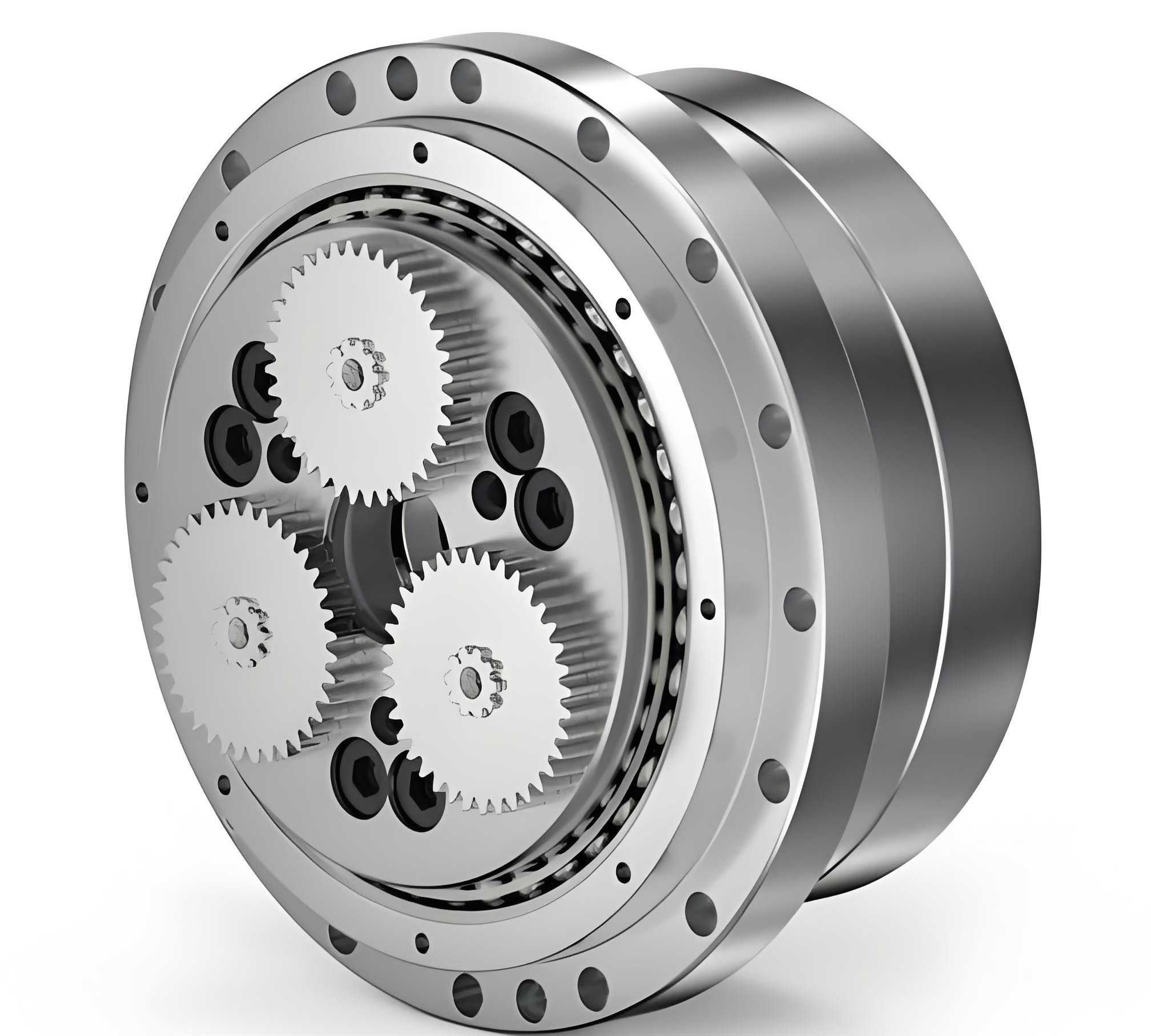
The rotary vector reducer features a two-stage design. The first stage is a planetary gear train, and the second is a cycloidal-pin gear mechanism, which provides the primary high reduction ratio. During torque transmission, the torsional deformation originating from the first stage is scaled down by this large ratio, rendering its contribution to the overall torsional stiffness negligible. Consequently, the global torsional stiffness of the rotary vector reducer is dominated by the stiffness characteristics of the second stage. Two components are primary contributors: the contact stiffness at the needle roller bearings connecting the cycloidal disks to the crankshafts, and the composite meshing stiffness between the cycloidal disks and the stationary pin wheel. Our theoretical model focuses on deriving the equivalent torsional stiffness arising from these two sources.
Theoretical Modeling of Key Stiffness Components
1. Stiffness of the Needle Roller Bearing Assembly
The force equilibrium on a cycloidal disk is complex due to its eccentric motion. The resultant force $\vec{F}$ from the pin wheel interaction can be resolved. This force provides both the tangential component $F_t$ responsible for the disk’s rotation and a radial component. The disk is supported at three points by crankshafts via needle roller bearings. For static equilibrium, the reaction forces at these three bearing locations (A, B, C) must sum to counteract $\vec{F}$. Assuming symmetric loading among the three bearings for the radial force component, we have:
$$F_A = F_B = F_C = \frac{F}{3}$$
However, these forces also provide a balancing torque. Considering the geometric arrangement where the bearings are located at 0°, 120°, and 240° around the cycloidal disk center, the radial load on each bearing becomes a vector sum:
$$
\begin{align*}
\vec{F_A} &= \frac{\vec{F}}{3} + \frac{F_t r’_c}{3a} \begin{Bmatrix} \sin 0^\circ \\ -\cos 0^\circ \end{Bmatrix} \\[6pt]
\vec{F_B} &= \frac{\vec{F}}{3} + \frac{F_t r’_c}{3a} \begin{Bmatrix} \sin 120^\circ \\ -\cos 120^\circ \end{Bmatrix} \\[6pt]
\vec{F_C} &= \frac{\vec{F}}{3} + \frac{F_t r’_c}{3a} \begin{Bmatrix} \sin 240^\circ \\ -\cos 240^\circ \end{Bmatrix}
\end{align*}
$$
where $r’_c$ is the pitch circle radius of the cycloidal disk, $a$ is the eccentricity, and $\vec{F}$ itself varies with the crank angle $\theta$:
$$\vec{F} = F \begin{Bmatrix} \sin(\alpha_c – \theta) \\ \cos(\alpha_c – \theta) \end{Bmatrix}$$
Here, $\alpha_c$ is the pressure angle. This analysis reveals that the bearings are subjected to time-varying radial loads $F_r$ during operation.
The radial stiffness of a needle roller bearing is not constant but is a function of the applied load, number of rollers, and their dimensions. A well-established empirical relation is used:
$$K_{Hc} = 0.34 \times 10^4 \cdot F_r^{0.1} \cdot Z^{0.9} \cdot l^{0.8} \cdot (\cos\alpha)^{1.9}$$
where $Z$ is the number of needles, $l$ is the effective length of the needles, and $\alpha$ is the contact angle (zero for pure radial load). Since $F_r$ for each bearing (A, B, C) changes with $\theta$, their individual stiffnesses $K_{HcA}, K_{HcB}, K_{HcC}$ are also time-varying. The combined effect of these three bearing stiffnesses, translated into an equivalent torsional stiffness about the output axis, is given by:
$$C_{THC} = 2 (K_{HcA} + K_{HcB} + K_{HcC}) \cdot l_c^2$$
where $l_c$ is the distance from the bearing center to the center of the cycloidal disk.
2. Single-Tooth Meshing Stiffness of the Cycloid-Pin Pair
The local contact between a cycloidal tooth and a pin can be modeled as contact between two cylinders, allowing the application of Hertzian contact theory. A critical parameter is the radius of curvature $\rho_i$ of the cycloidal tooth at the contact point, which varies significantly with the meshing phase angle $\theta$. The formula for this radius of curvature is:
$$\rho_i = \frac{r_p(1 + K’^2 – 2K’\cos\theta)^{3/2}}{K'(z_p + 1)\cos\theta – (1 + z_p K’^2)} + r_{rp}$$
where $r_p$ is the pin circle radius, $r_{rp}$ is the pin radius, $z_p$ is the number of pins, and $K’$ is the shortened coefficient ($K’ = a z_p / r_p$).
The deformation at the contact point under a load $F_i$ consists of contributions from both the pin and the cycloidal tooth. The contact deflection for the pin (modeled as a cylinder of radius $r_{rp}$) is:
$$\delta_z = \frac{4F_i \rho_c (1 – \mu^2)}{\pi b E r_{rp}}$$
where $\rho_c = \rho_i r_{rp} / (\rho_i + r_{rp})$ is the equivalent contact radius, $b$ is the tooth width, $E$ is Young’s modulus, and $\mu$ is Poisson’s ratio. For the cycloidal tooth, whose curvature radius $\rho_i$ can be positive or negative, the deflection is:
$$\delta_c = \frac{4F_i \rho_c (1 – \mu^2)}{\pi b E |\rho_i|}$$
The individual contact stiffnesses are the inverse of these deflections:
$$k_z = \frac{F_i}{\delta_z} = \frac{\pi b E r_{rp}}{4\rho_c (1 – \mu^2)}$$
$$k_c = \frac{F_i}{\delta_c} = \frac{\pi b E |\rho_i|}{4\rho_c (1 – \mu^2)}$$
The combined meshing stiffness for a single cycloid-pin pair is therefore the series combination:
$$K_c = \frac{k_z \cdot k_c}{k_z + k_c} = \frac{\pi b E |\rho_i| (\rho_i – r_{rp})}{4\rho_i (1 – \mu^2) (r_{rp} + |\rho_i|)}$$
Since each meshing point acts at a different moment arm $L_j$ relative to the output center, its contribution to the total equivalent torsional stiffness is $K_c \cdot L_j^2$. For two cycloidal disks operating 180° out of phase, the total equivalent torsional stiffness from all $n$ simultaneous meshing points is:
$$C_{Tc} = 2 \sum_{j=1}^{n} K_c(\theta_j) \cdot L_j^2$$
This value $C_{Tc}$ is a strong function of which specific pins (and thus which phase angles $\theta_j$) are in contact.
3. Overall Torsional Stiffness Model
In the stiffness chain of the rotary vector reducer, the equivalent torsional stiffness from the needle bearings $C_{THC}$ and the equivalent torsional stiffness from the cycloid-pin meshing $C_{Tc}$ are connected in series. Therefore, the theoretical overall torsional stiffness $C_W$ of the reducer is given by:
$$C_W = \frac{C_{THC} \cdot C_{Tc}}{C_{THC} + C_{Tc}}$$
This equation forms the cornerstone of our逆向 analysis. By measuring $C_W$ and calculating $C_{THC}$, we can solve for the actual $C_{Tc}$ present during the test. Comparing this calculated $C_{Tc}$ to the sum of possible combinations of single-point stiffnesses will reveal the actual set of meshing pins.
Experimental Measurement of Overall Torsional Stiffness
To obtain the crucial empirical data, a comprehensive test bench for rotary vector reducer performance evaluation was utilized. The setup consists of a drive motor, precision torque and angle sensors on both the input and output sides, the reducer under test (mounted with its input shaft fixed), and a servo motor for applying controlled load torque. This system enables accurate measurement of transmission error, backlash, and torsional stiffness. For this study, an RV-40E type rotary vector reducer was tested. The output flange was subjected to a torque sweep from 0 N·m up to the rated torque of +412 N·m, then down through 0 N·m to -412 N·m, and back to 0 N·m. The angular displacement of the output flange was recorded simultaneously with the applied torque.
The resulting hysteresis curve, inherent due to friction and backlash within the reducer, provides the necessary data. The torsional stiffness at any point is the local slope $C = dT / d\theta$. For analysis, the stiffness value at the maximum rated torque (412 N·m) is particularly relevant, as it represents the operational condition under load. From the experimental data, the overall torsional stiffness $C_W$ at 412 N·m was determined to be $3.06 \times 10^8$ N·mm/rad.
Inverse Determination of the Meshing Zone
With the measured $C_W = 3.06 \times 10^8$ N·mm/rad and the theoretical model for $C_{THC}$ calculated based on the geometry and operating conditions, we can isolate the contribution from the cycloid-pin meshing. Applying the series stiffness formula in reverse:
$$C_{Tc} = \frac{C_W \cdot C_{THC}}{C_{THC} – C_W}$$
Using the specific parameters of the RV-40E reducer, this calculation yielded a value for $C_{Tc}$ of approximately $6.24 \times 10^8$ N·mm/rad. This number represents the total equivalent torsional stiffness produced by all meshing cycloid-pin pairs during the test.
The next step is to find which combination of consecutive meshing points produces a summed stiffness closest to this value. First, the single-point equivalent torsional stiffness $K_c(\theta_j) \cdot L_j^2$ must be calculated for every potential contact point around the half-cycle (0° to 180°), which corresponds to pins numbered 1 through 21. The following table summarizes these calculated stiffness values.
| Pin Number (j) | Equivalent Torsional Stiffness (N·mm/rad) | Pin Number (j) | Equivalent Torsional Stiffness (N·mm/rad) |
|---|---|---|---|
| 1 | 0 | 12 | $8.93 \times 10^7$ |
| 2 | $2.20 \times 10^6$ | 13 | $7.33 \times 10^7$ |
| 3 | $1.97 \times 10^7$ | 14 | $5.79 \times 10^7$ |
| 4 | $1.33 \times 10^8$ | 15 | $4.38 \times 10^7$ |
| 5 | $1.84 \times 10^8$ | 16 | $3.12 \times 10^7$ |
| 6 | $1.76 \times 10^8$ | 17 | $2.03 \times 10^7$ |
| 7 | $1.66 \times 10^8$ | 18 | $1.16 \times 10^7$ |
| 8 | $1.52 \times 10^8$ | 19 | $5.25 \times 10^6$ |
| 9 | $1.38 \times 10^8$ | 20 | $1.33 \times 10^6$ |
| 10 | $1.22 \times 10^8$ | 21 | 0 |
| 11 | $1.06 \times 10^8$ |
The task is to find a set of consecutive pins (representing a continuous meshing zone) whose summed equivalent torsional stiffness (for two disks) equals $C_{Tc} \approx 6.24 \times 10^8$ N·mm/rad. By systematically trying different intervals, it was found that the combination of pins 6, 7, 8, and 9 provides the closest match. The calculation is as follows for one disk, multiplied by 2:
Sum for Pins 6-9 (one disk): $1.76 + 1.66 + 1.52 + 1.38 = 6.32 \times 10^8$ N·mm/rad (for two disks: $6.32 \times 10^8$ N·mm/rad).
This value of $6.32 \times 10^8$ N·mm/rad is in excellent agreement with the target value of $6.24 \times 10^8$ N·mm/rad derived from the experiment. This corresponds to a meshing phase angle interval of approximately 54° to 81°. Any other combination of four consecutive pins yields a sum significantly different from the target. This result indicates that under the rated load of 412 N·m, the actual meshing zone for this rotary vector reducer involves four pins in simultaneous contact per cycloidal disk, specifically those within this identified angular interval. This finding contradicts the broader, commonly assumed (25–100)° interval and provides a precise, mechanically consistent constraint.
Finite Element Analysis Validation
To corroborate the findings from the stiffness-based inverse analysis, a finite element analysis (FEA) was conducted. A detailed model of the cycloidal disk and pin wheel assembly was constructed. A torque of 412 N·m was applied to the cycloidal disk, and contact elements were defined between the cycloidal teeth and all potential pin locations. The analysis solved for the contact pressures and states. The results clearly showed that only pins numbered 6, 7, 8, and 9 exhibited significant contact pressure, confirming their status as the active load-bearing contacts. All other pins showed zero or negligible contact force. This FEA outcome provides direct visual and quantitative validation that the meshing zone identified through the torsional stiffness methodology is physically accurate.
Conclusion
This research presents a novel and practical methodology for determining the true meshing zone in a rotary vector reducer, bypassing the limitations of direct measurement and theoretical assumption. The core achievement lies in successfully linking the measurable macroscopic property—overall torsional stiffness—to the microscopic contact condition between the cycloidal disk and the pin wheel.
The process involved several key steps: First, a comprehensive analytical stiffness model was developed that accounts for the time-varying stiffness of the needle roller bearings and the position-dependent meshing stiffness of each individual cycloid-pin pair. Second, this model was used to establish the relationship where the overall torsional stiffness is a function of which specific pins are in contact. Third, the overall torsional stiffness of an RV-40E reducer was accurately measured under its rated load using a dedicated test bench. Fourth, employing the stiffness model in reverse, the total equivalent torsional stiffness contributed by the meshing teeth was extracted. Finally, by calculating the summed stiffness for all possible consecutive sets of meshing pins and comparing them to this extracted value, the actual set of pins in contact was unambiguously identified as pins 6 through 9, corresponding to a phase angle zone of 54° to 81°.
The results were conclusively validated by finite element analysis, which showed perfect agreement in the identified active contact pins. This methodology provides a powerful tool for researchers and engineers working on rotary vector reducer design and optimization. It offers a physically-grounded, experimentally-derived constraint for the meshing zone, which is critical for refining profile modification strategies aimed at optimizing stiffness, minimizing backlash, and improving the overall efficiency and longevity of the rotary vector reducer. By moving from assumed intervals to calculated, load-dependent zones, this approach enhances the precision and reliability of the design process for this vital robotic component.